
INDUSTRY INSIGHTS
Automotive LED Lighting Industry Insights: Trends & B2B Opportunities
Introduction
Automotive LED lighting is evolving beyond basic illumination. Developments in adaptive beam control, compact LED packaging, digital lighting systems, and vehicle electronics are changing how lighting products are designed, evaluated, and sourced.
For automotive aftermarket distributors, lighting brands, importers, and OEM/ODM buyers, these changes create opportunities as well as new sourcing challenges. A promising technology does not automatically translate into a suitable product for every vehicle, market, or sales channel.
Understanding automotive LED lighting trends requires a practical view of optical performance, product maturity, electrical compatibility, supply chain capabilities, and regulatory requirements.
This guide examines five areas that B2B buyers should consider when planning future automotive lighting product portfolios.
Table of Contents
Automotive LED Lighting Trends
QUICK GUIDE
1. Automotive LED Lighting Market Landscape
The automotive lighting industry serves several distinct markets, including original-equipment vehicle manufacturing, replacement parts, aftermarket upgrades, commercial vehicles, and specialized vehicle applications.
Although these markets share some underlying LED technologies, they differ in purchasing requirements, product development cycles, regulatory obligations, and customer expectations.
Electrification and Lighting Efficiency
Electric vehicles place attention on electrical efficiency, packaging space, thermal management, and integration with vehicle electronics.
LED technology offers opportunities to reduce lighting-system energy consumption compared with some conventional lighting solutions. However, the actual effect on vehicle driving range depends on the complete vehicle energy balance and should not be inferred from LED chip efficiency alone.
For suppliers and distributors, relevant evaluation factors include system power consumption, thermal stability, optical performance, electrical interfaces, and long-term reliability.
Increasing Electronic Integration
Modern vehicles may use electronic control modules to monitor lighting circuits, detect faults, and coordinate lighting functions.
This creates additional compatibility considerations for aftermarket LED products. A replacement lamp must be evaluated not only for physical fitment and light output, but also for electrical behavior and the requirements of the vehicle application.
Aftermarket Product Differentiation
Aftermarket customers may seek improved product design, different lighting appearances, complete lighting assemblies, or application-specific solutions.
LED replacement bulbs, projector modules, and complete lamp assemblies can serve different customer needs. Their commercial potential depends on local demand, vehicle compatibility, installation complexity, regulatory suitability, and supplier support.
For B2B buyers, the key question is not simply which technology is newest, but which product can be reliably supplied and supported in the intended market.
2. Emerging Automotive LED Lighting Technologies
Several automotive lighting technologies deserve attention, although their maturity and commercial applications differ considerably.
CSP and Flip-Chip LED Packaging
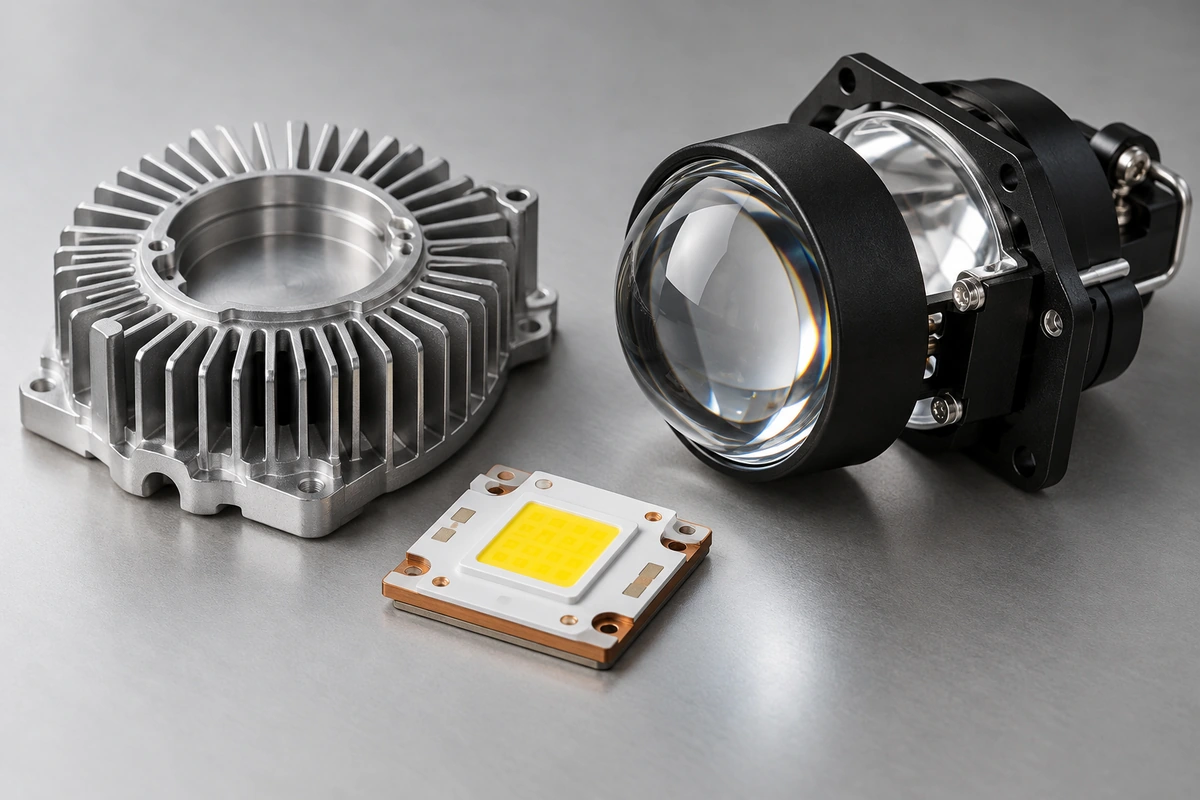
Chip Scale Package (CSP) and flip-chip technologies can support compact LED source designs and different electrical or thermal architectures.
Their benefits depend on the particular chip construction, substrate, packaging, heat-transfer path, and operating conditions.
In replacement lighting applications, the position and dimensions of the emitting area can influence optical performance. However, CSP packaging alone does not guarantee an accurate beam pattern or superior performance over every COB design.
The complete optical and thermal system must be evaluated.
Bi-LED Projector Modules
Bi-LED projector systems commonly integrate LED light sources, optical elements, and a mechanism or design that provides low-beam and high-beam functions.
They can offer opportunities for controlled beam distribution and integrated lighting designs, but performance varies by product and installation.
B2B buyers should evaluate beam measurements, mounting compatibility, electrical requirements, thermal behavior, installation instructions, and market-specific road-use requirements.
A projector configuration does not automatically eliminate glare or establish regulatory compliance.
Adaptive Driving Beam Systems
Adaptive Driving Beam (ADB) systems adjust portions of the forward-lighting distribution in response to surrounding traffic and driving conditions.
Depending on the system, this may involve individually controlled LED segments or higher-resolution light-source architectures combined with sensors and electronic control.
ADB introduces requirements beyond the LED source itself, including sensing, software, control electronics, optical performance, system validation, and regulatory approval.
These systems are primarily relevant to integrated vehicle-lighting development. Aftermarket applications require particularly careful evaluation of vehicle integration and legal suitability.

Micro-LED and Digital Lighting
Micro-LED and other high-resolution light-source technologies are being explored for increasingly precise control of light distribution and, in some applications, projected information or visual communication.
Commercial implementation depends on optical efficiency, pixel control, thermal management, system complexity, cost, and applicable regulations.
B2B buyers should distinguish research demonstrations and premium OEM applications from products that are mature, available, and appropriate for aftermarket distribution.
Technology Comparison Table
| Technology | Main Characteristics | Typical Commercial Context | Key Buyer Considerations |
|---|---|---|---|
| LED replacement bulbs | Compact LED sources designed for specific replacement applications | Aftermarket replacement and upgrades | Fitment, beam compatibility, thermal performance, electrical behavior, road-use suitability |
| Bi-LED projector modules | Integrated LED sources and projector optics, often supporting low- and high-beam functions | Retrofit specialists and complete lighting projects | Photometric evidence, installation, thermal management, compliance |
| Adaptive Driving Beam (ADB) | Electronically controlled light distribution responding to traffic conditions | Integrated OEM lighting systems and specialized development | Sensors, software, vehicle integration, approvals, system validation |
| Micro-LED / high-resolution lighting | Fine-grained electronic control of light-emitting elements | Emerging and premium digital lighting applications | Technology maturity, cost, thermal design, optical performance, regulatory suitability |
Buyer takeaway: Technology labels describe design approaches, not guaranteed levels of brightness, safety, reliability, or profitability.
3. Automotive LED Lighting Supply Chain Trends
A reliable automotive lighting supply chain involves more than selecting an LED chip or comparing quoted prices.
Product consistency depends on component selection, design validation, manufacturing controls, inspection criteria, and supplier communication.
LED Components and Packaging Choices
CSP, flip-chip, COB, and other LED constructions may offer different design trade-offs.
Buyers should request information relevant to the actual product, including:
- LED source specifications and approved component configurations.
- Electrical operating conditions.
- Thermal performance at representative temperatures.
- Optical performance of the assembled lamp.
- Component-change management and supply continuity.
It is important to distinguish component-level specifications from the performance of the finished lighting product.
Manufacturing and Quality Management
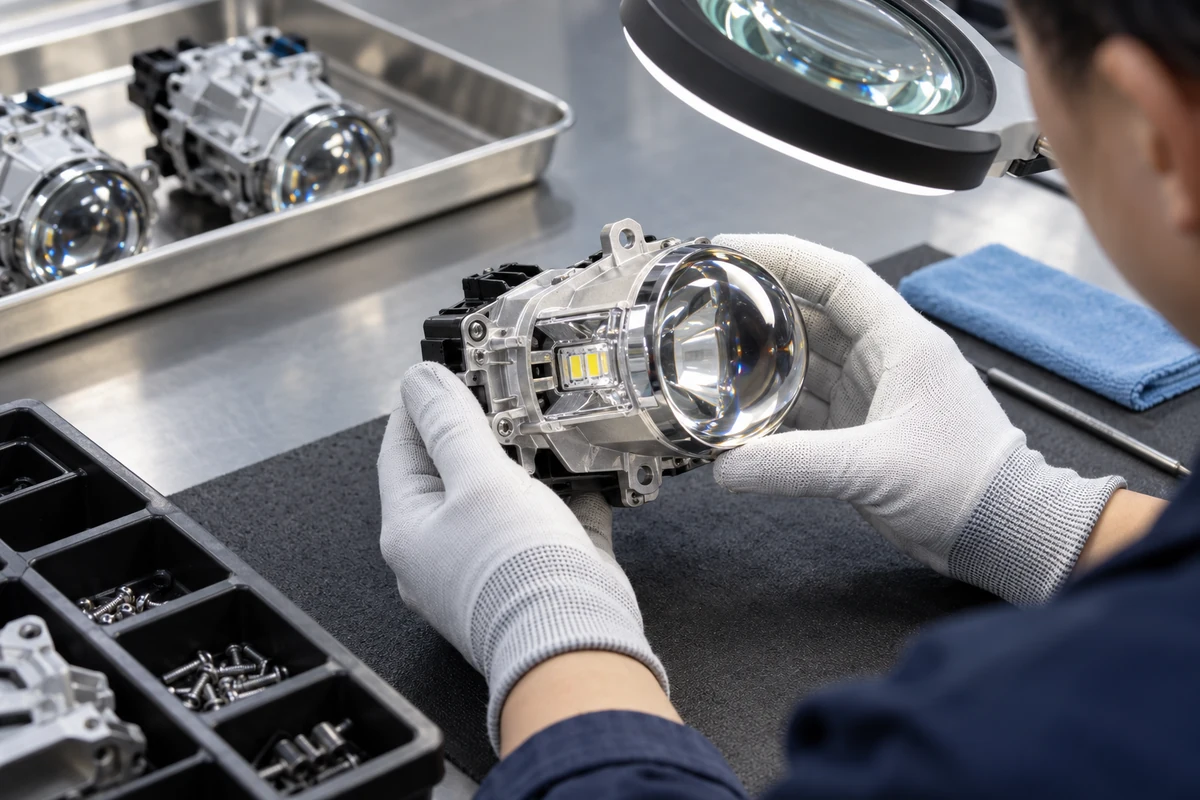
Automated assembly, inspection equipment, and documented quality procedures can support manufacturing consistency when appropriately implemented.
However, automation does not eliminate all defects, and a quality-management certification does not guarantee zero failures.
Buyers should examine the supplier’s actual manufacturing scope, applicable quality-system certifications, process controls, product testing, traceability, and corrective-action procedures.
Evidence should correspond to the supplier, facility, and product being evaluated.
Cost and Supply Continuity
The lowest unit price does not necessarily produce the lowest total sourcing cost.
Additional factors include tooling, packaging, logistics, minimum order quantities, product returns, replacement parts, warranty handling, and inventory turnover.
Where possible, distributors should compare total landed cost and agreed quality requirements rather than relying solely on nominal lumen output or LED chip descriptions.
For long-term programs, buyers should also discuss lead times, component substitutions, production changes, and documentation updates.
4. Automotive Lighting Regulations and Market Requirements
Automotive lighting compliance depends on the lamp’s function, vehicle application, destination market, and installation.
A product described as an LED headlight, fog light, or auxiliary light cannot be considered road legal based on its technology name or marketing description alone.
United States: FMVSS 108
In the United States, Federal Motor Vehicle Safety Standard No. 108 addresses specified motor vehicle lighting equipment and associated requirements.
Applicable provisions depend on the lighting function and vehicle context. A lighting component’s suitability must be assessed against the relevant requirements, not assumed from a general claim of DOT or SAE compliance.
Adaptive Driving Beam systems have a regulatory framework under FMVSS 108, but a particular system still needs to satisfy the applicable requirements.
Europe and UN Regulations
Markets applying UN vehicle-lighting regulations use different instruments for particular lamp functions, installations, and technical characteristics.
For example, UN Regulation No. 149 addresses certain road-illumination devices, while UN Regulation No. 148 covers specified light-signalling devices. UN Regulation No. 48 addresses installation of lighting and light-signalling devices on vehicles.
Other requirements, including electromagnetic compatibility, may apply depending on the product and market.
Buyers should verify which regulations and versions apply to the specific product and destination rather than relying on a generic “ECE approved” statement.
EMC and Electrical Compatibility
Automotive lighting electronics may create or be affected by electromagnetic disturbances.
EMC evaluation should consider the applicable product requirements, test methods, and installation context.
A reference to CISPR 25 or an EMC test report should not be treated as universal proof of road-use approval or complete vehicle compatibility.
Documentation Checklist for Importers
Before placing an order, request and review:
- Exact product model and configuration.
- Intended vehicle applications and markets.
- Relevant approval or conformity documentation, where applicable.
- Photometric reports for the supplied configuration.
- Electrical and EMC information relevant to the application.
- Environmental and durability test evidence.
- Product marking, labeling, and traceability information.
- Written clarification of any limitations on road use.
The distinction between factory quality-system certification, product approval, test reports, and supplier declarations should remain clear throughout procurement.
5. B2B Product Portfolio and OEM/ODM Sourcing Strategies
Industry trends become commercially useful only when they are translated into appropriate product selection and supplier-management decisions.
Match Products to Customer Segments
Distributors should consider which customers they serve:
- General automotive aftermarket wholesalers.
- Vehicle-specific replacement-parts distributors.
- Retrofit and installation specialists.
- Private-label automotive accessory brands.
- Commercial and specialized vehicle customers.
Each segment may prioritize different combinations of price, installation simplicity, product appearance, technical documentation, and support.
Evaluate Complete Products, Not Marketing Claims
High lumen ratings, advanced LED packaging, or premium optical terminology should not replace product validation.
For headlights and fog lights, relevant checks may include beam distribution, glare control, electrical behavior, thermal stability, and vehicle fitment.
For other lighting categories, such as license plate lights and signal lamps, evaluation should reflect their specific functions and regulatory requirements.
Plan OEM/ODM Projects Around Clear Specifications
A successful OEM/ODM discussion begins with defined requirements.
Buyers should prepare information about:
- Target vehicle and lighting application.
- Destination markets.
- Required functions and electrical interfaces.
- Product dimensions and mounting constraints.
- Optical and environmental performance expectations.
- Branding and packaging needs.
- Forecast volumes, target costs, and delivery schedules.
- Testing, documentation, and acceptance criteria.
Customization feasibility and project timelines should be confirmed for the actual product rather than assumed from a supplier’s general OEM/ODM offering.
Use a Structured Supplier Evaluation
A practical supplier review can compare technical communication, sample quality, production consistency, documentation, commercial terms, and after-sales response.
For important projects, request representative samples and agree on measurable acceptance criteria before committing to volume production.
Supplier selection should balance product performance, regulatory suitability, reliability, service, and total sourcing cost.
6. Frequently Asked Questions
Q1. What is the difference between CSP and COB LEDs in automotive lighting?
CSP and COB describe different LED packaging or assembly approaches. CSP designs can provide compact emitting structures, while COB arrangements integrate multiple LED elements on a shared substrate. Neither technology automatically guarantees a better headlight beam. Optical design, source positioning, thermal management, and the complete lamp configuration determine the result.
Q2. How are electric vehicles influencing automotive LED lighting?
Electric vehicles encourage attention to lighting efficiency, electronic integration, compact packaging, and thermal management. However, the impact of lighting efficiency on overall driving range varies by vehicle and operating conditions. Buyers should assess complete system performance rather than relying on LED source efficiency alone.
Q3. What is Adaptive Driving Beam technology?
Adaptive Driving Beam technology adjusts parts of a vehicle’s forward-lighting distribution to respond to surrounding traffic. Depending on the system, it can use individually controlled LED segments, sensors, and electronic control. Its suitability depends on system design, integration, validation, and applicable regulations.
Q4. Are Bi-LED projector modules better than standard LED replacement bulbs?
They serve different applications. A well-designed projector module may provide controlled optical distribution for a particular installation, while a replacement bulb may be intended for a different product configuration. Neither category is automatically superior in every vehicle. Buyers should compare verified performance, installation requirements, compatibility, and legal suitability.
Q5. What certifications and documents should automotive LED lighting buyers check?
Buyers should distinguish quality-management certifications, product approvals, regulatory declarations, and technical test reports. Depending on the product and market, relevant evidence may include ISO 9001 or IATF 16949 quality-system information, applicable UN approvals, FMVSS 108-related compliance evidence, and EMC or environmental test reports. No single document establishes compliance for every product and destination.
Q6. How can NVEL support B2B automotive lighting buyers?
NVEL focuses on automotive LED lighting products and B2B lighting solutions for distributors, brands, and vehicle-related businesses. Buyers can contact the NVEL team to discuss available product ranges, application requirements, OEM/ODM possibilities, private-label needs, and sourcing plans. Model-specific specifications, customization options, testing evidence, and commercial terms should be confirmed during project evaluation.
Conclusion: Turning Automotive LED Lighting Trends Into Sourcing Decisions
Automotive LED lighting trends offer opportunities for product development and aftermarket differentiation, but technology adoption should be guided by measurable performance, market requirements, and commercial practicality.
For distributors and brands, a strong sourcing strategy combines suitable product selection, reliable documentation, realistic inventory planning, and supplier communication. Advanced lighting technology is valuable when it solves a defined application need—not simply because it is new.
NVEL works with B2B customers seeking automotive LED lighting products and customized sourcing solutions. If you are evaluating a new lighting category or planning an OEM/ODM project, our team can discuss your target market, application requirements, and product options.