TECHNICAL GUIDES · LED PROJECTOR LENS
Bi-LED Projector Lenses vs. Drop-in LED Bulbs: Optical Performance & B2B Buying Guide
Compare optical architecture, beam quality, installation requirements and B2B sourcing considerations.
October 16, 2026 · 20 min read
Introduction
When upgrading automotive headlights, choosing between drop-in LED replacement bulbs and Bi-LED projector lenses involves much more than comparing brightness ratings.
Both technologies use LEDs as light sources, but they differ significantly in optical design, installation requirements, system integration, and potential applications.
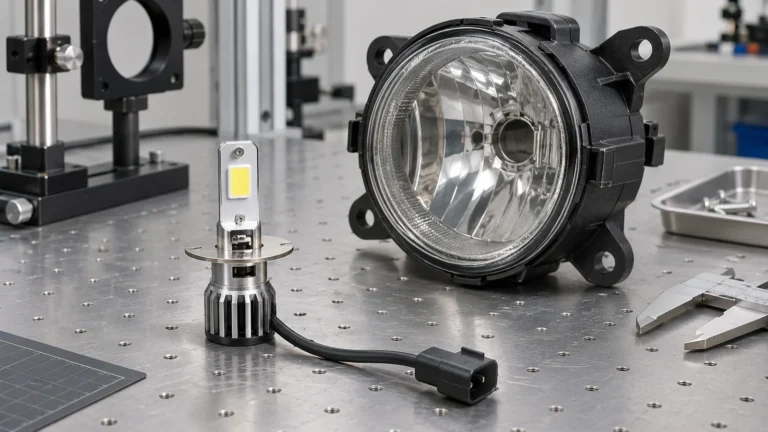
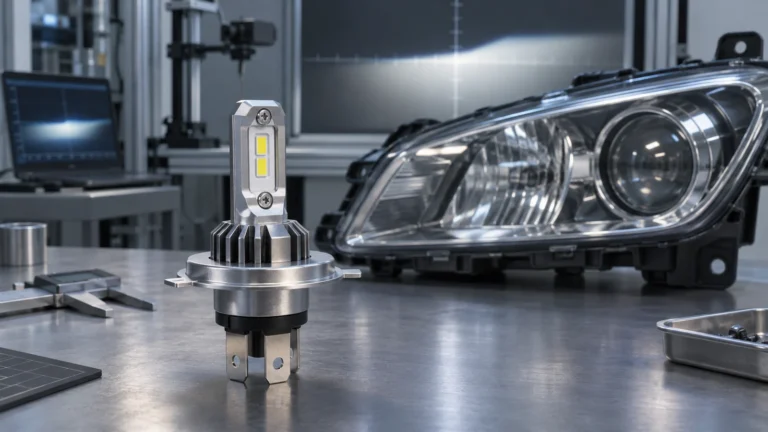
Drop-in LED bulbs are designed to replace compatible existing light sources while retaining the vehicle’s original headlamp optics. They can offer a comparatively straightforward installation where the product, housing, and applicable requirements are compatible.
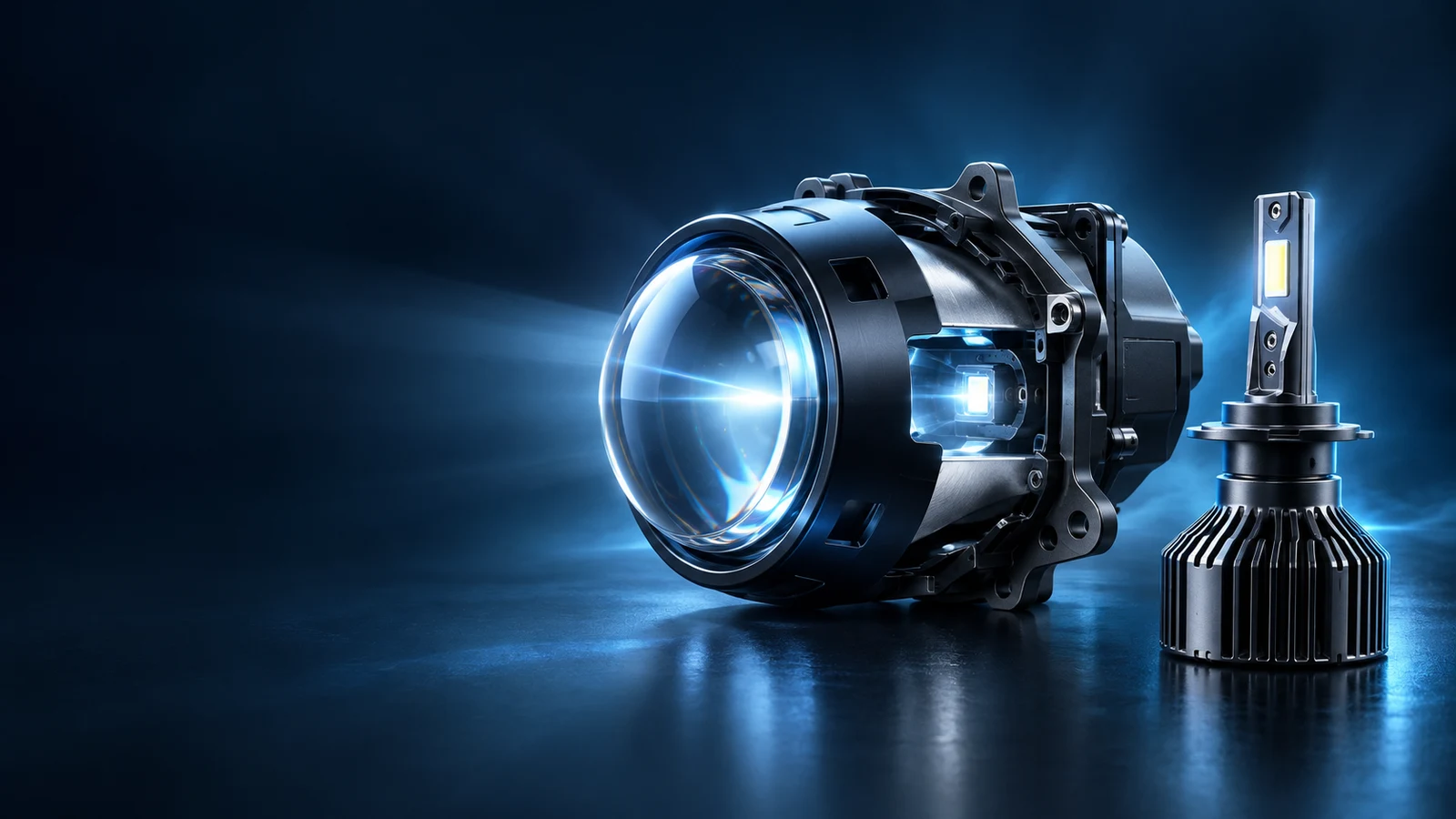
Bi-LED projector lenses, on the other hand, incorporate LED light sources into a dedicated optical module. They are commonly considered for more extensive headlamp upgrades, custom lighting projects, and specialized retrofit applications.
For automotive lighting distributors, importers, retrofit specialists, and private-label brands, understanding these differences is essential when selecting products for a particular market.
This guide compares Bi-LED projector lenses and drop-in LED headlight bulbs in terms of optical architecture, beam distribution, glare control, thermal management, electrical compatibility, installation, and B2B sourcing considerations.
The goal is to help buyers evaluate the right product category for their customers rather than assuming that one technology is always the better choice.
Bi-LED Projector Lenses vs Drop-in LED Bulbs
QUICK GUIDE
Drop-in LED bulbs work with existing headlamp optics, while Bi-LED projector modules integrate the LED source and optical components into a dedicated system.
Beam quality depends on the complete optical system, including light-source positioning, beam distribution, cutoff control, and correct installation.
Both product types require effective cooling, stable LED drivers, and compatibility with the vehicle’s electrical system.
LED bulb replacement may involve fewer installation steps. Bi-LED projector retrofits often require more extensive headlamp modification and professional installation.
LED bulbs and Bi-LED projectors serve different customer segments. Buyers should compare total costs, technical support needs, product reliability, and market demand.
1. Bi-LED Lens vs. LED Bulb: Understanding the Optical Architecture
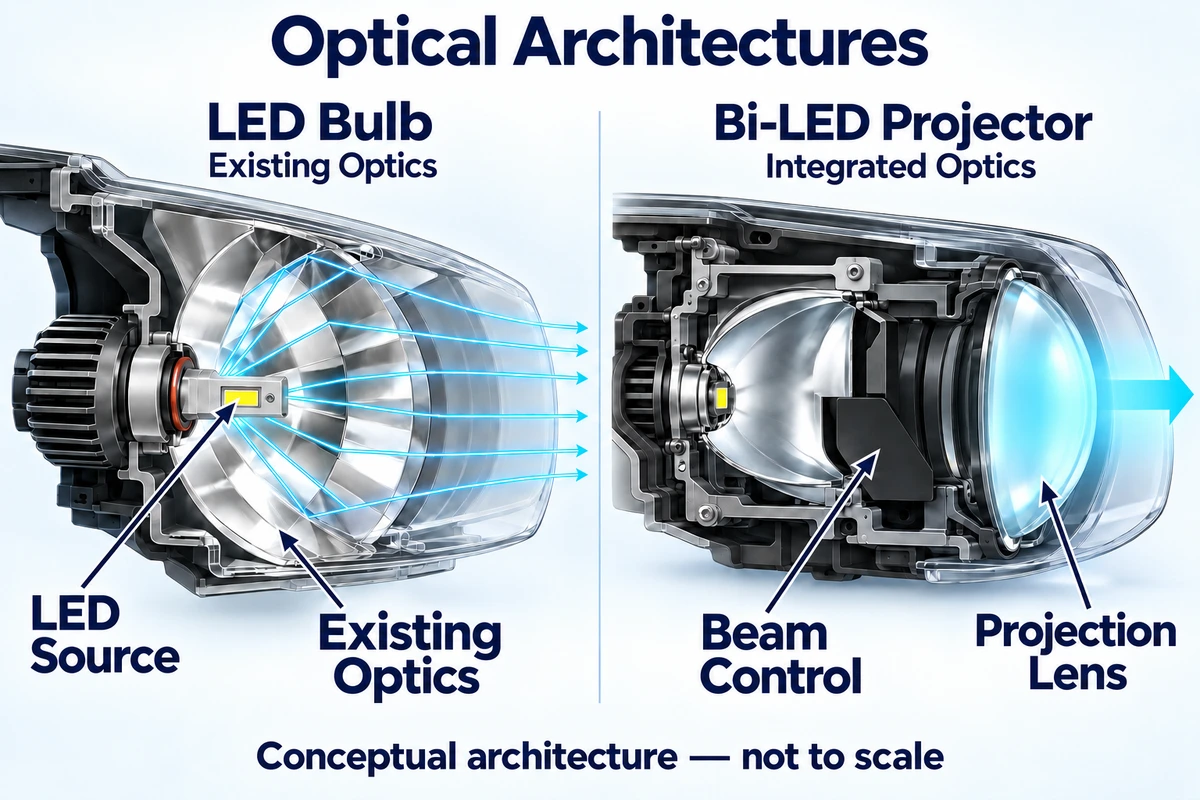
The most important difference between drop-in LED bulbs and Bi-LED projector lenses is how the light source interacts with the surrounding optical system.
How drop-in LED bulbs work
A drop-in LED headlight bulb is designed to replace an existing bulb within a compatible headlamp assembly.
Unlike a complete projector module, the replacement bulb generally depends on the original headlamp’s reflector or projector optics to form the final beam pattern.
In a halogen reflector headlamp, for example, the reflector is designed around the location and geometry of the original filament.
An LED replacement uses semiconductor light emitters with different physical characteristics. The position, size, and orientation of those emitters affect how light interacts with the existing reflector.
If the LED source does not adequately reproduce the optical position and distribution expected by the headlamp, the resulting beam may differ from the original design.
Potential consequences include:
- Excessive foreground illumination.
- Reduced downroad light distribution.
- Uneven beam patterns.
- Uncontrolled light above the intended cutoff.
- Inconsistent performance between different headlamp housings.
However, these results are not identical for every LED bulb or headlamp.
The performance of a drop-in LED bulb must be evaluated as part of the complete headlamp system, not by the bulb’s advertised output alone.
How Bi-LED projector lenses work
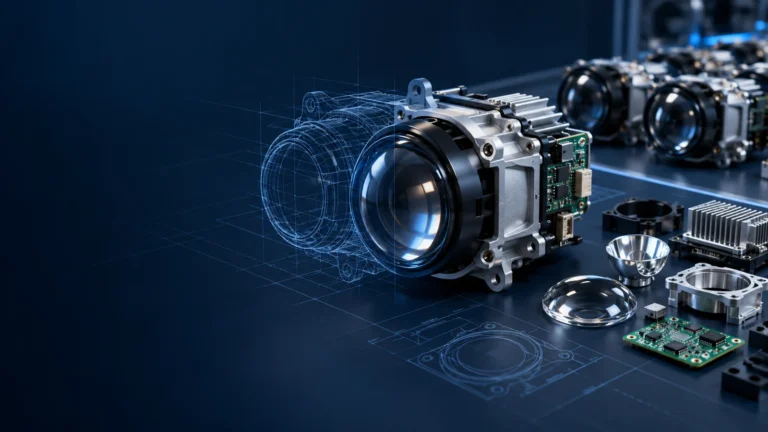
A Bi-LED projector lens is part of a dedicated headlamp optical module that typically integrates:
- LED light sources.
- Reflective or other light-directing optical components.
- A projection lens.
- A beam-forming shield or equivalent control mechanism.
- LED driver electronics.
- Thermal management components.
Many Bi-LED projector designs use an electrically operated shutter to switch between low-beam and high-beam functions.
Because the light source and optics are developed as part of one module, the manufacturer has greater control over the relationship between LED positioning and light distribution.
This can support more predictable beam characteristics than an unsuitable replacement bulb installed in optics designed for a different light source.
Nevertheless, actual performance still depends on the projector’s optical design, component quality, manufacturing consistency, installation, and alignment.
Key takeaway
A drop-in LED bulb adapts to the optics already installed in a vehicle. A Bi-LED projector provides its own integrated optical system.
For B2B buyers, the best choice depends on whether customers need compatible replacement bulbs or a more comprehensive headlamp upgrade.
2. Beam Pattern, Cutoff Line and Glare Control
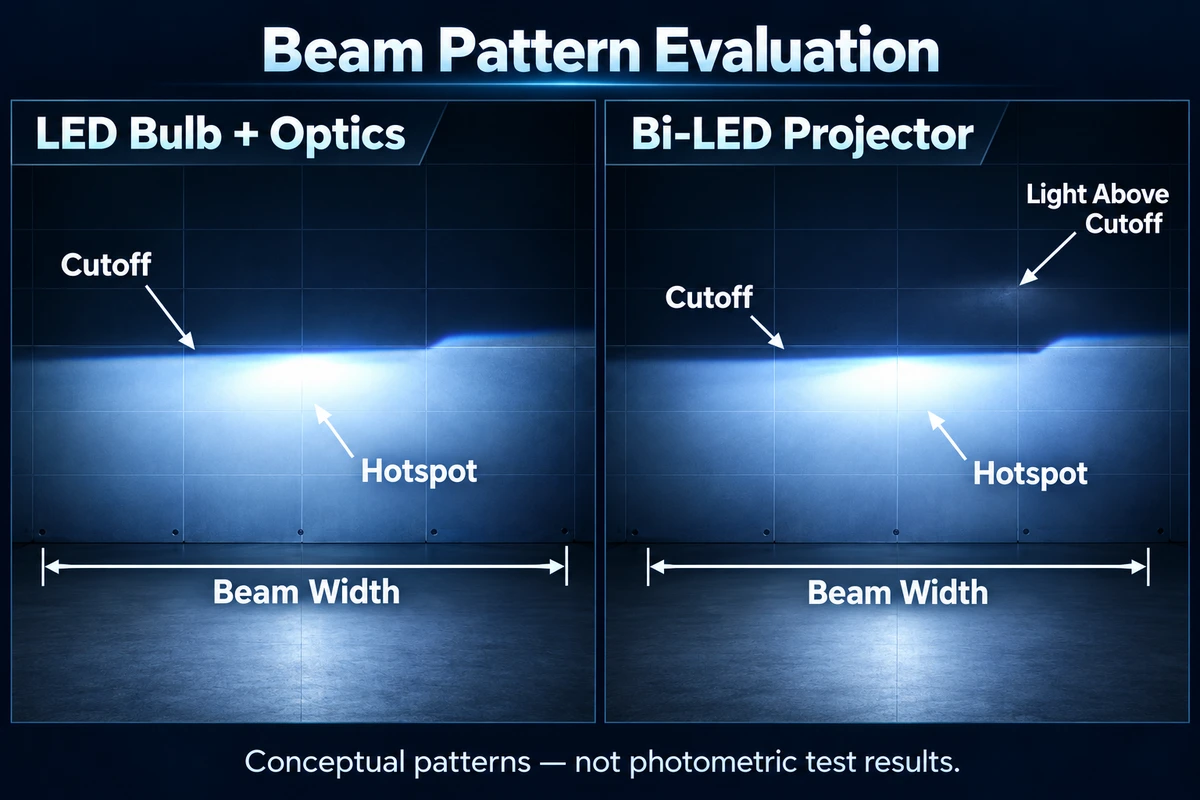
A headlight’s useful performance is determined by where it distributes light, not simply by how much light its LEDs produce.
Important evaluation factors include the low-beam cutoff, hotspot placement, roadway illumination, foreground brightness, and glare toward other road users.
Understanding the beam cutoff
The low-beam cutoff is the boundary that helps limit unwanted illumination above the intended beam pattern.
Many projector systems use a defined cutoff shape created by their optical components and beam-control mechanisms.
Depending on the optical design and target market, the cutoff may include a stepped or asymmetric pattern.
A clearly defined cutoff can help manage the distribution of low-beam light, but a sharp-looking cutoff alone does not prove that a headlamp is safe, compliant, or free from glare.
The complete beam must satisfy the relevant performance requirements for its intended application.
Why LED source positioning matters
When an LED replacement bulb is installed in an existing reflector, small differences in light-source geometry can affect the final beam.
Even a bulb with high advertised luminous output may deliver unsatisfactory road illumination if the optical system distributes that light poorly.
This is why comparing LED chip specifications alone is insufficient.
Buyers should evaluate the actual beam produced by the complete headlamp.
Hotspot concentration and downroad visibility
The hotspot is the region of relatively high illumination within a beam pattern.
A useful headlight design must balance several requirements:
- Sufficient illumination at relevant distances.
- Appropriate horizontal beam coverage.
- Controlled foreground brightness.
- Limited unwanted light above the intended beam.
- Suitable illumination across the required test points.
Bi-LED projector modules may offer advantages in controlling these characteristics because their optical components are designed together.
However, the actual difference between a projector and an LED replacement bulb can only be established through comparable testing.
How to evaluate beam performance
For meaningful technical comparisons, buyers should request or perform measurements using consistent conditions.
Important information includes:
- Measuring distance and test setup.
- Light distribution at defined positions.
- Hotspot location.
- Low-beam cutoff characteristics.
- Illumination uniformity.
- High-beam performance, where applicable.
- Complete headlamp installation conditions.
Lux readings are useful only when the measurement distance, location, equipment, and test method are known.
A single peak Lux number should not be treated as proof of superior headlight performance.
3. Bi-LED Projector Lenses vs. LED Bulbs: Technical Comparison
The following table summarizes the principal engineering and application differences.
These are general product-category characteristics. Individual models may vary.
| Evaluation Factor | Drop-in LED Headlight Bulbs | Bi-LED Projector Lens Modules |
|---|---|---|
| Optical System | Depends on the existing headlamp optics | Uses a dedicated optical module |
| Beam Distribution | Highly dependent on bulb-to-housing compatibility | Primarily determined by the integrated projector design and installation |
| Low-Beam Cutoff | Depends on the complete headlamp system | Typically controlled by dedicated optical components |
| Hotspot Performance | Varies with the bulb and original optics | Varies with projector optical design |
| Low/High Beam Operation | Depends on bulb and original headlamp configuration | Commonly uses an integrated beam-switching mechanism |
| Thermal Management | Compact heatsinks, fans, or other model-specific designs | Module-specific heatsinks and cooling systems |
| LED Driver | Integrated or external, depending on model | Integrated or external, depending on module |
| Electrical Compatibility | Must be verified for the vehicle system | Must be verified for the vehicle system and retrofit configuration |
| Installation | Often less invasive when compatible | Frequently requires additional mounting, alignment, and housing work |
| Typical Buyer | Replacement-parts distributors and aftermarket brands | Retrofit specialists, custom builders, and specialized lighting distributors |
| Main Purchasing Consideration | Fitment, system compatibility, consistency, and value | Optical quality, installation requirements, reliability, and technical support |
What this comparison means for B2B buyers
Neither category should be selected solely on the basis of advertised wattage or brightness.
For LED replacement bulbs, the compatibility of the light source with the intended headlamp system is especially important.
For Bi-LED projectors, the quality of the integrated optical module and the requirements of the complete retrofit are major considerations.
In both cases, product-level verification is necessary before making performance or compliance claims.
4. Thermal Management and CANBus Compatibility
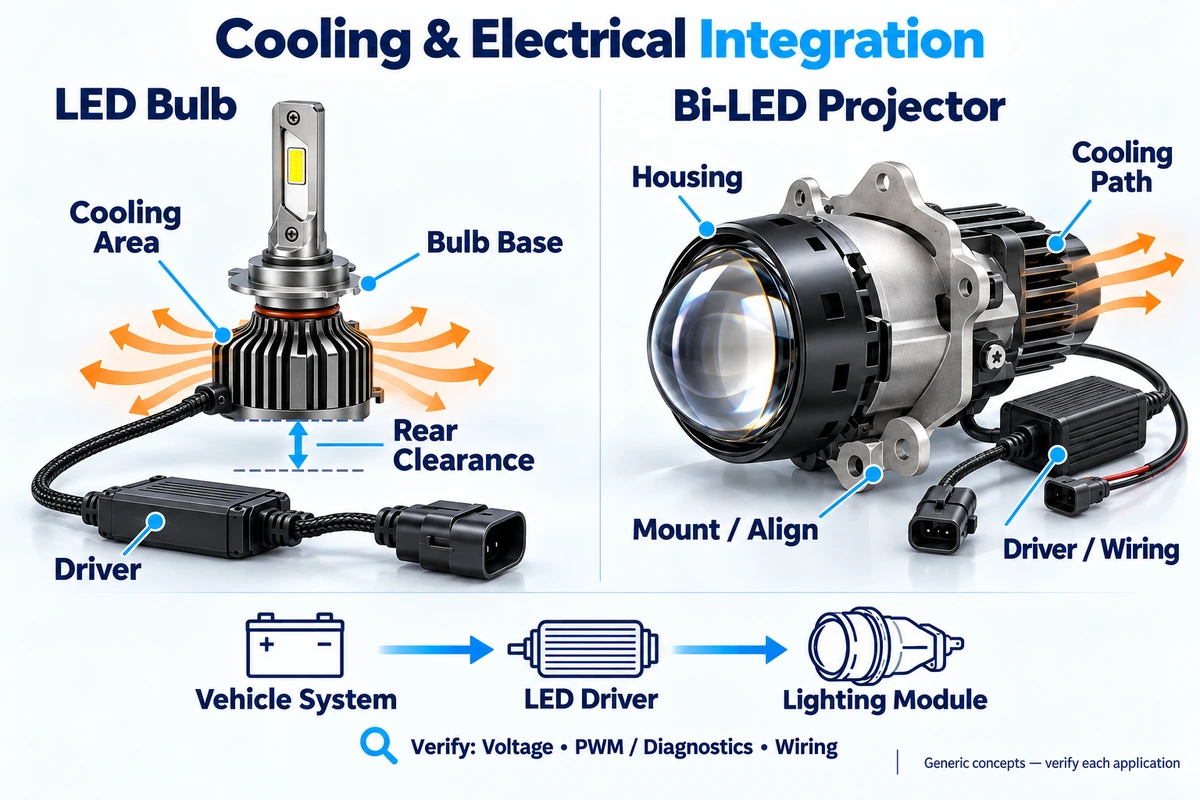
Effective thermal management and electrical stability are essential to the performance and reliability of automotive LED lighting products.
However, the cooling structures and driver requirements vary significantly between models.
Thermal management in LED replacement bulbs
LED headlight bulbs must dissipate heat while fitting within limited installation space.
Common cooling designs may include:
- Aluminum heatsinks.
- Compact cooling fans.
- Heat-conducting components.
- Passive thermal structures.
The appropriate design depends on the LED package, operating power, driver configuration, installation space, and surrounding temperature.
A compact product is not necessarily thermally inferior, just as a larger heatsink does not automatically guarantee greater reliability.
Buyers should examine the cooling design and request relevant operating-temperature or endurance-test information when available.
Thermal management in Bi-LED projector modules
Bi-LED projector assemblies may have more space for integrated thermal-management components.
Depending on the product, these can include:
- Aluminum heat-dissipation structures.
- Heat pipes.
- Copper-based thermal interfaces.
- Active cooling fans.
- Temperature monitoring or protective driver functions.
These components help manage heat generated by the LED sources and associated electronics.
Actual operating temperatures depend on the design and test environment. Buyers should not assume that every projector module uses the same cooling architecture or maintains the same thermal performance.
Understanding LED drivers and CANBus-related issues
Modern vehicle electrical systems may monitor lighting circuits or use pulse-width-modulated power signals.
When an incompatible replacement lighting product is installed, potential symptoms can include:
- Dashboard warning messages.
- Flickering.
- Unexpected startup behavior.
- Intermittent operation.
- Electrical interference.
Some lighting products use driver circuitry or additional compatibility modules to address specific operating conditions.
However, CANBus compatibility is not a universal guarantee.
A product described as CANBus-compatible may still require application-specific testing or additional components.
For Bi-LED retrofits, buyers must also consider the electrical requirements of the projector module and its low/high-beam control mechanism.
Recommended electrical evaluation
Before approving a product for distribution, review:
- Supported operating voltage.
- Nominal and measured electrical consumption.
- Startup and steady-state operation.
- Compatibility with relevant vehicle monitoring systems.
- Driver temperature and electrical stability.
- Electromagnetic compatibility documentation, where applicable.
- Any additional wiring or control components required for installation.
These checks are especially important when products will be supplied to multiple vehicle platforms or geographic markets.
5. Installation Complexity, Fitment and Regulatory Considerations
Installation requirements often influence whether LED replacement bulbs or Bi-LED projector lenses are commercially suitable for a particular market.
Installing drop-in LED replacement bulbs
Compatible LED replacement bulbs may be installed without opening the headlamp housing.
However, installers still need to verify:
- Correct bulb designation.
- Mounting and locking mechanism.
- Available rear clearance.
- Cooling-system clearance.
- Electrical connectors.
- Driver placement.
- Headlamp beam alignment.
- Applicable vehicle and product requirements.
A replacement bulb should not automatically be described as plug-and-play for every vehicle using the same nominal bulb base.
Installing Bi-LED projector modules
A Bi-LED projector retrofit is often more involved.
Depending on the headlamp and mounting design, installation may require:
- Opening the headlamp assembly.
- Removing or modifying existing optical components.
- Installing brackets or adapters.
- Checking projector alignment.
- Connecting the LED driver and beam-control wiring.
- Resealing the headlamp.
- Testing the completed assembly.
Some projector modules offer mounting configurations that simplify particular installations.
Nevertheless, fitment must be confirmed for the actual housing, and the completed system may require professional adjustment and validation.
Improper installation can affect beam alignment, sealing, durability, and road-use suitability.
Why regulatory compliance matters
Lighting regulations vary according to the destination market, product type, vehicle application, and intended road use.
For example, automotive lighting equipment used in the United States may be subject to applicable requirements under FMVSS No. 108.
Other markets may apply relevant national rules or UN vehicle-lighting regulations.
Replacing a halogen light source with an LED bulb, or modifying a headlamp with a projector retrofit, does not automatically make the completed system legally compliant.
Buyers should request documentation relevant to the exact product configuration and intended market.
Claims concerning DOT, E-mark, or other regulatory requirements must be supported by appropriate evidence.
For distributors, this is not simply a technical detail. It can affect product positioning, customer expectations, installation services, and commercial risk.
6. B2B Cost, Market Positioning and Return on Investment
LED replacement bulbs and Bi-LED projector lenses can serve different customer groups and business models.
The commercial opportunity should be evaluated according to total operating costs, target customers, installation requirements, and after-sales responsibilities.
Drop-in LED bulbs: Replacement and distribution opportunities
LED replacement bulbs may be relevant to businesses serving established aftermarket replacement channels, subject to application compatibility and applicable regulations.
Potential commercial advantages include:
- Compact products that are relatively easy to store and ship.
- Familiar replacement-bulb categories.
- Potentially simpler installation for compatible applications.
- Opportunities for differentiated product ranges and private-label packaging.
- Distribution through wholesale, retail, and selected online channels.
However, buyers should consider the risks associated with vehicle fitment, beam quality, electrical compatibility, and customer expectations.
A low purchase price does not necessarily result in a lower total business cost if returns or support requirements are high.
Bi-LED projector lenses: Specialized retrofit opportunities
Bi-LED projector modules may be suitable for businesses serving professional retrofit workshops, custom lighting installers, and specialized automotive lighting brands.
Potential commercial advantages include:
- More extensive optical and product differentiation.
- Opportunities to offer model-specific projector configurations.
- Additional professional installation services.
- Specialized technical support as part of the customer offering.
- Potential customization or private-label opportunities where supported by the supplier.
These advantages must be balanced against more complex installation requirements, technical support needs, and market-specific regulatory considerations.
Higher selling prices do not automatically mean higher profitability.
Comparing the total commercial cost
B2B buyers should consider more than the factory quotation.
A practical comparison includes:
| Commercial Factor | Why It Matters |
|---|---|
| Product Purchase Cost | Determines the initial sourcing expenditure |
| Shipping and Import Costs | Affect delivered product cost |
| Installation Requirements | Influence professional labor and customer suitability |
| Training and Technical Support | Affect distributor and installer operating costs |
| Warranty and Returns | Influence after-sales expenditure |
| Inventory Turnover | Affects stock financing and warehouse efficiency |
| Product Documentation | Supports accurate selling and application guidance |
| Customer Demand | Determines realistic sales volume |
| Regulatory Suitability | Affects which products can be marketed for particular uses |
A useful profitability assessment should compare expected selling prices and volumes against all relevant costs.
For professional retrofit businesses, installation services may contribute to revenue, but they also introduce labor, training, and liability considerations.
For volume distributors, inventory turnover and application coverage may be just as important as unit margin.
Choosing the right product portfolio
The strongest commercial strategy is not necessarily to offer only one type of automotive LED headlight product.
Some distributors may benefit from maintaining compatible replacement-bulb ranges alongside specialized projector products.
Others may prefer a focused portfolio aligned with their customer segment and technical capabilities.
The right sourcing decision depends on verified product performance, target-market requirements, installation resources, and realistic customer demand.
7. B2B Supplier Evaluation Checklist
Before placing a bulk order for LED headlight bulbs or Bi-LED projector lenses, distributors and automotive lighting brands should establish clear technical and commercial evaluation criteria.
Optical performance
- Request beam-pattern images or photometric information relevant to the product.
- Confirm the measurement methods and conditions.
- Review low-beam and high-beam performance, where applicable.
- Examine cutoff quality, hotspot positioning, and light distribution.
- Verify performance in the intended headlamp or retrofit configuration.
Product construction and thermal management
- Confirm the actual lens and optical-component materials.
- Review the heatsink and cooling structure.
- Check installation dimensions and mounting interfaces.
- Request available temperature or endurance-test information.
- Identify differences between product versions or configurations.
Electrical compatibility
- Confirm operating-voltage requirements.
- Review LED driver configuration and electrical consumption.
- Check relevant PWM or vehicle monitoring requirements.
- Verify electromagnetic compatibility information where applicable.
- Confirm any additional wiring, adapters, or decoders required.
Installation and market suitability
- Obtain accurate product dimensions or technical drawings.
- Verify the intended bulb base or projector mounting arrangement.
- Confirm installation requirements for the target application.
- Review applicable road-use and product-compliance requirements.
- Ensure customer-facing fitment claims are supported by evidence.
Commercial and quality controls
- Evaluate product samples before approving bulk orders.
- Confirm the exact product version and approved specifications.
- Discuss quality-inspection criteria.
- Verify packaging and labeling requirements.
- Confirm MOQ, lead time, warranty terms, and after-sales procedures.
- Discuss available OEM/ODM or private-label options.
- Agree on the process for managing quality issues and product changes.
A structured evaluation process can help buyers avoid selecting products based only on advertised brightness, appearance, or price.
8. Choosing Between Bi-LED Projectors and LED Bulbs for Your Market
The appropriate product category depends on what customers are trying to achieve.
Choose compatible LED replacement bulbs when:
- The customer requires a replacement solution for an existing headlamp system.
- A suitable and permitted product configuration is available.
- Installation simplicity is an important purchasing consideration.
- The distributor can verify the intended vehicle applications.
- The business focuses on established replacement-parts channels.
Consider Bi-LED projector modules when:
- The project requires a dedicated optical system.
- Professional installation or headlamp modification is acceptable.
- Customers need a specialized retrofit or custom lighting solution.
- The buyer can assess projector-specific optical and electrical performance.
- Technical support and installation capability are available.
- Regulatory suitability can be established for the intended use.
Why application-specific evaluation is essential
It is possible for a properly engineered projector retrofit to deliver a more controlled and useful beam than an unsuitable LED replacement bulb.
It is also possible for a well-designed original headlamp to perform better than a poorly selected or incorrectly installed aftermarket projector.
The correct comparison is therefore not simply between two product labels.
It is between complete lighting systems evaluated under appropriate, comparable conditions.
For B2B buyers, this approach leads to more meaningful product comparisons and better-informed sourcing decisions.
9. How NVEL Supports Automotive LED Lighting Buyers
NVEL offers automotive LED lighting product ranges for distributors, importers, aftermarket brands, and other professional buyers.
For businesses comparing headlight replacement products and projector solutions, the following product categories provide a starting point:
LED Headlight Bulbs
Explore NVEL’s available LED headlight bulb series and review the specifications of individual models.
Bi-LED Projector Lenses
Explore NVEL’s projector lens range and compare available model configurations, dimensions, and lighting functions.
For B2B sourcing inquiries, buyers can provide the intended product category, target market, application requirements, anticipated order quantity, and any specific branding or customization needs.
NVEL can then discuss available product information and applicable sourcing options.
Technical compatibility, customization feasibility, documentation, and commercial terms should be confirmed for the specific product and project.
10. Frequently Asked Questions
Q1. Can a drop-in LED bulb perform as well as a Bi-LED projector lens?
Performance depends on the complete headlamp system.
A suitable LED replacement bulb used in compatible optics may provide useful performance, while an unsuitable bulb can create poor beam distribution or glare.
A properly engineered Bi-LED projector can offer more integrated optical control, but its performance must still be verified through appropriate testing.
There is no universal outcome for every bulb, projector, or vehicle.
Q2. What does Bi-LED mean in automotive headlights?
Bi-LED commonly refers to an LED-based optical module that provides both low-beam and high-beam functions.
Many Bi-LED projectors use an electrically operated shutter to change the beam distribution, although the precise operating mechanism depends on the design.
Q3. Are Bi-LED projector lenses difficult to install?
Installation is generally more involved than replacing a compatible headlight bulb.
Many retrofits require opening the headlamp assembly, mounting the projector, completing electrical connections, and resealing and aligning the housing.
Requirements differ according to the vehicle and projector configuration. Professional installation may be advisable.
Q4. Do Bi-LED projectors always produce less glare than LED bulbs?
No.
A well-designed projector can provide controlled beam distribution, but glare depends on the full optical system, installation, alignment, and operating conditions.
A projector does not automatically eliminate glare or guarantee regulatory compliance.
Q5. Do Bi-LED projector lenses have lower warranty return rates than LED bulbs?
There is no reliable universal comparison.
Warranty performance depends on product design, manufacturing quality, thermal management, installation conditions, and customer use.
B2B buyers should request product-specific reliability information and review actual warranty and return data where available.
Q6. Do Bi-LED projector lenses require external CANBus decoders?
Requirements vary by vehicle and product configuration.
Some projector systems or LED drivers may work without additional compatibility components in certain applications, while others may require adapters, wiring changes, or control modules.
Electrical compatibility should be confirmed for the intended installation.
Q7. Are LED bulb replacements and Bi-LED projector retrofits road legal?
Legality depends on the product, complete headlamp configuration, vehicle application, jurisdiction, and applicable approval requirements.
Neither an LED replacement bulb nor a projector retrofit should be assumed to be road legal merely because it has a sharp cutoff or is marketed for automotive use.
Buyers should verify the relevant requirements and supporting documentation before making compliance claims.
Q8. Which option offers better value for automotive lighting distributors?
The answer depends on the buyer’s market.
Compatible LED replacement bulbs may suit businesses prioritizing replacement-part coverage and distribution efficiency.
Bi-LED projector modules may offer differentiated opportunities for professional retrofit and specialized lighting markets.
Product demand, total costs, installation requirements, warranty performance, and compliance considerations should all be included in the business evaluation.
Q9. What should buyers request from a Bi-LED projector supplier?
Useful information includes product specifications, dimensions, mounting requirements, optical performance data, electrical characteristics, available reliability-test information, and applicable compliance documentation.
Buyers should also confirm MOQ, production lead time, warranty arrangements, quality controls, and available customization options.
Q10. How can NVEL assist with LED headlight bulb and projector lens sourcing?
Buyers can explore NVEL’s available LED headlight bulb and projector lens products, review individual model information, and contact the team with their technical and commercial requirements.
Available configurations, customization options, and project-specific support should be confirmed during the sourcing discussion.
Conclusion: Choosing the Right Automotive LED Headlight Solution
Bi-LED projector lenses and drop-in LED headlight bulbs are designed for different installation methods and product applications.
Drop-in LED bulbs depend on the original headlamp optics and can be attractive for suitable replacement applications where compatibility and regulatory requirements are satisfied.
Bi-LED projector lenses use dedicated optical modules and may provide greater flexibility for specialized headlamp projects, particularly when installation expertise and application-specific validation are available.
However, neither technology should be judged solely by advertised brightness, peak Lux figures, or marketing claims about beam patterns.
For distributors, importers, automotive lighting brands, and professional retrofit businesses, the most effective sourcing strategy combines optical performance verification, electrical compatibility, thermal reliability, installation suitability, regulatory assessment, and realistic commercial planning.
NVEL welcomes inquiries from B2B buyers interested in evaluating automotive LED headlight bulb ranges and Bi-LED projector lens products for their target markets.
Explore NVEL Automotive LED Lighting Products
Contact NVEL with your target market, product category, application requirements, anticipated order quantity and branding or customization needs.
Technical and regulatory note: This guide provides general product comparison and sourcing information. Actual optical performance, compatibility, compliance, and installation suitability must be verified for the specific product, vehicle, and destination market.