TECHNICAL GUIDES · LED FOG LIGHTS
Quality Control Standards for OEM/ODM Automotive LED Fog Lamps: IATF 16949 and Production Testing
Quality planning, production inspection and verifiable supplier evidence
October 28, 2026 · 12 min read
Introduction
A successful automotive fog lamp program is not defined by one impressive prototype. Overseas brand owners, fleet buyers and OEM/ODM sourcing teams need the same fit, beam performance, electrical behavior and sealing quality across repeat production lots. A small shift in connector fit, solder coverage, lens alignment or gasket compression can turn a seemingly minor process deviation into field failures and warranty exposure.
Quality control therefore starts before assembly. Design reviews, supplier qualification, process risk analysis, measurement capability and traceable acceptance records must work together. IATF 16949 provides an automotive quality-management framework for eligible organizations, while project-specific specifications and customer requirements establish the actual performance and inspection criteria. A certificate alone cannot demonstrate that every fog lamp is defect-free.
For an importer evaluating an OEM LED fog light manufacturer, the practical question is not simply whether a supplier owns automated equipment. It is whether the manufacturer can show which critical features are controlled, how those controls are validated, what happens when a unit fails and how each released batch can be traced. This guide explains the evidence buyers should request—from APQP and SMT inspection to validated leak testing and environmental qualification.
Table of Contents
Quick Guide: OEM/ODM Fog Lamp Quality Control
QUICK GUIDE
1. IATF 16949: From Quality Planning to Production Control
IATF 16949:2016 is an automotive quality-management-system standard used alongside ISO 9001 and relevant customer-specific requirements. It emphasizes process effectiveness, defect prevention, variation reduction and systematic improvement. Certification relates to a defined organization and site scope; it is not an automatic product approval or a guarantee of zero defects.
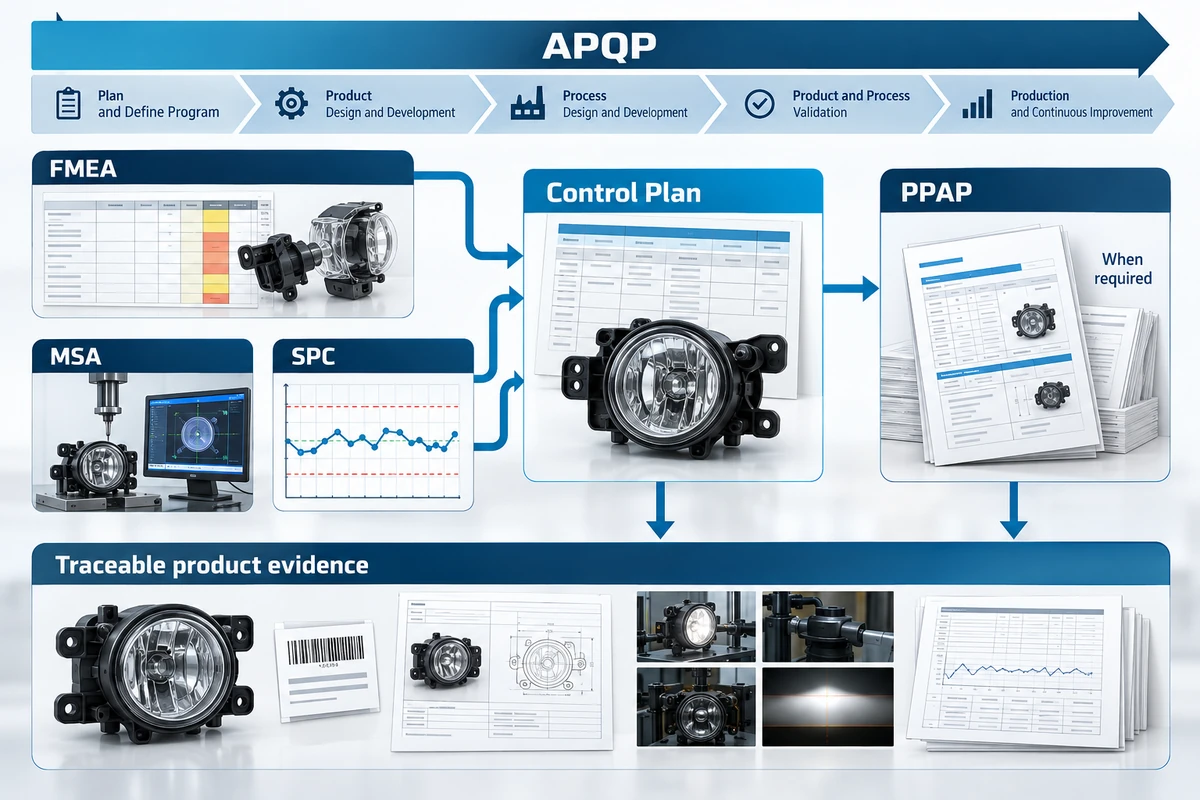
An effective fog lamp program links the automotive Core Tools to physical manufacturing evidence. Advanced Product Quality Planning (APQP) coordinates launch activities, while a Control Plan connects product risks, inspection methods, sample frequency, limits and reaction plans. Design and Process FMEA help teams identify risks before volume production; Measurement System Analysis (MSA) checks whether gauges are fit for their intended decisions; Statistical Process Control (SPC) tracks process stability; and PPAP provides customer-defined production approval documentation when required.
What buyers should request
Certification scope: verify the actual manufacturing site, certificate status and covered activities. A trader’s or partner’s certificate must not be presented as NVEL’s own certification.
Part-specific APQP and risk records: review the DFMEA/PFMEA or equivalent risk assessment, especially sealing, electronics, optics and mounting features.
A current Control Plan: inspect critical-to-quality characteristics, instrument calibration, sampling frequency, acceptance limits and documented containment actions.
PPAP package when contractually required: confirm submission level and contents with the customer; Level 3 is common in some programs but is not universal for every aftermarket order.
The outcome should be a connected set of records rather than isolated certificates: a drawing requirement leads to a measured characteristic, a defined process control, a retained result and an escalation rule when the result is out of tolerance.
2. SMT Assembly: SPI, AOI and Electrical Verification
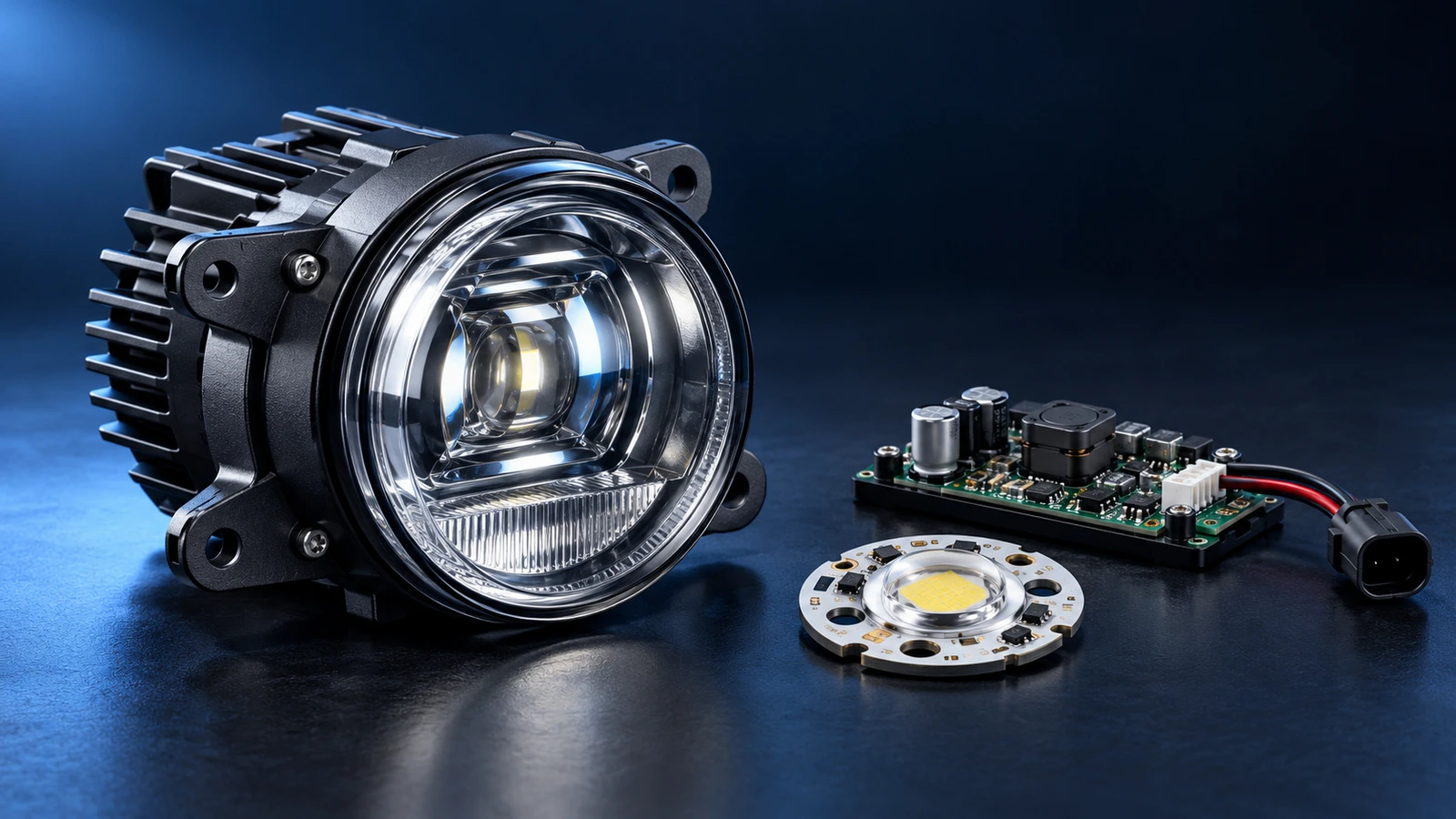
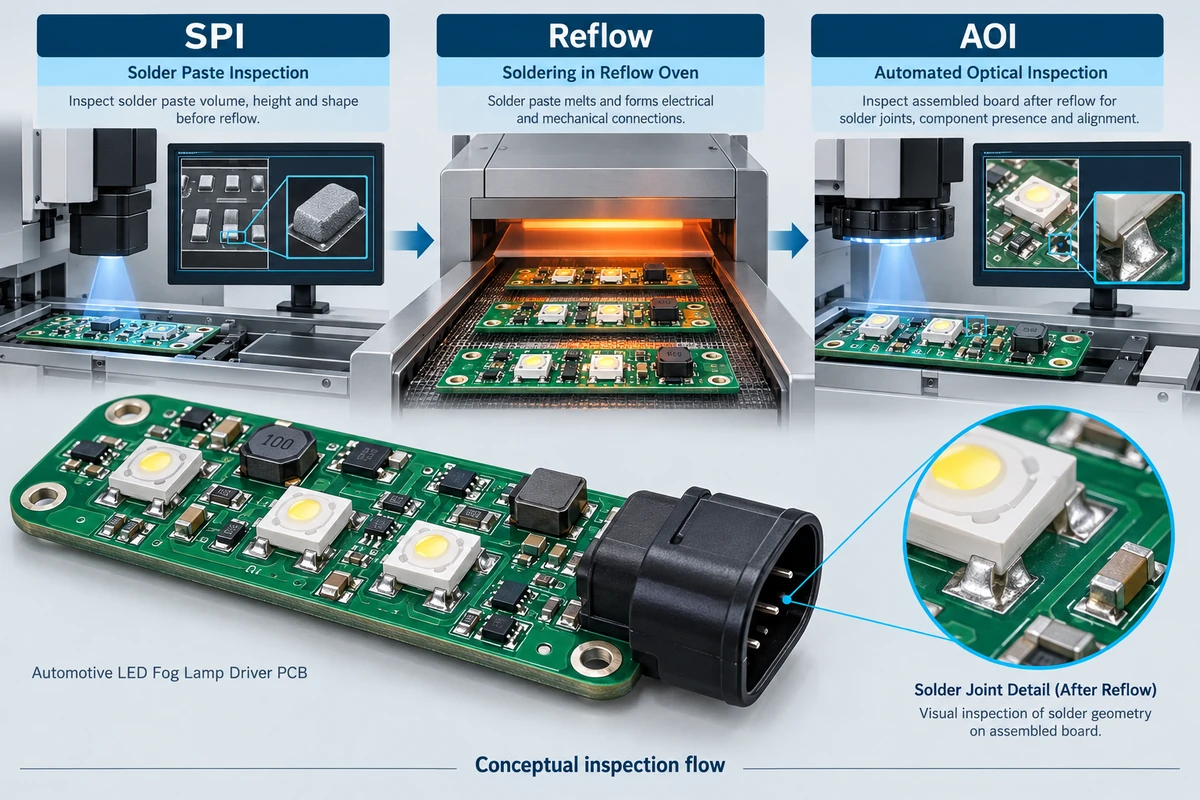
LED fog lamps combine optoelectronic packages, drivers, connectors and sometimes protective coatings on compact circuit boards. Solder-volume variation, polarity errors, component displacement and inadequate thermal attachment can reduce reliability even when a lamp powers on during an initial test.
A well-designed SMT quality flow may include solder-paste printing, solder-paste inspection (SPI), controlled component placement, verified reflow profiles, automated optical inspection (AOI), and application-appropriate electrical or functional testing. Each station must have documented coverage, limits and traceable defect handling. Not every product requires exactly the same equipment sequence.
What AOI can—and cannot—prove
2D or 3D AOI can help identify visible placement errors, polarity issues, bridges and solder-joint geometry defects. It does not necessarily reveal hidden interfaces, internal voids, marginal electrical behavior or long-term thermal degradation. Depending on risk, manufacturers may need X-ray inspection, in-circuit or functional tests, thermal characterization and process audits in addition to AOI.
An OEM buyer should ask for defect-category reports, false-call review, AOI program revision control, measurement repeatability, rework traceability and yield trends—not just a photograph of an inspection machine. “100% AOI” is meaningful only if the inspected population and detectable defect classes are defined.
Table 1. Example fog lamp production control plan
| Stage | Critical concern | Possible inspection / record | Buyer verification |
|---|---|---|---|
| PCB incoming / SMT | PCB finish, correct BOM, solder deposition | Traceability + SPI / profile records | Material lot and approved settings |
| Post-reflow | Component position, polarity, visible solder defects | AOI + targeted supplementary tests | AOI coverage, defect logs, rework control |
| Housing assembly | Gasket placement, torque, connector seal | Poka-yoke, torque record, visual check | Work instruction and reaction plan |
| Leak screening | Housing/connector path integrity | Validated pressure or flow test | Limits, calibration, correlation evidence |
| Final electrical / optical | Input current, dimming, beam, color | Functional test + qualified photometry | Measurement uncertainty, golden sample |
| Release / shipment | Mix-ups, labeling, containment | Lot traceability, final quality release | Batch records and escalation owner |
3. Production Leak Testing: Distinguish Screening from IP Qualification
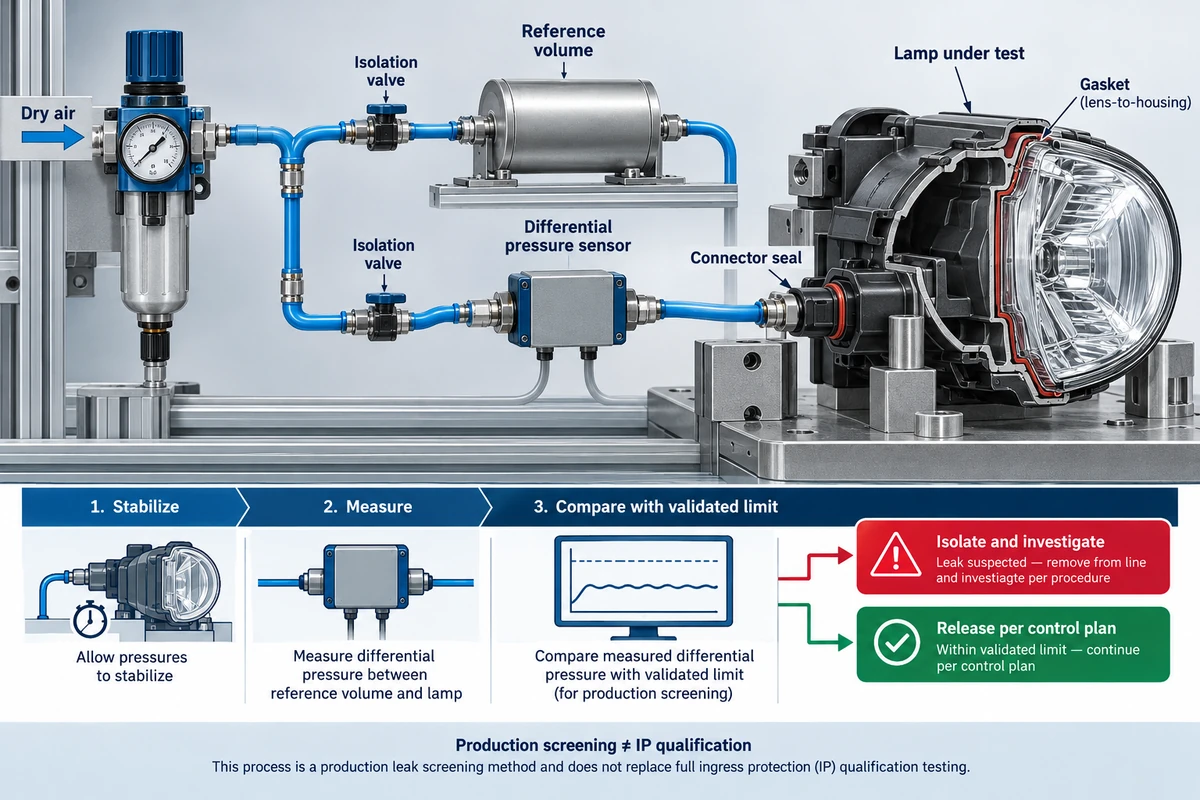
Low-mounted fog lamps experience road splash, cleaning jets, dust and repeated thermal pressure changes. A sealing failure may occur at the lens-to-housing joint, wiring exit, connector interface, service cover or breather. Testing should address the actual leakage pathways and their expected operating conditions.
Dry-air pressure-decay, differential-pressure, vacuum or mass-flow tests can screen assemblies quickly without submerging every part. The method depends on enclosure volume, venting, allowable leak rate, sealing design and cycle-time constraints. A negative-pressure recipe such as −30 kPa for ten seconds is not a universal automotive requirement, and neither is a single allowable leak rate.
Five controls behind a trustworthy inline leak test
Define the application: specify intended IP performance, exposed interfaces, pressure direction and how membrane vents are handled during the test.
Validate the test: correlate the chosen dry-air measurement and acceptance threshold with an appropriate water-ingress qualification method for that exact assembly design.
Control the station: retain calibrated reference leaks or masters, fixture maintenance records, stabilization time and temperature compensation where needed.
Record every tested unit when 100% screening is required: link result, fixture, timestamp and product lot or serial number.
Define disposition: failed units require isolation, controlled rework or scrap, retest rules and trend analysis; a tester must not silently release borderline parts.
Crucially, 100% dry-air leak screening is not itself evidence that each product individually underwent IP68 or IPX9K water testing. IP ratings depend on the specified qualification conditions and applicable standards. For road-vehicle equipment, ISO 20653 covers IP-code requirements including special “K” water-protection provisions; verification must match the claimed rating and product design.
4. Environmental Reliability and Photometric Qualification
Production screening detects process drift; qualification testing asks whether the design tolerates its intended environment. These are different activities and belong in separate test plans. Climatic loading under ISO 16750-4, vibration according to the applicable road-vehicle program, corrosion exposure and ingress qualification can be relevant—but no single universal test matrix applies to every fog lamp or vehicle location.
Thermal cycling and vibration
Thermal cycling may reveal gasket compression change, differential thermal expansion, solder fatigue or optical alignment movement. Selection of extreme temperatures, dwell times, ramp rates and cycle count must follow the mounting position and agreed customer specification. A statement such as “−40°C to +105°C for 500 cycles” is an example of a proposed requirement, not an automatic IATF 16949 mandate.
Similarly, vibration testing should reflect the mounting structure and realistic operating loads. Inspect brackets, fasteners, cable strain relief and optical aim before and after exposure. Document functional measurements rather than reporting only that the unit remained visually intact.
Salt spray and corrosion
ASTM B117 or ISO 9227 salt spray exposure can compare selected coatings and materials under controlled conditions. A 500-hour target may be specified by a buyer, but the test method itself does not establish a mandatory exposure time for all fog lamps, nor does a pass predict five years of field life. Record the sample configuration, surface preparation, acceptance criteria and actual failure modes.
Photometry: luminous flux is not the same as beam compliance
A calibrated integrating sphere can measure total luminous flux and related color characteristics. A goniophotometer or equivalent qualified method evaluates angular light distribution and aiming-related optical behavior. Therefore, a high lumen value or a sphere-only test cannot by itself establish a compliant fog-lamp beam pattern. Define which properties need production checks, which require qualification and which measurement uncertainties apply.
Table 2. Example qualification and production evidence matrix
| Test area | Method / reference | Define before testing | Expected evidence |
|---|---|---|---|
| Climatic exposure | ISO 16750-4 and customer plan | Profiles, dwell, cycles, function checks | Before/after readings, visual findings |
| Vibration / mechanical | Vehicle-specific vibration plan | Axis, spectrum, duration, mounting | Bracket, connector and aim results |
| Corrosion | ASTM B117 / ISO 9227 as applicable | Hours, coating, visual acceptance | Photos, rating, affected parts |
| Ingress protection | Applicable IEC 60529 / ISO 20653 | Exact IP designation and conditions | Qualification report for assembly |
| Production leak screen | Validated air-pressure / flow method | Leak limit, fixture, frequency | Calibrated unit/lot traceability |
| Optical qualification | Integrating sphere + beam evaluation | Flux, CCT, beam criteria, tolerance | Calibrated reports and uncertainty |
Selection of test standards and numerical pass/fail limits remains a contractual engineering decision; this table is a sourcing framework, not a certificate or an assertion of NVEL factory capability.
5. B2B Factory Audit Checklist for OEM/ODM Fog Lamps
An OEM LED fog light manufacturer should be assessed through objective records, process traceability and repeatable acceptance criteria. Ask a prospective production partner for the following evidence before tooling approval or an initial mass-production order:
- ☐ Confirm the legal manufacturer, factory address, quality-system scope, and current certificate validity where IATF 16949 certification is claimed.
- ☐ Review product drawings, revision control, BOM, change approval and customer-specific requirements.
- ☐ Examine the APQP timeline, PFMEA, Control Plan, MSA records and PPAP submission level when required.
- ☐ Inspect actual SPI/AOI test coverage, functional-test limits and how rejected/reworked boards are tracked.
- ☐ Ask whether the proposed fog lamp receives 100% dry-air leak screening or a risk-based sample plan, and require the validated leakage threshold.
- ☐ Obtain separate reports for ingress qualification, thermal cycling, vibration, corrosion and photometric beam evaluation, as applicable.
- ☐ Verify gauge calibration, golden samples, retention of unit/lot records and written nonconformance handling.
- ☐ Confirm packaging, labeling and traceability from finished lot back to PCB, seals, housing and key component batches.
- ☐ Review corrective-action performance, warranty-return analysis and on-time containment responsibilities.
- ☐ Agree in writing on inspection frequency, acceptance limits, evidence delivery and approval checkpoints before production.
During negotiations, ask for representative anonymized reports or a controlled facility audit. If a trading partner coordinates several factories, verify the evidence for the particular site producing your order rather than assuming that one certificate covers the full supply chain.
Frequently Asked Questions
Q1. Is IATF 16949 certification mandatory for every aftermarket LED fog lamp supplier?
No single rule makes IATF 16949 certification mandatory for every aftermarket transaction. Requirements depend on the customer, supply-chain role and applicable program. An OEM or Tier supplier may require the standard and additional customer-specific controls. Buyers should verify whether certification is expected and which facility and scope it covers.
Q2. Does 100% vacuum or pressure-decay testing guarantee IP68 or IPX9K performance?
No. A validated production leak screen can detect selected enclosure defects, but the claimed IP rating requires appropriate assembly-level water-ingress qualification under the specified conditions. Pressure testing and water-ingress testing answer related but different questions.
Q3. Why use AOI after SMT reflow if the fog lamp also passes a power-on test?
Power-on screening can miss placement variation or solder geometry defects that later become intermittent failures. AOI improves coverage of visible assembly defects; electrical, thermal or X-ray tests may still be necessary for risks AOI cannot see.
Q4. Does passing a 500-hour salt spray test prove five-year corrosion resistance?
No. Salt spray tests provide controlled comparative exposure data. Their results do not translate automatically into a specified number of years in real service. Buyers must define the coating, test duration, acceptance criteria and supporting service evidence.
Q5. What should a PPAP submission include for a custom fog lamp?
The evidence package depends on customer requirements and the agreed submission level. Common elements can include design records, change documentation, process flow, FMEA, Control Plan, dimensional and material results, measurement-system evidence, samples and customer approval documentation.
Q6. How should buyers assess quality capabilities when working with NVEL?
Ask NVEL to identify the manufacturing partner for the intended product and provide the applicable product specifications, available factory credentials, inspection plans and test evidence. Confirm which checks are performed on every unit, which are sampled, and which are type-qualification tests before agreeing to supply conditions.
Conclusion: Buy the Evidence, Not Just the Equipment List
Reliable OEM/ODM fog lamp programs combine preventive planning, controlled assembly, validated leak screening, environmental qualification and traceable release records. IATF 16949-oriented quality practices can provide a useful framework, but quality assurance depends on how well the actual manufacturing site applies customer requirements to a specific part number and production process.
For brand owners and fleet importers, the most valuable sourcing questions concern measurable risk: which defects are detected, how tests are validated, when production is stopped and what evidence accompanies shipment. An appropriate OEM LED fog light manufacturer or sourcing partner should help make those answers verifiable before volume orders begin.
Explore NVEL automotive lighting product options, or contact the OEM team to discuss fitment targets, inspection plans, prototype evaluation and documentation requirements for your project.
Discuss Your OEM/ODM Fog Lamp Project
Explore NVEL automotive lighting product options, or contact the OEM team to discuss fitment targets, inspection plans, prototype evaluation and documentation requirements for your project.