
TECHNICAL GUIDES · LED OFF-ROAD LIGHTS
What Makes a Truly High Quality Off Road LED Lights?
2026 Buyer’s Guide
September 30, 2026 · 12 min read
When you are navigating tight trails at night or crossing open desert terrain, off-road lights are not simply accessories. They are part of the vehicle’s safety system, helping drivers identify obstacles, changes in terrain, trail edges, people, and equipment beyond the reach of standard road lighting.
Yet the market is crowded with products promoted through impressive lumen figures and dramatic photographs. Raw brightness alone does not prove optical quality, durability, electrical reliability, or long-term value. A light that appears powerful in a short demonstration may scatter glare, overheat, admit moisture, loosen under vibration, or overload an unsuitable wiring harness in real service.
For distributors, aftermarket brands, professional buyers, and OEM/ODM customers, the better question is: what engineering details separate high quality off road LED lights from short-lived alternatives? This buyer’s guide explains the five areas that deserve close evaluation and provides a practical supplier checklist for commercial purchasing decisions.
Five Signs of a Professional-Grade Off-Road Light
QUICK GUIDE
01 · Waterproof Protection and Seal Integrity
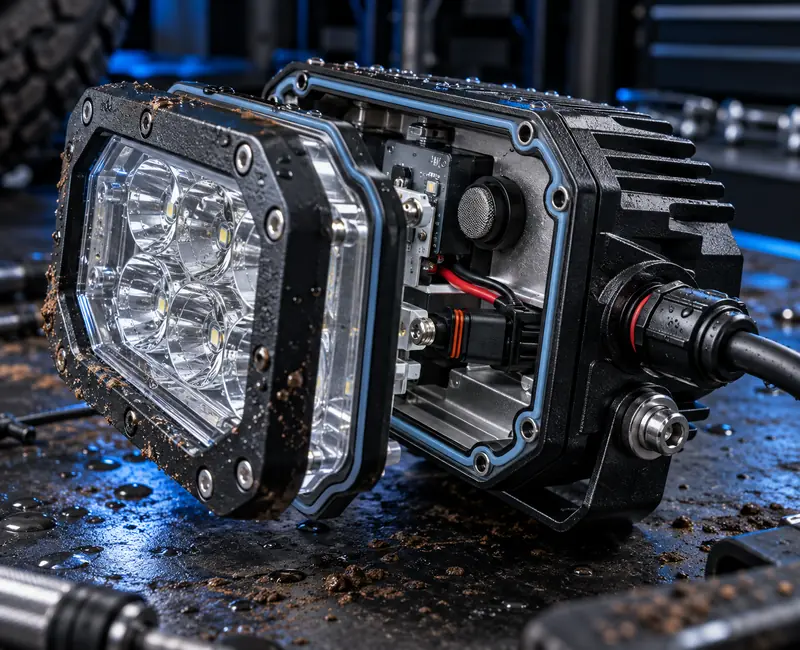
Off-road lamps operate in an unusually aggressive environment. Dust, mud, standing water, rain, temperature cycling, and high-pressure cleaning can all attack the enclosure. The quality of the seal therefore depends on the complete system—not merely a waterproof label on a carton.
Inspect the lens-to-housing joint, rear cover, cable entry, connector, fasteners, and any pressure-equalizing membrane. Heavy-duty gaskets should be compressed evenly, while cable glands and connectors should resist both water entry and movement. A properly selected breather can help equalize internal and external pressure as the lamp heats and cools, reducing stress on seals and the likelihood of condensation. A breather is not a substitute for sound enclosure design.
IP68 vs IP69K: Different Tests, Different Risks
IP68 addresses complete protection against dust and protection during continuous immersion under conditions agreed by the manufacturer and test laboratory. Buyers should request the actual immersion depth, duration, and configuration because the standard does not reduce every IP68 claim to one universal depth or time.
IP69K addresses resistance to close-range, high-pressure, high-temperature water jets from multiple angles. It is particularly relevant where equipment is cleaned aggressively. It does not mean the same thing as IP68, and one rating should not automatically be treated as proof of the other. For either claim, ask whether testing covers the complete production configuration, including the connector and cable exit.
Buyer takeaway: Verify the test conditions and the exact model covered. A rating without a traceable report, sample definition, and complete sealing design offers limited purchasing confidence.
02 · Thermal Management and Long-Term Reliability
LEDs are efficient, but they still create heat at the semiconductor junction and in the driver electronics. If this heat cannot travel through the circuit board, housing, and heat-sink surfaces into the surrounding air, junction temperature rises. The result can be reduced light output, color shift, accelerated component aging, and early driver failure.
A well-engineered lamp creates a continuous thermal path. The LED board should make effective contact with the housing through suitable interface materials and controlled assembly. Aluminum housings are widely used because they can combine structural strength with useful thermal conductivity. However, alloy designation alone does not prove performance: die-cast and extruded parts serve different design needs, and thermal results depend on geometry, wall thickness, surface area, interfaces, airflow, and manufacturing consistency.
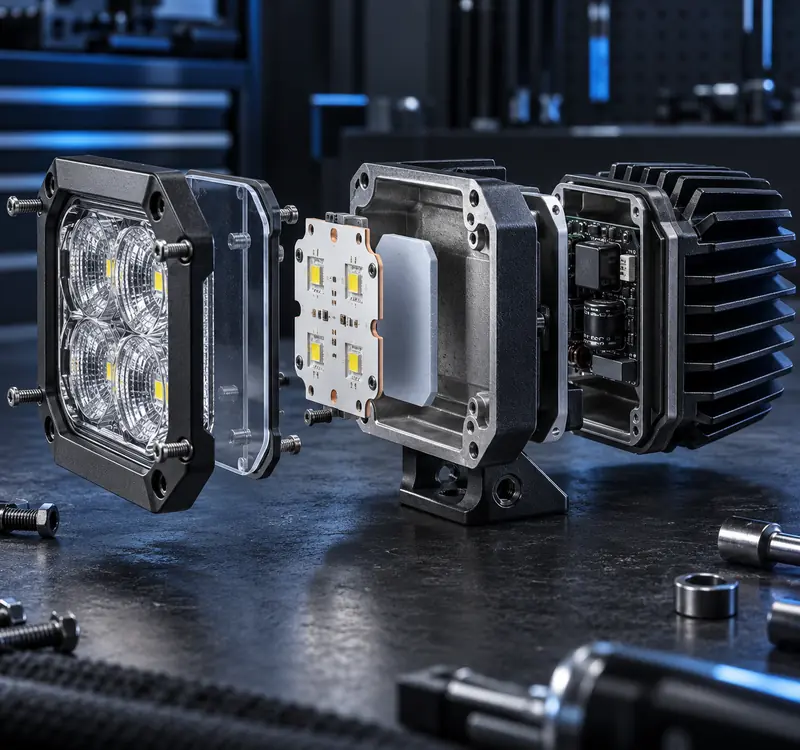
External fins should have enough spacing and exposed area to release heat rather than merely create an aggressive appearance. Buyers should also examine how the driver is positioned, whether heat-sensitive components are isolated appropriately, and how the design behaves when the vehicle is stationary with little airflow. Some products may use thermal protection or current reduction, but this feature should be confirmed per model rather than assumed.
- Request stabilized output data, not only the first seconds after switch-on.
- Ask about thermal validation at representative ambient temperatures and input voltages.
- Review housing construction, PCB contact, driver placement, and fin geometry together.
- Confirm that production controls maintain the same interface materials and assembly torque.
Buyer takeaway: Reliable thermal performance is a system property. A large housing or a famous LED brand cannot compensate for a weak thermal path or poorly designed driver.
03 · Optical Precision and Usable Light Output
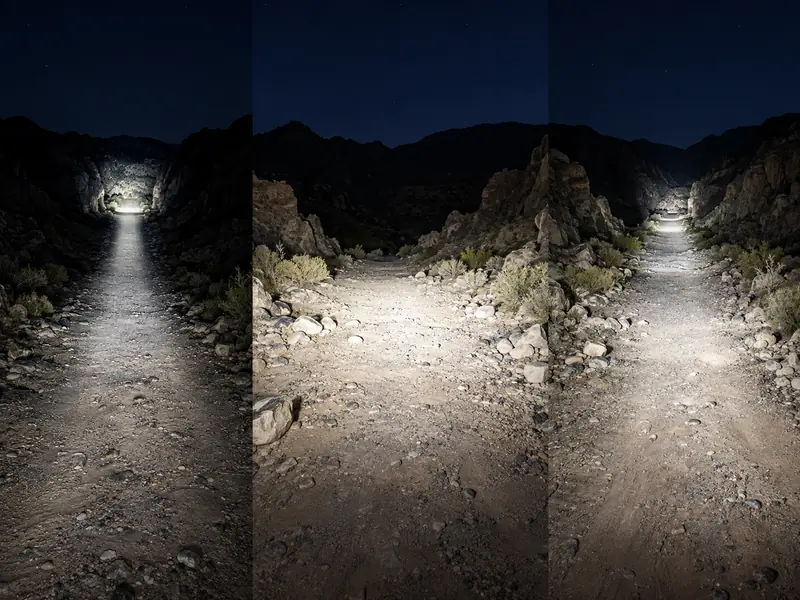
A high lumen number can describe the theoretical output of LED packages under specified laboratory conditions, yet it does not reveal how much useful light reaches the trail. Optical efficiency, driver current, temperature, lens transmission, reflector accuracy, and beam distribution all affect real performance.
Raw Lumens vs Effective Lumens
Raw lumens are often calculated by multiplying the nominal lumen value of each LED by the number of emitters. This can be useful for component-level comparison, but it does not include optical losses, thermal reduction, or electrical operating conditions. Effective lumens describe measured output from the complete lamp under defined conditions. Even that figure should be read with test duration, voltage, temperature, and measurement method.
For driving, lux at relevant distances and a beam-distribution plot may be more informative than total lumens. A controlled beam places light where the driver needs it while limiting near-field glare, hot spots, and stray upward light. Engineered reflectors and TIR optics can both perform well when matched accurately to the LED source and intended application.
Spot vs Flood vs Combo Beam
| Beam Type | Typical Strength | Best-Fit Use | Buyer Check |
|---|---|---|---|
| Spot | Long, concentrated reach | Higher-speed open terrain and distance visibility | Center intensity and controlled spill |
| Flood | Wide near- and mid-field coverage | Technical trails, work areas, and low-speed maneuvering | Uniformity and useful side illumination |
| Combo | Blended distance and width | Mixed environments requiring one versatile lamp | Balanced transition without severe hot spots |
Lens material also matters. Polycarbonate is widely selected for impact resistance and lower weight, but formulation, thickness, UV stabilization, hard coating, sealing, and geometry determine field performance. It should not be described as indestructible. Ask suppliers how they manage abrasion, yellowing, stone impact, and chemical exposure for the intended market.
Buyer takeaway: Compare beam plots, lux measurements, and stabilized complete-lamp output. Select the beam for the driving task rather than choosing the largest advertised lumen figure.
04 · LED Components and Electronic Reliability
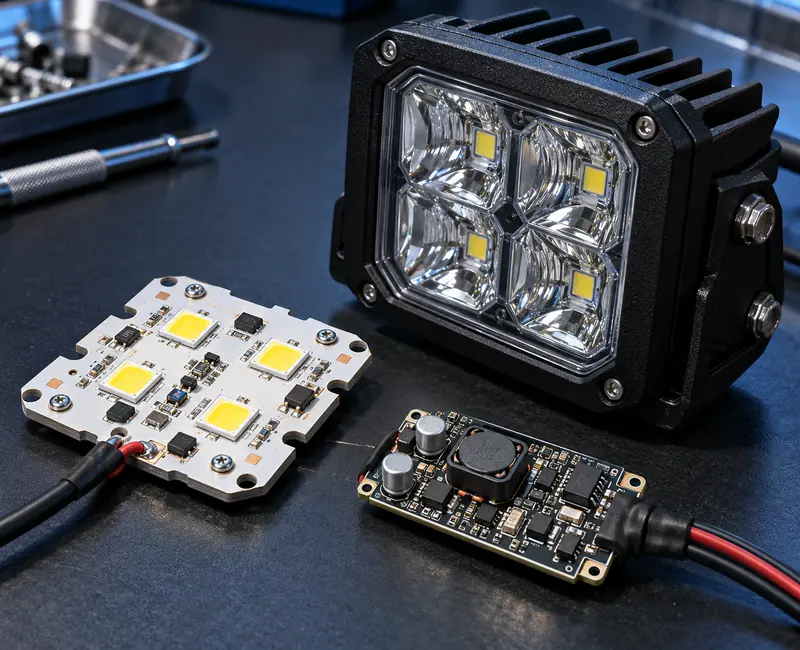
LED package quality influences efficiency, color consistency, optical alignment, and resistance to thermal stress. But buyers should evaluate the full electronic platform. Driver topology, component derating, PCB layout, solder quality, transient protection, reverse-polarity protection, and waterproof interconnections can matter as much as the emitter name.
Color temperature should match the application and market expectation. Cooler white output can provide a crisp visual appearance, while warmer or selective-yellow light may improve perceived contrast in dust, rain, fog, or snow for some drivers. No single color temperature is universally best. More important are consistency between lamps, controlled tint, optical suitability, and stable color as the product reaches operating temperature.
EMC and EMI Considerations
Poorly controlled switching electronics can create electromagnetic interference that affects radios, communication equipment, sensors, or other vehicle electronics. Conversely, the light must tolerate disturbances present in the vehicle’s electrical system. Professional buyers should define the target market and required standards, then request model-specific evidence. Do not assume that every variant carries the same EMC approval because one product family has been tested.
- Confirm input-voltage range and power consumption under steady operation.
- Review protections against voltage spikes, reverse polarity, and overheating where specified.
- Ask for production-level consistency in LED binning, driver components, and PCB assembly.
- Match EMC documentation to the exact model, configuration, and destination market.
Buyer takeaway: A premium emitter does not make a premium lamp by itself. Evaluate the driver, PCB, protection strategy, assembly quality, and compliance evidence as one electronic system.
05 · Mounting Hardware and Wiring Quality
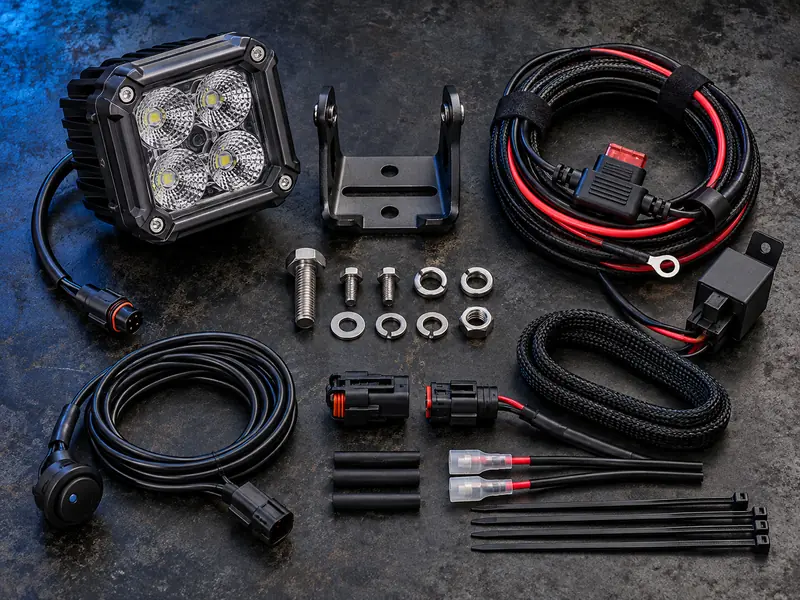
Off-road vibration creates repeated loads that can expose weak brackets, undersized fasteners, loose pivots, and brittle cable exits. The mounting system must hold aim while allowing practical adjustment. Buyers should check bracket thickness, geometry, surface treatment, fastener material, locking method, and corrosion resistance for the target environment. “Stainless steel” should be supported by a defined material specification when it is a purchasing requirement.
A quality wiring harness should be designed around the actual current draw and cable length. Conductor size, insulation temperature rating, abrasion protection, relay capacity, fuse placement, switch rating, grounding, and connector sealing all influence safety. The fuse should protect the circuit and be located appropriately near the power source. Waterproof connectors should be assembled with correct seals and strain relief; a familiar connector shape alone does not prove its origin or performance.
For distributors and private-label brands, installation quality affects return rates and customer trust. Request clear instructions, labeled wiring, consistent accessories, and packaging that prevents brackets or hardware from damaging the lamp during transport.
Buyer takeaway: Treat the bracket and harness as functional parts of the lighting system. Strong optics cannot compensate for a lamp that moves, corrodes, or is powered through inadequate wiring.
How to Evaluate High Quality Off Road LED Lights
A professional sourcing decision should move from marketing claims to traceable specifications, samples, and production controls. Use the following checklist when comparing suppliers or preparing an OEM/ODM brief.
| Evaluation Area | What to Request | Why It Matters |
|---|---|---|
| Ingress protection | Model-specific report with depth, duration, pressure, temperature, and test configuration | Confirms what the IP claim actually covers |
| Optical performance | Beam plots, lux data at stated distances, and stabilized output method | Shows usable light distribution, not just raw lumens |
| Thermal design | Operating-temperature validation, thermal path details, and stabilized power/output | Supports consistency and component reliability |
| Electrical design | Voltage range, protection functions, current draw, and applicable EMC evidence | Reduces compatibility, interference, and failure risks |
| Mechanical durability | Vibration, corrosion, impact, bracket, fastener, and cable-entry information | Protects aim and enclosure integrity in rough service |
| Quality control | Incoming, in-process, end-of-line, traceability, and change-control procedures | Helps samples and mass production remain consistent |
Supplier Evaluation Questions
- Which performance claims are verified for this exact model rather than a related series?
- Can the supplier explain the optical, thermal, sealing, and electrical design choices?
- How are critical components and processes controlled between sample approval and mass production?
- What inspection records, traceability information, and engineering-change controls are available?
- Can packaging, labeling, harnesses, connectors, beam patterns, and compliance needs be adapted for the destination market?
- Are warranty terms, failure-analysis procedures, and after-sales responsibilities documented clearly?
Buyers can review NVEL’s LED off-road lighting solutions and visit the Technical Guides hub for additional automotive-lighting information. Product specifications and test evidence should always be confirmed for the exact model and project requirement.
Frequently Asked Questions
What makes an off-road LED light high quality?
High quality comes from the complete system: controlled optics, an effective thermal path, verified sealing, reliable electronics, durable mounting hardware, and correctly sized wiring. Traceable test evidence and stable production controls matter more than one headline specification.
Is IP69K better than IP68?
They address different exposure conditions. IP68 concerns continuous immersion under declared test conditions, while IP69K concerns close-range, high-pressure, high-temperature water jets. A buyer may require one or both depending on use, but neither should be treated as automatically proving the other.
Are more lumens always better for off-road driving?
No. Beam placement, intensity at useful distances, width, uniformity, glare control, and stabilized output are more meaningful for driving than a raw-lumen calculation alone. Excessive foreground brightness can also make distant terrain harder to see.
Should I choose a spot, flood, or combo beam?
Choose according to speed and terrain. Spot beams support distance visibility, flood beams support wide near-field awareness, and combo beams balance the two. Many professional setups use complementary beam patterns rather than relying on one lamp for every condition.
What color temperature is best for off-road lights?
There is no universal best choice. White light can offer a crisp appearance and good general visibility, while warmer or yellow output may improve perceived contrast in certain dust, fog, rain, or snow conditions. Consider the environment, beam design, regulations, and driver preference together.
Why do EMC and EMI matter in an LED pod light?
The LED driver switches current electronically and can generate interference if it is poorly designed. Appropriate EMC engineering helps the lamp coexist with radios, sensors, and vehicle electronics and resist disturbances from the electrical system. Applicable requirements vary by market and vehicle application.
What should a B2B buyer verify before placing a bulk order?
Approve model-specific samples, confirm specifications and reports, review the factory’s quality controls, define acceptable component substitutions, verify packaging and labeling, and document warranty and change-control expectations. A golden sample is useful only when production traceability and inspection criteria support it.
Conclusion: Buy for Usable Performance and Long-Term Value
High-quality off-road lighting should be evaluated through five connected outcomes: reliability, safety, optical performance, environmental durability, and long-term ownership value. The strongest product is not necessarily the one with the highest advertised lumens. It is the one that controls light effectively, manages heat, resists the intended environment, integrates safely with the vehicle, and remains consistent from approved sample to production shipment.
For distributors, wholesalers, aftermarket brands, and OEM/ODM programs, disciplined evaluation protects both the end user and the brand. Define the application first, request evidence for the exact model, and compare total system quality rather than isolated claims.