
TECHNICAL GUIDES · LED FOG LIGHTS
3000K vs. 4300K vs. 6000K
Which Color Fog Light Color Temperature Is Better?
October 7, 2026 · 9 min read
Choosing between 3000K, 4300K and 6000K fog lights is not simply a choice between “good,” “better” and “best.” Each color temperature creates a different visual appearance, and drivers may prefer one over another depending on weather, road environment and the color of their main headlights.
Color temperature can influence perceived contrast and subjective glare, but it does not determine fog-light performance by itself. Beam pattern, vertical control, aiming, optical efficiency and usable intensity usually have a greater effect on where the light reaches the road.
This guide compares the three common choices without treating Kelvin as a brightness rating or claiming that one color universally penetrates fog better.
Table of Contents
Fog Light Color Temperature at a Glance
QUICK GUIDE
01 · Quick Answer: 3000K vs. 4300K vs. 6000K Fog Lights
3000K generally produces a warm, yellowish appearance; some drivers prefer its visual comfort in adverse weather. 4300K offers a neutral-to-warm white appearance for buyers who want a middle ground between yellow and cool white. 6000K produces a cool-white appearance and is commonly chosen to coordinate with modern LED headlights and daytime running lights. These are appearance and preference differences, not a ranking of visibility or safety.
There is no universally best fog light color temperature for every application. A well-controlled 6000K fog beam can be more useful than a poorly aimed 3000K lamp, while a properly engineered 3000K system may feel more comfortable to some drivers in adverse weather. Beam control remains fundamental.
02 · What Is Fog Light Color Temperature?
Fog light color temperature is expressed as correlated color temperature (CCT) in kelvins, abbreviated K. Lower CCT values generally look warmer and more yellow, while higher values look cooler and whiter. CCT describes color appearance, not the LED’s actual operating temperature, a single wavelength, brightness, power consumption or beam reach. The CIE definition of CCT relates a source’s chromaticity to that of a nearby Planckian radiator.
CCT also does not fully describe a lamp’s spectral power distribution. Two LED fog lights labeled 3000K—or two labeled 6000K—can still differ in tint, color rendering and the amount of energy emitted across different wavelengths. LED package selection, phosphor design, current and optics all contribute to the final appearance.
03 · 3000K vs. 4300K vs. 6000K Fog Lights: Quick Comparison
| Characteristic | 3000K | 4300K | 6000K |
|---|---|---|---|
| Typical appearance | Warm, yellowish | Neutral to warm white | Cool white |
| Adverse-weather preference | Some drivers prefer warmer appearance | Middle-ground appearance; verify performance | Verify beam and aim; CCT alone is insufficient |
| Match with modern LED headlights | Visibly different | Compare samples; tint varies | Common styling choice; confirm match |
| Clear-road appearance | Warm and distinctive | Neutral-to-warm white | Crisp and modern |
| Typical buyer priority | Weather-oriented visual preference | Middle-ground white appearance | Styling consistency |
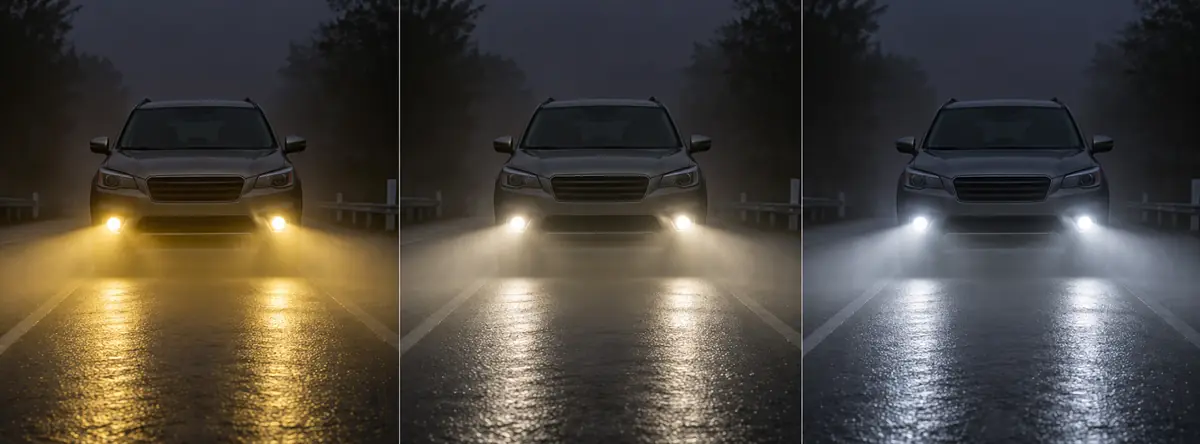
04 · 3000K Fog Lights: Warm Yellow for Adverse-Weather Preference
Products sold as 3000K generally have a warm, yellowish appearance, with the exact hue depending on spectrum and tint. Some drivers find this appearance less harsh in certain rain, fog, snow or dusty conditions, or feel that particular road features are easier to distinguish. Subjective comfort and perceived contrast are not the same as measured target detection distance; road surfaces, markings and objects respond differently to a change of spectrum.
Rayleigh scattering applies to particles much smaller than the wavelength. Fog droplets are often comparable to or larger than visible wavelengths, so fog scattering cannot be explained by a simple Rayleigh rule. Mie theory describes scattering by spherical particles across this size range; particle size relative to wavelength, refractive index, viewing geometry and multiple scattering all affect the result. Fog density, beam distribution, intensity, aim, road reflectance and driver adaptation also matter. Neither 3000K nor a yellow appearance guarantees a longer effective viewing distance in every fog, rain or snow condition.
The main trade-off is appearance. A warm yellow fog lamp contrasts strongly with cool-white headlights, which some drivers value for function and others may not prefer aesthetically.
A 3000K label does not automatically mean legally defined amber or selective yellow. CCT, marketing color names and regulated chromaticity boundaries are different specifications. Request measured color evidence for the intended product and destination market rather than treating the Kelvin label as proof of road-use compliance.
05 · 4300K Fog Lights: A Neutral-to-Warm White Option
4300K sits visually between warm yellow and cool white. Its neutral-to-warm white appearance may appeal to drivers who want an OEM-style look without the distinctive yellow of 3000K or the cooler impression of 6000K. Some HID products use a similar nominal CCT, but 4300K is not a universal standard for all OEM halogen or HID lamps. Compare the actual specifications and samples when matching factory lighting.
A 4300K rating does not automatically produce more lumens, better object recognition, higher efficiency or more balanced performance in mixed weather. Those outcomes depend on the LED source, driver electronics, thermal design and optical system. Select it for its middle-ground appearance where product specifications, measured optical performance and actual market demand support the choice.
06 · 6000K Fog Lights: Cool White and Modern LED Styling
6000K fog lights deliver a cool white appearance, sometimes with a slight blue impression depending on the emitter and observer. They are frequently chosen because they coordinate visually with modern LED headlights, DRLs and other exterior lighting. On clear roads, many drivers describe the result as crisp and contemporary.
The same nominal CCT does not guarantee identical white appearance across different lamps. Spectral output, tint, operating temperature and aging can affect visual matching. Assess representative samples side by side under consistent conditions instead of relying on the Kelvin label alone.
6000K does not inherently mean higher brightness, longer beam reach, better dry-road visibility or worse performance in fog. Some drivers may notice more discomfort with a particular cool-white lamp in certain conditions, but this cannot be predicted from CCT alone. Evaluate measured distribution, directional intensity, installation and aim under representative conditions.
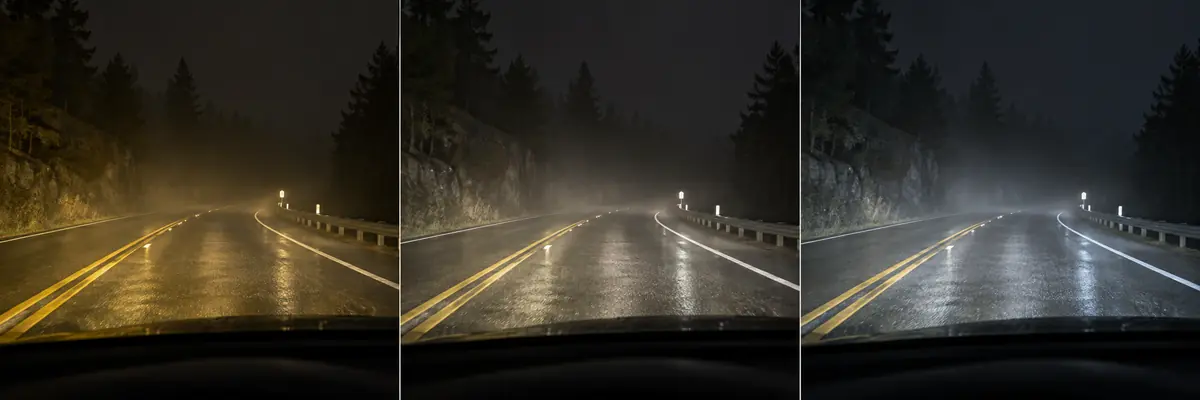
07 · Color Temperature vs. Beam Pattern: Which Matters More?
Color temperature changes how the light looks; beam pattern determines where it goes. Useful fog-lamp performance depends on appropriate lateral coverage, controlled vertical distribution, mounting height, proper aim and limited upward spill. The required distribution depends on the lamp function and applicable standard. Follow approved installation instructions and evaluate useful road illumination and glare rather than Kelvin alone.
No Kelvin choice can correct a scattered hotspot, excessive upward light or poor mounting alignment. Strong foreground illumination can make the road immediately ahead look bright without improving recognition of targets farther away. Balance near-field coverage, useful target visibility and glare control. For a broader quality checklist, see NVEL’s high-quality fog light buyer’s guide.
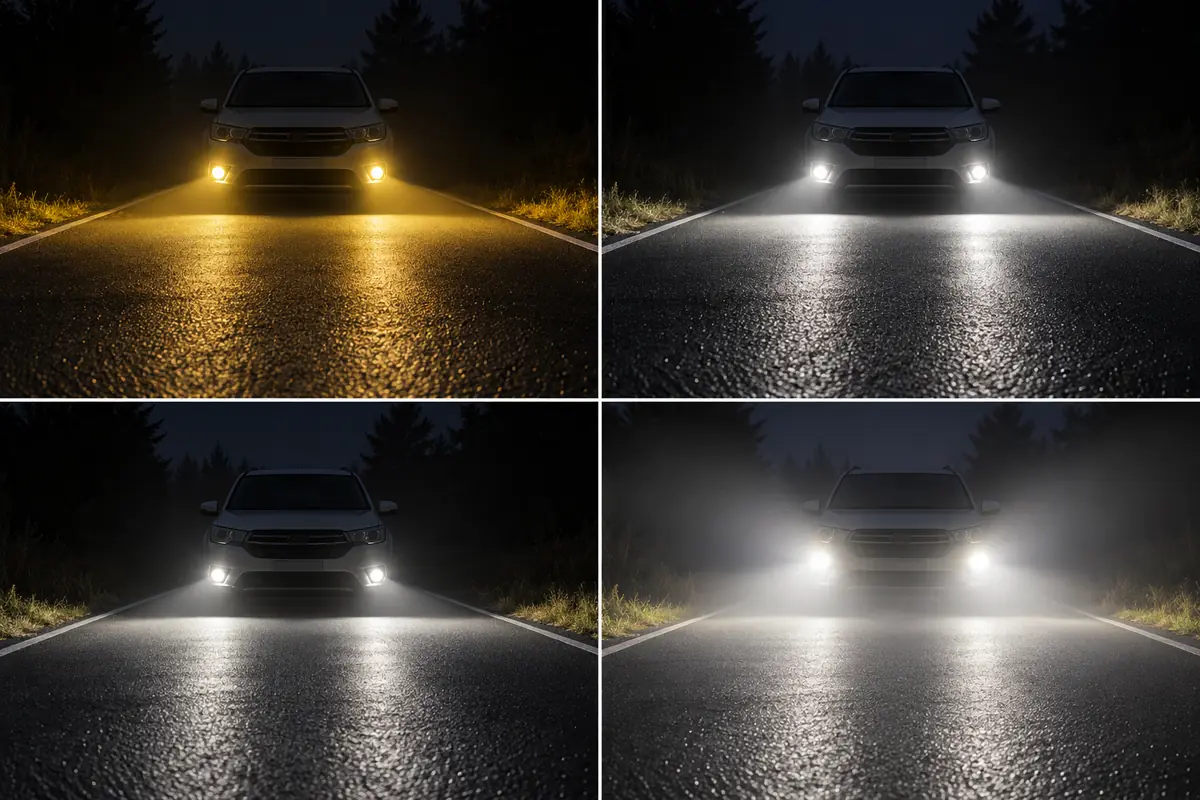
08 · Does Higher Color Temperature Mean a Brighter Fog Light?
No. Kelvin is not a brightness unit. Lumens describe total emitted light, candela describes luminous intensity in a direction, and lux describes illumination on a surface. A 6000K product can be brighter or dimmer than a 3000K product depending on LED efficiency, electrical drive, thermal management and optical losses.
Compare photometric results under equivalent supply voltage and operating conditions after thermal warm-up. Reports should identify the actual supplied model, LED and optical configuration, measurement method and operating mode, rather than a different lamp or color version. Lumens alone cannot describe useful distribution, and neither luminous output nor nominal CCT establishes detection distance.
09 · Which Fog Light Color Temperature Should You Choose?
Choose 3000K If…
You prefer a warm, yellowish appearance or find a representative sample more comfortable in your driving conditions, and matching cool-white headlights is a lower priority. Confirm optical performance and legal suitability separately.
Choose 4300K If…
You want a neutral-to-warm white appearance for daily use and an OEM-style visual balance. Verify the actual match and performance; an intermediate Kelvin value does not prove balanced weather performance.
Choose 6000K If…
You prioritize a cool-white appearance and visual coordination with modern LED headlights or DRLs. Check sample color matching, measured distribution and aim for the intended application.
Before buying, also verify the beam pattern, optical quality, vehicle application, mounting position, aiming procedure and applicable local compliance requirements.
Road-Use Compliance
Permitted fog-lamp colors, installation positions, switching arrangements and approval requirements vary by destination market and lamp function. A 3000K, 4300K or 6000K label alone does not establish road legality. Verify measured color, the complete lamp configuration and installation against applicable requirements; do not assume that all yellow, amber or selective-yellow fog lamps are legal throughout Europe or North America.
10 · Are Dual-Color Fog Lights a Good Option?
Dual-color systems allow the driver to switch between white and yellow modes, offering flexibility for changing conditions or styling preferences. Their usefulness depends on more than the number of modes. Buyers should check whether both settings maintain a consistent, controlled beam; how switching is triggered; whether the system remembers its last mode; and whether its thermal and electrical design is compatible with the vehicle. Evaluate both modes separately for color, photometric performance, reliability, control logic and applicable road-use requirements; approval or test evidence for one mode does not automatically cover the other.
11 · What Buyers Should Check Beyond Color Temperature
- Beam pattern and vertical control: Review usable coverage, aim and glare-control evidence for the intended installation.
- Photometric documentation: Use the correct metric and match reports to the supplied model, configuration, voltage, thermally stabilized state and each operating mode.
- Market, configuration and optics: Confirm destination market, lamp function, vehicle fitment, lens or reflector design and mounting height.
- Thermal management and color consistency: Check stabilized output; agree chromaticity specifications, allowable variation and measurement conditions, using approved samples for acceptance.
- Environmental testing and reliability: Check sealing and substantiated ingress-protection, vibration and temperature evidence, with relevant exposure conditions and agreed acceptance criteria.
- Electrical compatibility and dual-color operation: Verify voltage, connectors, driver behavior and vehicle diagnostics; check switching, memory and both color modes.
- Compliance documentation: Verify applicable color, lamp approval and installation requirements, and confirm that documents cover the offered configuration and both modes where relevant.
- CCT range and SKU planning: Use sales, stock turnover, returns and lead times to decide which color and fitment combinations to stock; confirm model-specific availability before adding SKUs.
12 · Frequently Asked Questions
Is 3000K or 6000K better for fog lights?
Neither is universally better. 3000K is often preferred for a warmer adverse-weather appearance, while 6000K is chosen for cool-white styling. Beam control and aim can matter more than CCT.
Are yellow fog lights better in fog?
Some drivers prefer the comfort or perceived contrast of warmer light. This does not establish longer target detection distance. Fog density, droplet size, spectrum, beam distribution and aim affect visibility; yellow does not guarantee better penetration in every condition.
What does 4300K look like?
It generally appears neutral to warm white, visually between yellowish 3000K and cool-white 6000K. Actual tint varies, and 4300K is not a universal OEM halogen or HID specification.
Does higher Kelvin mean brighter light?
No. Kelvin describes color appearance. Spectrum can influence luminous efficacy, but nominal CCT does not determine output. Compare measured lumens, directional candela and road lux under equivalent supply and thermal conditions.
Does color temperature affect beam pattern?
Not directly. The optical system determines distribution, although different emitters can interact differently with a design if their geometry changes.
Are 6000K fog lights suitable for rain?
They can be suitable when the complete lamp and installation meet application and market requirements. Some drivers prefer warmer light, but suitability depends on measured distribution, intensity and aim rather than 6000K alone.
Are yellow fog lights road legal?
That depends on the destination market, measured color, lamp approval and installation. Yellow, amber and selective yellow are not interchangeable regulatory terms, and 3000K alone does not establish legality. For dual-color lamps, assess both modes and their control logic.
Choose the Right Fog Light for Your Driving Conditions
Do not evaluate a fog light by Kelvin alone. Combine color preference with beam pattern, optical performance, vehicle application and the weather conditions you actually encounter. Explore NVEL’s fog-light range or contact our team to discuss a suitable solution.
Browse more automotive lighting technical guides.