TECHNICAL GUIDES · B2B SUPPLIER EVALUATION
How to Evaluate an Automotive Lighting Supplier Before Placing a Bulk Order?
Verify samples, production readiness, quality evidence and purchasing terms before committing to a bulk order.
October 9, 2026 · 11 min read
Introduction
A bulk automotive lighting order commits cash, warehouse space and your reputation to products that must perform consistently. Quality problems can create installation complaints and returns; delays can leave distributors short of stock. A competitive quotation and one impressive sample do not show whether the supplier can repeat that result across your order.
To evaluate an automotive lighting supplier before placing a bulk order, connect technical sample approval with factory evidence, quality records and enforceable purchasing controls. This guide gives importers, wholesalers, aftermarket brands and OEM/ODM purchasing managers a practical verification sequence. The objective is informed approval of a specific order, with documented responsibilities and remaining risks.
Table of Contents
Quick Guide
1. Evaluate Samples Before Approving a Bulk Order
Representative samples and sample quantity
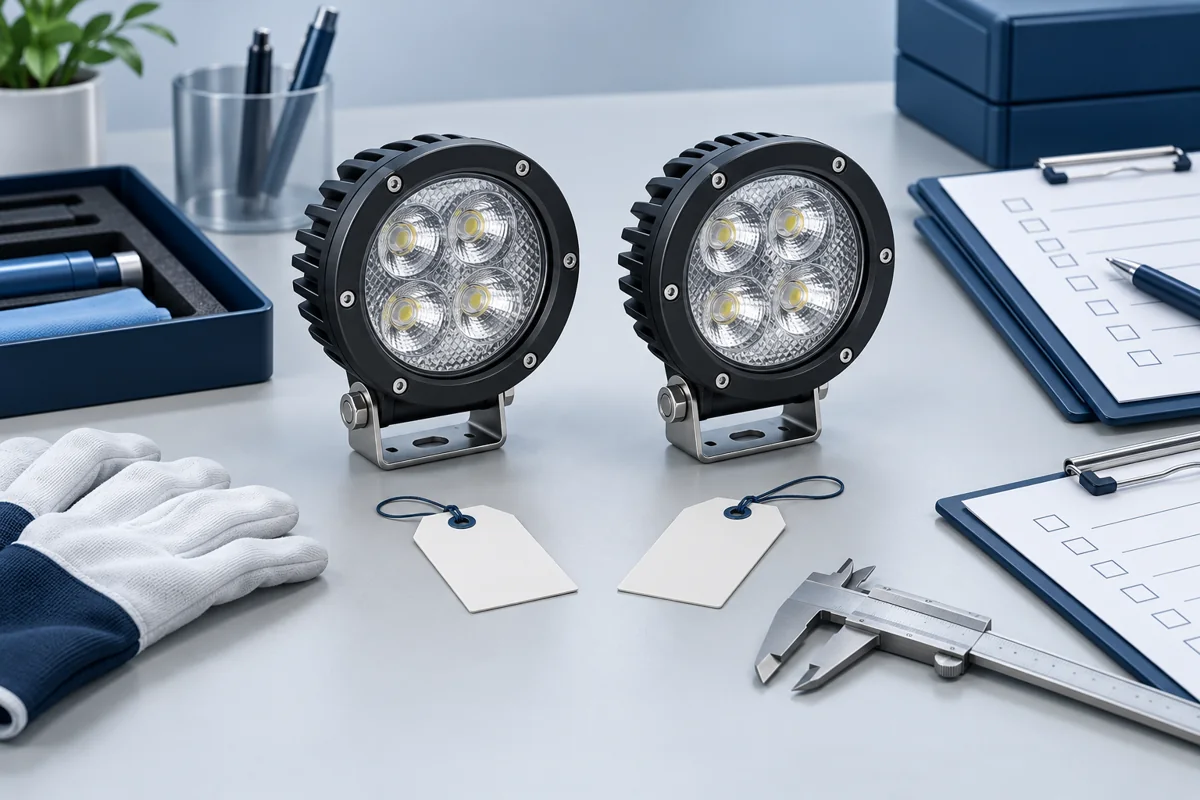
Request the exact models, electrical versions, beam configurations and packaging options planned for your purchase. Include variants that introduce meaningful risk, such as different drivers, housings or mounting arrangements. Ask how each sample was produced and whether its components and assembly process represent the proposed bulk order.
Choose sample quantity according to product complexity, application diversity, supplier history and the consequences of failure. A small development batch can reveal differences between units, but it cannot establish the defect rate of a future shipment. Agree a separate lot-inspection plan for production; no fixed sample count is suitable for every project.
Optical, thermal and electrical evaluation
Compare beam distribution, useful intensity, uniformity, color consistency and glare control under documented conditions. Record voltage, mounting, aim, measurement distance and ambient temperature. For vehicle headlights, assess the complete lamp or approved installation rather than judging an isolated LED bulb by advertised lumens.
Check sustained output and temperature behavior after stabilization under representative operating conditions. Verify rated voltage, current draw, connector polarity, vehicle bulb monitoring and relevant PWM behavior on intended applications. An informal radio check can identify a concern, but it does not replace suitable EMC testing. Have qualified personnel or laboratories perform electrical stress, environmental and destructive tests using an agreed procedure.
Fitment and approval records
Trial-install samples in representative housings or vehicles. Check mounting security, adjustment, rear-cover clearance, cooling, cable routing and installation instructions. Distinguish an engineering sample used for development from an approved reference sample and a production sample taken from an actual manufacturing lot.
Keep approved samples with model and revision identifiers, photographs, measurement results and written acceptance criteria. Record any deviations and who authorized them. Approval should cover a defined configuration; it should not permit unreviewed substitutions in the bulk order.
2. Verify Manufacturing Facilities and Production Capacity
Factory identity and process ownership
Match the supplier’s legal identity, quotation, factory address and contracting entity. Clarify whether you are buying from the manufacturer, an export affiliate or a trading company, and identify who controls production and handles claims. A trading company can be a capable partner when responsibilities and manufacturing access are transparent.
Use a scheduled site visit, independent audit or live production tour to verify the proposed manufacturing location. Ask to see the relevant process flow, assembly stations, inspection points and material controls. Evaluate equipment against the product and acceptance requirements; an in-house SMT line or ISO-classified cleanroom is not a universal entry requirement.
Capacity, scheduling and continuity
Request realistic available capacity for your model, not only total monthly factory output. Check bottleneck processes, staffing, shifts, component availability and existing order commitments. Ask how the supplier schedules your quantity and what happens if tooling, drivers, optical parts or packaging arrive late.
Where PCB assembly, coating, machining or testing is outsourced, request subcontractor qualification and incoming verification arrangements. Establish how changes are approved and traced. Discuss critical-component lead times, contingency sourcing and notification of shortages. These controls reduce uncertainty but cannot eliminate supply-chain risk.
3. Audit Quality Control and Traceability
Inspection stages and records
Ask for a model-specific control plan. Incoming quality control (IQC) should address relevant materials and purchased parts; in-process quality control (IPQC) should check assembly and critical process settings. Final quality control (FQC) and outgoing quality control (OQC) should verify finished-product and shipment requirements. Names alone do not demonstrate effective inspection.
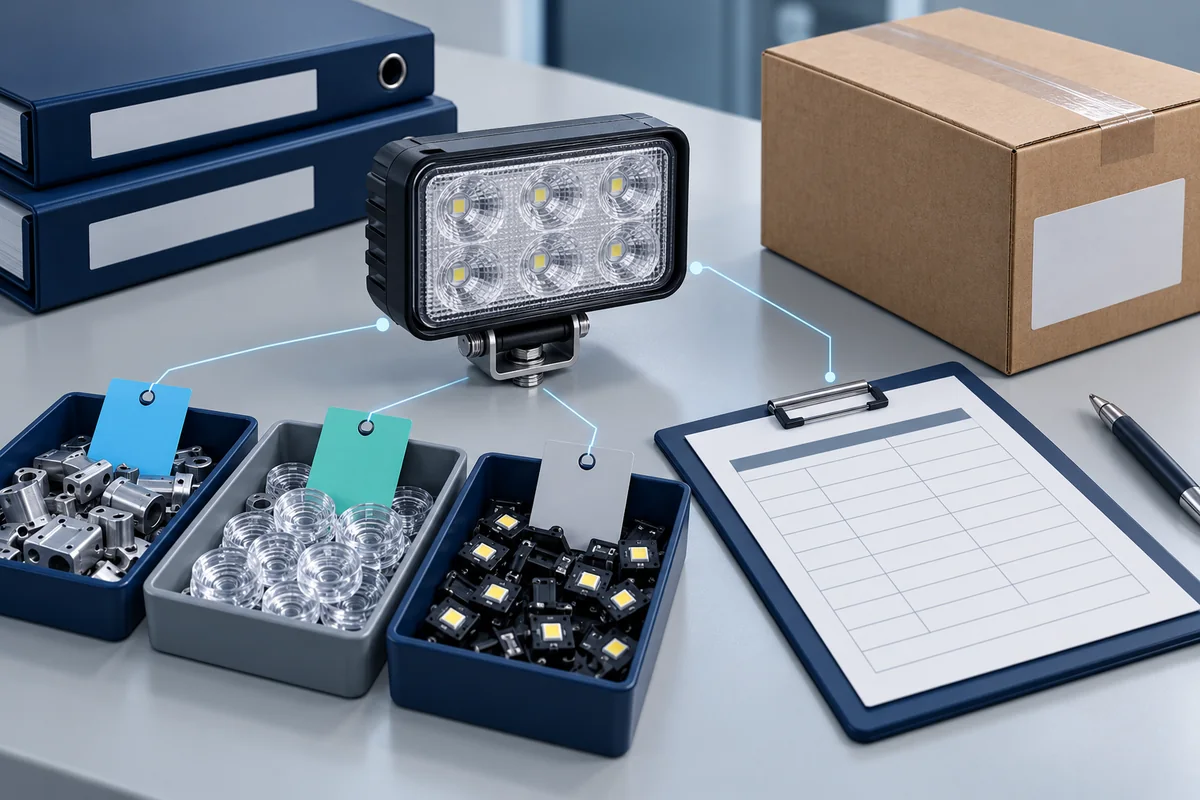
Review recent records showing acceptance limits, inspection results, lot identifiers, dates and responsible personnel. Request examples of rejected material, segregation, rework approval and final disposition. Trace a finished unit or batch back to its production records and relevant component lots, using a system appropriate to the product and contract.
Reliability testing and sampling
Request reliability evidence matched to expected use: thermal endurance, vibration, ingress protection, electrical conditions and optical stability where applicable. Confirm sample identity, test method, conditions, acceptance criteria and equipment calibration. A laboratory report for another model is not evidence for the configuration you plan to purchase.
Agree whether screening or aging is needed, which units it covers and how its settings were validated. Neither 100% aging nor a fixed two-to-four-hour duration is a universal standard for all automotive LED products. Excessive or unsuitable screening can also damage products.
AQL is an index used in acceptance sampling plans. The plan combines lot size, inspection level, sample size and acceptance or rejection numbers for defined defect categories. It is not the measured defect rate of the shipment and does not guarantee quality. Agree the sampling framework and separate treatment of safety-critical defects before inspection.
Corrective action and compliance evidence
Ask how complaints lead to containment, root-cause analysis, corrective action and effectiveness checks. Review an anonymized example if possible. Request relevant quality-system certificates and product evidence for the intended market, checking model, scope and applicability. DOT-related compliance, E-mark approvals, CE, RoHS and FCC requirements are not a single universal certification package for every LED product.
4. Evaluate Engineering and OEM/ODM Support
Technical communication and revisions
Bring a concrete requirement to the engineering team: an optical target, thermal packaging limit or vehicle electrical issue. Evaluate whether the supplier asks useful questions, explains tradeoffs and provides revision-controlled drawings or test data. Broad claims of universal vehicle compatibility should prompt application-specific validation.
For OEM/ODM projects, agree development stages, sample revisions, validation responsibilities and release criteria. Define who approves optical, thermal, mechanical and electrical changes. Private labeling can be simpler than a new product design, but artwork, installation instructions and packaging still require controlled approval.
Tooling, IP and documentation
Put tooling ownership, maintenance, access, storage and end-of-project arrangements in writing. Clarify rights to drawings, firmware, designs and pre-existing technology, alongside confidentiality and any exclusivity. Do not assume paying for tooling automatically transfers every intellectual-property right.
Request the documentation your purchasing and service teams need: specifications, dimensioned drawings, wiring information, installation limits, approved artwork and test summaries. Link documents to the released revision. Assess the supplier’s engineering capability against the specific project rather than treating an OEM/ODM label as proof.
5. Review Commercial Terms Before Paying a Deposit
Quotation, specification and timing
Obtain a written quotation identifying legal entities, model and revision, quantity, currency, unit price, MOQ, packaging and quotation validity. Attach agreed specifications and approved-sample references. Separate development costs, tooling, testing and freight from recurring product costs so the order has a clear basis.
Define when the lead-time clock starts and which approvals or materials it depends on. Request production and shipment milestones, with a process for communicating delay and recovery plans. MOQ and lead time vary by model, customization and sourcing conditions; a universal delivery promise is not a purchasing control.
Payment, delivery and inspection
Negotiate payment milestones against your exposure and verifiable progress. No single deposit/balance split suits every supplier relationship. Independently verify beneficiary information through a trusted channel, especially after a requested bank-detail change. Agree inspection timing, access, report recipients, release authority and the handling of failed inspection before final payment.
State the chosen Incoterms rule, named place or port and edition. Clarify transport, insurance and customs responsibilities, while addressing payment, title and acceptance separately in the contract. Confirm shipping documents and packing requirements. Consider independent pre-shipment inspection for new suppliers or high-risk orders; it complements process controls rather than guaranteeing every unit.
Warranty, disputes and change control
Define warranty coverage, exclusions, evidence requirements, claim deadlines and responsibility for freight, labor or replacement costs where relevant. Agree whether defects lead to repair, replacement, credit or another remedy, with response timelines. Warranty length and remedy terms are negotiated, not uniform industry constants.
Record governing law, dispute-resolution arrangements and escalation contacts with appropriate professional advice for the transaction. Require written approval for changes to components, software, manufacturing site, subcontractors or packaging that affect the agreed product. Define revalidation and cost responsibilities before a change reaches production.
6. Automotive Lighting Supplier Evaluation Checklist
Use this checklist as a release gate before sending a purchase order or deposit. Assign each item an owner, evidence reference, status and resolution date. Keep unresolved material issues visible; a completed checklist is useful only when its supporting evidence is credible.
- Company verification: confirm legal identity, factory address, contracting entity and verified payment beneficiary.
- Approved samples: retain identified reference units, evaluation records and signed acceptance criteria.
- Quality documentation: review inspection plans, lot records, traceability and corrective-action procedures.
- Relevant certificates: verify quality-system documents and model-specific evidence applicable to the intended market.
- Production capacity: confirm available model capacity, bottlenecks, component readiness and milestones.
- Product specifications: freeze model, revision, optical targets, electrical limits, fitment and approved changes.
- Purchase order terms: document price, MOQ, payment milestones, delivery rule and acceptance responsibilities.
- Packaging: approve artwork, labels, accessories, installation instructions and transport-protection requirements.
- Inspection plan: agree sampling, defect categories, functional checks, independent access and release authority.
- After-sales responsibilities: agree claim evidence, deadlines, remedies, costs and escalation contacts.
Key takeaway: Approve the product configuration and the evidence behind it together. Assign an owner to each unresolved issue and resolve material gaps before authorizing production or payment. Carry the approved criteria into the production inspection plan.
7. Supplier Evaluation Comparison Table
Use warning signs to trigger further investigation, not automatic conclusions about a supplier. Ask for evidence tied to your model and order. Record how each concern was resolved before approval.
| Evaluation Area | Warning Signs | Evidence to Request |
|---|---|---|
| Samples | Unidentified or unrepeatable sample configuration | Revision record, representative samples and documented evaluation results |
| Factory | Unclear production location or process ownership | Legal identity, process flow and site or independent audit evidence |
| Quality control | Generic certificates without model-specific records | Control plan, inspection results, traceability and corrective-action examples |
| Engineering | Universal compatibility claims without validation | Drawings, application test data and controlled sample revisions |
| Delivery | Capacity claims with no scheduling basis | Available model capacity, component status and order milestones |
| Payment | Unexplained beneficiary changes or unclear milestones | Verified beneficiary and written payment/release conditions |
| After-sales | Vague warranty or undefined replacement responsibility | Written claim process, remedies, costs and escalation arrangements |
8. How NVEL Supports B2B Bulk Orders
NVEL’s official factory page describes 25+ years of automotive lighting experience and presents ISO 9001 and IATF 16949 quality-system information. Request the current certificates and verify their validity, scope and supplying entity during qualification. NVEL’s manufacturing, OEM/ODM and technical communication services provide a starting point for project-specific discussions with importers, distributors, wholesalers and aftermarket brands.
For a potential bulk order, share target applications, market requirements, proposed quantities and customization needs. Discuss sample evaluation, specifications, documentation, inspection expectations and after-sales responsibilities with the NVEL team. Confirm commercial terms and project requirements in writing; quality-system certification does not replace approval of the specific product.
Review NVEL’s OEM/ODM automotive lighting solutions and automotive LED lighting products to frame your inquiry. Capacity, MOQ, lead time, payment terms and warranty arrangements should be confirmed for your actual order rather than inferred from general company information.
Frequently Asked Questions
How do I verify an automotive lighting supplier before a bulk order?
Verify the contracting entity and production location, evaluate representative samples, review quality and traceability records, confirm available capacity and agree written purchase terms. Use an independent audit where the order risk or lack of reliable evidence justifies it.
How many samples should I test?
Choose quantity based on product risk, variants, application coverage and supplier history. Development samples support technical evaluation but do not prove a future lot’s defect rate. Establish a separate production inspection and sampling plan.
Is an in-house SMT line always necessary?
No. A controlled, qualified subcontractor may produce suitable PCB assemblies. Verify process capability, subcontractor oversight, incoming checks and traceability. Judge the manufacturing arrangement against the product’s requirements rather than equipment ownership alone.
What quality records should a supplier provide?
Request relevant IQC, IPQC and final or outgoing inspection records, lot traceability, reliability reports, calibration evidence and examples of corrective action. Records should identify the model, revision, method, acceptance limits and results.
What does AQL mean in bulk inspection?
AQL is an index in an acceptance sampling plan. It helps select a plan alongside lot size and inspection level; it is neither the actual shipment defect rate nor a guarantee that every unit meets requirements.
Should I use third-party pre-shipment inspection?
Consider it for new suppliers, larger financial exposure or products with important acceptance risks. Define sampling, functional checks, documentation and shipment-release rules beforehand. Inspection cannot replace design validation or eliminate hidden defects.
What should be included in an automotive lighting purchase agreement?
Include legal parties, product revision, approved specifications, quantities, prices, delivery milestones, payment terms, Incoterms, inspection and acceptance procedures, packaging, warranty remedies, change control and dispute resolution. Allocate responsibilities explicitly and obtain appropriate advice for complex transactions.
Conclusion
Before approving a bulk order, verify the actual sample configuration, manufacturing arrangement, quality controls, engineering support and written purchase terms. Keep the evidence connected to the model and revision you intend to buy. Resolve material gaps before payment, and carry approved criteria into production inspection.
To evaluate an automotive lighting supplier effectively, treat approval as a sequence of evidence-based decisions rather than a price comparison. Explore NVEL’s product range and contact our team with your applications, specifications and evaluation needs. For related technical background, visit the Technical Guides Hub.
Ready to Discuss Your Next Automotive Lighting Bulk Order?
Share your product specifications, target market and purchasing requirements with NVEL. Discuss samples, OEM/ODM cooperation and the evidence needed for your bulk-order approval.