
TECHNICAL GUIDES · LICENSE PLATE LIGHTS
Automotive LED License Plate Lights: A B2B Sourcing Guide
Introduction
LED license plate lights are small automotive components, but their performance can affect rear registration plate visibility, vehicle compatibility, product reliability, and regulatory compliance.
For automotive distributors, aftermarket brands, wholesalers, and importers, choosing the right LED license plate lighting solution involves more than selecting a bright white LED. Buyers must evaluate optical distribution, vehicle fitment, electrical compatibility, water resistance, durability, and the documentation available for their target markets.
A poorly designed product may produce uneven illumination, dashboard bulb warnings, intermittent flickering, or moisture-related failures. These issues can lead to installation complaints, warranty claims, and higher after-sales costs.
This guide explains the key engineering and sourcing considerations for LED license plate lights, helping B2B buyers compare replacement bulbs, complete lighting assemblies, and potential OEM/ODM solutions.
Table of Contents
Quick Guide: Five Key Sourcing Considerations
1. What Are LED License Plate Lights?
2. LED Bulbs vs. Complete License Plate Light Assemblies
3. License Plate Light Regulations: FMVSS 108 and UN Regulations
4. Optical Design: Brightness, Uniformity, and Glare
5. Electrical Compatibility: BCM Monitoring and LED Flickering
Quick Guide: Five Key Sourcing Considerations
Understand the applicable requirements for rear registration plate illumination.
Evaluate how evenly the lamp illuminates the registration plate.
Assess BCM monitoring, flickering, and vehicle-specific warning messages.
Review sealing methods, ingress protection, and environmental testing.
Verify fitment, product documentation, sample performance, and quality consistency.
1. What Are LED License Plate Lights?
LED license plate lights are lighting devices designed to illuminate a vehicle’s rear registration plate, allowing its characters to remain visible under low-light conditions.
They are commonly installed above, beside, or within the rear license plate mounting area, depending on the vehicle design.
In the aftermarket, buyers typically encounter two main product categories:
- LED replacement bulbs: LED light sources designed to replace compatible incandescent bulbs within an existing license plate lamp housing.
- Complete LED license plate light assemblies: Integrated lamp units that may include the LED circuit board, optical lens, housing, electrical connector, and mounting features.
These product categories serve different distribution channels and involve different compatibility considerations.
A replacement bulb may offer a straightforward upgrade for an existing lamp housing. A complete assembly may provide greater control over optical distribution and sealing, but requires closer verification of vehicle-specific mounting and electrical interfaces.
Why Product Classification Matters
Before requesting quotations, buyers should determine whether they need a replacement light source, a complete lamp assembly, or a custom lighting product.
This distinction affects product specifications, testing, packaging, inventory planning, and regulatory documentation.
2. LED Bulbs vs. Complete License Plate Light Assemblies
Neither replacement bulbs nor complete LED assemblies are automatically superior in every application.
The appropriate solution depends on the original vehicle design, target market, installation requirements, and customer expectations.
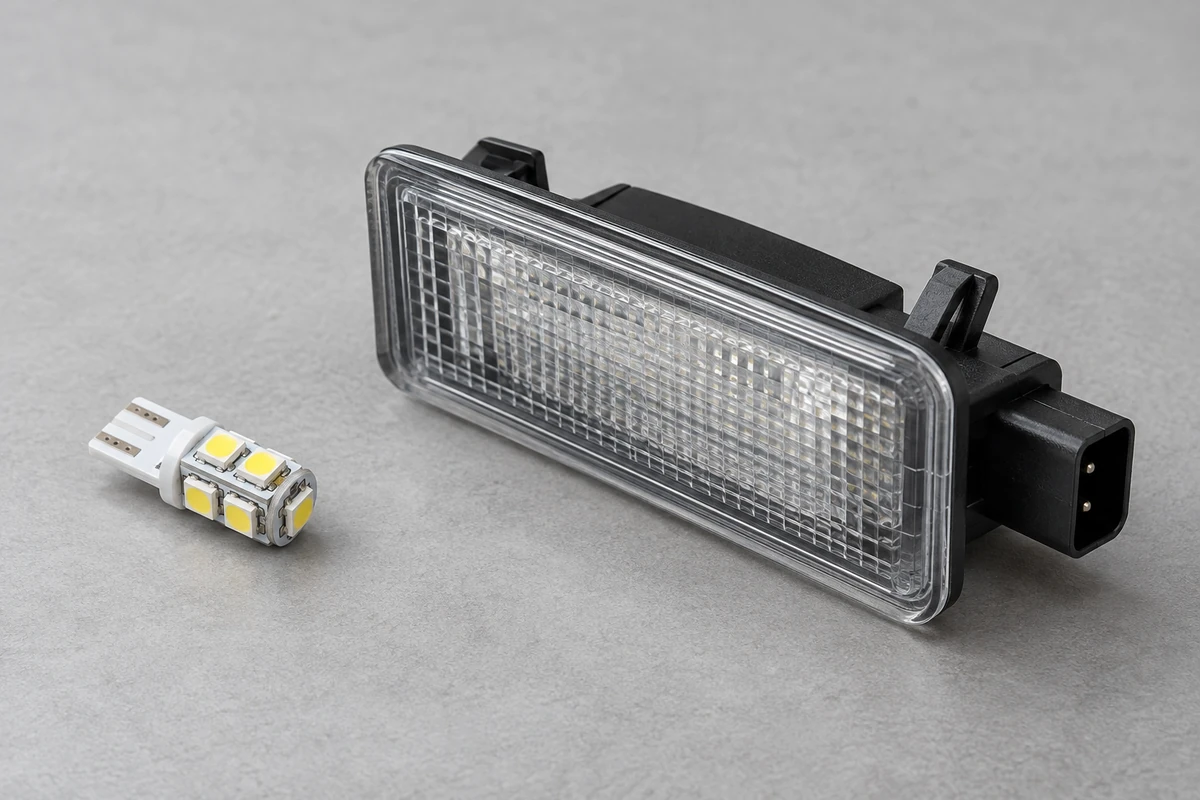
| Evaluation Factor | LED Replacement Bulbs | Complete LED Assemblies |
|---|---|---|
| Product format | Replacement light source | Integrated lighting unit |
| Vehicle fitment | Depends on bulb base, dimensions, polarity, and original housing | Depends on mounting geometry, connector, and vehicle application |
| Optical performance | Influenced by the original housing and reflector | Can be engineered as an integrated optical system |
| Electrical compatibility | Depends on vehicle monitoring and bulb electronics | Depends on integrated driver design and vehicle monitoring |
| Water resistance | Primarily influenced by the existing lamp housing and its seals | Influenced by assembly sealing, interfaces, and installation |
| Installation | May be simpler when the bulb is accessible | May require replacing the complete lamp unit |
| Inventory planning | Often organized by bulb format and application | Often organized by vehicle-specific part numbers |
| Typical sourcing focus | Dimensions, electrical behavior, brightness, and compatibility | Fitment, optics, sealing, connectors, and complete-unit validation |
When Replacement Bulbs Make Sense
Replacement bulbs may be suitable for distributors serving customers who want a compatible LED upgrade without replacing the original lamp housing.
However, bulb dimensions, socket fit, light distribution, and vehicle electronics must be checked carefully.
A bulb that physically fits the socket may still produce an unsuitable beam pattern or trigger a dashboard warning.
When Complete Assemblies Make Sense
Complete assemblies can be useful when buyers need an integrated solution with a defined housing, lens, connector, and mounting arrangement.
They may also support vehicle-specific product differentiation and private-label packaging.
However, buyers should not assume that every complete LED assembly offers better sealing, more uniform illumination, or error-free electrical performance. These characteristics require product-specific validation.
3. License Plate Light Regulations: FMVSS 108 and UN Regulations
Rear registration plate illumination is regulated in many automotive markets.
For B2B buyers, regulatory compliance should be evaluated before placing large orders, especially when products will be sold for public-road use.
United States: FMVSS No. 108
In the United States, Federal Motor Vehicle Safety Standard No. 108 establishes requirements for vehicle lamps, reflective devices, and associated equipment.
Registration plate lamps are subject to applicable requirements concerning illumination, color, installation, and performance.
Buyers should distinguish between a compliant complete lamp and an aftermarket replacement light source. Replacing the original light source can affect the performance of the installed lighting system.
A product’s white appearance or high brightness alone does not establish compliance.
European and UNECE Markets: UN R4 and UN R148
UN Regulation No. 4 historically addresses rear registration plate illuminating devices, while UN Regulation No. 148 consolidates requirements for several light-signalling devices, including rear registration plate lamps.
The applicable approval route depends on the product, market, regulatory version, and relevant transitional provisions.
Importers should request documentation that identifies the actual approved device and the regulation under which approval was granted.
What Buyers Should Verify
Before claiming that a license plate lamp is road legal, review:
- Applicable national or regional regulations
- Required light color and photometric performance
- Registration plate illumination and uniformity
- Relevant installation requirements
- Approval markings, where applicable
- Approval certificates and supporting documentation
- Whether the approval applies to the exact product configuration being purchased
An E-mark, DOT marking, or supplier statement should not be treated as universal proof of compliance across all markets.
Important: Color temperature, expressed in kelvin (K), is not interchangeable with regulatory color requirements. A nominal 6000K specification does not independently demonstrate that a lamp meets an applicable white-light color boundary.
4. Optical Design: Brightness, Uniformity, and Glare
The purpose of a license plate lamp is not simply to produce a large amount of light. It must illuminate the relevant registration plate area appropriately.
A very bright LED can still perform poorly if its light is concentrated in a small area.
Why Uniform Illumination Matters
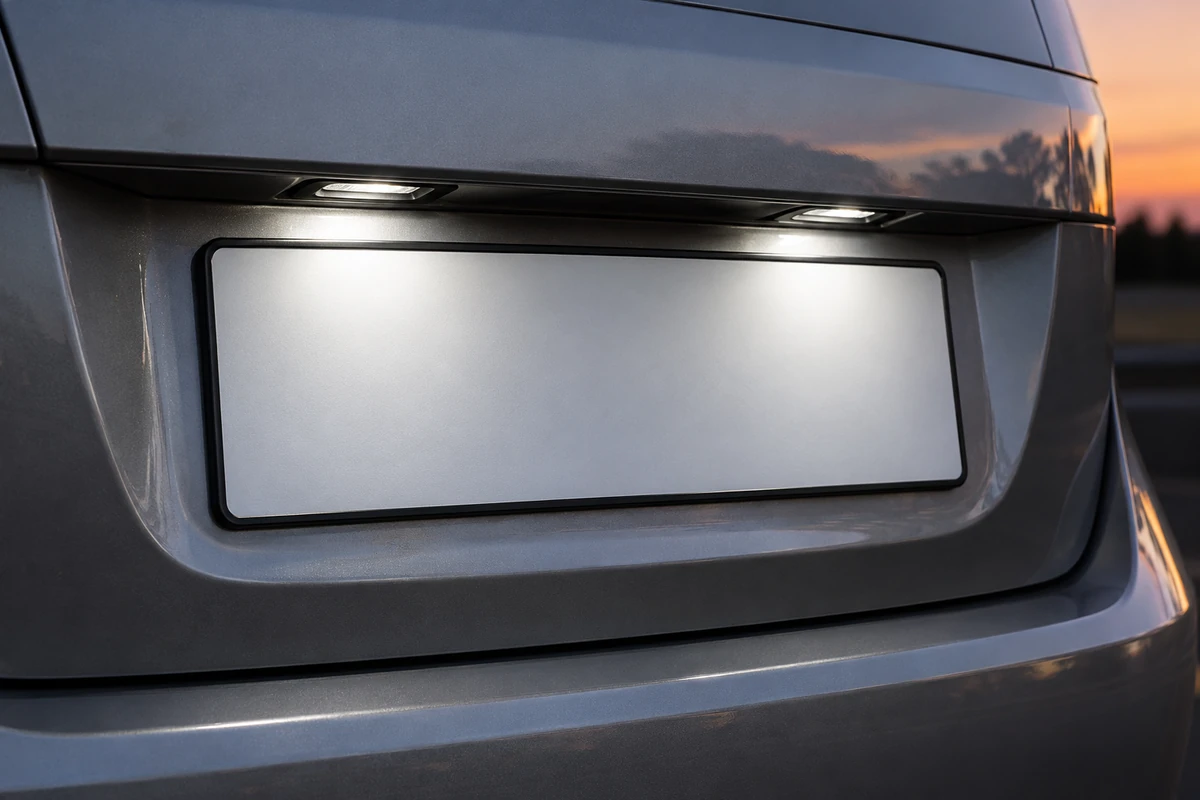
Uneven illumination may produce bright spots near the lamp and darker areas toward the edges of the plate.
This can reduce visual consistency and may affect compliance with applicable photometric requirements.
For integrated LED assemblies, manufacturers can influence light distribution through the arrangement of LEDs, lens geometry, housing design, and optical materials.
For replacement bulbs, the original housing also plays a significant role.
Common Optical Design Approaches
Diffusing lenses: Frosted or textured optical surfaces can help redistribute light and reduce visible point-source effects.
Prismatic optics: Engineered surface features can direct or spread light toward intended areas.
LED positioning: The location and orientation of LED emitters affect how light reaches the plate.
Housing geometry: Internal surfaces, openings, and mounting angles influence the final distribution.
There is no single beam angle that is appropriate for every license plate lamp.
The required optical design depends on factors such as plate dimensions, lamp placement, mounting orientation, and applicable testing requirements.
What Should Buyers Request?
For higher-value or regulated applications, consider requesting:
- Product-specific photometric data
- Test conditions and measurement geometry
- Sample illumination photographs
- Information about the intended plate size and mounting arrangement
- Confirmation of the tested product configuration
Visual appearance should be assessed alongside relevant measurements rather than used as a substitute for them.
5. Electrical Compatibility: BCM Monitoring and LED Flickering
Electrical compatibility is an important consideration when replacing incandescent license plate bulbs with LEDs.
Some vehicles use a Body Control Module (BCM) or related electronics to monitor exterior lighting circuits.
Because LEDs may draw less current and respond rapidly to electrical pulses, certain replacement products can trigger unexpected behavior.
Common Compatibility Problems
Dashboard bulb warnings: The vehicle may interpret an LED’s electrical characteristics as a lamp failure.
Intermittent flickering: Diagnostic pulses, pulse-width modulation, or driver behavior may cause visible flashes.
Polarity sensitivity: Some replacement products require a particular electrical orientation.
Voltage-related issues: Vehicle electrical systems experience operating conditions that should be considered during driver design and validation.
Is a “CANBus Error-Free” Label Enough?
No.
In aftermarket marketing, “CANBus compatible” or “error-free” often describes an attempt to address bulb monitoring or electrical compatibility issues.
It does not guarantee compatibility with every vehicle using a CAN bus network.
Compatibility depends on the vehicle’s monitoring strategy, circuit design, electrical thresholds, and the characteristics of the replacement product.
How Should Distributors Evaluate Compatibility?
Before bulk purchasing:
- Identify the target vehicle makes, models, and model years.
- Confirm the original lamp configuration.
- Test the replacement product under relevant operating conditions.
- Check for dashboard warnings and visible flickering.
- Record any vehicle-specific limitations.
- Request a supported fitment or compatibility list from the supplier.
External load resistors may address certain monitoring problems, but they can generate significant heat and require careful installation. They should not be treated as a universal solution.
6. Waterproofing, Corrosion Resistance, and Durability
License plate lamps operate in an exposed automotive environment.
Depending on their installation location, they may encounter rain, road spray, cleaning chemicals, vibration, temperature changes, and road salt.
A reliable product must account for both the lamp itself and the way it interfaces with the vehicle.
Understanding IP Ratings
Ingress Protection (IP) ratings describe protection against solid particles and water under specified test conditions.
For example:
- IP67: Includes dust-tight protection and protection against temporary immersion under defined test conditions.
- IP68: Includes dust-tight protection and protection against immersion under conditions specified for the rating.
These ratings should not be interpreted as guarantees against every real-world exposure.
In particular, IP67 does not automatically establish resistance to high-pressure water jets.
Buyers should confirm the exact tested configuration and conditions.
Sealing Methods and Design Considerations
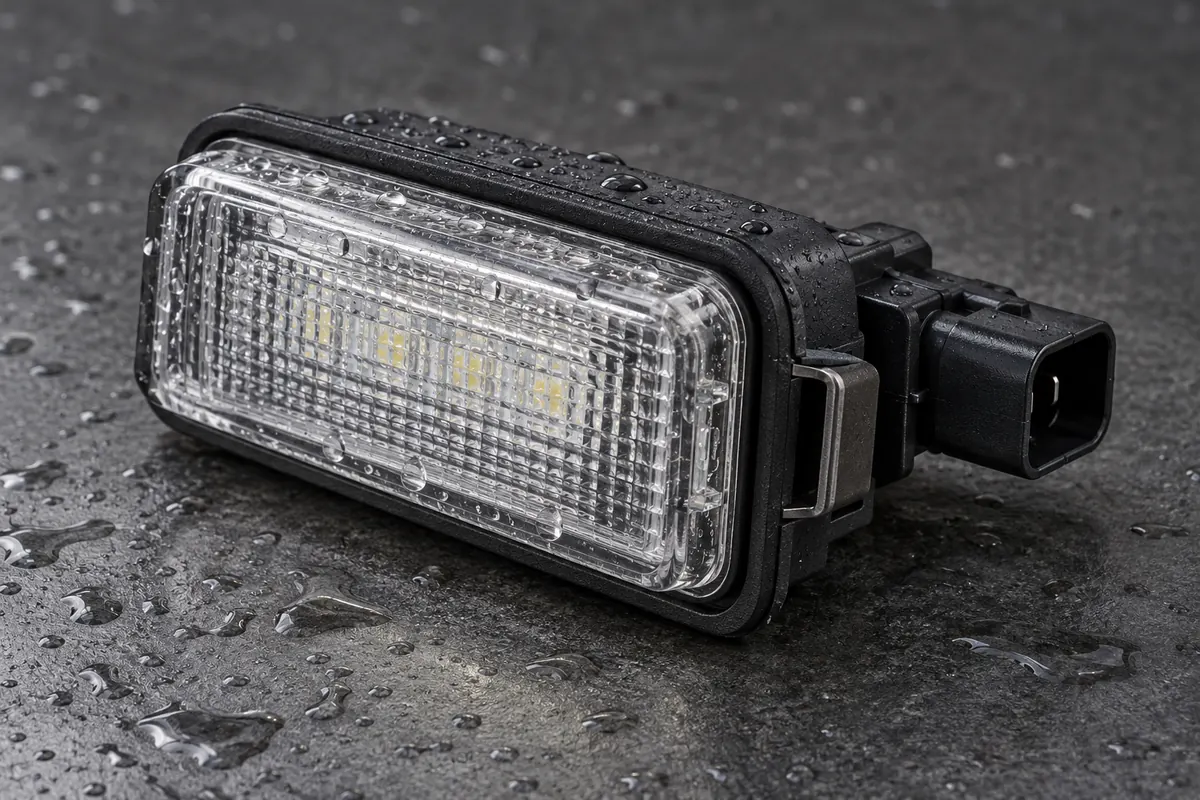
Depending on the product, sealing methods may include:
- Housing and lens joining processes
- Elastomeric gaskets
- Connector sealing
- Protective coatings or encapsulation
- Controlled assembly processes
No single method guarantees a waterproof product.
Sealing effectiveness depends on the complete design, material compatibility, production consistency, and installation conditions.
Beyond Water Resistance
B2B buyers should also consider:
Corrosion resistance: Contacts and terminals may be exposed to moisture and road contaminants.
Thermal performance: LED drivers and emitters must operate within their specified temperature limits.
Vibration resistance: Mounting features, connectors, and internal electronics should withstand expected vehicle vibration.
Material durability: Housings and lenses should be evaluated for relevant temperature, weathering, and chemical exposure.
Condensation behavior: Moisture or fogging should be investigated in relation to product design and test conditions rather than automatically attributed to a single cause.
7. How to Evaluate an LED License Plate Light Supplier
For distributors and brand owners, supplier evaluation should go beyond a product photograph and a quoted unit price.
A structured review can reduce uncertainty before the first bulk order.
B2B Sourcing Checklist
- ☐ Confirm product type: Replacement bulb or complete assembly.
- ☐ Verify vehicle fitment: Dimensions, mounting features, connectors, and applicable vehicle list.
- ☐ Review optical performance: Illumination coverage, uniformity, and applicable test results.
- ☐ Assess electrical compatibility: Operating voltage, driver behavior, BCM warnings, and flickering.
- ☐ Review environmental protection: IP test conditions, sealing design, and relevant durability evidence.
- ☐ Check compliance documentation: Applicable regulations, approval scope, and product identification.
- ☐ Evaluate samples: Test actual samples before committing to bulk orders.
- ☐ Confirm quality consistency: Agree on inspection criteria and handling of nonconforming products.
- ☐ Discuss packaging and labeling: Ensure the product can meet channel and market requirements.
- ☐ Clarify commercial terms: MOQ, lead time, sample availability, and after-sales support.
Ask for Evidence, Not Just Specifications
A supplier may advertise a product as waterproof, error-free, or compliant.
Buyers should ask what those statements mean for the exact product being offered.
Useful supporting information may include technical drawings, test reports, compatibility lists, product samples, and inspection criteria.
The goal is not to demand every possible test for every product. It is to select verification activities that match the intended application and purchasing risk.
8. OEM/ODM Customization and Bulk Ordering
OEM/ODM sourcing can help automotive lighting brands and distributors develop products for specific vehicles, markets, or distribution channels.
However, customization should begin with a clear technical and commercial specification.
Define the Product Requirements
Before requesting a quotation, prepare:
- Target vehicle applications
- Product type and intended installation
- Mechanical dimensions and connector requirements
- Electrical operating conditions
- Optical performance expectations
- Environmental and durability requirements
- Target market and applicable regulatory requirements
- Packaging and labeling preferences
- Estimated order volume and delivery schedule
A detailed requirement list makes it easier for suppliers to evaluate feasibility and identify areas requiring validation.
Typical Customization Areas
Depending on supplier capability and project scope, customization may involve:
Mechanical design: Housing dimensions, mounting clips, and connectors.
Optical design: LED placement, lens geometry, and illumination distribution.
Electrical design: Driver characteristics and vehicle-specific monitoring behavior.
Product appearance: Lens finish and external design details, subject to regulatory constraints.
Brand presentation: Packaging, product labels, instructions, and catalog information.
Not every customization is suitable for every existing product platform. Tooling, testing, approval requirements, and order quantities may influence project feasibility.
MOQ and Lead Time Considerations
Minimum order quantities can vary according to product type, customization level, component availability, tooling needs, and packaging requirements.
A standard replacement product may have a different commercial structure from a newly developed vehicle-specific assembly.
Rather than relying on a universal MOQ figure, buyers should request a quotation based on their actual specifications and estimated volume.
Sample Approval Before Mass Production
A practical sourcing process may include:
- Requirement confirmation
- Initial product or design review
- Sample preparation
- Mechanical and electrical fitment testing
- Optical and environmental evaluation, where applicable
- Approval of the final sample and specifications
- Production and agreed quality inspection
- Shipment and after-sales follow-up
The exact process should be agreed with the supplier before order confirmation.
9. Common Sourcing Mistakes to Avoid
Choosing Only by Brightness
Higher advertised brightness does not guarantee better registration plate illumination. Optical distribution and the installed configuration matter.
Assuming Universal Vehicle Compatibility
A matching connector or bulb base does not guarantee that the product will work without electrical warnings or fitment problems.
Treating IP Ratings as Unlimited Waterproofing
IP ratings apply to defined conditions. Buyers should review the test method and tested configuration.
Accepting Compliance Claims Without Documentation
A product should not be marketed as road legal solely because a supplier describes it as compliant.
Skipping Sample Validation
Sample testing helps identify issues before a large order, particularly when a product will be distributed across multiple vehicle platforms.
10. Frequently Asked Questions
Q1. Why do LED license plate lights flicker or trigger dashboard warnings?
Some vehicles monitor lighting circuits through electrical load measurements or diagnostic pulses. LED replacements may behave differently from the original incandescent bulbs, resulting in visible flickering or warning messages. Compatibility should be checked on the intended vehicle application.
Q2. Are LED license plate lights legal in Europe and North America?
Legality depends on the product, vehicle application, applicable requirements, and target jurisdiction. In the United States, FMVSS No. 108 is relevant. In UNECE markets, applicable requirements may involve UN R4 or UN R148. Buyers should verify the correct approval route and supporting documentation for the specific product.
Q3. Is a complete LED license plate light assembly better than a replacement bulb?
Not necessarily. A complete assembly offers an integrated design, while a replacement bulb may be more convenient for certain existing housings. Performance depends on optical design, electrical compatibility, sealing, and installation quality.
Q4. What color temperature is best for LED license plate lights?
A neutral-to-cool white appearance is common in automotive LED applications, but there is no universally ideal CCT for every product or market. Buyers should prioritize appropriate illumination, visual consistency, and compliance with applicable white-light color requirements rather than selecting a lamp by kelvin rating alone.
Q5. What is the difference between IP67 and IP68?
Both ratings include dust-tight protection, but their water immersion test conditions differ. IP68 conditions must be specified for the product. Neither rating alone establishes resistance to all cleaning methods or high-pressure water exposure.
Q6. Can LED license plate lights be customized for OEM/ODM projects?
Depending on the manufacturer’s capabilities, projects may involve changes to mechanical fitment, optics, electronics, packaging, or labeling. Buyers should confirm the supplier’s actual customization scope, tooling requirements, sample process, and applicable validation needs.
Q7. What should distributors check before placing a bulk order?
Distributors should verify product fitment, electrical compatibility, optical performance, environmental protection, relevant compliance documentation, sample quality, MOQ, lead time, and after-sales arrangements. The verification plan should reflect the intended vehicles and markets.
Conclusion: Source LED License Plate Lights With Confidence
Sourcing reliable LED license plate lights requires a balanced evaluation of optical performance, electrical compatibility, mechanical fitment, environmental durability, and market-specific compliance.
For B2B buyers, the most effective purchasing decisions are based on clear product specifications, relevant test evidence, and sample validation—not on brightness claims or marketing labels alone.
NVEL focuses on automotive LED lighting products and B2B lighting solutions for distributors, brands, and vehicle-related businesses. If you are evaluating license plate lighting products or exploring a customized project, our team can discuss your application requirements, target market, and sourcing needs.
You can also explore our range of LED license plate lights, which are popular among customers in European and North American markets. Our products offer practical lighting solutions for distributors and automotive aftermarket businesses looking to expand their product portfolios.