TECHNICAL GUIDES · WINTER LED LIGHTING
LED Headlights in Freezing Winter: Resolving Lens Icing and Snow Accumulation
Understand lens icing, heated covers, thermal pathways and winter sourcing requirements.
October 22, 2026 · 16 min read
Introduction
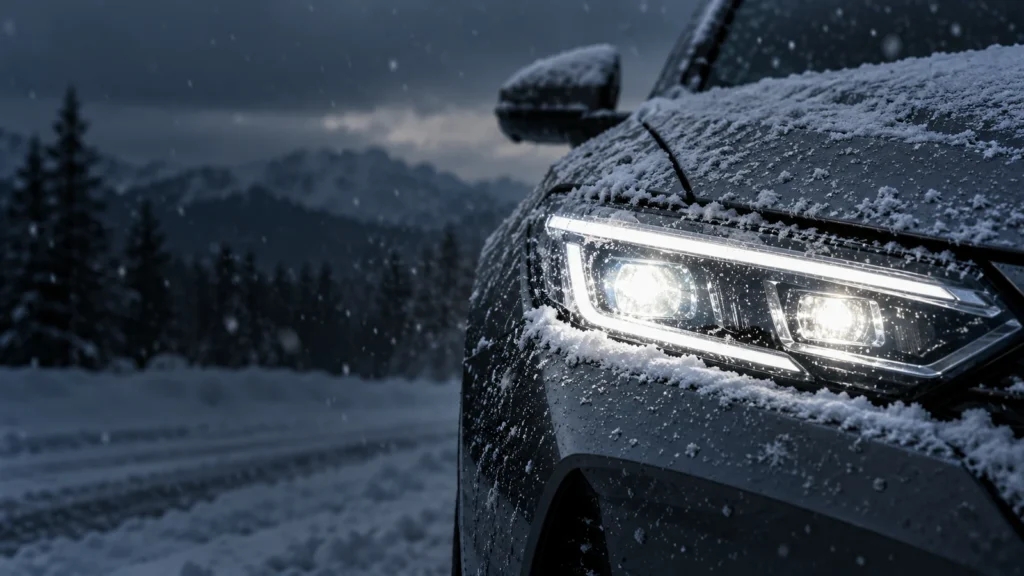
LED headlamps provide precise beam control and efficient illumination, but winter weather exposes a limitation that is easy to overlook in a warm-weather product demonstration. When heavy, wet snow, sleet or freezing rain strikes the front lens, the lamp may struggle to keep the optical surface clear. Snow or ice covering the lens can reduce useful light output and disturb the intended beam pattern, even if the LED light source and electrical driver remain fully functional.
This issue matters to distributors supplying northern North America, Scandinavia, Eastern Europe and high-altitude regions. It also affects fleet operators, snow-service vehicles and workshops selecting replacement lighting for winter duty. LED headlights in snow need to be evaluated as complete systems, not judged only by lumen claims or the brightness of an LED chip.
The key engineering question is not whether an LED produces heat. It does. The question is where that heat goes and whether enough thermal energy reaches the exposed lens under the actual weather and vehicle-speed conditions. This guide explains lens icing, heated-surface designs, heat redistribution, cold-weather electronics and the product-level evidence B2B buyers should request.
LED Headlights in Freezing Winter
QUICK GUIDE
LEDs generate heat, but the thermal path may deliver less passive warmth to the exposed lens.
Controlled heating near the optical cover requires optical, electrical and durability validation.
Reusing waste heat depends on lamp architecture and must protect LED operating temperatures.
Cold-start electronics, seals, vents and condensation need separate product-level checks.
Define test conditions, optical evidence, market requirements and change control before ordering.
1. Why LED Headlights Can Accumulate Snow and Ice
The difference between producing heat and warming the lens
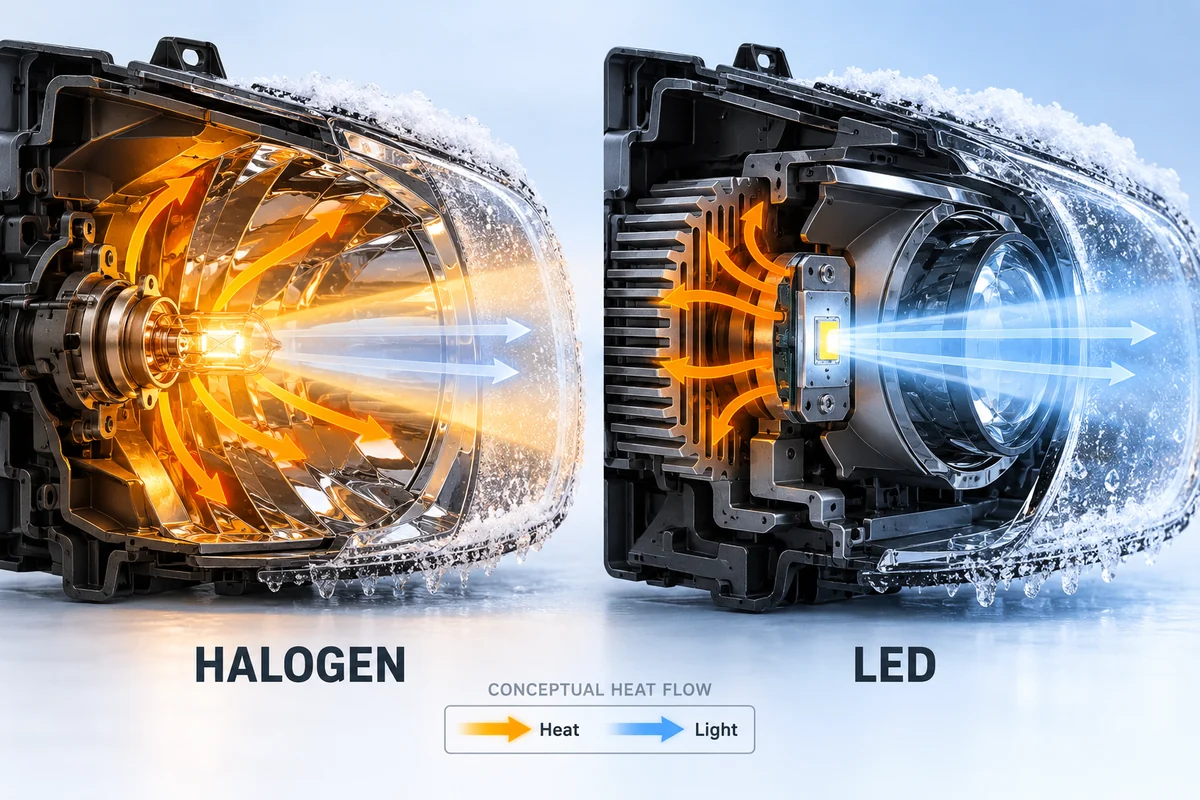
Traditional halogen lamps waste considerable electrical energy as heat, including thermal radiation originating near the light source. In a particular headlamp design, some of that energy can contribute to warming the front optical surface. High-power LEDs also generate substantial heat at their semiconductor junctions, but that heat is typically managed through a metal-core board, heatsink, housing or active cooling system. Relatively little infrared radiation travels forward with the visible light beam.
The result is not that every LED lens remains cold or that all halogen headlamps melt snow. Lens temperature depends on lamp geometry, internal airflow, ambient temperature, operating time, precipitation, vehicle speed and available electrical power. Nevertheless, LED architectures may have less passive lens-warming capacity, which can make winter snow accumulation harder to control.
How winter conditions affect usable illumination
Three related failure modes deserve separate attention:
- External snow or ice: Wet snow, freezing rain or slush can accumulate on the outer lens and obscure the optical exit area.
- Internal condensation: Moisture inside the housing can condense on a cooler internal surface. This is a humidity, ventilation and thermal-design problem, not the same as exterior icing.
- Cold-start electrical behavior: Low ambient temperatures and a weak battery during cranking can affect some driver components or control strategies. This must be evaluated independently of lens icing.
Obstruction at the front lens may scatter or absorb light and alter the intended distribution. No single percentage loss applies to every lamp or ice layer: loss depends on coverage, thickness, optical geometry and the condition of the snow or ice.
B2B takeaway: Ask for assembled-lamp winter tests, including photographs of lens coverage and photometric results before and after exposure. A room-temperature lumen figure does not answer this question.
2. Heated-Lens Technologies: Active De-Icing by Design
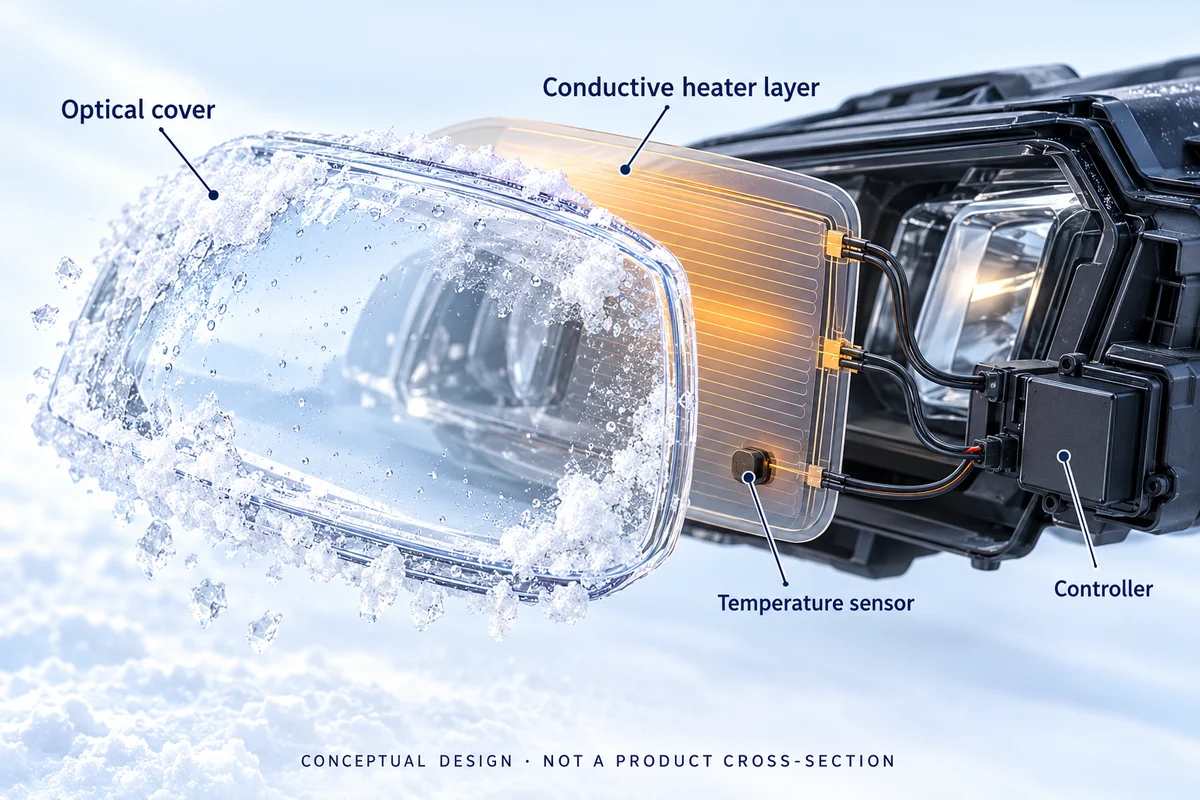
A purposeful heated-lens design adds controlled thermal energy where snow and ice accumulate: on or close to the optical cover. Depending on the lamp, heating may use fine resistive conductors, a transparent conductive coating, a bonded heater layer or another integrated element. These are engineering options—not features that every LED headlamp or replacement bulb includes.
Heating elements, optical quality and control
Transparent or fine-line heaters. Conductive coatings and micro-patterned resistive elements can distribute heat across selected regions of a compatible lens. The material and geometry must be evaluated for light transmission, haze, reflections and visible artifacts. It is not safe to claim that every transparent heater is shadow-free or provides a particular transmission percentage without optical measurements.
Temperature sensing and regulation. An electronic controller can use a thermistor or other sensor to decide when heating is useful. Activation thresholds, shutdown logic, current limiting and fault detection are product-specific design choices. A fixed temperature threshold quoted in promotional material is not sufficient proof of winter performance.
Electrical and mechanical integration. A heater adds power demand, electrical interfaces and potential failure modes. The design should be assessed for conductor fatigue, adhesive durability, thermal expansion, moisture entry, lens coating compatibility and serviceability. Heating elements must not impair required optical or electrical performance.
Vehicle-level testing. A heater that clears a stationary lens indoors may perform differently at road speed, when moving air removes heat and new precipitation continuously hits the surface. De-icing speed depends on ambient temperature, wind, ice thickness, heater power, lens geometry and control strategy. Ask for a documented test method rather than accepting a universal clearing time.
What a credible heated-lens test report should include
- Complete lamp model and hardware revision; exact heater configuration.
- Supply voltage and measured electrical consumption during the heating cycle.
- Initial ambient and lens temperatures, precipitation or ice application method, and thickness or mass of the deposit.
- Airflow or vehicle-speed conditions and the time-based clearing criterion.
- Beam or light-transmission assessment before and after heating.
- Endurance, cycling, electrical-fault and moisture-resistance results where relevant.
3. Forward Heat Transfer and Passive Snow-Management Strategies
A heater on the optical cover is not the only possible approach. A headlamp designer may seek to reuse heat already generated by the LED system and route a controlled portion toward the front lens, while still keeping LED junction temperature within safe limits.
Thermal pathways and trade-offs
Heat pipes or other conductive structures. Engineered thermal links may move heat from hotter regions toward the front housing or lens area. The benefit depends on contact resistance, mounting geometry and the available temperature gradient. This approach cannot be described as automatically eliminating icing or as having no engineering cost.
Internal airflow management. Controlled circulation may redistribute heat inside a housing, assisting defogging and surface temperature balance. Fans introduce their own concerns, including noise, reliability, contamination, power use and service life. Not all lamp housings can accommodate them.
Lens material, coatings and geometry. Surface finishes, hydrophobic treatments and the shape of the cover may influence how water or slush adheres and drains. A water-repellent coating is not equivalent to active ice melting and can degrade with abrasion or exposure to road chemicals.
Comparing winter lens-management approaches
| Approach | Main mechanism | Potential advantage | Important limitation | B2B evidence to request |
|---|---|---|---|---|
| Integrated resistive lens heater | Supplies heat near the exterior optical surface | Directly targets the accumulation zone | Adds electrical load and optical-integration challenges | De-icing tests, photometry, heater power and durability |
| Transparent conductive layer | Spreads resistive heating over a selected area | Can provide a visually discreet heating surface | Coating uniformity, haze and aging need validation | Optical transmission and cycling data |
| Forward thermal path / heat pipe | Redirects part of existing waste heat | May reduce dependence on a separate heater | Performance varies with thermal gradient and lamp architecture | Thermal model, cold-soak and lens-temperature tests |
| Internal circulation / heat exchanger | Redistributes housing heat | Can assist defogging and thermal balance | Adds complexity and may not clear external ice | Airflow, condensation and endurance testing |
| Surface coating or drainage design | Changes wetting and water-shedding behavior | Passive support measure | Cannot guarantee ice-free operation | Coating durability and realistic winter exposure data |
Engineering priority: Thermal performance at the front cover must not come at the expense of LED junction temperature, beam stability or the intended service life of the electronic driver.
4. Sub-Zero Drivers, Sealing and Condensation Control
Cold-weather readiness extends beyond the lens. A winter-duty headlamp contains electrical, mechanical and optical components that experience repeated temperature swings, wet conditions and road contaminants.
Cold starts and electrical components
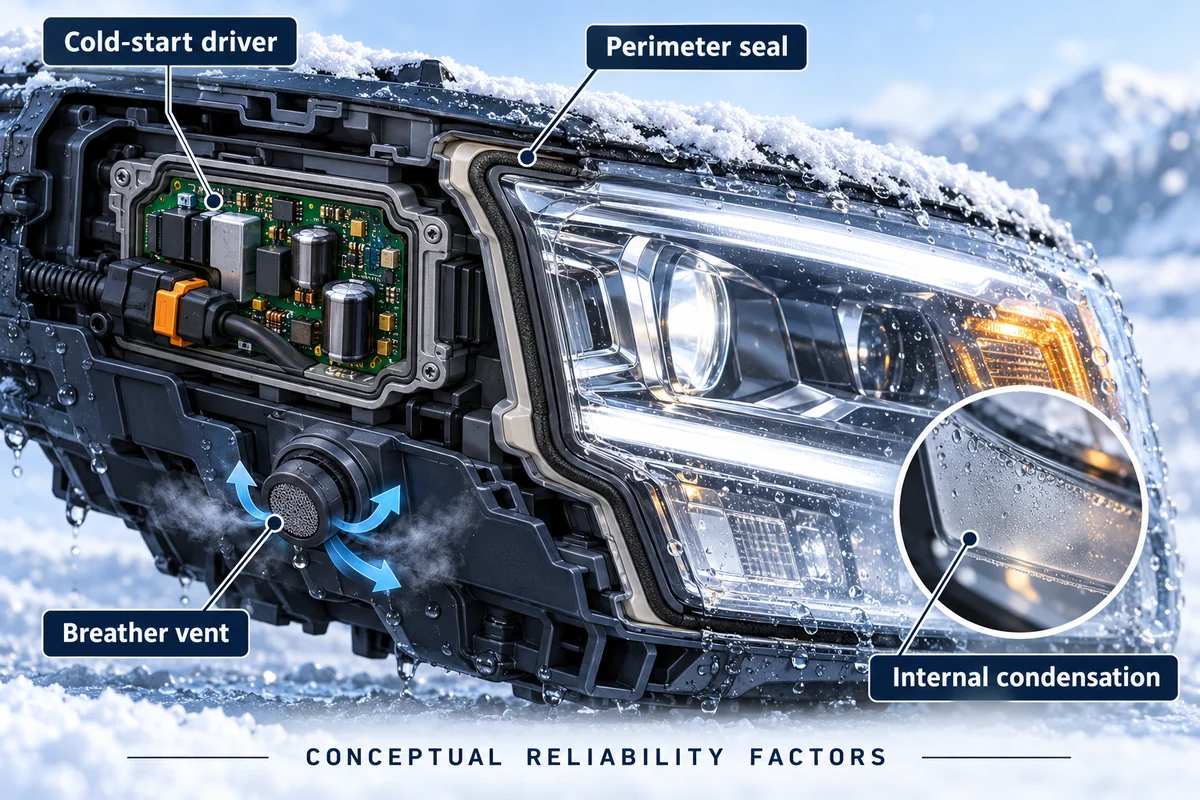
Electrolytic capacitors, semiconductors, connectors and other components have operating-temperature specifications that vary by part number. At low temperatures, capacitor characteristics such as equivalent series resistance may change, and batteries can deliver less voltage during engine cranking. These effects should be considered in the driver design and tested in the assembled system.
There is no universal rule that all electrolytic capacitors “freeze” or that only tantalum capacitors will work in winter. Buyers should request component ratings, cold-start behavior, output stability, protection operation and low-voltage recovery data for the actual driver used in a particular SKU.
Seals, vents and internal moisture
Polycarbonate lenses, seals, adhesives and housings expand and contract at different rates. Temperature cycling can stress joints and gaskets, while moisture may condense inside the lamp when the internal surface falls below the local dew point. Carefully engineered venting and moisture-management paths can reduce pressure differences and help manage condensation; a breather membrane alone does not guarantee a fog-free housing.
Ingress protection and low-temperature durability are different test questions. An IP rating addresses specified access and water/dust exposure conditions. Cold-soak, temperature cycling, high-pressure wash resistance and thermal shock require their own applicable tests. In particular, immersion conditions and high-pressure wash conditions should not be conflated.
For road-vehicle equipment, ISO 16750-4 describes climatic test considerations for applicable electrical and electronic systems, while ISO 20653 addresses automotive IP-code testing. Buyers should request the exact standard edition, test method, test severity and product configuration rather than accepting an unexplained “IP68 winter-proof” statement.
Optical and road-use considerations
Cold-weather attachments, supplemental heaters or replacement assemblies may affect approved headlamp photometry, lens materials and legal road use. Distributors should verify applicable requirements in destination markets and avoid promising that an aftermarket heating layer or replacement LED bulb is universally street legal. For the United States, the relevant lighting requirements include FMVSS No. 108; other markets have their own approval and installation frameworks.
5. B2B Sourcing Checklist for Winter Markets
For importers and private-label brands, the goal is to translate a broad promise such as “snow-resistant LED headlights” into product-level acceptance criteria. An effective supplier review should distinguish catalog specifications from tests performed on the actual production-representative assembly.
Pre-order technical verification
- Confirm the exact product type. Is the offer a complete headlamp assembly, a replacement LED light source, a dedicated work light or a separate heating accessory? Do not assume they share the same compliance route.
- Request cold-soak and thermal-cycling evidence. Specify expected destination-market temperatures and request tests for the complete assembled product under a recognized or documented method.
- Validate ice-clearing claims. Define ice or snow amount, ambient temperature, airflow, supply voltage, starting condition and objective pass/fail criteria before testing.
- Check optical effects of heating. Ask for beam pattern, lens transmission, haze and glare assessments after heater installation and durability cycling.
- Review driver behavior during cold starts. Request low-voltage, cranking recovery, current draw and protective-shutdown behavior for the actual driver configuration.
- Inspect seals, vents and coating durability. Verify condensation, water entry, salt exposure, lens abrasion and repeated freezing/thawing, with exact methods recorded.
- Verify installation fit and electrical interfaces. Confirm physical dimensions, connector type, current draw, fuse/wiring needs, housing clearances and vehicle-specific limitations.
- Review compliance evidence for each market. Separate optical approval, electrical/EMC documentation and environmental testing. Do not accept one as proof of another.
- Agree on sample inspection and change control. Fix the approved part number, materials, controller settings and production revision so that later shipments reflect the tested sample.
- Plan service and warranty support. Define failure reporting for lens damage, heating-circuit faults, condensation, driver resets and winter field returns.
Suggested procurement acceptance matrix
| Evaluation area | Question for the supplier | Acceptable evidence |
|---|---|---|
| Ice management | Under what exposure does the product clear or resist deposits? | Time-stamped test report with defined conditions |
| Optical performance | Does the heater or coating change the approved light distribution? | Before/after photometric and transmission data |
| Electrical robustness | Will the driver operate through cold starting and voltage fluctuation? | Electrical test report for the production configuration |
| Environmental reliability | How do seals and vents respond to cycling and wash exposure? | Cold/thermal cycling and applicable IP test records |
| Market suitability | Is the exact lighting product acceptable for its intended road use? | Market-specific approval and installation documentation |
Portfolio planning for northern regions
Not every customer needs an active heated lens. Segment offers by use case: standard passenger vehicles, remote-route fleet vehicles, snow-removal equipment and off-road/work-light applications. The required beam, mounting arrangement, serviceability and legal status can differ substantially. A product that performs well as a work lamp cannot automatically be marketed as a road-approved headlamp.
Distributors should also distinguish products that are currently manufactured and validated from proposed custom-development capabilities. If a supplier offers a heated-lens project, ask whether it is an existing production SKU, an engineering sample or an untested concept.
Frequently Asked Questions
Q1. Why do some LED headlights collect more snow or ice than halogen lights?
LED headlamps usually manage semiconductor heat through heatsinks and other thermal paths, with less forward infrared radiation than a traditional filament source. Depending on the complete lamp design, the outer lens may receive less passive heat. Wet snow or freezing rain can then persist on the lens. The effect varies by vehicle, weather and lamp architecture; not all LED lamps behave the same way.
Q2. How quickly can a heated LED headlight lens remove ice?
There is no universal clearing time. Performance depends on heater power, lens area, ice thickness, ambient temperature, airflow and the test’s definition of “clear.” Ask the manufacturer for an actual test report with stated conditions, rather than relying on an advertised number of minutes.
Q3. Will transparent lens heaters affect the beam pattern?
They may, depending on the conductive material, wire geometry, optical position and aging behavior. A well-integrated design aims to limit transmission loss, haze and unwanted shadows. The correct way to confirm performance is through photometric and optical testing of the finished assembly.
Q4. Do heated lenses consume additional battery power?
Yes. An electrically heated lens draws power when its heating circuit is active. Consumption varies by heating area, conductor design, control logic and vehicle supply voltage. Request actual operating power, peak current, duty cycle and any additional harness or fuse requirements for the relevant model.
Q5. Is lens fogging inside the headlamp the same problem as exterior ice?
No. Exterior snow and ice develop on the exposed optical surface. Internal fogging is condensation of moisture within the housing and requires attention to moisture ingress, venting, temperature gradients and housing design. A surface heater may affect internal conditions but does not by itself solve every condensation problem.
Q6. Does IP68 prove that a headlamp is reliable at -40°C or during hot-pressure washing?
No. An IP rating addresses defined ingress exposures, not all climatic or electrical operating conditions. Low-temperature performance, thermal cycling, immersion and high-pressure cleaning should be assessed using the standards and test conditions appropriate to the specific product and intended market.
Q7. What should B2B buyers ask NVEL about winter-market lighting?
Buyers can share the target vehicle or application, destination market, winter temperature profile, expected snow/ice exposure, requested lighting type and anticipated order quantity. NVEL’s team can then discuss product options or sourcing requirements and identify which specifications, test reports and customization services can be documented for the selected model. Availability of heated-lens products, exact IP ratings and test qualifications must be confirmed for each SKU before they are advertised.
Conclusion: Specify Winter Readiness, Not Just Brightness
Reliable winter lighting requires more than high output from an LED chip. Lens temperature, snow accumulation, optical performance, electronic cold-start behavior, moisture management and market-specific compliance must be evaluated together. Active heating, forward heat transfer and passive surface measures each offer potential benefits, but none is an automatic guarantee of a clear headlamp under every storm condition.
For distributors and private-label buyers, the strongest sourcing strategy is to demand repeatable, product-specific evidence: defined cold-weather tests, before-and-after optical performance, environmental durability, power consumption and accurate installation information. That evidence supports better product selection, clearer customer expectations and fewer preventable warranty disputes.
Explore NVEL Automotive LED Lighting Products
Tell NVEL about your target region, winter-use application, required lighting category, vehicle platform, anticipated order quantity and any verified cold-weather performance criteria. Our team can discuss applicable product and sourcing options and confirm which specifications and testing records are available for the models under consideration.
Technical and regulatory note: This guide provides general lighting engineering and sourcing information. Product performance, cold-weather capabilities, safety, compatibility and compliance must be verified for the specific light assembly, vehicle configuration and destination market. Images illustrating heaters or thermal paths are conceptual unless identified as photographs of a verified production model.