TECHNICAL GUIDES · AUXILIARY & SIGNAL LIGHTING
Modern Automotive Auxiliary LED Lighting: DRLs, License Plate Lights, and Signal Optics
Evaluate DRL optics, plate illumination, signal behavior and vehicle-specific electrical compatibility.
October 22, 2026 · 13 min read
Introduction
LED headlights and projector modules attract most of the attention in vehicle lighting upgrades, but smaller lamps perform essential daily functions. Daytime running lights (DRLs) help make vehicles more conspicuous, license plate lamps illuminate the rear registration plate, and turn signals and side markers communicate vehicle presence or intended movement. For distributors and aftermarket brands, these applications also create multiple opportunities for model-specific replacement parts and auxiliary lighting product lines.
Engineering requirements differ substantially from one function to another. A DRL requires a recognizable, controlled luminous appearance; a license plate lamp must illuminate the specified plate area without unwanted glare; and a direction indicator must maintain the correct color, intensity distribution and flashing behavior. An LED assembly that simply fits a socket may still deliver poor optics or trigger a vehicle’s lamp-failure monitoring system.
This guide explains the practical differences among auxiliary LED applications, why bulb-out warnings and hyperflashing can occur after a retrofit, how DRL light guides and compact diffusers are evaluated, and what B2B buyers should request before committing to a product line. The aim is to support technically defensible sourcing decisions rather than assume that any product advertised as “CANBus-ready” will work on every vehicle.
Quick Guide: Automotive Auxiliary LED Lighting
Specify DRLs, plate lamps and signals by their distinct optical function and installation requirements.
Separate BCM load detection, hyperflashing and PWM flicker before choosing a vehicle-specific solution.
Evaluate guide uniformity, plate coverage, signal color and viewing angles in the installed lamp.
Verify the complete housing, joints and connector; ingress tests do not prove unlimited durability.
Request SKU-level fitment, diagnostic, optical, thermal and regulatory evidence before bulk approval.
1. Auxiliary LED Applications and Product Segmentation
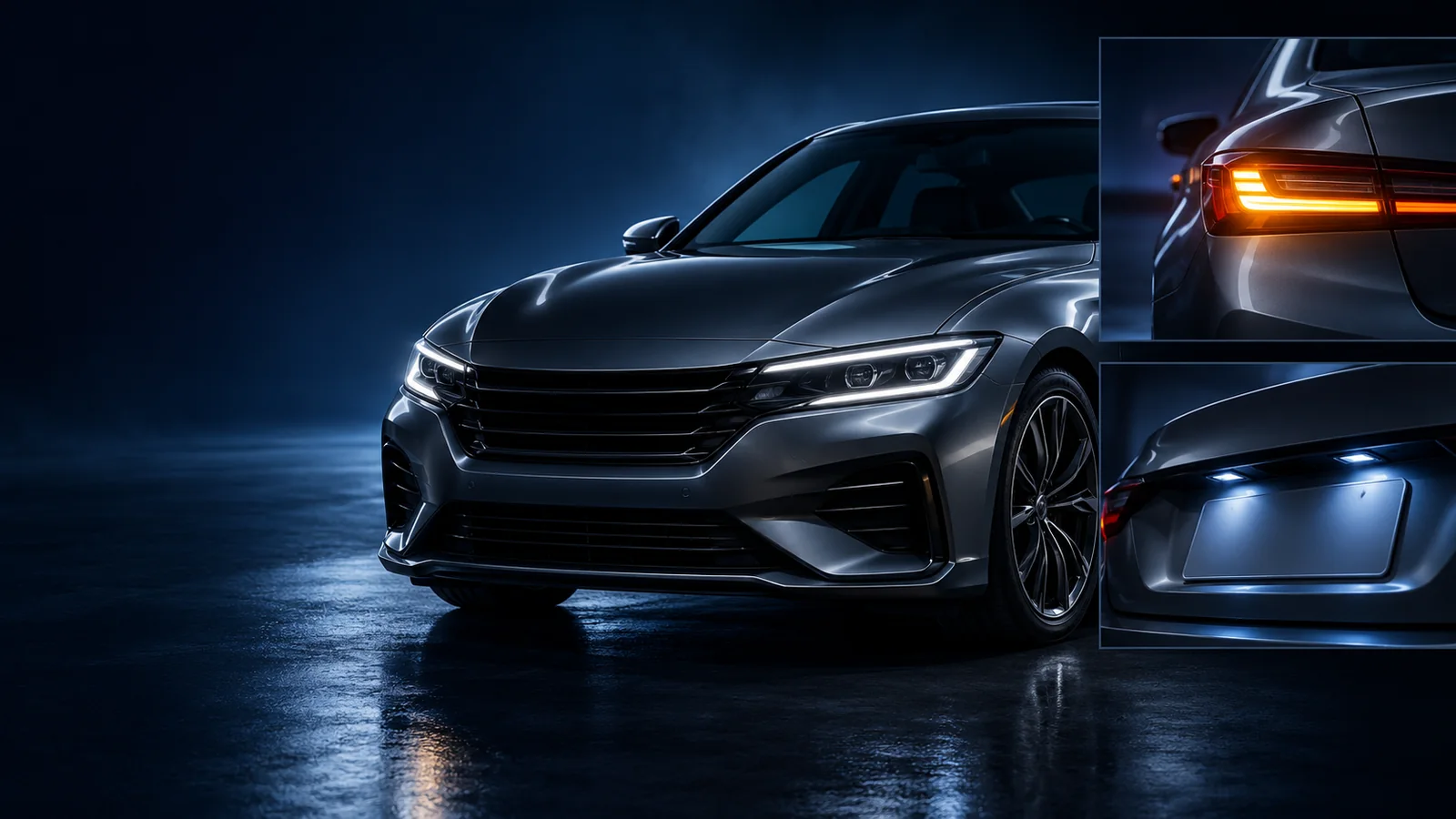
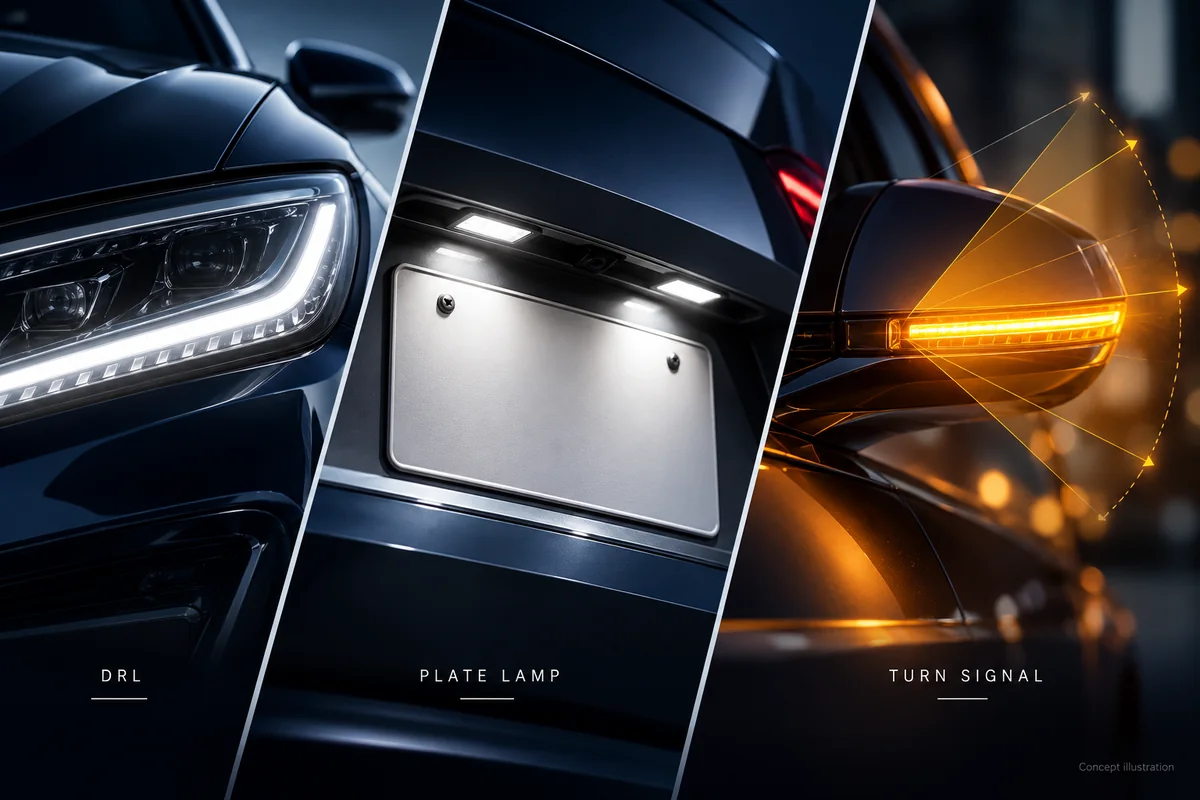
Auxiliary automotive lighting encompasses several distinct devices. Their physical size may be small, but they are not interchangeable simply because they use similar LED packages or connectors.
Daytime Running Lights: Conspicuity and Recognizable Appearance
DRLs are designed primarily to increase the visibility of a vehicle to other road users during daylight. Dedicated DRL assemblies may use multiple LEDs behind diffusers, shaped reflectors or polymer light guides to create a continuous luminous signature. Depending on the vehicle and applicable rules, a DRL may switch off, dim or change operating mode when other exterior lighting is activated. The behavior must be checked for each vehicle and target market rather than treated as universal.
A DRL should not be marketed as a substitute for a low-beam headlamp. Brightness alone does not demonstrate conformity: optical distribution, mounting position, operating logic and interaction with turn indicators may all matter.
License Plate Lamps: Uniform Coverage and Controlled Spill
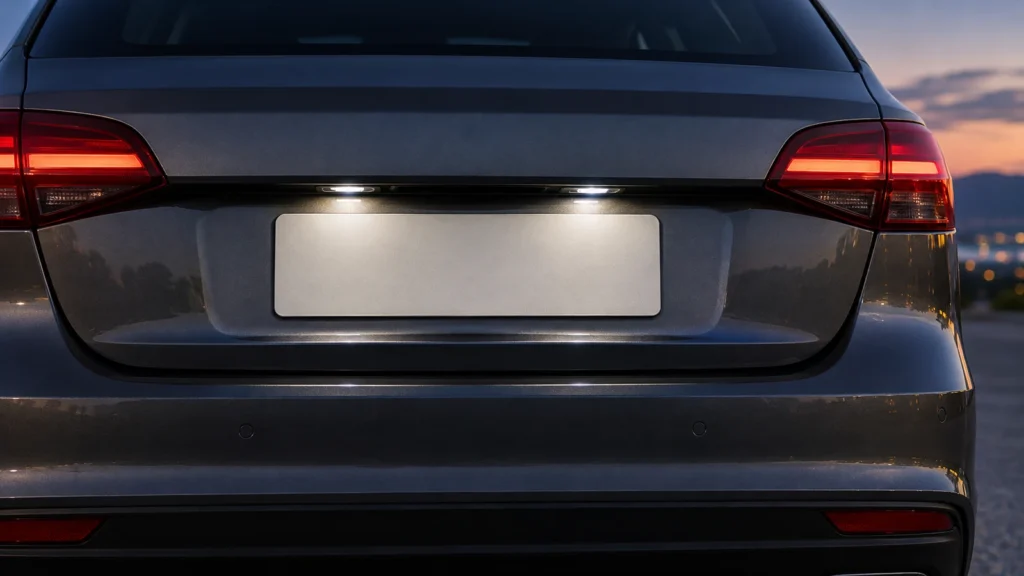
Rear license plate lamps illuminate the registration plate so it can be read under prescribed conditions. Uniformity across the relevant plate area, appropriate light color and minimal objectionable spill are more useful acceptance criteria than an unqualified claim such as “360-degree brightness” or “6000K maximum output.” The right optic may use a diffuser, reflector or carefully oriented LEDs depending on lamp geometry.
For a focused procurement review, see our LED license plate light sourcing guide. For distributors, it is important to distinguish a replacement rear plate-illumination lamp from a license plate frame with an integrated auxiliary LED light bar. They are different products and should not be assumed to satisfy the same lighting function or regulatory requirements.
Turn Signals and Side Markers: Visibility, Color and Flash Behavior
Direction indicators need a clearly distinguishable flashing signal at the required viewing angles. Side marker functions and colors depend on vehicle location and destination-market rules. Some replacement LED lamps operate within an existing approved optical housing; complete signal assemblies have additional optical and installation responsibilities.
An LED’s rapid electrical response does not, by itself, prove that the finished lamp meets photometric or flash-frequency requirements. Product selection needs to consider the full lamp-and-vehicle system.
Product-Family Selection Table
| Application | Main purpose | Optical checks | Electrical / installation checks |
|---|---|---|---|
| DRL | Daytime vehicle conspicuity | Intensity distribution, uniformity, color, effective illuminated area | Operating mode, dimming or deactivation, vehicle integration |
| Rear license plate lamp | Plate legibility | Illuminance and uniformity across the plate area; controlled spill | Plate size, geometry, mounting, polarity, connector |
| Turn signal | Indicate intended turn or lane change | Color, angular visibility, intensity and flash presentation | Flash rate, fault detection, load and vehicle logic |
| Side marker / position lamp | Vehicle presence and outline indication | Appropriate location-specific color and distribution | Housing position, harness, sealing, vehicle compatibility |
2. Bulb-Out Warnings, Hyperflashing and Electrical Compatibility
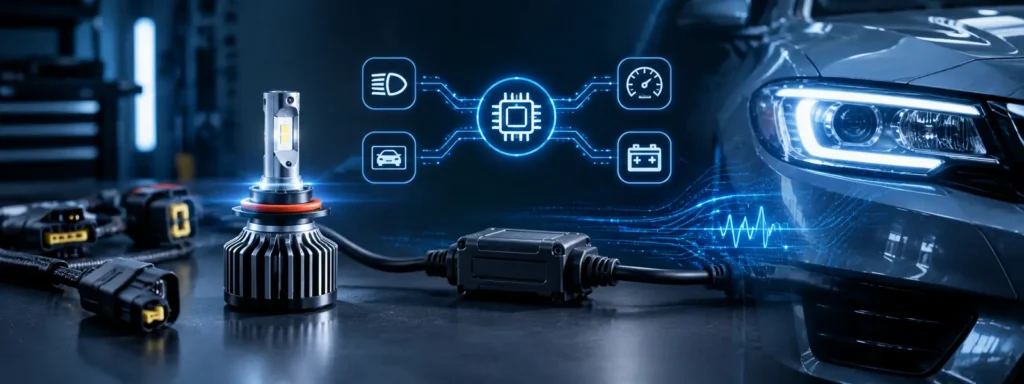
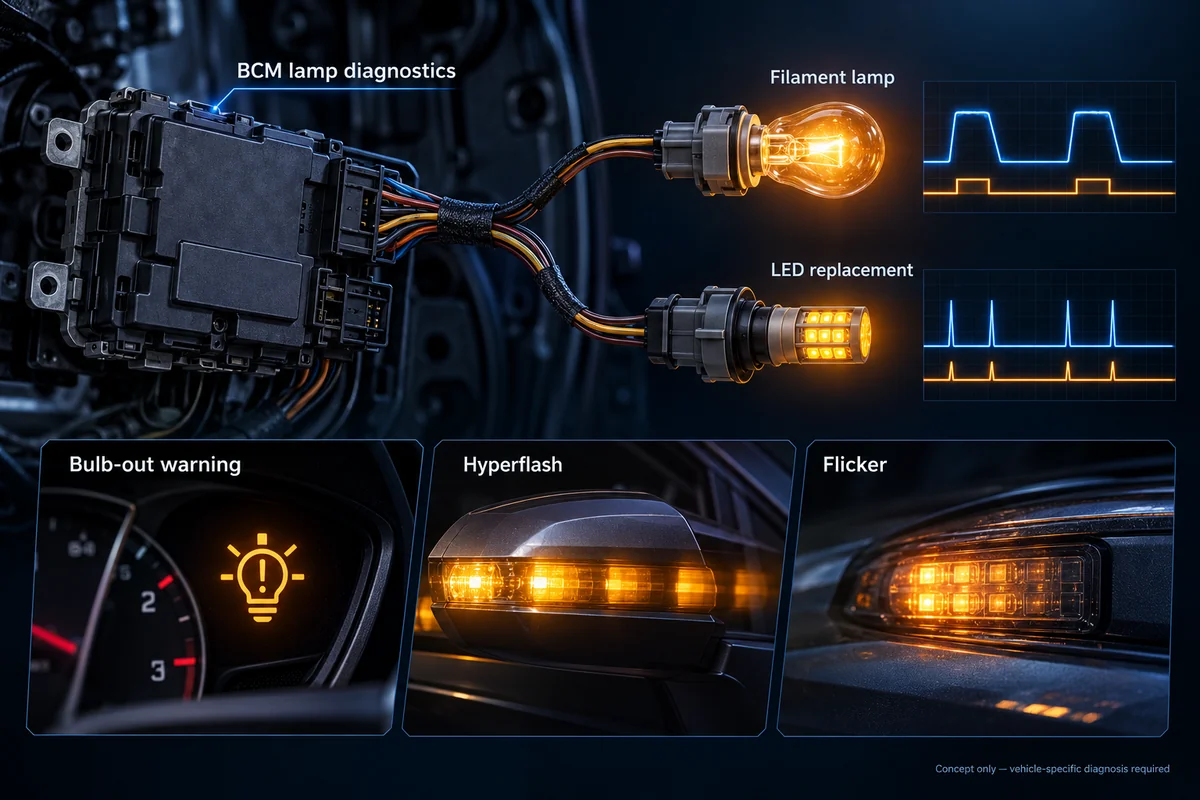
A filament lamp and an LED replacement can draw different amounts of current even when both fit the same socket. Some vehicles monitor lamp circuits by measuring current, voltage or a response to diagnostic pulses. A body control module (BCM), an electronic flasher or another control unit may interpret a low-current LED as an open circuit or failed bulb. The result can be a dashboard bulb-out warning, an unusually fast indicator flash rate, intermittent flashing or visible flicker.
These symptoms do not necessarily mean that the LED communicates directly on the vehicle’s CAN network. Buyers searching for CANBus LED signal lights will often encounter the aftermarket label “CANBus-ready”, which typically describes an attempted compatibility feature rather than a standardized electrical protocol or a guarantee of successful installation.
Three Problems That Need Different Diagnoses
Bulb-out warnings. A control unit may compare the lamp circuit against calibrated load or diagnostic thresholds. A replacement LED with different current characteristics can fall outside the expected range, but damaged wiring, connector resistance or an actual lamp fault can generate similar warnings.
Hyperflashing. The turn indicator may flash more quickly when the vehicle detects a failed lamp or unexpectedly low electrical load. Some vehicles use flasher electronics; others use BCM-based logic. Diagnose the actual system before selecting a corrective accessory.
Flicker or glow when nominally off. Cold checks, pulse-width modulation (PWM), leakage current, supply ripple or driver incompatibility can create visible pulses or residual glow. Not every flash or flicker is evidence of a communication-network fault.
Engineering Options and Trade-Offs
Vehicle-specific LED driver designs, verified load-management modules, suitable electronic flashers or approved control-unit settings may address particular compatibility problems. External load resistors can also be used in some systems, but they dissipate real heat and must be electrically and thermally specified, installed away from heat-sensitive materials, and checked for their effect on fault detection. They are not a universal plug-and-play remedy.
A buyer should ask for a compatibility matrix identifying vehicle platform, production year, lamp position, original bulb type, tested replacement SKU and observed warning / flash behavior. Marketing labels alone are not adequate evidence. See also our CANBus LED headlight compatibility guide for related vehicle-system checks.
3. DRL Light Guides, Plate Illumination and Signal Optics
Small LED emitters are highly directional point sources. Optical design is therefore needed to turn a cluster of individual light sources into the required luminous appearance without objectionable hot spots, dark segments or uncontrolled stray light.
PMMA and Polycarbonate Light Guides
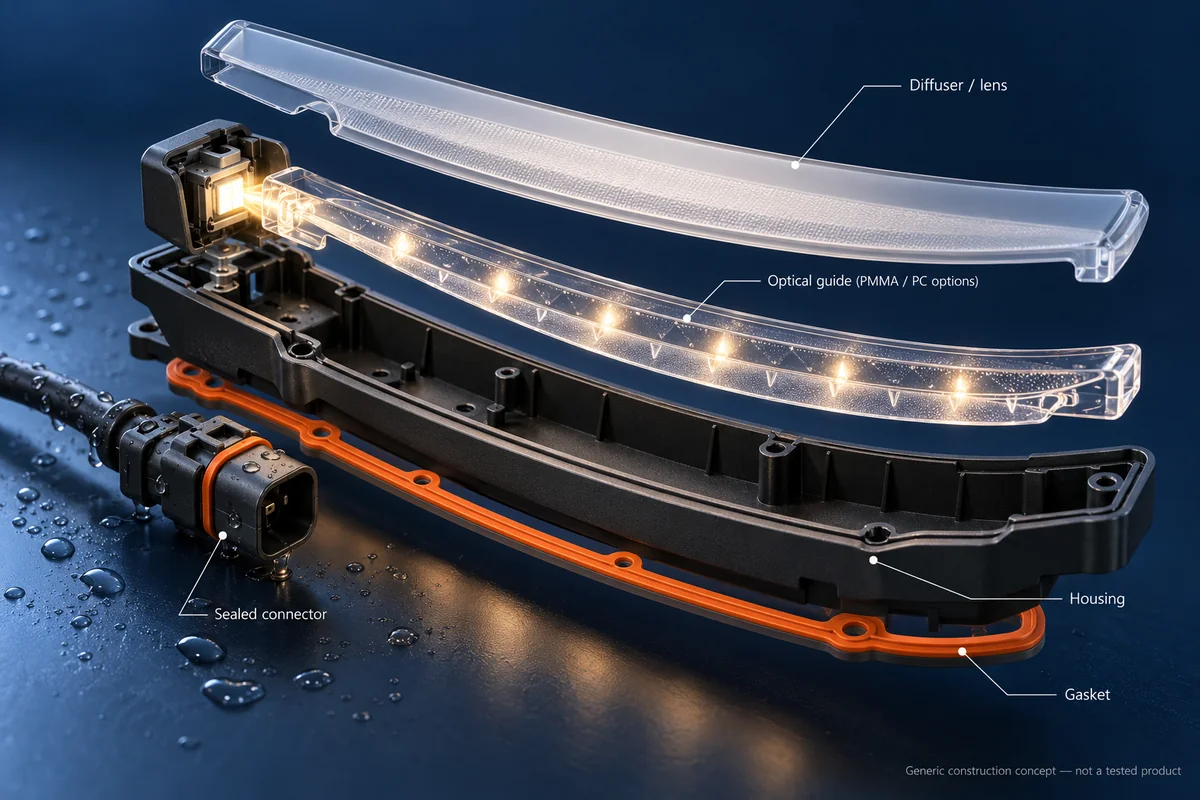
DRL designers commonly consider optical-grade PMMA or polycarbonate (PC) for light-guide and diffuser components. The material choice depends on optical transmission, weathering, operating temperature, impact resistance, geometry and manufacturing constraints. Extractor features, surface textures and local optics distribute light along a guide; their placement needs to be verified through optical simulation and physical measurements.
A continuous-looking light bar is not necessarily an approved DRL. Photometric performance must also be verified at the specified test points and in the installed configuration.
License Plate Optics: Coverage Before Maximum Brightness
For plate illumination, a controlled spread of light is more valuable than a simple claim of maximum lumens. Too narrow a beam can leave unreadable corners; too much spill can create visual distraction. Buyers should request a test report or measured coverage on the designated plate format, with photos showing the actual installed position and mounting angle.
A direct-fit product still needs vehicle-specific clearance, latch, gasket and wiring validation. The existence of an original-equipment-shaped connector does not guarantee correct plate illumination or lawful use in every market.
Indicators: Color, Viewing Angles and Thermal Stability
Signal-optic evaluation should cover the required color range, brightness at prescribed horizontal and vertical angles, appearance during flashing and behavior after warm-up. LEDs and small drivers produce heat; a compact lamp can suffer output changes or premature failures if heat has no adequate escape path.
Engineering Comparison: Basic Retrofit vs. Application-Validated Design
| Engineering area | Basic replacement approach | Application-validated approach |
|---|---|---|
| Optics | Bright LED emitters with limited distribution control | Designed light guide, diffuser or reflector validated for the actual function |
| Electrical behavior | Fits the connector and illuminates | Tested against relevant vehicle diagnostics, PWM and flash logic |
| Thermal design | Minimal heat-spreading provisions | Temperature, driver and light-output stability checked in the enclosure |
| Sealing | Claimed from material or component alone | Complete assembly and interfaces tested under defined conditions |
| Fitment | Bulb type or physical envelope only | Vehicle / year / trim / lamp-position matrix with installation checks |
| Compliance evidence | Generic “E-mark” or “DOT” marketing label | Device-specific documentation for target markets and applicable functions |
4. Sealing, Condensation and Corrosion Resistance
License plate lamps and bumper-mounted auxiliary lights can be exposed to road spray, cleaning agents, salt, thermal cycling and mechanical vibration. Long service life depends on the entire assembly: lens, body, seal, connector, cable entry, fasteners and pressure-management features where used.
Ingress Protection Is a Tested Assembly Property
An IP rating, such as IP67, describes specific dust and water ingress test conditions for the product and configuration assessed. It should not be interpreted as a blanket guarantee against all high-pressure washing, long-term immersion, condensation or corrosion. If a supplier quotes IP67 or IP68, request the test standard, tested specimen, conditions and exact SKU. Water sealing and corrosion resistance require separate evidence.
Lens Joining and Moisture Management
Ultrasonic welding, adhesive bonding, gaskets and potting can be useful construction methods, but none is inherently best for every assembly. Lens-to-body joints may fail after thermal expansion, improper assembly or mechanical damage. Some sealed housings use vent membranes to manage pressure differences; these do not automatically remove every condensation risk.
Corrosion, UV and Vibration Testing
Appropriate validation may include salt-spray exposure, UV aging, temperature cycling, connector corrosion inspection and vibration testing. Acceptance criteria should reflect the actual application rather than arbitrary “pass” claims. Visual appearance should be assessed alongside electrical continuity, lens clarity, seal integrity and photometric performance.
5. Regulatory Requirements and Market-Specific Fitment
DRLs, direction indicators, position lamps and registration plate lamps have distinct legal functions. In UNECE markets, UN Regulation No. 148 covers specified light-signalling devices and consolidates several earlier device regulations; historic approvals may refer to earlier rules such as R4, R6, R7 or R87. Installation requirements, including switching behavior and lamp placement, must also be reviewed under the relevant vehicle-level regulations.
In the United States, FMVSS No. 108 specifies requirements for applicable lamps, reflective devices and associated equipment. A claim such as “DOT approved” should not substitute for checking the actual legal certification framework, correct marking, permitted function and the exact product configuration. Standards and legal use must be checked for the destination market and vehicle.
For complete assemblies, distributors should verify applicable documentation and marking. For replacement LED bulbs, they should also determine whether that specific retrofit is permitted in the original lamp housing. Mechanical fitment alone does not establish regulatory compliance.
6. B2B Sourcing and Quality-Control Checklist
Before committing to an auxiliary LED product family, buyers should obtain representative samples and validate the installation, function and supporting documentation for their intended market.
☐ Define the actual lamp function. Separate DRLs, rear registration plate lamps, turn signals, position lamps and side markers in the product catalog rather than grouping them under one generic “signal light” specification.
☐ Confirm exact fitment. Record bulb base or assembly part number, vehicle/year/trim, connector polarity, mounting clearance and housing geometry; validate each advertised cross-reference.
☐ Check diagnostic behavior. Test for bulb-out warnings, hyperflashing, PWM flicker and residual glow on the actual target vehicle; document conditions and results by SKU.
☐ Measure photometric performance. Obtain function-specific color and distribution data, including license plate illumination coverage or DRL / indicator measurements where applicable.
☐ Review thermal behavior. Check LED and driver temperatures, light output after warm-up and any heat introduced by external load-matching accessories.
☐ Verify sealing and materials. Request specimen-level ingress, thermal cycling, UV and corrosion results appropriate to the installation location and claimed rating.
☐ Check regulatory evidence. Confirm applicable UN / FMVSS requirements, approval or conformity records and markings for the exact device, market and use case; do not rely on generic badges.
☐ Audit packaging and traceability. Require a clear installation guide, application list, batch identification, warranty process and controlled revision history for OEM/ODM or private-label orders.
For brand owners, the strongest supplier comparison is based on SKU-level test evidence, documented fitment and reproducible quality, not unsupported promises of “error-free CANBus” or “universal compatibility.”
Frequently Asked Questions
1. Why do some LED turn signal bulbs cause hyperflashing?
Some vehicles interpret the lower current draw of a replacement LED as a failed filament bulb and alter the flash rate as a warning. Depending on the design, the detection may be performed by the BCM, an electronic flasher or another circuit. Correcting the behavior requires a vehicle-specific diagnosis and compatible solution.
2. What does “CANBus-ready” mean for an auxiliary LED bulb?
It is a common aftermarket compatibility label, not a standardized guarantee. It may indicate a modified driver or load-management design intended to work with certain vehicle monitoring systems. Ask for the tested vehicle list and evidence of actual warning-free and stable operation.
3. Why might an LED license plate lamp flicker after installation?
Possible causes include lamp-check pulses, PWM-driven supply behavior, residual current, poor wiring connections or a driver that is unsuitable for the vehicle. The source of the flicker should be measured rather than automatically blamed on the CAN network.
4. What is the difference between a DRL light guide and a diffuser?
A light guide transports and distributes light along a designed shape, often using optical extraction features. A diffuser spreads incident light to improve luminous appearance. Assemblies may use both. The finished optical design still requires application-specific photometric validation.
5. Does IP67 mean an auxiliary LED lamp can withstand any winter road condition?
No. IP67 refers to defined ingress tests, not universal resistance to pressure washing, road salt, condensation or aging. Confirm the exact tested assembly, test conditions and additional environmental validation relevant to the installation.
6. Are H8/H11-style or T10-style LED replacements automatically legal in signal and plate lamp applications?
No. A compatible base or connector does not, by itself, make an LED retrofit suitable or legal for a particular lamp function. The device or replacement must meet the requirements applicable to the vehicle, function and destination market.
7. Which specifications matter most when sourcing LED license plate lamps?
Review plate illumination distribution and uniformity, required color, actual mounting geometry, connector and polarity, diagnostic behavior, moisture protection, material durability and the documentation supporting any claimed compliance.
8. How can NVEL support B2B buyers evaluating auxiliary LED products?
NVEL serves automotive lighting distributors and brand owners with product selection and OEM/ODM discussions. Buyers can share the intended application, vehicle or assembly reference, destination market, requested features and test requirements so the appropriate available products, documentation and customization feasibility can be confirmed before an order is placed.
Conclusion: Source Auxiliary LED Lighting by Function, Not by Label
A successful auxiliary lighting portfolio requires more than bright, compact LEDs. DRLs depend on controlled luminous appearance and switching behavior; rear license plate lamps demand suitable plate illumination; and turn signals require correct optical presentation and stable vehicle-system operation. In each case, electrical compatibility, sealing and market requirements need to be validated for the exact product and installation.
For B2B distributors and private-label brands, a function-by-function specification, a verified application matrix and credible test records reduce compatibility problems and make product ranges easier to support. These checks are particularly important where products are marketed using broad terms such as “CANBus-ready,” “waterproof” or “plug-and-play.”
Explore NVEL Automotive LED Lighting Products
Tell NVEL about your target market, auxiliary lighting application, vehicle or assembly reference, anticipated order quantity and branding requirements. Our team can discuss suitable available products, documentation and OEM/ODM options.
Technical and regulatory note: Product compatibility, lighting performance, permitted usage and applicable regulatory approvals must be verified for the specific lamp, vehicle, product version and destination market.