

TECHNICAL GUIDES · MATRIX ADB
Matrix ADB (Adaptive Driving Beam) Technology: Optical Precision and Smart Micro-LED Arrays
Understand adaptive beam control, Micro-LED and DMD optics, vehicle integration and B2B engineering checks.
October 22, 2026 · 12 min read
Introduction
Automotive headlamps are evolving from fixed-beam devices into electronically controlled systems that adapt their light distribution to the traffic scene. Matrix ADB headlights—systems using adaptive driving beam (ADB) technology—can reduce illumination in selected regions where other road users are detected while retaining useful forward lighting elsewhere.
That capability depends on much more than the LED emitter. Effective ADB requires a coordinated optical system, a reliable perception and control chain, calibrated vehicle integration, and compliance with the rules of the intended market. Digital light sources such as addressable Micro-LED arrays and digital micromirror devices (DMDs) offer different ways to achieve fine-grained beam control, each with different optical and engineering trade-offs.
For automotive lighting brands, distributors, engineering teams and OEM/ODM buyers, understanding those trade-offs is essential before treating matrix lighting as a commercially ready product category. This guide explains the operating principles, compares Micro-LED and DMD architectures, reviews camera and lighting-ECU integration, clarifies the US and UN regulatory frameworks, and provides a practical sourcing checklist.
Matrix ADB Headlight Engineering
QUICK GUIDE
Selectively reduce light toward detected road users while retaining useful illumination elsewhere.
Compare emitting pixel arrays with reflective micromirror projection engines.
Validate perception, beam planning, control interfaces, diagnostics and calibration.
Check FMVSS 108 or applicable UN R149 and R48 requirements for the exact system.
Review optical evidence, reliability, software ownership, traceability and commercial support.
1. How Matrix ADB Headlights Work
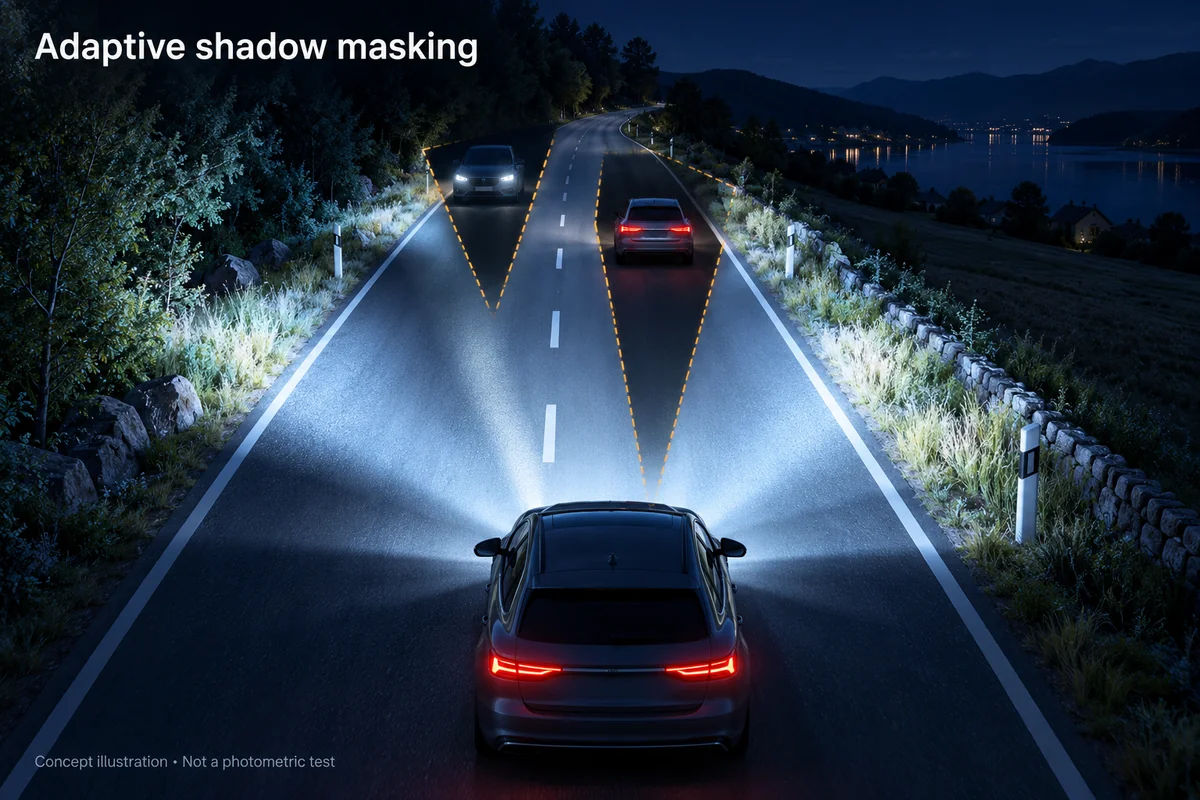
A conventional automatic high-beam (AHB) system typically changes between broad high-beam and lower-glare passing-beam operation in response to detected traffic. An ADB system does something more selective: it dynamically modifies parts of the driving-beam distribution to limit illumination toward other road users while preserving additional light where permitted and useful.
A simplified operating chain is:
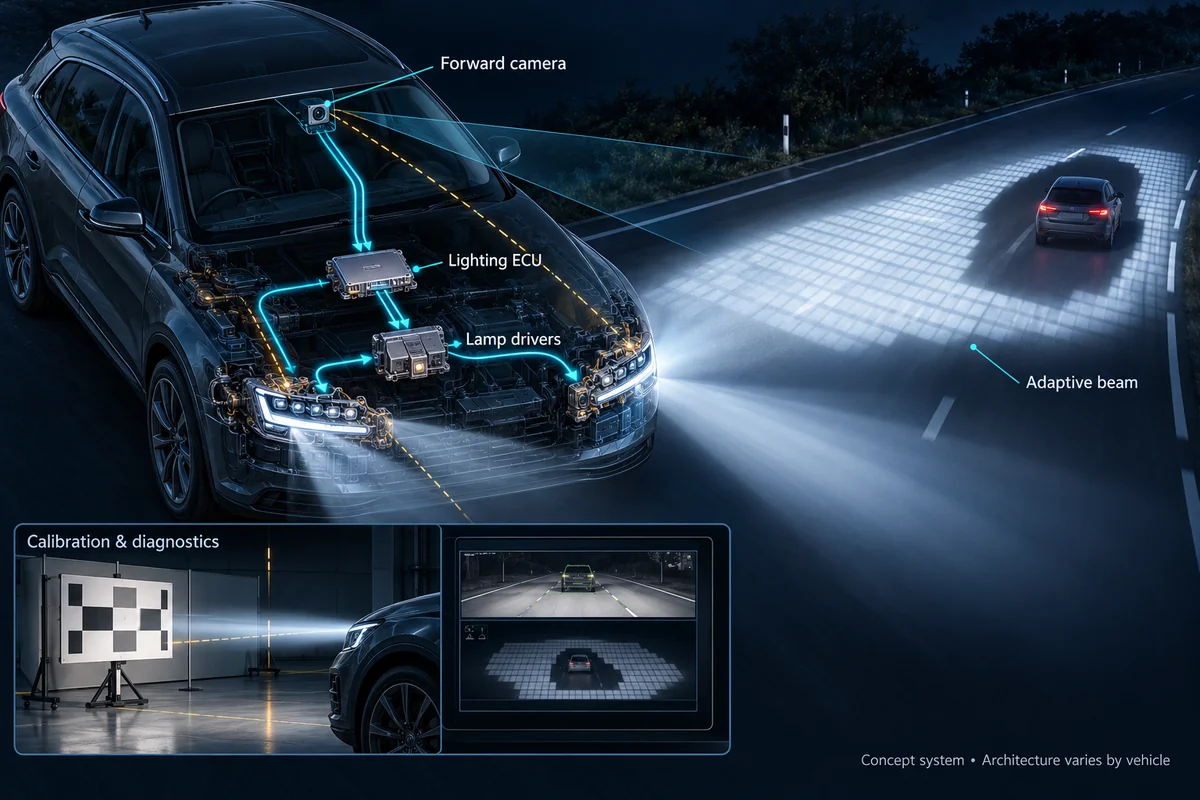
Forward-looking camera or other available scene input → perception and object tracking → vehicle/lighting controller → addressable light segments or spatial modulator → projected beam pattern.
The vehicle-side communication interface depends on the architecture. CAN, CAN FD, Automotive Ethernet and dedicated links may be involved, but no single bus or sensor combination defines every ADB system.
Selective glare control, not guaranteed “zero glare”
When the vehicle detects oncoming or preceding traffic, the control system estimates where light should be limited and commands a suitable dimming zone. Systems with more independently controllable elements may form more detailed masks, but useful performance also depends on optical resolution, calibration, response time, sensing quality and beam-control algorithms.
The expression glare-free high beam describes the design intent—not a guarantee that glare never occurs. Camera occlusion, weather, roadway geometry, bright reflections or incorrect calibration can affect recognition and beam response. A correctly designed system needs safe fallback behavior when sensor or actuator information becomes unreliable.
What a buyer should measure
A marketing video showing moving dark zones is not sufficient proof of performance. Ask for photometric evidence under the specified operating modes, tested glare-control behavior for oncoming and preceding road users, beam transitions, failure diagnostics and documented calibration procedures. Beam control must be evaluated at vehicle/system level, not inferred from the number of LEDs alone.
2. Micro-LED Arrays vs. DMD Projection Optics
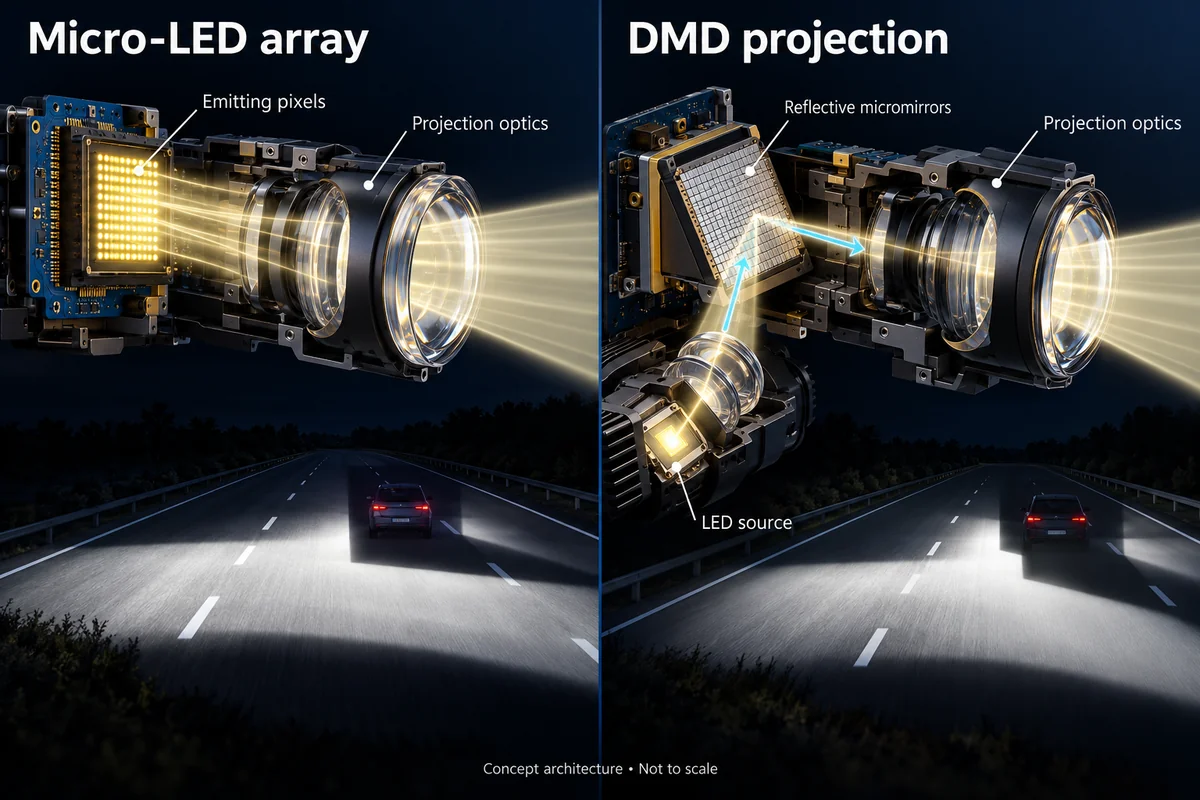
Both addressable LED arrays and DMD projection engines can produce spatially variable light patterns, but the underlying hardware is different.
Addressable LED or Micro-LED arrays form light patterns by controlling emitting elements, often with optics that project the result onto the road. Coarse segment matrices and high-density Micro-LED pixel arrays are not interchangeable descriptions: their controllable-element counts and achievable spatial detail can differ substantially.
DMD systems use a reflective micromirror array to redirect light from a separate illumination source, commonly an LED light engine. The micromirrors are spatial light modulators; they are not themselves LEDs. Projection optics, light-source coupling, cooling and control electronics are integral parts of the system.
Technology comparison
| Engineering factor | Addressable LED / Micro-LED array | DMD-based projection engine |
|---|---|---|
| Pattern generation | Independently controlled emitting segments or pixels | Independently controlled reflective micromirrors with a separate light source |
| Resolution | From relatively coarse LED segments to high-density arrays, depending on product | High-resolution micromirror arrays available; product dependent |
| Optical architecture | Emitter, driver and projecting optics | Illumination engine, DMD, driver and projecting optics |
| Thermal priorities | LED junction heat, driver electronics and package | Light engine, DMD and driver temperature management |
| Functional possibilities | ADB masking; finer patterns and some projections on suitable systems | ADB masking; detailed patterns and road projection on suitable systems |
| B2B selection criteria | Usable photometry, driver/control integration, pixel defects, cost, reliability | Optical throughput, projector packaging, control stack, thermal management, cost |
A verified commercial example is the ams OSRAM EVIYOS HD 25 device with 25,600 individually controllable Micro-LED pixels. In a separate technology family, Texas Instruments offers automotive DMD devices with about 1.3 million micromirrors for high-resolution exterior lighting. These are examples of specific products, not standard resolution requirements for all matrix ADB headlights.
Why pixel count is only one metric
A larger pixel count can enable more detailed patterns, but the road image is also influenced by field of view, luminous intensity, contrast, angular resolution, color uniformity and stray light. The headline number alone cannot establish superior nighttime visibility, lower glare, electrical efficiency or regulatory compliance. Similarly, a Micro-LED architecture should not automatically be described as low cost or aftermarket-ready; production maturity, tooling and vehicle integration vary by project.
3. Camera, Lighting ECU and Vehicle-System Integration
An ADB system must turn information about surrounding traffic into beam commands quickly and reliably. A forward-facing camera is a common scene source, but the precise perception stack is vehicle-specific. Other vehicle data—such as steering angle, vehicle speed and, in some designs, map or additional sensor information—may support the control strategy. LiDAR is not a universal requirement.
A typical control workflow
Perception: Identify relevant lamps and other detectable objects in the forward scene, with confidence estimates and appropriate handling of ambiguous conditions.
Tracking and projection: Estimate how detected objects map into the headlamp’s optical field.
Beam planning: Determine which segments or pixels need reduced output and how the transition should be managed.
Actuation: Command the driver electronics or optical modulator and supervise its status.
Diagnostics and fallback: Monitor faults, lost camera input, communication errors and calibration drift; restore a safe lighting state when required.
Actual frame rates, network topology and end-to-end response time must be supported by the specified vehicle or component validation report. Numbers such as “under 20 ms” should not be asserted for an unspecified ADB platform.
Integration challenges beyond the module
Optical aiming and coordinate alignment between camera, vehicle and headlamp are critical. A replacement assembly may require compatible control software, vehicle coding, diagnostic support, aiming equipment and approved configuration data. An apparently matching connector or physical mounting pattern does not prove system compatibility.
For B2B buyers, verify the full system boundary: what hardware the supplier provides, which ECU functions remain in the vehicle, what data interfaces are documented, and who takes responsibility for final vehicle-level photometry and compliance.
4. Matrix ADB Regulations: United States and UN Markets
Regulatory approval is specific to the lighting function, vehicle application and destination market. Descriptions such as matrix LED, digital headlight or glare-free high beam do not, by themselves, establish street legality.
United States: FMVSS No. 108
In February 2022, the US National Highway Traffic Safety Administration amended Federal Motor Vehicle Safety Standard (FMVSS) No. 108 to permit adaptive driving beam systems meeting the applicable US requirements. This opened a regulatory pathway for qualifying ADB equipment; it did not approve every ADB headlamp, retrofit kit or imported assembly.
Relevant test and certification obligations must be evaluated for the specific product and vehicle context. Requirements address illumination and glare-management performance. Passing a laboratory demonstration in another jurisdiction does not automatically establish FMVSS 108 compliance.
UN regulatory markets: R149 and R48
In jurisdictions applying UN vehicle-lighting rules, UN Regulation No. 149 addresses road-illumination devices and applicable adaptive front-lighting functions, while UN Regulation No. 48 addresses installation of lighting and light-signalling devices on vehicles. UN Regulation No. 123 is an older adaptive-front-lighting reference that may appear in legacy approval documentation. A buyer should verify the applicable regulation, amendment series, approval and installation provisions rather than treating R123 and R149 as interchangeable labels.
Regulatory comparison for importers
| Buyer question | United States | UN-regulation markets |
|---|---|---|
| Main framework to check | Applicable FMVSS 108 requirements | Applicable UN R149 device requirements and UN R48 installation provisions |
| Proof to request | Product/vehicle compliance basis and relevant photometric test evidence | Product type-approval documentation where applicable, and vehicle installation evidence |
| Major risk | Assuming 2022 permission means any retrofit is legal | Assuming a component approval alone covers any vehicle installation |
| Key practice | Assess the exact system configuration and target market | Check regulation series, intended function and installation context |
Do not claim “zero glare” or universal legal operation. ADB approval and road projection functions are subject to their own applicable requirements; permissible projection content should not be inferred from a demonstration video.
5. B2B Sourcing and Engineering Validation Checklist
Matrix ADB should be evaluated as an integrated optical, electronic and software system—not as a routine LED bulb replacement SKU. Its commercial potential may be most relevant to platform-specific OEM programs, approved replacement assemblies and tightly scoped engineering projects.
☐ Define the system and market: Record vehicle platform, lighting function, destination country, road-use status and whether the project is OEM, service replacement or a proposed retrofit.
☐ Request optical evidence: Obtain beam-distribution data, relevant glare-control tests, aiming instructions and evidence covering both normal and failure modes.
☐ Verify architecture: Document the emitter or DMD device, optical engine, driver/control units, sensor inputs, power supply and relevant communications interfaces.
☐ Review software and calibration: Confirm the control-stack owner, coding requirements, update process, diagnostics, calibration tools and post-service procedures.
☐ Inspect reliability records: Request project-relevant thermal, vibration, moisture, EMC and electrical-transient test data, with clearly identified methods and acceptance criteria.
☐ Review quality and traceability: Check component-level traceability, optical alignment controls, end-of-line tests, software/hardware revision control and defect-response processes.
☐ Confirm regulatory applicability: Examine the actual documents covering the correct headlamp assembly and installation; do not equate component-level certification with vehicle-level approval.
☐ Validate commercial support: Clarify sampling, engineering change control, availability, MOQ, warranty scope, service parts, installation training and after-sales responsibilities.
Separating engineering possibilities from market-ready products
High-resolution automotive lighting is commercially real in selected OEM programs, but the availability of one chip or reference design does not establish that a universal plug-and-play aftermarket matrix ADB kit exists. For distributors, broad compatibility claims create a serious warranty, safety and compliance risk. Product eligibility should be confirmed vehicle by vehicle and market by market.
Frequently Asked Questions
Q1. How are automatic high beams different from Matrix ADB?
Automatic high-beam systems generally switch between high and lower beams based on traffic conditions. Matrix ADB systems can selectively reshape the driving-beam distribution, reducing light toward detected road users while retaining illumination in other regions when conditions allow. Exact behavior differs by system.
Q2. Are Matrix ADB headlights legal in the United States?
ADB headlamps are permitted under the US FMVSS 108 framework following the 2022 rule change, provided the particular system meets the applicable requirements. The rule does not make arbitrary aftermarket retrofits automatically legal or compliant.
Q3. Is a Micro-LED matrix the same as a DMD projector?
No. A Micro-LED array forms patterns by controlling emitting pixels; a DMD uses reflective micromirrors to modulate light from a separate source. Each needs suitable optics, electronics, thermal control and system validation.
Q4. Does a million-pixel headlamp guarantee better visibility?
No. Useful visibility and glare control depend on photometry, beam contrast, angular resolution, sensing, calibration and control—not pixel count alone. Advertised resolution must be considered alongside verified system performance.
Q5. Can Matrix ADB react to reflective traffic signs?
Some systems can incorporate sign detection or targeted dimming, but such behavior is implementation-specific. Buyers should ask for product-specific documentation and tests rather than assume all matrix systems suppress sign reflections.
Q6. Can Matrix ADB headlights be installed as aftermarket retrofits?
Possible applications are highly vehicle- and market-specific. Camera integration, ECU compatibility, coding, alignment, approvals and service access must all be evaluated. A matching connector or headlamp shape does not establish a safe or legal retrofit.
Q7. Which technical documents should B2B buyers request?
Ask for the actual headlamp configuration, photometric and glare-control evidence, relevant type-approval or compliance basis, environmental and electrical test reports, software/calibration procedures, diagnostic information, and revision-controlled fitment data.
Q8. How can NVEL help with adaptive-lighting sourcing discussions?
NVEL works with automotive LED lighting buyers and can discuss relevant lighting product categories, optical-module requirements and potential OEM/ODM sourcing needs. Availability of a specific matrix ADB system, high-density Micro-LED architecture, vehicle integration service or certification must be confirmed for the individual project; no unverified in-house capability is implied.
Conclusion: Treat Matrix ADB as a Complete System
Matrix ADB technology illustrates how optics, sensing and software can work together to adapt the distribution of forward light. Addressable Micro-LED arrays and DMD projection architectures expand what designers can control, but their real-world value depends on the validated headlamp and vehicle system—not a single component specification.
For distributors and OEM/ODM buyers, the most effective sourcing strategy is to start with the target vehicle and jurisdiction, then validate optical behavior, integration responsibilities, reliability, supporting documentation and commercial readiness. NVEL welcomes discussions with brands and buyers exploring appropriate automotive LED lighting products and project requirements.
Explore NVEL Automotive LED Lighting Products
Contact NVEL with your target market, product category, application requirements, anticipated order quantity and branding or customization needs.
Technical and regulatory note: This article provides general engineering and sourcing information. Safety, photometric performance, legal suitability and certification must be confirmed for the exact product, vehicle configuration and destination market.
Related Technical Guides
B2B Sourcing · Technical Guides
OEM Automotive Lighting Development Process: From Concept to Mass Production
LED Headlights · Technical Guides