TECHNICAL GUIDES · B2B SOURCING
OEM Automotive Lighting Development Process: From Concept to Mass Production
A practical six-stage roadmap for engineering, validation, buyer approvals and production readiness.
October 20, 2026 · 12 min read
Introduction
Developing a custom automotive lighting product connects engineering decisions with manufacturing controls and commercial commitments. A projector module, complete headlamp, fog lamp or auxiliary off-road light may need different optics, tooling and validation. A structured roadmap helps buyers identify gaps before those gaps become expensive production changes.
This guide explains the OEM automotive lighting development process for automotive lighting brands, OEM/ODM buyers, vehicle manufacturers, Tier-1 suppliers, distributors and importers. It follows six practical stages, from requirements to Start of Production (SOP). Activities can overlap, but each approval should identify the exact product revision, evidence reviewed and outstanding actions.
OEM Automotive Lighting Development Roadmap
QUICK GUIDE
Define the application, target markets, requirements and approval responsibilities before committing the project.
Review optical, mechanical, thermal and electrical interfaces together before releasing the design.
Identify sample revisions, assess fitment and agree tooling acceptance evidence before production release.
Validate the design and production process, then secure the agreed customer approval package.
Close launch gates, confirm traceability and control changes throughout the production ramp-up.
1. Requirements Definition & APQP Planning
Begin with a product requirement document that defines the lighting function, vehicle application, installation envelope and target markets. Separate mandatory requirements from preferences. Assign responsibility for design, regulatory assessment, testing and customer approval so that the quotation reflects the real project scope.
Optical requirements should describe beam distribution, applicable measurement points, color limits, glare control and aiming conditions. Electrical requirements cover the supply range, current consumption, connector pinout, switching behavior and vehicle diagnostics. Mechanical requirements include mounting interfaces, tolerances, service access and packaging space. Environmental conditions must reflect the intended installation rather than a generic temperature range.
Use APQP planning to connect feasibility reviews, risk analysis, design milestones, supplier readiness and production controls. Identify special characteristics and acceptance evidence early. A requirements matrix should trace each critical requirement to a drawing, test method or inspection record and to the person authorized to accept it.
Development timelines vary depending on product complexity, tooling requirements, validation scope, regulatory requirements, customer approval procedures and engineering changes. Build a milestone schedule with review windows, component lead times and retest allowance. Do not treat six to ten months as a universal commitment.
Non-recurring engineering (NRE) may include engineering design, prototypes, tooling, testing and validation. Request a scope-based, itemized quotation with deliverables, exclusions, payment milestones and change procedures. Settle the treatment of canceled projects and unsuccessful trials before authorizing major expenditure.
2. Optical, Mechanical & Electrical Engineering
Optical, mechanical and electrical design should develop together. Changing an LED package or drive current can affect beam distribution and heat generation; changing the housing can alter optical alignment, sealing and cooling. Review these interfaces as a system instead of approving each discipline in isolation.
Optical engineering may use ray tracing and tolerance analysis to evaluate reflector, lens and projector configurations. Simulation helps compare concepts, but physical photometric measurements are still needed. The required beam pattern depends on the lamp’s function, traffic direction and market; a single cutoff geometry is not suitable for every product.
Mechanical design addresses locating features, mounting stiffness, material compatibility, sealing paths, ventilation and assembly access. Design-for-manufacture reviews should consider molding or casting tolerances, optical surface quality and inspection access. Document assumptions about installation space, airflow and heat transfer so that later tests represent the real application.
Thermal analysis should assess sustained operation, ambient conditions, drive current and component temperature margins. LED junction temperature limits and design targets depend on the selected components and reliability objectives. There is no universal below-120°C target for every automotive light. Confirm the model through measurements on representative hardware.
Electrical engineering covers driver behavior, protection against relevant disturbances, grounding, wiring and electromagnetic compatibility (EMC). Define vehicle diagnostic requirements explicitly. A “CANBus compatible” label cannot establish compatibility with every vehicle. The design review should close significant risks or record a controlled plan for resolving them before tooling release.
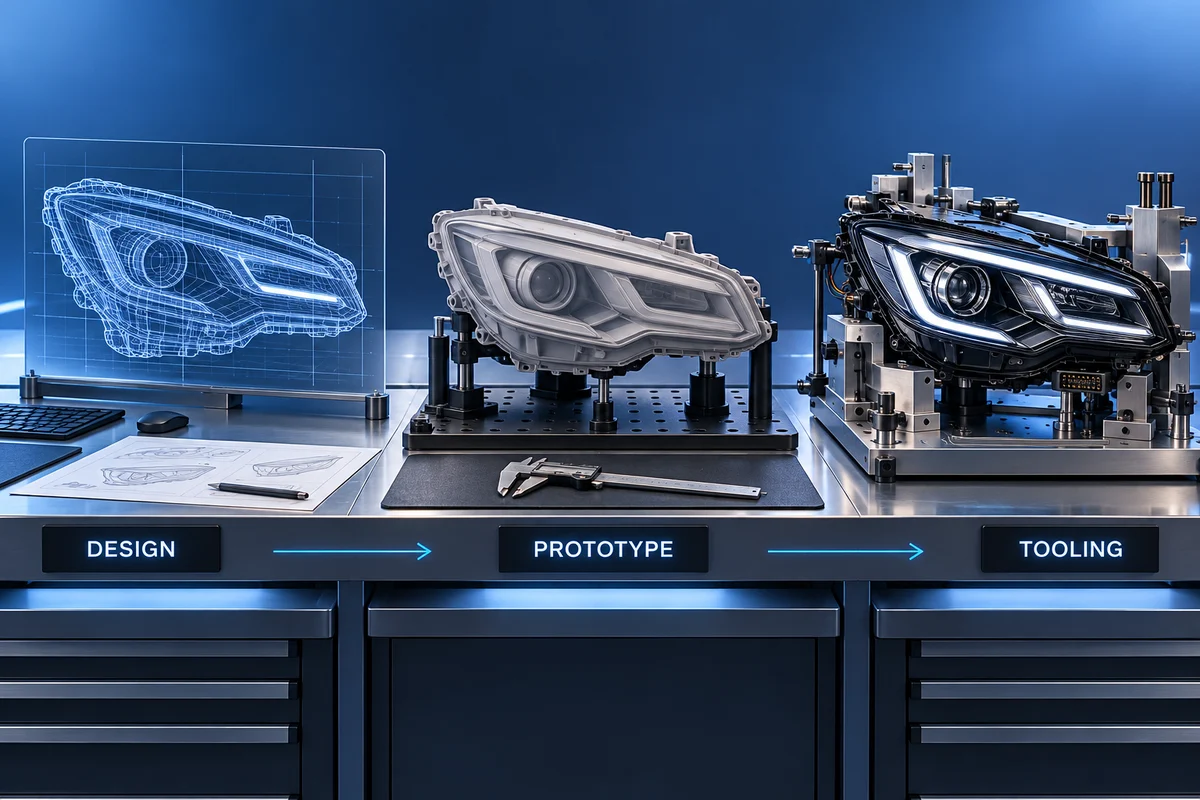
3. Prototyping & Tooling Development
Prototypes turn the design into evidence for fitment, assembly and performance decisions. Depending on the project, parts may be printed, machined or made using temporary tools. Prototype electronics and optical components may differ from production parts; record these differences and the limits of each test conclusion.
Use early samples to check mounting interfaces, connector access, adjustment, service clearance and preliminary beam behavior. Evaluate thermal and electrical performance under defined conditions. Buyers should approve an identified revision with a discrepancy list, rather than signing an attractive sample whose materials or construction are undocumented.
Authorize production tooling only after reviewing design maturity and the cost of unresolved changes. Agree tool specifications, cavity identification, trial stages, dimensional reports and correction responsibilities. Tool-trial labels such as T0 or T1 are supplier conventions; define the actual acceptance evidence rather than assuming the label proves readiness.
IP ownership, tooling ownership, licensing rights, access to engineering files and confidentiality obligations must be explicitly defined in the development and supply agreements. Separate pre-existing supplier technology from project-created work. Specify tool storage, permitted use, maintenance, access and transfer arrangements. Paying NRE does not automatically transfer every CAD file, optical design or mold.
4. Design and Process Validation
Design validation (DV) evaluates whether the product design meets the agreed requirements. Process or production validation (PV) evaluates whether representative production methods consistently deliver conforming parts. Terminology varies between customers, so define the project’s DV and PV scope, sample source and acceptance criteria in writing.
Create a validation plan that identifies the requirement, applicable standard or customer specification, test conditions, sample quantity and pass/fail criteria. Reports should identify the product revision, materials and test setup. Investigate failures, implement corrections and repeat affected tests; an isolated passing result does not resolve an unrelated failure.
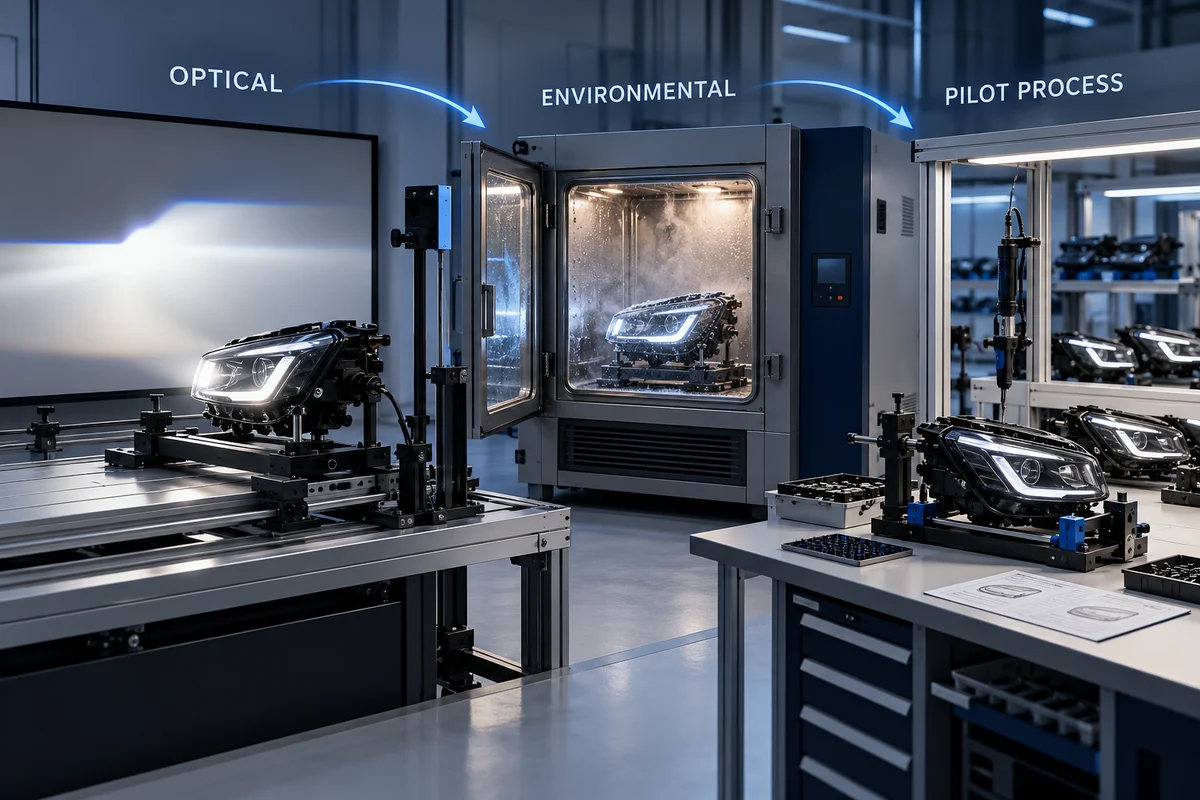
- Optical and functional checks: evaluate the relevant beam distribution, color, aiming, output stability and operating modes.
- Thermal and environmental checks: select temperature limits, dwell times, cycle counts, humidity and corrosion exposure for the application.
- Ingress protection: distinguish dust and immersion testing from high-pressure water-jet testing. IP68 does not establish high-pressure spray resistance.
- Electrical and EMC checks: assess applicable emissions, immunity and supply disturbances. CISPR 25 addresses radio disturbances affecting on-board receivers; it is not a complete EMC compliance program.
- Mechanical durability: specify mounting, vibration profiles, frequency ranges and exposure durations according to the applicable requirements.
Temperature ranges, spray pressures, thermal cycle counts and vibration profiles are project-specific rather than universal requirements. Test parameters and component temperature margins must be justified for the product, target market and customer specification.
Road-use compliance requires a separate market review. Applicable U.S. lighting equipment follows a manufacturer self-certification framework; DOT is not a government-issued product certification. Markets using UNECE type approval may require different optical performance, markings and approval documentation. A common housing platform does not automatically establish both U.S. and European compliance.
5. Pilot Production & Production Approval
Pilot production should use representative tools, materials, operators and process settings. Its purpose is to reveal variation and production risks before the planned ramp-up. Define the pilot quantity and operating conditions according to customer requirements and risk, then record yield, defects, rework and unresolved capacity constraints.
Review process flow, process FMEA, work instructions and the production control plan together. Confirm critical assembly settings, sealing controls, inspection methods and traceability. Check measurement suitability and equipment calibration where relevant. Production screening or aging should be justified by the failure modes and agreed controls, not assumed to be an identical two-to-four-hour test for every unit.
Where required, PPAP—Production Part Approval Process—provides customer-requested evidence for production part approval. Applicable elements can include design records, dimensional results, material or performance tests, risk analyses, control plans and measurement studies. Applicability, submission level and approval procedures depend on customer requirements and project type. PPAP Level 3 is not mandatory for every OEM lighting order.
For projects without formal PPAP, agree another documented production approval package. Record who can approve shipment, how deviations are handled and when requalification is needed. Distinguish full approval from temporary authorization with limits. A successful pilot supports readiness decisions but does not guarantee zero defects.
6. Start of Production (SOP)
Start of Production begins when the agreed technical, quality and commercial gates are satisfied. Confirm the approved specification, production revision, components, tooling status and customer authorization. Do not allow an unresolved engineering change to disappear into a purchasing email or an informal sample comment.
Plan the ramp-up around verified capacity, component supply and inspection resources. Early production may need additional monitoring of critical characteristics and an agreed response to unexpected variation. Keep records that connect finished batches to relevant components, process conditions and inspection results.
After SOP, maintain controlled change notification for materials, suppliers, firmware, tools and process settings. Assess whether changes require customer approval or renewed testing. Agree warranty investigation, containment, corrective action and service support. Reliable volume supply depends on ongoing control and feedback, not solely on the launch approval.
Development Phase Comparison
Use this overview to assign owners and approval gates. Deliverables should be tailored to the agreed project and customer requirements.
| Development Phase | Key Activities | Typical Deliverables | Buyer Approval / Decision Points |
|---|---|---|---|
| Requirements & APQP | Feasibility, requirements, quality planning | Requirement matrix; milestone plan | Approve scope, responsibilities and budget |
| Engineering design | Optical, mechanical, thermal and electrical design | Drawings; BOM; design review records | Approve design revision and open risks |
| Prototyping & tooling | Prototype evaluation; tool trials and corrections | Sample records; dimensional reports | Approve sample and tooling release |
| DV / PV | Requirement-based design and process tests | Validation reports; corrective actions | Accept results and deviation treatment |
| Pilot & approval | Production trial; process controls; applicable PPAP | Control plan; pilot data; approval package | Authorize production and shipment |
| SOP | Controlled launch; monitoring; change management | Released records; traceability; launch results | Approve ramp-up and ongoing controls |
Pre-SOP Checklist for OEM Buyers
Assign an owner and completion evidence to each item. Escalate missing approvals before releasing volume orders.
- Approved specifications and drawings: confirm revision numbers, acceptance criteria and authorized signatures.
- BOM and change control: approve component identities, substitution rules and notification responsibilities.
- Prototype / master sample approval: identify the accepted sample, permitted deviations and retained reference units.
- Validation records: match reports to the approved configuration and close failed or incomplete tests.
- Tooling and ownership agreements: record IP rights, tool ownership, maintenance, permitted use and access.
- Production control plan: confirm critical characteristics, inspection methods, traceability and reaction plans.
- Packaging and labeling: approve protection, part identification, instructions and market-specific markings.
- Warranty and quality agreements: define acceptance procedures, claim handling, corrective action and responsibilities.
Frequently Asked Questions
How long does OEM automotive lighting development take?
Development timelines vary with complexity, tooling, validation, regulatory requirements, customer approvals and engineering changes. Ask for a milestone plan with dependencies and review windows. A platform adaptation and a new complete lighting system should not share an assumed standard schedule.
What does NRE cost include?
NRE may cover engineering, prototypes, tooling, testing and validation, with some items quoted separately. Costs require a project-specific scope and quotation. Request deliverables, exclusions and payment milestones; no unverified fixed price range is appropriate for every project.
Who owns the IP and tooling?
The development and supply agreements must define ownership, licensing, engineering-file access and confidentiality. Background IP and new project work may have different rights. Identify each tool and its storage, maintenance and transfer terms. Payment alone does not establish complete ownership.
What is the difference between DV and PV?
DV assesses the design against agreed requirements. PV assesses results from representative production methods and process conditions. Define the terminology and sample source with the customer. Prototype results cannot automatically prove production consistency.
Is PPAP always required?
PPAP requirements depend on the customer and project. Agree applicable elements, submission level and approval procedures early. Where formal PPAP is not required, establish a documented alternative production approval package. Do not assume Level 3 applies to every order.
Can one design meet DOT and E-Mark requirements?
Potentially, but feasibility must be assessed for the exact lamp, installation and markets. Different optical requirements, markings and compliance routes may require variants. DOT is not a U.S. government-issued product certification; applicable U.S. requirements use self-certification, while relevant UNECE approvals follow type-approval procedures.
What is a Golden Master Sample?
It is an agreed reference unit representing the accepted product revision and relevant appearance, fitment and performance characteristics. Record its identification, approval date, retention conditions and replacement procedure. It complements specifications and test records; it cannot replace quantified requirements or regulatory evidence.
Conclusion: Plan Your OEM Development Project
A successful OEM automotive lighting project connects a controlled specification with engineering reviews, representative samples, requirement-based validation and documented production approval. Treat each stage as an evidence gate, then maintain traceability and change control after SOP. For buyers, clear responsibilities and revision records are as important as an attractive first sample.
NVEL’s official factory information describes 25+ years of automotive lighting experience and presents ISO 9001 and IATF 16949 quality management credentials. Buyers should review the relevant certificates and confirm the supplying entity and scope. Quality management certification does not establish product road-use approval.
Share the application, markets, technical requirements, forecast quantities and desired launch milestones. Ask the NVEL team to confirm engineering scope, available resources, validation arrangements and commercial terms for the specific project. No particular software, production equipment, laboratory or PPAP submission capability is assumed in this guide.
Browse the Technical Guides Hub for related topics, then prepare a written brief that connects requirements, evidence and approvals.
Discuss Your OEM Lighting Development
Share your specifications, target markets and planned volumes. Request a project-specific review of engineering, samples, validation and production readiness.
Related Technical Guides
Technical Guides LED Headlights