TECHNICAL GUIDES · LED FOG LIGHTS
Dual-Color LED Fog Lamps: Optical Engineering, Circuit Switching, and Severe Weather Penetration
Evaluate 3000K/6000K optics, synchronized switching, thermal stability and environmental validation.
October 26, 2026 · 14 min read
Introduction
Modern automotive lighting must perform reliably across varied environments, from clear nighttime roads to heavy rainfall, coastal fog, snow, and wet mountain highways. For aftermarket brands and professional distributors, dual color LED fog lights offer two selectable lighting modes within one assembly.
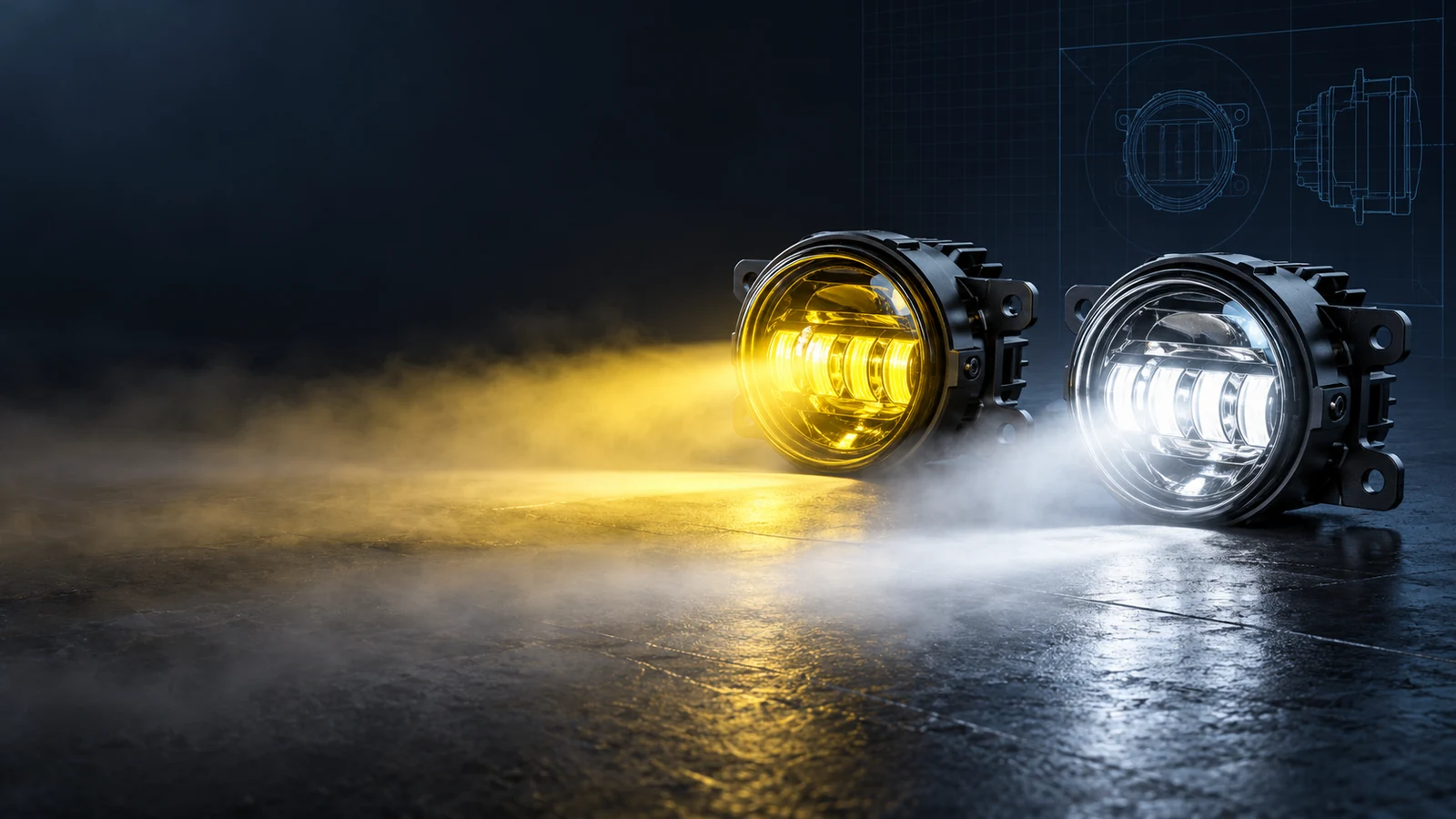
A typical system combines a cool-white mode around 6000K with a warm-white or yellowish mode around 3000K. This flexibility lets drivers choose a preferred lighting appearance without installing separate lamp assemblies. However, effective product engineering requires more than arranging two LED chip arrays on a circuit board. A nominal 3000K rating does not establish selective-yellow chromaticity; verify the emitted color against the applicable color boundaries.
A dependable design balances optical alignment, beam distribution, electronic switching, thermal stability, electrical protection, and environmental sealing. Weaknesses in any of these areas may cause glare, color-mode desynchronization, overheating, moisture damage, and avoidable warranty returns. This guide explains the underlying engineering and offers B2B buyers a practical framework for evaluating OEM and ODM suppliers.
Dual-Color LED Fog Light Engineering
QUICK GUIDE
01
Optical Scattering & Fog Visibility
Evaluate scattering, cutoff and glare in both modes.
02
Dual-Mode Switching Circuits
Verify channel selection, synchronization and reset logic.
03
CSP Packaging & Thermal Management
Match emitter geometry and validate sustained heat dissipation.
04
Environmental Sealing & Condensation
Verify seals, pressure management and assembly-level evidence.
Approve application-specific samples before bulk sourcing.
1. Optical Engineering: 3000K Yellow vs. 6000K White Light in Fog
1.1 Color temperature is not a wavelength
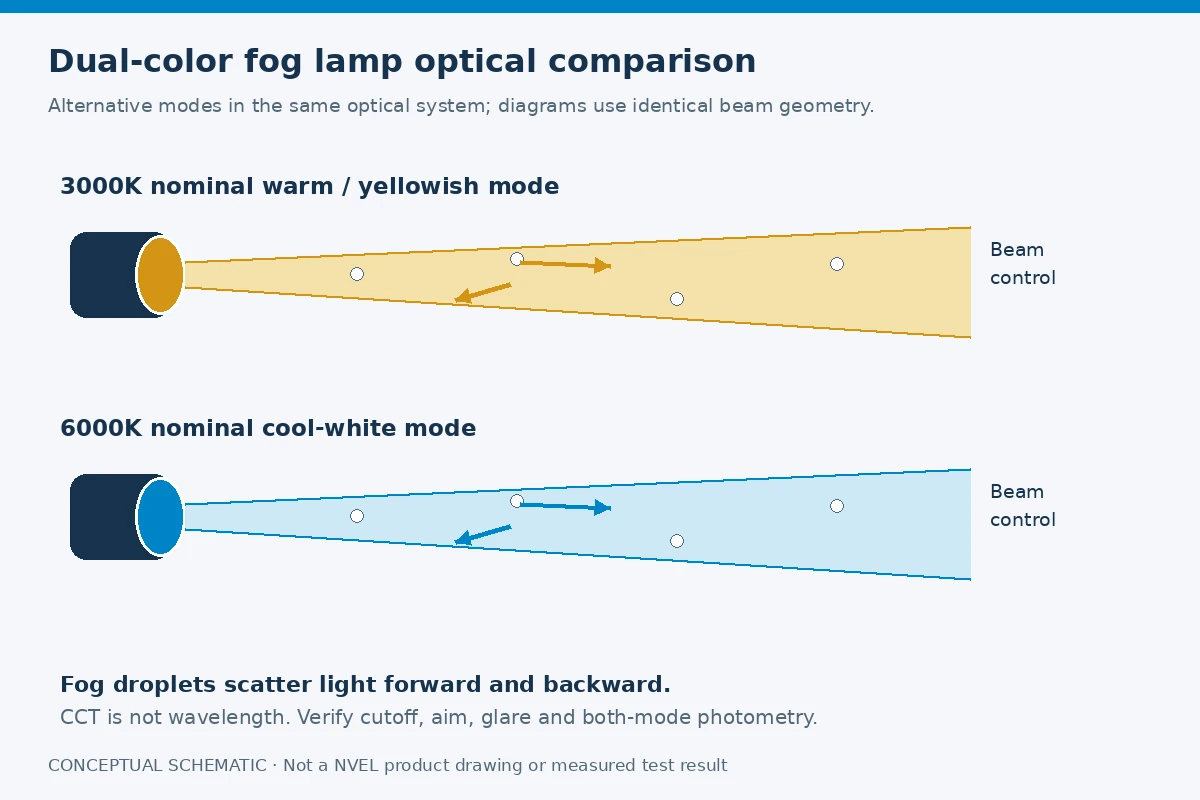
A 6000K LED source normally appears cool white, while a 3000K source appears warm white or yellowish. Correlated color temperature (CCT) summarizes appearance; it is not a single wavelength. White LEDs emit across a distribution of wavelengths, so treating a 6000K lamp as exclusively 450 nm and a 3000K lamp as exclusively 580 nm is scientifically misleading.
1.2 Rayleigh versus Mie scattering
Rayleigh scattering describes particles much smaller than the wavelength of incident light. Its simplified wavelength relationship is: scattering intensity ∝ 1 / wavelength⁴. Fog droplets are generally comparable to or substantially larger than visible-light wavelengths; Mie scattering is therefore more relevant to dense roadway fog. Its behavior depends on droplet size, wavelength, refractive index, and direction, rather than a simple fourth-power relationship.
Consequently, a 3000K lamp cannot be claimed to penetrate every fog condition farther than a 6000K lamp solely on the basis of color temperature. Yellow light may affect subjective glare, comfort, and visual perception, but measured beam performance remains essential.
Fog droplets often scatter strongly in the forward direction, spreading light around objects and reducing contrast. Backscattered light returns toward the driver and can create a veiling luminance. Droplet-size distribution, fog density, road reflectance and viewing geometry affect the outcome. Evaluate road-edge recognition as well as subjective glare.
1.3 Beam quality and glare control
Fog lamps should deliver useful foreground and lateral illumination while controlling upward stray light that can contribute to backscatter. Beam cutoff, mounting height and angle, reflector or projector geometry, and LED emitting-surface position all matter. In retrofit designs, the two color channels may occupy slightly different physical positions, so the yellow and white modes should be evaluated independently.
- Request photometric distribution data for both modes, not just lumen figures.
- Check glare and excessive upward intensity in the intended housing.
- Evaluate road-edge contrast and driver comfort under representative conditions.
- Avoid treating physical socket fit as proof of optical or regulatory suitability.
Engineering takeaway: Color selection may be useful, but effective adverse-weather lighting depends primarily on the complete optical system and its measured performance.
2. Dual-Mode Switching Circuits: Driver Logic, Synchronization, and Reset Control
2.1 Operating principles
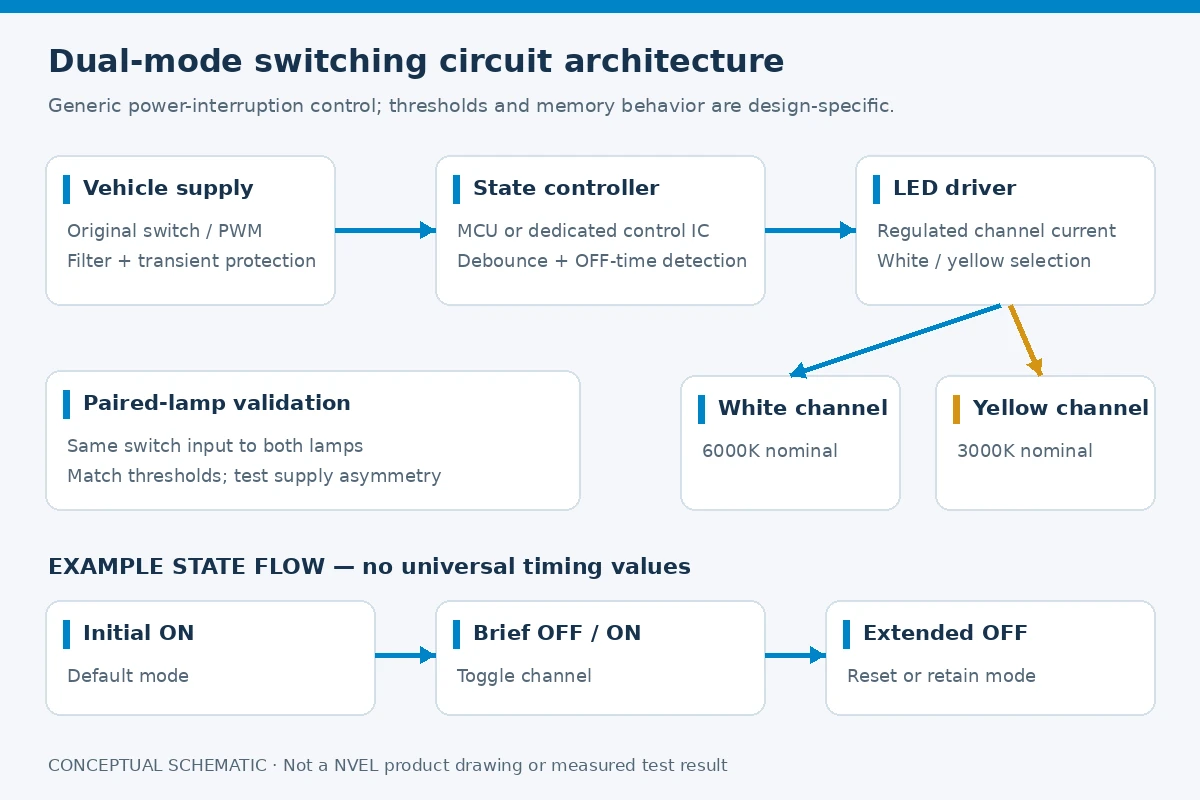
Many dual-color aftermarket lamps monitor brief power interruptions from the original fog-light switch. A controller then selects either a white or yellow LED channel. A representative sequence is initial ON → white; brief OFF/ON → yellow; subsequent recognized input → white. Some products return to a default color after an extended OFF interval; others remember the last setting. Actual timing and memory behavior are model-specific and must be documented.
2.2 Driver-control architecture
An MCU or dedicated control IC may monitor supply interruptions, reject noise, select LED channels, and manage reset behavior. Reliable designs distinguish deliberate switching from momentary voltage drops, startup variation, or automotive electrical disturbances. Input filtering, stable thresholds, appropriate firmware or state logic, and robust power management help avoid unexpected mode changes.
A representative dual-mode LED driver uses separately controlled white and yellow LED channels, often enabling only one at a time. Depending on the design, a hold-up supply, capacitor-discharge measurement or other timing circuit helps distinguish a short interruption from a long shutdown. Filtering must also avoid interpreting PWM lamp control as a deliberate mode-change command.
2.3 Paired-lamp synchronization
Desynchronization occurs when left and right lamps interpret the same switching event differently. Contributing factors include threshold tolerances, discharge timing, noise, firmware differences, or supply asymmetry. Suppliers should demonstrate repeated paired-lamp operation at different voltages, temperatures, and shutdown intervals; where supported, reset procedures should be unambiguous.
2.4 Automotive electrical protection
Appropriate input design may include transient-voltage suppression (TVS), reverse-polarity protection, filtering, overcurrent limitation, undervoltage management, and thermal protection. The requirements vary by nominal 12V or 24V vehicle platform. A generic claim of “24V spike protection” is not a substitute for specifying relevant transient profiles and pass/fail criteria.
Engineering takeaway: Consistent switching demands verified state management, paired-lamp testing, and protection against real vehicle electrical disturbances.
3. CSP LED Packaging, Optical Alignment, and Thermal Management
3.1 Chip packaging and emitting geometry
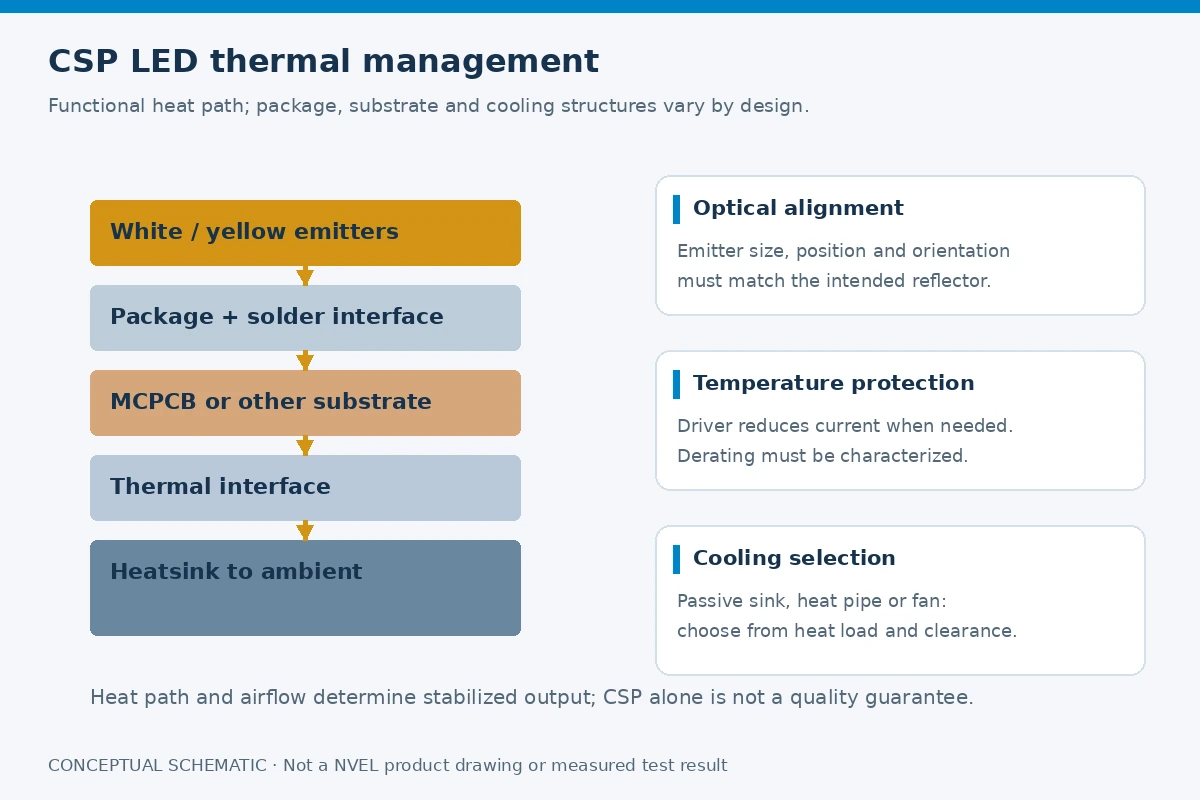
Dual-color fog lamps may use conventional SMD packages, chip-scale packages (CSP), or application-specific arrays. CSP can enable compact construction, but a premium package alone does not guarantee a superior beam. The location, size, and orientation of each emitting surface must be matched to the optical system. A bulb that mechanically replaces a halogen lamp may still produce an unacceptable distribution in the original housing.
3.2 Thermal conduction and derating
LED electrical input generates heat that must move through the package, substrate, interface materials, and heatsink to ambient air. Compact multi-channel boards complicate routing and packaging, even where only one color channel is powered at a time. Excess junction temperature can accelerate light-output depreciation, shift color, or stress the driver. Passive heatsinks, metal-core PCBs, copper paths, heat pipes, and fans are options whose suitability depends on actual power, resistance, airflow, space, and environment.
Well-engineered designs may lower drive current at elevated temperature to protect components. Buyers should review stabilized thermal results, output derating behavior, and long-duration operation rather than rely on a brief room-temperature demonstration.
Substrate options include aluminum-core MCPCBs, copper-based boards and other engineered heat-spreading structures. Their dielectric layers, thickness, contact pressure and thermal-interface quality contribute to total thermal resistance. A heat pipe or fan may help where justified by heat load and available airflow, but neither is a universal requirement. Validate the installed configuration in sustained operation, including a restricted-airflow case.
Technical Matrix: Dual-Color LED Engineering and Validation
| Area | Engineering consideration | Buyer validation |
|---|---|---|
| Chip Package | SMD/CSP or application-specific LED geometry | Inspect emitter locations and consistency |
| Optical Alignment | Both modes matched to intended optics | Photometry for yellow and white modes |
| PCB / Substrate | Metal-core PCB and appropriate thermal interfaces | Stabilized board and case temperatures |
| Thermal Path / Cooling | Passive sink, heat pipe or fan if justified | Thermal endurance and derating behavior |
| Driver Protection | Controlled current and fault protection | Electrical-transient and temperature testing |
| Switching | Defined timing, state and reset logic | Repeated paired-lamp switching |
| Environment | Suitable seals, connectors and enclosure | Documented ingress and durability tests |
| Validation Method | Document the specimen, setup, operating conditions and acceptance criteria | Compare both modes after thermal stabilization and environmental exposure |
Engineering takeaway: Optical, thermal, and electronic performance must be designed and validated together; component labels alone do not establish product quality.
4. Environmental Sealing: IP Protection, Moisture Control, and Condensation
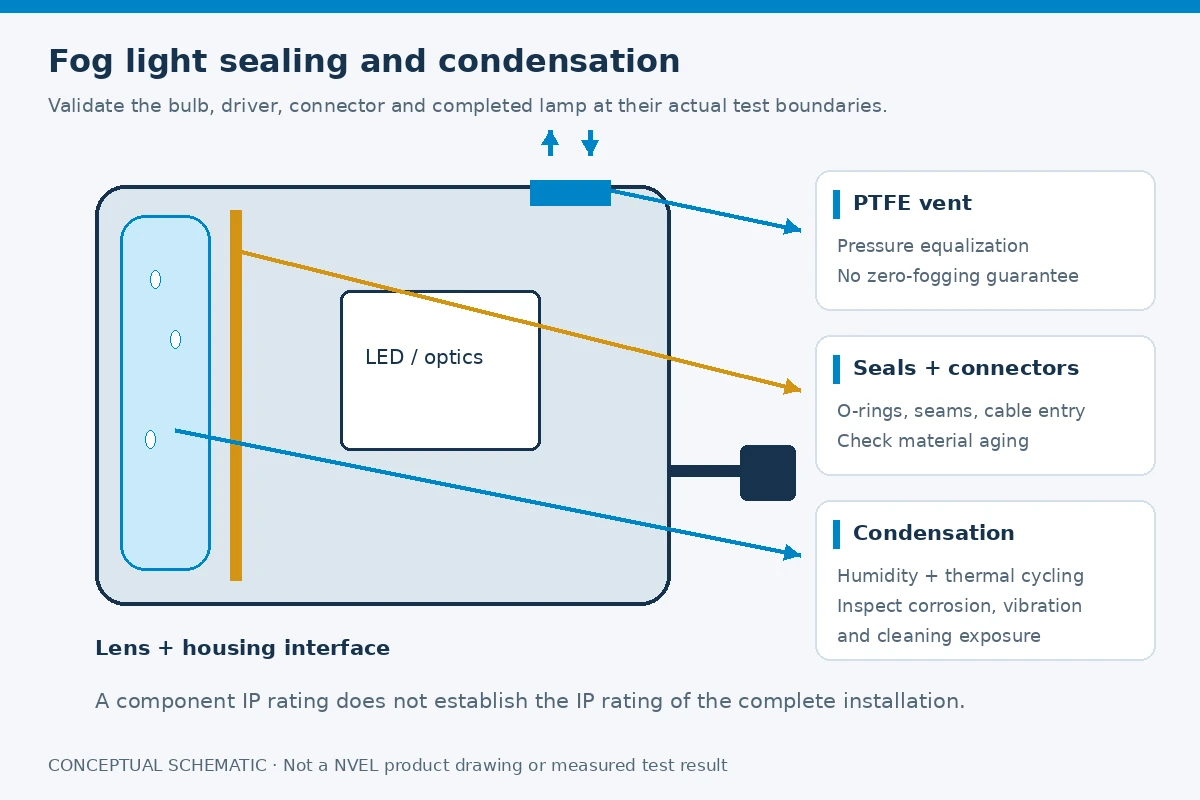
Fog-light systems are exposed to spray, mud, dust, road de-icers, vibration, humidity, and temperature cycling. Their waterproofing claim must identify the item tested: LED bulb, external driver, connector, or complete lamp housing. An IP-rated driver does not automatically make the vehicle installation IP-rated.
4.1 Sealing elements and pressure management
Elastomeric gaskets, appropriately designed connectors, enclosure seams, and protective potting materials can reduce ingress risk. Hydrophobic PTFE vents can equalize pressure while resisting liquid water under specified conditions; they cannot guarantee that condensation never occurs. Internal humidity, temperature gradients, and enclosure design remain important.
O-ring compression, mating-surface finish, connector seals and cable strain relief must remain effective through temperature cycling and vibration. Potting can protect electronics but may impede heat removal, stress components during cure or make repairs difficult; material selection and thermal expansion therefore need validation. Condensation can form when moist internal air contacts a surface below its dew point, even without a failed immersion seal.
4.2 Interpreting ingress claims
IP67 and IP68 have defined but distinct water-ingress requirements. An IP68 claim needs the agreed immersion conditions; it does not automatically confirm resistance to high-pressure or high-temperature washing. Suppliers should provide test methods, specimen identification, conditions, results, and acceptance criteria.
- Confirm precisely which part or assembly carries a reported IP rating.
- Request humidity, thermal cycling, water ingress, and corrosion evidence appropriate to the intended application.
- Assess cable entry points, strain relief, connector seals, and long-term material aging.
- Treat pressure equalization as one element of moisture management, not a guarantee against fogging.
Engineering takeaway: Documented assembly-level validation is more meaningful than broad “fully waterproof” marketing language.
5. B2B Sourcing Checklist: How to Evaluate Dual-Color LED Fog Light Suppliers
Optical performance
- ☐ Obtain independent or documented photometric measurements for both color modes.
- ☐ Check beam distribution, glare, upward light, color consistency, and intended-housing compatibility.
- ☐ Confirm road-use requirements in each target market; do not equate socket fit with compliance.
Switching and electrical reliability
- ☐ Perform repeated ON/OFF cycles with both lamps connected and confirm synchronized switching.
- ☐ Document mode sequence, switching window, memory behavior, and any reset procedure.
- ☐ Request voltage-range, electrical-transient, and reverse-polarity test information.
- ☐ Check compatibility with vehicle lamp monitoring and PWM electrical systems where relevant.
Thermal and mechanical design
- ☐ Review sustained operating temperature, output stability, and any thermal derating.
- ☐ Verify socket geometry, retention, cooling clearance, wire strain relief, and connectors.
- ☐ Check representative samples across lots instead of only a selected demonstration unit.
Environmental and commercial qualification
- ☐ Confirm test evidence for sealing, environmental durability, and corrosion exposure.
- ☐ Review product-specific regulatory evidence applicable to the destination market.
- ☐ Approve specification-controlled preproduction samples and inspection criteria.
- ☐ Agree on OEM/ODM customization, traceability, warranties, lead times, and MOQ.
Retrofit note: H8, H11, H16, 9006, 5202 and other socket listings are not universal fitment or road-legality guarantees. Housing optics, electrical operation, space, sealing and local rules still require verification.
Compliance note: Applicable requirements may involve SAE J583, relevant U.S. vehicle-lighting rules, or UNECE regulations depending on the product and market. Testing to a technical standard is not identical to formal approval or certification.
Keep the evidence categories separate: SAE J583 provides front-fog-lamp test and design guidance; applicable UN lighting regulations, including UN Regulation No. 149 where adopted, concern specified device approvals. Installation and road-use requirements depend on the jurisdiction. “DOT approved” is not a substitute for product-specific evidence; the NHTSA auxiliary-lamp interpretation explains the distinction from required lighting equipment. An IP enclosure rating concerns ingress protection, while ISO 9001 or IATF 16949 concern management systems within a certified scope. None of these labels proves all the others, and this guide makes no certification claim for NVEL or a particular product.
Frequently Asked Questions
Q1. Why might 3000K yellow fog lights be preferred over 6000K white lights in adverse weather?
Some drivers prefer yellow illumination because of perceived comfort and reduced blue spectral content. Yet dense fog usually involves Mie scattering, and real visibility depends on the complete beam, glare control and conditions. Yellow color alone does not ensure longer viewing distance.
Q2. How do dual-color LED fog lights switch without extra wiring?
Many systems detect brief interruptions in the existing fog-light power feed and use an internal controller to select the white or yellow channel. The switching threshold, mode sequence and memory behavior vary by design.
Q3. What happens when left and right fog lamps become unsynchronized?
Differences in supply conditions, detection thresholds, control timing or electrical noise can cause paired lamps to select different modes. Some systems reset after a defined OFF interval; buyers should verify the recovery method through paired-lamp tests.
Q4. Will dual-color LED fog-light bulbs fit original factory housings?
A matching socket such as H8, H11, H16 or 9006 only establishes potential mechanical compatibility. Correct photometric output, cooling clearance, electrical behavior and local road-use rules must be checked for the actual lamp assembly.
Q5. Do dual-color LED fog lights generate excessive heat?
They require deliberate heat management, but two sets of LEDs do not necessarily mean twice the operating heat because many designs use only one channel at a time. Heat depends on drive current, efficiency, construction and cooling; thermal testing is essential.
Q6. How should B2B buyers qualify a dual-color LED fog light manufacturer?
Request clear engineering drawings and specifications, photometric results, paired-switching tests, thermal and electrical validation, sealing evidence, quality-control criteria and relevant market compliance documentation. Confirm OEM/ODM capacity and sample consistency before bulk ordering.
Conclusion: Reliable Dual-Color Lighting for Global Aftermarket Programs
Dual-color LED fog lamps offer a practical combination of selectable white and yellow illumination, but strong product performance starts with engineering rather than color-temperature marketing. Measured beam quality and glare control must be considered alongside driver switching stability, thermal design, and environmental reliability.
For OEM/ODM buyers and aftermarket distributors, sourcing confidence comes from defined specifications, application-specific measurements, representative samples, and transparent acceptance criteria. Yellow and white operation should both be validated in the intended lamp and vehicle context; no single material, chip package or marketing claim substitutes for complete-system verification.
NVEL welcomes technical discussions with automotive lighting brands and sourcing teams assessing dual-color fog lamp programs. Define the desired optical behavior, switching features, environmental targets, customization scope, and destination-market requirements before committing to bulk manufacture.
Explore NVEL Automotive LED Lighting Products
Contact NVEL with your target market, product category, application requirements, anticipated order quantity and branding or customization needs.