

TECHNICAL GUIDES · LED OFF-ROAD LIGHTS
Off-Road Beam Patterns: Spot, Flood, and Combo Driving Light Optics
Match spot, flood and combo optics to off-road visibility, heavy-duty tasks and B2B validation.
October 26, 2026 · 15 min read
Introduction
In off-road driving, agricultural operations, construction, mining, and forestry, effective illumination depends less on an advertised wattage or raw LED-chip lumen figure than on where the light is delivered. A lamp with ample output can still leave distant hazards underlit, create distracting foreground brightness, or spill unwanted glare outside the work zone.
The central choice is beam distribution: a narrow spot for distance, a wide flood for the immediate work area, or a combo pattern that allocates light to both. Common spot designs may specify a nominal 10°–15° beam; broad flood products may specify 45°–60°. These are examples rather than universal definitions, and beam-angle figures must be interpreted alongside the manufacturer’s measurement method, candela distribution, and real installation height.
This guide explains spot vs flood beam offroad lights, how reflector and total internal reflection (TIR) optics shape the beam, how application requirements influence mounting, and which durability and test documents B2B purchasers should request before approving production.
Off-Road & Heavy Duty Beam Patterns
QUICK GUIDE
Distance, spread, intensity and beam-angle definitions.
02
TIR Lens vs. Reflector Optics
Light control, materials, packaging and validation trade-offs.
Beam placement for 4×4, UTV, agriculture and heavy machinery.
04
Vibration & Thermal Engineering
Mechanical endurance, sealing, thermal paths and EMC checks.
Evidence and sample checks to request before bulk purchase.
1. Optical Breakdown: Spot, Flood, and Combo Beam Patterns
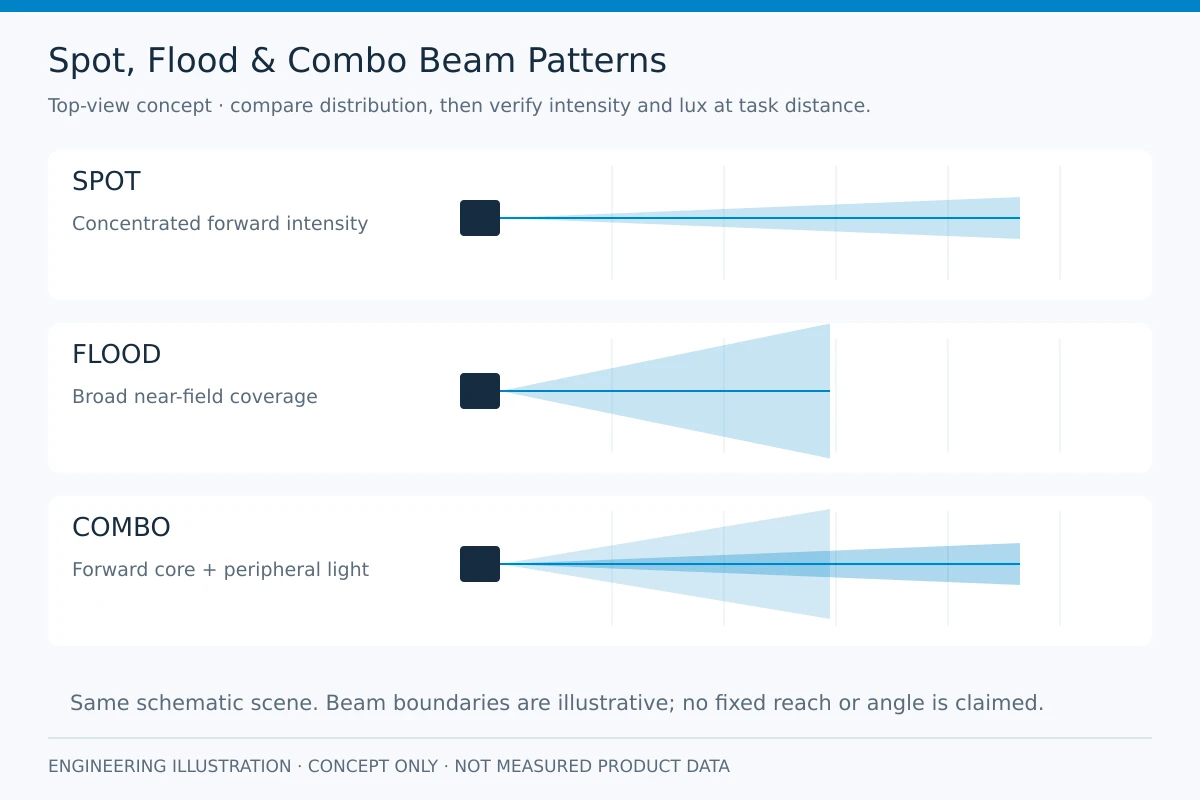
1.1 Spot beams: reach and concentrated intensity
A spot beam concentrates light into a relatively narrow angular area. Collimating lenses, specially designed reflectors, or hybrid optical assemblies increase peak luminous intensity (candela) in the forward direction. Compared with a flood lamp of similar emitted lumens, a spot beam can illuminate a smaller distant target more strongly; the actual distance depends on measured candela, atmospheric conditions, and the illuminance threshold chosen.
Nominal 10°–15° spot patterns are commonly marketed for long-range tasks, but a “500 m+” reach claim has little meaning without the lux criterion and supporting measurement. Buyers should obtain an intensity distribution or isocandela chart and a stated distance at a defined threshold, such as 1 lux or another task-appropriate level.
1.2 Flood beams: wide-area task illumination
Flood optics distribute light across a wider angle, often around 45°–60° or more depending on product design. The goal is useful area coverage and uniformity close to the machine, not maximum downrange intensity. Well-designed flood work lights reduce deep shadows around buckets, cutting edges, steps, access platforms, and the equipment perimeter.
Wide light can also create reflected glare from dust, rain, snow, or light-colored equipment surfaces. Mounting position, tilt, shielding, and the orientation of the work surface are therefore as important as the advertised beam width.
1.3 Combo beams: distance and peripheral coverage
Combo patterns use multiple optical zones—or separate modules—to place a higher-intensity region forward while retaining useful side coverage. Common implementations include a central spot cluster with wider outer optics. A combination lamp is convenient when mounting points are limited, but it should still be evaluated for whether its beam matches the real task: a mixed beam may underperform a dedicated spot or flood lamp in a specialized application.
| Pattern | Typical priority | Example applications | Main selection risk |
|---|---|---|---|
| Spot | High candela / longer reach | Fast off-road trails, distant inspection | Excessive near-field brightness or insufficient peripheral view |
| Flood | Broad area / near-field uniformity | Excavator boom, agricultural implement, work zone | Insufficient range; light spill into operator’s eyes |
| Combo | Forward reach + edge coverage | 4×4 and mixed-duty fleets | Unbalanced distribution; compromise at both extremes |
1.4 Spot vs Flood Beam Offroad Lights: Lumens, Candela, Lux and Beam Angle
Luminous flux (lumens) describes total photometric light output; luminous intensity (candela) describes output in a direction; illuminance (lux) describes light arriving on a surface. Raw LED-chip lumen estimates should not be confused with measured lumens emitted by the complete lamp. Driver input, optical losses, temperature, and current regulation influence delivered performance.
Beam-angle definitions also differ: some manufacturers quote the full width at half maximum intensity, while others use a different threshold or an informal “useful light” boundary. Always request the definition used. For comparisons, measure optical performance at stabilized operating temperature and use consistent conditions and distance.
2. TIR Lens Technology vs. Traditional Reflector Optics
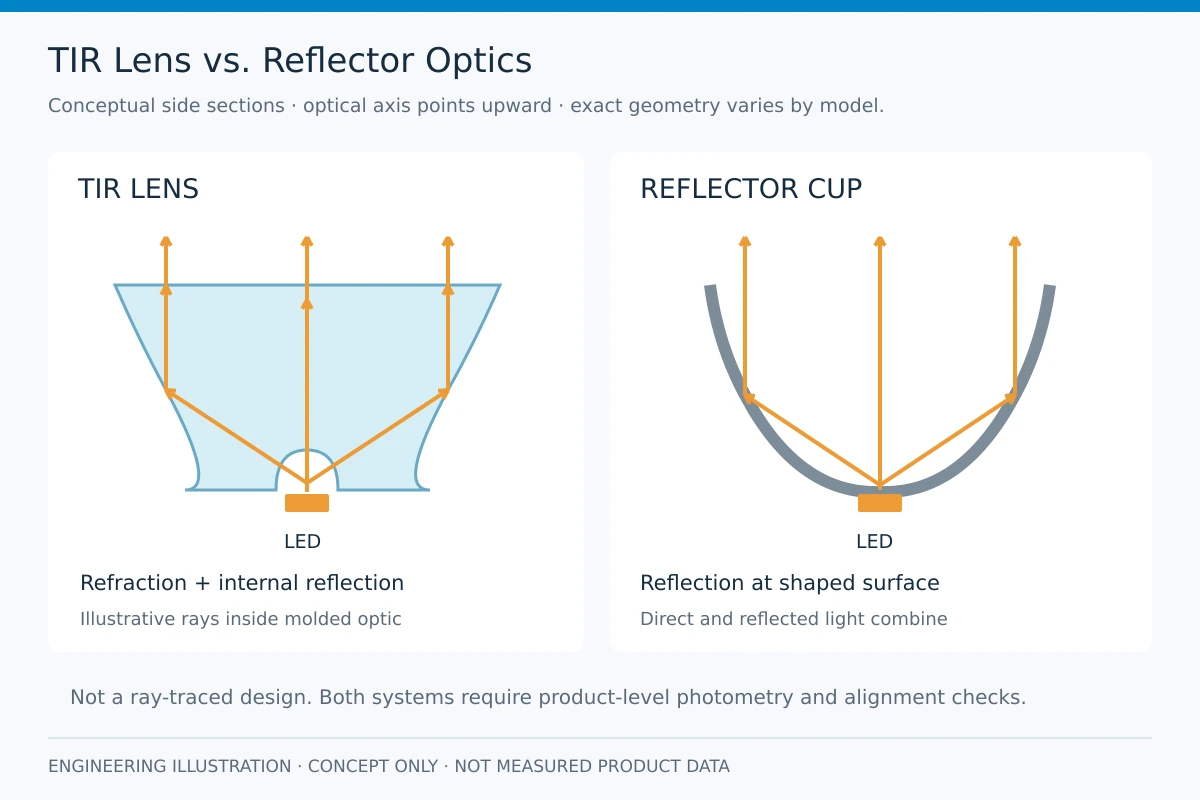
Traditional reflector designs use shaped reflective surfaces—sometimes combined with front lenses—to redirect LED emission. TIR lenses use refraction and internal reflection within a transparent optical medium to guide light into an engineered pattern. Both approaches can produce excellent work lights when properly designed.
TIR optics may provide compact control of several emitted angles and allow repeatable modular arrays. Reflector-based designs may offer advantages in cost, appearance, beam shaping, thermal separation, or serviceability. Neither architecture is intrinsically superior in every application; optical efficiency depends on geometry, materials, surface finish, alignment, and the exact LED package.
PMMA and polycarbonate (PC) are used for optical components. Select the actual material grade around optical performance, temperature, UV exposure, impact and chemical compatibility; validate the finished optic. Consult the LEDiL optical-material and installation resources when reviewing a supplier’s material data.
Compare optical efficiency only when product-level test reports use a documented and comparable method.
| Factor | Reflector-based system | TIR lens system | Buyer verification |
|---|---|---|---|
| Beam control | Shaped reflective surface; may pair with a cover lens | Internal reflection plus refraction in molded optic | Intensity map and beam-angle definition |
| Packaging | Reflector depth and LED placement affect footprint | Potentially compact modules with integrated beam shaping | Dimensions and LED-to-optic alignment |
| Material aging | Coating corrosion and reflector surface durability matter | Polymer UV/thermal aging and surface finish matter | Aging test and transmission/reflectance checks |
| Glare and spill | Depends on reflector geometry and shielding | Depends on lens design and shielding | Photometric readings beyond useful beam |
| Vibration behavior | Dependent on assembly fasteners and materials | Dependent on optic mounting and materials | Application-specific vibration testing |
| Optical principle | Reflection from shaped surface | Refraction plus total internal reflection | Ray trace and measured intensity map |
| Stray light management | Reflector profile and shielding | Lens surfaces and shielding | Off-axis photometry |
| Thermal considerations | Coating and substrate temperature limits | Polymer grade and local temperature limits | Stabilized output and component temperatures |
| Mechanical integration | Reflector retention and source alignment | Lens retention and source alignment | Fixture-specific shock and vibration |
| Manufacturing validation | Coating coverage and surface finish | Molding defects and optical surfaces | Sample-to-sample beam consistency |
3. Application Matching: Choosing the Right Light for the Job
3.1 High-speed off-road and long trails
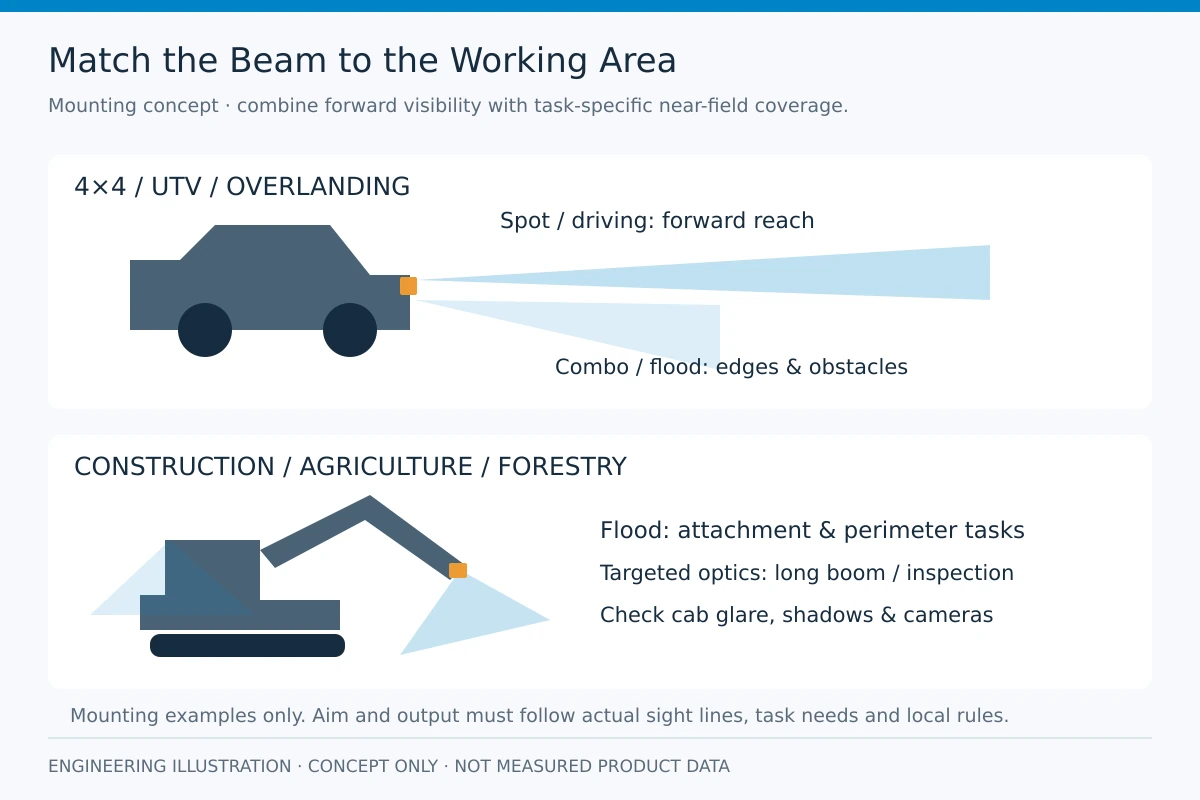
For faster off-road travel, forward visibility should support the driver’s available reaction and stopping distance, considering terrain, speed, weather, and braking performance. Spot or driving patterns can provide longer-range illumination, while additional side or corner lighting can improve awareness of curves and obstacles. Mounting high above the road is not automatically better: glare, reflections from dust, roof glare, and windshield reflections can reduce useful visibility.
3.2 Low-speed crawling and overlanding
Technical trails typically benefit from near-field width, obstacle contrast, and light at the sides of the vehicle. A combo system or separate forward and ditch lighting often provides a useful balance. Avoid prescribing a fixed percentage of “70% combo / 30% flood”: the suitable allocation varies with vehicle geometry, speed and terrain.
For 4×4 and UTV trail driving, evaluate the driver’s sight lines and available mounting points separately. Confirm the combined electrical load of forward, side and work lights, including the wiring and switching capacity, before adding lamps.
3.3 Construction, mining, and forestry equipment
Excavators, loaders, and forestry machines need light over work attachments, swing arcs, access areas, and perimeter hazards. Wide flood beams can help operators distinguish trench edges and moving equipment, while additional targeted optics may support long-boom reaches or inspection tasks. Evaluate working positions, attachment movement, camera visibility, reflected glare, and required task illuminance.
3.4 Agricultural machinery
Harvesters, tractors, and sprayers often benefit from forward mixed beams for travel plus wide side and rear work lights for implement monitoring. Lighting should be designed around the operator’s sight lines, crop or soil reflectance, equipment shadows and electrical-system capacity. Task-specific night trials provide better evidence than one universal beam-angle recommendation.
Important: Some auxiliary driving lights and off-road light bars are restricted on public roads. Verify mounting, aiming, switching and permitted use in the destination market before advertising any configuration as road legal.
4. Heavy-Duty Reliability: Vibration, Sealing, and Thermal Engineering
4.1 Mechanical endurance and mounting
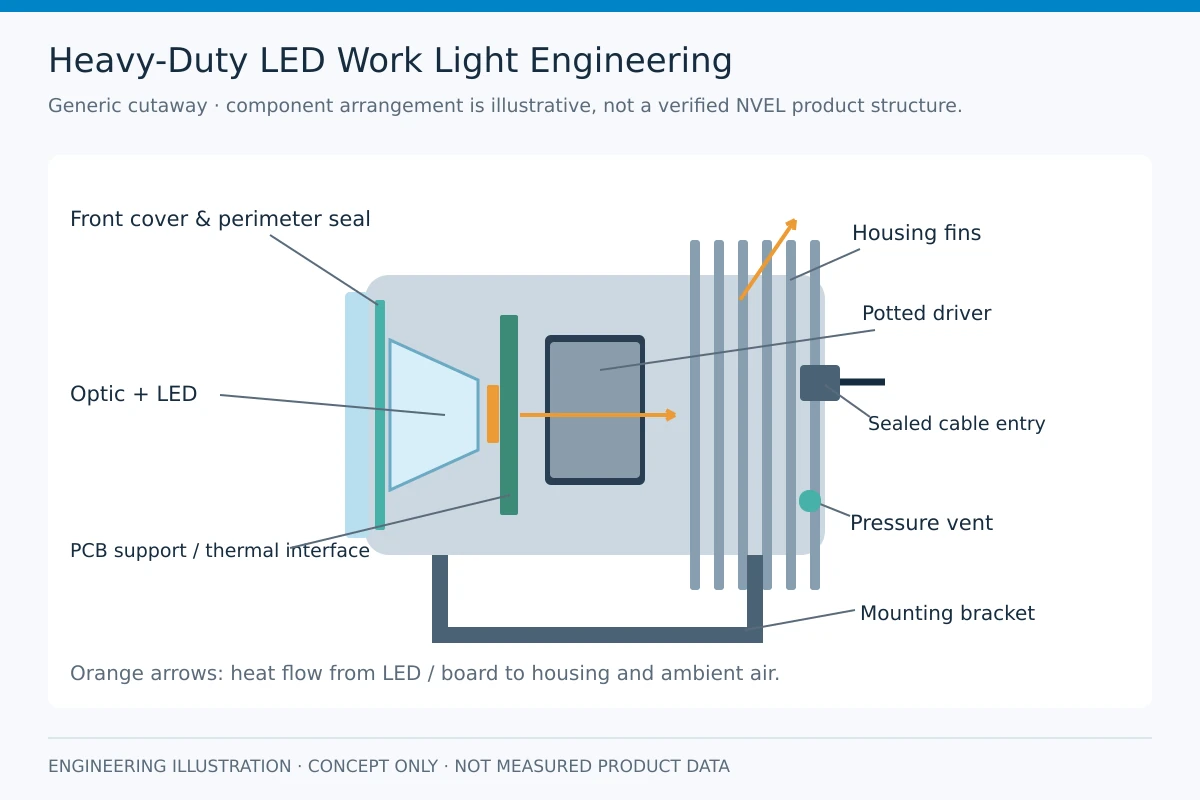
Off-road and industrial lighting faces continuous vibration, shocks, impacts, dust, and repeated temperature changes. Structural reliability depends on housing design, lens retention, fasteners, brackets, wire strain relief, and the interaction of PCB materials with the enclosure. Die-cast aluminum housings and stainless-steel hardware are common engineering options, but materials alone do not prove an assembly’s endurance.
A “50G shock” or “MIL-STD-810G” claim must identify the actual test method, pulse, axis, duration, sample mounting and acceptance criteria. ISO 16750-3 may be relevant to some vehicle electrical/electronic equipment; the suitability of its test profiles must be determined for the target installation. No certification or passing result should be claimed without a product-specific report.
PCB supports and controlled fastener loading help limit board movement. Driver potting can protect sensitive electronics, but its material properties, application and compatibility must be evaluated alongside component temperatures and assembly stress. Dow’s lighting-material guidance describes protection and thermal-management options; it does not certify the performance of a finished work light.
4.2 Ingress protection and condensation
Ingress-protection ratings are defined by specific test conditions. IP68 does not automatically include IP69-style high-pressure/high-temperature spray resistance. Appropriate gasket compression, vent design, cable entry, and connector sealing must be evaluated at the level of the complete assembly. Hydrophobic vents can equalize pressure, but they do not guarantee zero condensation under all environmental conditions.
4.3 LED junction temperature and driver protection
Long-term LED output depends on controlling junction temperature and other component temperatures. Heat travels through the LED package, board, interface and housing to ambient air. Passive fins, adequate metal contact, thermal interface materials and driver current regulation are all important. Temperature-related current reduction can improve protection, but the thermal threshold is model-specific; buyers should request the actual control strategy and measured temperatures for the selected lamp.
4.4 EMC and electrical compatibility
Switch-mode LED drivers may generate conducted and radiated electromagnetic emissions. Depending on equipment and market requirements, suppliers may test against relevant automotive EMC standards such as CISPR 25 and other applicable regulatory or OEM limits. A passing result for one test setup or class does not prove the light can never interfere with radios, GNSS, or machine telemetry in every installation.
5. B2B Sourcing Checklist for Off-Road and Work Lights
- Photometry: request measured lamp lumens, luminous-intensity maps, isolux charts, the lux-distance criterion and stabilized-temperature test conditions.
- Beam definition: document the beam-angle measurement method and verify output at relevant mounting distances and angles.
- TIR/reflector quality: inspect molded optics, surface finish, alignment, transmission or reflectance stability, and consistency between samples.
- Application fit: confirm target vehicle or machine mounting location, line-of-sight, power consumption, connectors, switching and environmental exposure.
- Thermal performance: review component temperatures, output stabilization, thermal derating and long-duration tests at representative ambient conditions.
- Mechanical testing: request vibration and shock reports with method, axes, fixture, duration and pass/fail criteria.
- Ingress and corrosion: verify IP test scope, connector sealing, humidity or salt-exposure plans and the applicable cleaning conditions.
- EMC: request conducted/radiated emissions reports with the exact tested configuration and relevant destination-market requirements.
- Quality consistency: inspect sample-to-sample beam uniformity, LED binning, seals, fastening torque and production inspection plans.
- Commercial validation: confirm warranty terms, agreed specification, traceability, MOQ, tooling ownership, packaging, and sample approval before bulk production.
- Effective light output: compare measured complete-lamp output with the raw LED-source figure under the agreed test conditions.
- Optical materials: confirm the resin or coating grade and its relevant environmental and chemical-compatibility data.
- Driver protection: document voltage range, startup behavior, thermal current reduction and the specified response to electrical faults.
- Sample approval: record the approved beam map, installation geometry, electrical measurements and sample identifiers before releasing the bulk order.
- Warranty and traceability: agree on batch identification, change notifications and the process for investigating field returns.
6. Frequently Asked Questions
Q1. What is the difference between raw lumens and effective lumens?
Raw lumens usually refer to an LED-source estimate derived from component specifications, while measured lamp lumens describe output emitted by the complete luminaire under stated test conditions. Lux and candela are different quantities: they describe illuminance and directional luminous intensity. A practical comparison should use measured photometry, not raw lumens alone.
Q2. Should I choose a spot beam or a flood beam for my off-road vehicle?
Choose according to task and mounting. A spot pattern prioritizes longer-range intensity; a flood prioritizes broad near-field coverage; a combo balances the two. Vehicle speed is relevant but does not create a universal cutoff—for example, “above 60 km/h always use spot.” Consider braking distance, terrain, visibility and local rules.
Q3. Are TIR lenses always superior to reflector cups?
No. TIR optics offer useful compact beam shaping, but reflectors can also achieve efficient, controlled distributions. Compare measured intensity maps, lamp-level efficiency, off-axis spill, material durability and installation constraints for each product rather than assuming a universal percentage advantage.
Q4. Why is EMC testing important for industrial LED work lights?
LED drivers contain electronic switching circuits that may emit electromagnetic noise. EMC testing evaluates whether emissions meet the relevant limits under defined conditions, helping buyers reduce the risk of interference with radios and other onboard systems. The appropriate standard, class and test configuration must match the intended market.
Q5. Can LED light bars be used on machines operating below freezing?
Yes, if the complete lamp and its components are specified and validated for those conditions. Review the documented operating-temperature range, startup behavior, moisture management, lens durability and relevant thermal cycling results. Do not assume that all products meet -40°C or other demanding ratings.
Q6. How can NVEL support B2B buyers choosing work-light optics?
NVEL can be approached to discuss off-road and heavy-duty lighting requirements, desired beam pattern, electrical interfaces, branding and sample evaluation. Buyers should request evidence for any model-specific claims about optical tests, IP ratings, EMC performance, manufacturing capability or quality-system certifications before relying on them in product listings.
Conclusion: Select the Beam You Can Measure
Effective off-road and heavy-duty lighting begins with an application-specific distribution of light rather than an attractive wattage or raw-lumen headline. Spot patterns favor concentrated forward intensity; flood patterns support broad working areas; and combo optics provide a compromise when several tasks share limited mounting locations. TIR and reflector systems can each perform well when design and manufacturing are controlled.
For B2B brands, the strongest supplier evaluation combines measured photometric data with documented vibration, environmental, thermal and EMC validation. These records help distinguish a dependable work-light program from unverified marketing specifications. Share your target vehicle, beam coverage, mounting geometry and market requirements with NVEL to discuss appropriate product and OEM/ODM sourcing options.
Discuss Your Off-Road & Work Lighting Requirements
Contact NVEL with your target market, product category, application requirements, anticipated order quantity and branding or customization needs.
Related Technical Guides


Technical Guides · LED Headlights