
TECHNICAL GUIDES · PRODUCT APPLICATIONS
How to Choose LED Off-Road Lights for Different Applications: A B2B Sourcing Guide
Match beam distribution, mounting and supplier evidence to desert travel, technical trails, camping and utility work.
By NVEL Editorial Team · 12 min read
Introduction
Choosing off-road lighting requires a clear understanding of where the vehicle operates and what the user needs to see. Desert travel, technical trails, camping and utility work place different demands on coverage, reach, power consumption and durability. For distributors, brands and commercial buyers, a useful specification connects those demands to documented product performance.
Learn how to choose LED off-road lights using beam distribution, installed visibility and supplier evidence. No single pattern suits every application.
Off-Road Lighting Applications
QUICK GUIDE
Compare useful reach, width and spill. A beam label or headline lumen figure does not describe the complete distribution.
Balance forward reach with route-edge visibility. Evaluate dust backscatter, mounting position and reflections from the vehicle.
Prioritize controlled near-field and side coverage. Protect lamps and wiring from rocks, debris and suspension movement.
Use independently switched scene lighting for the task. Aim away from people and allow for battery reserve.
Approve the exact configuration using samples, beam data, electrical specifications and relevant environmental test reports.
1. Understanding LED Off-Road Beam Patterns
Knowing how to choose LED off-road lights starts with the distribution of light, rather than a headline wattage or lumen figure. Reflectors, lenses and total internal reflection optics can concentrate output, spread it across a scene, or combine several distributions. The complete lamp, its mounting position and its aim determine what the driver actually sees.
Spot beams typically concentrate intensity in a relatively narrow forward region. They can support distant obstacle recognition on open terrain, but may leave trail edges and nearby hazards poorly illuminated. Flood beams distribute light more broadly and often suit slower maneuvering or stationary work. Their useful width, vertical spill and reach vary significantly between products.
Combo beams combine more concentrated forward illumination with wider coverage. Some lamps use separate optical zones; others achieve a blended distribution. A combo label does not guarantee an even transition or sufficient side visibility. Driving beams generally describe a forward distribution with useful width and reach. The term alone does not establish approval for use on public roads.
Beam angle depends on optical design and measurement thresholds; spot, flood and driving labels do not define universal angle ranges.
Lumens describe luminous flux: the total visible-light output. Candela describe luminous intensity in a particular direction. Lux describe illuminance on a target surface. A high center-point lux reading can coexist with poor peripheral coverage, so it cannot represent the complete beam. Distinguish measured lamp output from theoretical LED-chip figures.
For distance comparisons, require a stated test distance, supply voltage, thermal stabilization period, sensor orientation and mounting geometry. Compare a grid or contour map as well as peak intensity. Night photographs can support evaluation, but exposure settings and scene reflectance prevent uncontrolled photographs from serving as reliable photometric measurements.
| Beam Type | Typical Characteristics | Potential Applications | Key Limitations |
|---|---|---|---|
| Spot Beam | Concentrated forward intensity | Open terrain with long sight lines | Limited peripheral or near-field coverage |
| Flood Beam | Broader area distribution | Slow trails and stationary work | Reach and vertical spill vary by design |
| Combo Beam | Blended or separate narrow and wide components | Mixed terrain and limited mounting space | Coverage balance must be measured |
| Driving Beam | Forward reach with useful width | Forward auxiliary illumination where appropriate | Name does not establish road-use approval |
2. Lighting for Desert and High-Speed Open Terrain
Faster travel on open terrain generally calls for earlier recognition of distant changes in the route. A concentrated forward component may be useful alongside enough width to identify turns, surface transitions and hazards outside the center line. The required visibility depends on speed, braking conditions, terrain and driver response; extra lights do not make a particular speed safe.
Dust and sand scatter light back toward the observer. Increasing intensity does not guarantee improved visibility in a dust plume and can increase apparent glare. No spot beam can be assumed to penetrate a dust storm. Reduce speed when visibility deteriorates, and evaluate beam placement and aim in representative conditions rather than relying on a color or power claim.
Roof mounting is one possible arrangement, not an automatic preference. Higher lamps may illuminate airborne particles and reflect from the hood, windscreen or equipment. Bumper or grille positions can reduce some reflections, but introduce their own obstruction, impact and cooling constraints. Check sight lines, body reflections and the lamp’s vertical distribution before approving the mounting location.
Long operation on corrugated tracks also demands stable brackets and electrical capacity. Verify vibration testing with the intended bracket, fastener retention and strain relief. Specify operating voltage, current draw, wire size, fuse protection and switching arrangements. Higher wattage increases load and heat; useful visibility depends on optical efficiency, distribution and installation.
3. Lighting for Rock Crawling and Forest Trails
At low speed, near-field illumination, side visibility and obstacle recognition often matter more than maximum forward reach. Drivers need to see rocks, ruts, roots, ledges and the wheel path without creating distracting glare. Broad, controlled illumination can be a starting point, but every flood beam must be evaluated for its actual coverage and brightness balance.
For rock crawling, consider protected forward and side positions that reveal the terrain near the tires. Separate zones can help passengers or spotters work around the vehicle. Avoid placing exposed lamps where rocks, suspension movement or debris can damage them. Underbody installations require careful assessment of wiring protection, ground clearance and service access.
Forest trails combine short sight lines, bends and objects above or beside the route. A broader forward pattern with controlled side coverage may help recognize branches and trail edges, while a modest distance component can support occasional clear stretches. Aim lamps to prevent bright reflections from vegetation immediately in front of the driver.
Polycarbonate lenses can provide useful impact resistance, but are not unbreakable. Ask about the lens grade, coating, abrasion resistance, chemical compatibility and impact test conditions. Housing materials, corrosion protection and mounting design also influence durability. A stainless bracket designation alone cannot establish fatigue strength or resistance to every corrosive environment.
Water protection needs the same care. IP67 addresses dust exclusion and temporary immersion under specified conditions. IP68 addresses dust exclusion and immersion under conditions specified for the product; it does not mean unlimited depth or duration. IP69 and IP69K refer to high-pressure, high-temperature water-jet protection under their applicable standards and test procedures.
Request the standard and edition, tested model, configuration and full report. Immersion and jet tests address different exposures and should not be treated as interchangeable evidence. Mud, chemicals, damaged seals and repeated cleaning can introduce conditions beyond a laboratory test. Follow the manufacturer’s cleaning limits for pressure, temperature, distance and nozzle placement.
4. Lighting for Camping, Overlanding and Utility Work
When the vehicle is stationary, lighting should suit the task: setting up camp, preparing equipment, inspecting cargo or carrying out repairs. Wide-angle work lights can cover a useful area with less need for long-range intensity. Several separately switched zones may be more practical than one powerful lamp that lights every direction at once.
For camping, consider low-level side and rear illumination aimed away from neighboring sites. Adjustable output can reduce glare and unnecessary power consumption. Check current draw at the actual battery voltage and estimate operating time using usable battery capacity, other loads and reserve requirements. A low nominal wattage is useful only if the lamp provides adequate task illumination.
Amber, warm-white and cool-white appearances involve practical tradeoffs. Some users prefer warmer light in certain scenes, but amber does not always improve visibility through dust. Beam direction, airborne particles, intensity and observer geometry remain important. Yellow light cannot be promised to repel insects; insect responses vary with spectrum, intensity and species.
Dual-color lamps can provide flexibility, but add switching behavior and optical consistency to the assessment. Compare output and distribution in each mode, how the lamp starts after power cycling, and whether controls suit the intended application. Dual color is not inherently preferable to a well-chosen single-color lamp.
Utility work may require lighting a defined inspection or loading area rather than the widest possible scene. Avoid shadows at the work surface, direct glare toward workers and confusing spill toward traffic. Vehicle-mounted work lighting may be subject to local restrictions on color, installation and operation, especially near public roads.
5. Application Selection Guide
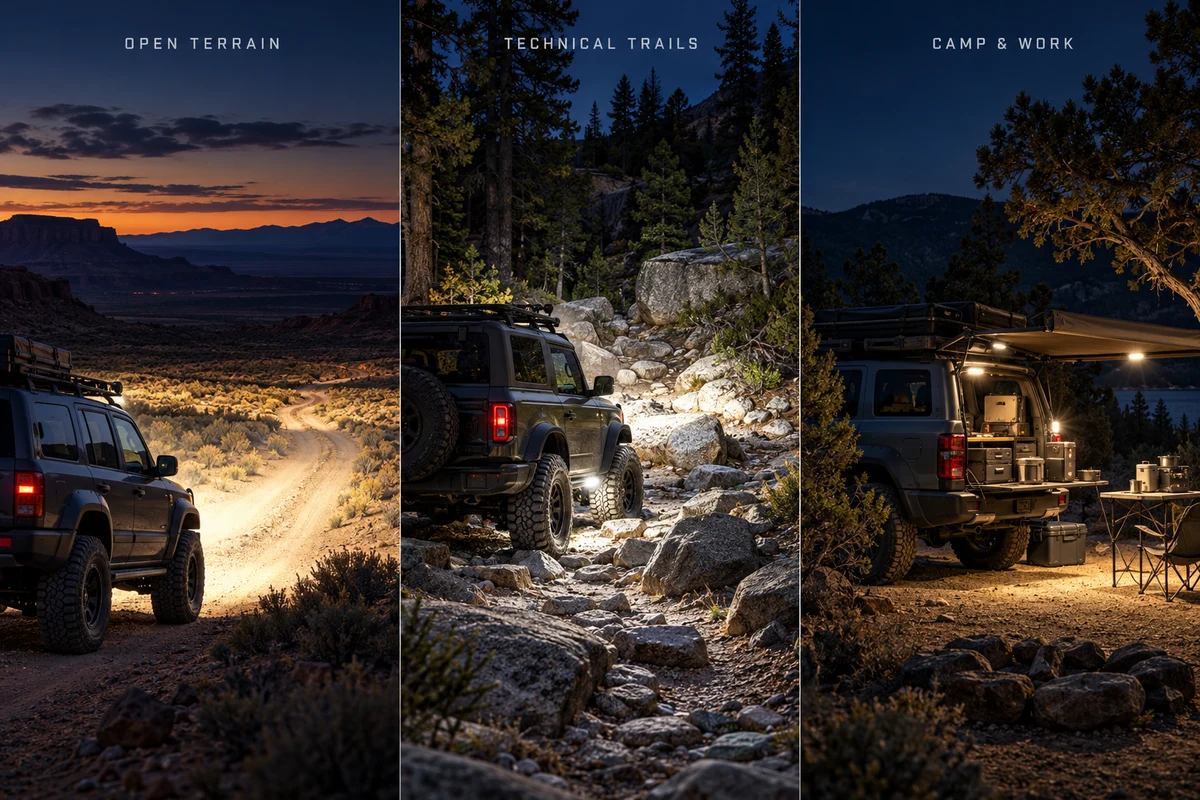
Desert / Open Terrain
Consider a concentrated forward component plus sufficient width for route changes. Check body reflections, aim and electrical load. Dust backscatter and restricted sight distance limit the benefit of additional output.
Rock Crawling
Prioritize controlled near-field and side coverage. Protect lamps and wiring from impact and suspension movement. Excessive brightness or poorly aimed light can hide terrain detail in glare.
Forest Trails
Consider broader forward coverage with useful edge visibility. Check branches, rack obstructions and reflections from nearby vegetation. Short sight lines still require conservative speed.
Camping
Consider wide, lower-output scene lighting with independent zones. Aim away from people and monitor battery reserve. Color preferences and insect response should not be treated as performance guarantees.
Utility Work
Match light distribution to the work surface and access route. Position lamps to reduce shadows and worker glare. Check restrictions when work takes place near public traffic.
6. B2B Off-Road Lighting Sourcing Checklist
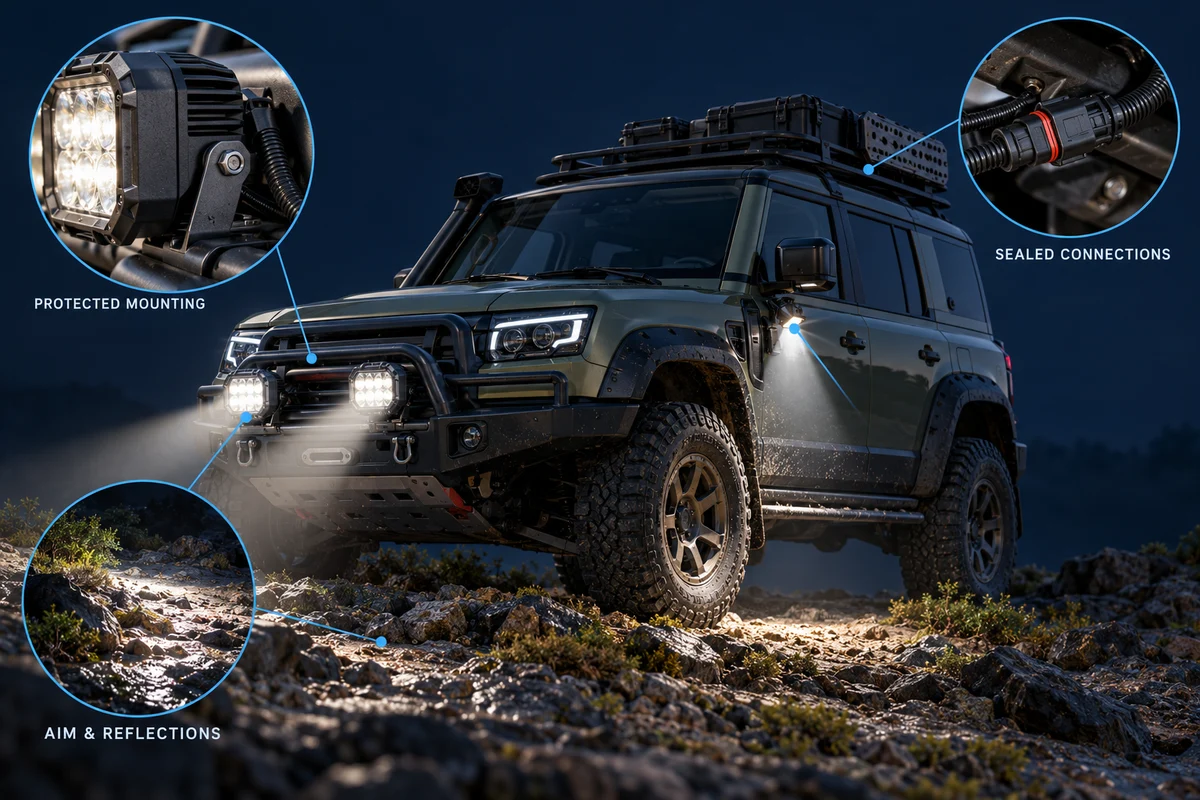
Match specifications to target vehicles, terrain, operating speed and tasks. No lamp category guarantees higher margins or faster stock turnover.
- Target Vehicle Applications: Record vehicle type, installation position, clearance, intended operating environment and duty cycle. Separate stationary work requirements from forward driving requirements, and state whether any road-use claim is required in the destination market.
- Beam Pattern Data: Request distribution plots and a clear definition of beam angle. Compare side coverage, vertical spill, hotspot shape and transitions. Evaluate a sample system on the intended vehicle rather than approving solely from a catalog label.
- Photometric Testing: Check measured luminous flux, directional intensity and illuminance maps with stated voltage, distance and stabilized temperature. Confirm whether results apply to the exact optical version and color mode being purchased. Agree acceptance criteria and retain approved samples.
- Environmental Protection: Review ingress reports, housing and lens materials, corrosion tests, seal design and condensation management. Check thermal performance during extended operation. A large heatsink is not proof of adequate cooling in a restricted installation, and thermal protection behavior should be documented.
- Vibration Testing: Ask for frequency range or vibration profile, duration, mounting configuration and post-test inspection. Include bracket movement, loose fasteners, connector retention and optical aim in sample evaluation. Test reports should identify the model and relevant configuration.
- Electrical Specifications: Verify voltage range, stabilized current, startup behavior, polarity protection and relevant electromagnetic compatibility evidence. Specify harness, connector sealing, relay or switching capacity and fuse requirements. Check compatibility with the actual vehicle electrical system.
- Mounting Hardware: Confirm adjustment range, torque instructions, material finish, load capacity and service access. Assess corrosion and fatigue resistance for the intended environment without requiring a particular membrane brand or fixed stainless-steel grade for every application.
- Regulatory Requirements: Road-use restrictions vary by market, lamp category, installation location and operating mode. Confirm applicable equipment and installation rules with qualified local support. A driving-beam description or an off-road label is not a road approval. Products designated Off-Road Use Only must not be represented as road-approved.
- Supplier Documentation: Request traceable specifications, applicable test reports, installation instructions, warranty terms and change-control arrangements. Define exclusions, claim handling, spare parts and responsibilities before ordering. Quality-system certification supports supplier assessment but does not certify every lamp or installation.
7. Frequently Asked Questions
What is the difference between lumens and lux?
Lumens quantify luminous flux; lux quantify illuminance on a surface. Candela quantify intensity in a direction. Compare lux only with the stated distance and conditions, and examine the full distribution. Neither total lumens nor a single lux reading establishes complete lighting performance.
Can one light bar provide both spot and flood lighting?
A combo design can combine concentrated forward output with wider illumination. Optical layouts differ, so do not assume that every lamp uses central spot optics and outer flood optics. Request a distribution map and check whether its coverage suits the application.
Is amber better than white for dusty trails?
It can be a user preference, but there is no universal dust-penetration advantage. Dust backscatter, beam aim, mounting height and intensity affect visibility. Compare representative conditions and reduce speed when visibility is limited; color cannot compensate for an unsafe sight distance.
How does IP68 differ from IP69K?
IP68 concerns immersion under specified product conditions. IP69K concerns high-pressure, high-temperature jet exposure under the cited test standard. IP69 under IEC terminology should also be identified precisely. These ratings do not automatically establish identical protection or resistance to every washing situation.
Why does internal condensation occur?
Moisture can condense as temperature changes. Sealing, residual humidity, vent design and thermal cycles influence the result. Brief misting and persistent droplets require different assessment. Follow supplier guidance and investigate persistent moisture or electrical symptoms; no named vent brand guarantees elimination of condensation.
Are LED off-road lights legal on public roads?
Legality depends on the market, lamp function, mounting, switching and actual use. Avoid blanket claims that all light bars are legal or illegal. Check local requirements and model-specific documentation. Off-Road Use Only products must not be sold as road-approved lighting.
Does NVEL offer off-road lighting for B2B buyers?
NVEL offers an LED off-road lighting range for B2B buyers. Confirm current model availability, beam data, customization options and relevant test documents with the team. Product ratings and available configurations should be checked for the exact model.
Key Takeaway
Specify lighting for what the driver or worker needs to see. Verify the complete installed system and supporting supplier evidence rather than selecting on wattage, color or a single brightness figure.
Conclusion: Match Lighting to the Application
Choosing LED off-road lights starts with the terrain, operating speed and task. Evaluate forward reach, side coverage, glare and mounting together, then check electrical load, environmental protection and service access for the intended vehicle.
For B2B sourcing, compare the exact optical configuration using documented test conditions and representative samples. Agree acceptance criteria, installation guidance and change control before approving a bulk order.
NVEL brings 25+ years of automotive lighting manufacturing experience to B2B sourcing discussions. Review the published LED Off-Road Lights range and share your target vehicles, beam requirements, installation constraints and destination markets. Confirm the scope of any OEM/ODM project and its supporting documents before placing an order.
Discuss Your Off-Road Lighting Application
Share your target vehicles, terrain, beam requirements, installation constraints and destination markets with NVEL. Confirm the available product configuration and supporting documents before ordering.
Related Technical Guides
LED Off-Road Lights · Technical Guides
Lumens vs. Lux: How Bright Should Off-Road LED Lights Really Be?
LED Off-Road Lights · Technical Guides
Spot vs. Flood vs. Combo Beam: Which Off-Road Light Pattern Do You Need?
LED Off-Road Lights · Technical Guides