
TECHNICAL GUIDES · LED OFF-ROAD LIGHTS
Lumens vs. Lux:
How Bright Should Off-Road LED Lights Really Be?
A practical guide to total output, beam intensity, and useful off-road visibility.
October 7, 2026 · 10 min read
When evaluating auxiliary lighting performance, understanding lumens vs lux off road led lights brightness metrics is essential for automotive engineers and procurement managers. While raw lumens measure total luminous output.
Useful visibility depends on a combination of total light output, directional intensity, optical efficiency, beam distribution, mounting, and aiming. Understanding lumens, lux, and candela helps buyers separate theoretical component claims from meaningful complete-lamp performance.
This guide explains the three measurements, why two lights with similar lumen output can perform differently, and how distributors, brands, vehicle builders, and professional buyers can compare off road light lumens without relying on a single marketing figure.
Five Factors Behind Useful Off-Road Light
QUICK GUIDE
Quick Answer: lumens vs lux off road led lights
Lumens measure the total amount of visible light produced by a source. Lux measures how much of that light reaches a surface. For off-road driving, useful visibility depends not only on lumen output, but also on directional intensity, optical efficiency, beam pattern, aiming, and where the light is distributed across the trail.
A lumen figure can help describe overall output, but it cannot show beam reach or coverage by itself. Lux values become meaningful only when the measurement distance, position, test conditions, and beam pattern are also known.
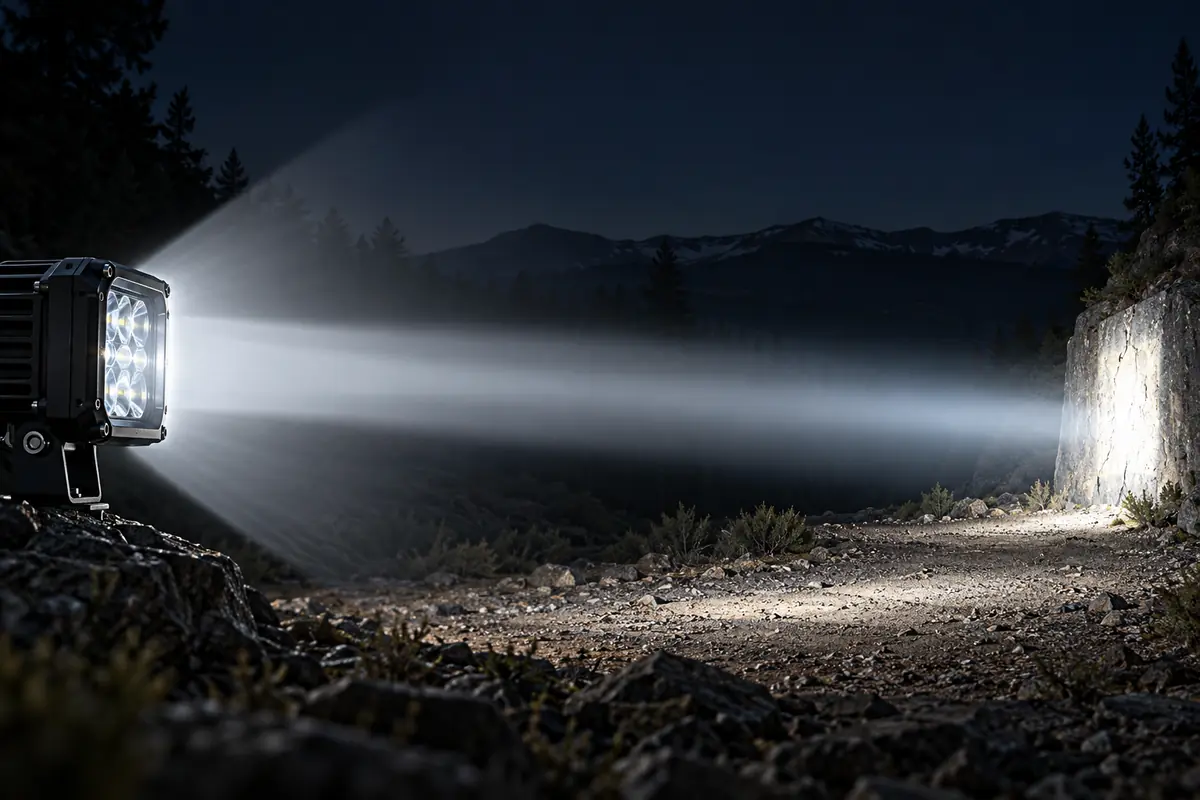
01 · Lumens: Measuring Total Light Output
A lumen is a unit of luminous flux: the total quantity of visible light emitted in all directions. For a complete lamp, a measured lumen value can describe total output, but it does not indicate whether that output forms a narrow long-range beam, a wide flood pattern, or uncontrolled glare.
What Are Raw Lumens?
Raw lumens are commonly calculated from the nominal output of the LED packages multiplied by the number of emitters. This theoretical figure may be useful for preliminary component comparison, but it does not represent complete-lamp output. It can omit actual operating current, driver losses, temperature, lens transmission, reflector efficiency, and assembly variation.
What Are Measured or Effective Lumens?
Measured or effective lumens refer to output from the assembled light under defined test conditions. The result may be lower than a theoretical raw-lumen calculation because the complete system includes electrical, thermal, and optical losses. The size of the difference is not universal. It depends on LED operating current, driver efficiency, thermal conditions, optical design, lens transmission, test duration, and measurement method.
Compare only data produced under equivalent voltage, temperature, duration, and measurement conditions.
02 · Lux: Measuring Light on the Road or Trail
Lux measures illuminance: the amount of luminous flux reaching a surface area. One lux equals one lumen per square metre. In practical terms, lux helps describe how much light arrives at a point on the trail, obstacle, or test screen rather than how much light leaves the lamp in total.
Why Distance Matters
Illuminance falls as the measurement point moves away from the source. Beam shape also changes how quickly useful light is distributed across distance and width. A lux claim without a stated distance and measurement position therefore provides little basis for comparison. Test voltage, mounting orientation, warm-up time, and the exact point within the beam should also be reported.
What Does “1 Lux Distance” Mean?
The auxiliary-lighting industry often uses 1-lux distance to describe beam reach: the distance at which illuminance at a specified point falls to one lux. It can be a useful comparison indicator when products are tested consistently, but it is not a universal safety threshold for every vehicle, speed, terrain, or weather condition.
03 · Lumens, Lux and Candela: What’s the Difference?
Candela measures luminous intensity in a particular direction. It helps describe how strongly a lamp concentrates light along a beam axis. Lumens describe total output; candela describes directional intensity; lux describes the light arriving at a surface.
| Metric | Symbol | What It Measures | Why It Matters | Limitation |
|---|---|---|---|---|
| Lumens | lm | Total luminous flux | Describes total visible output | Does not show direction or beam shape |
| Candela | cd | Intensity in a direction | Helps describe concentration and reach | Does not show the full beam distribution alone |
| Lux | lx | Illuminance on a surface | Shows light arriving at a defined point | Depends on distance, position, and test conditions |
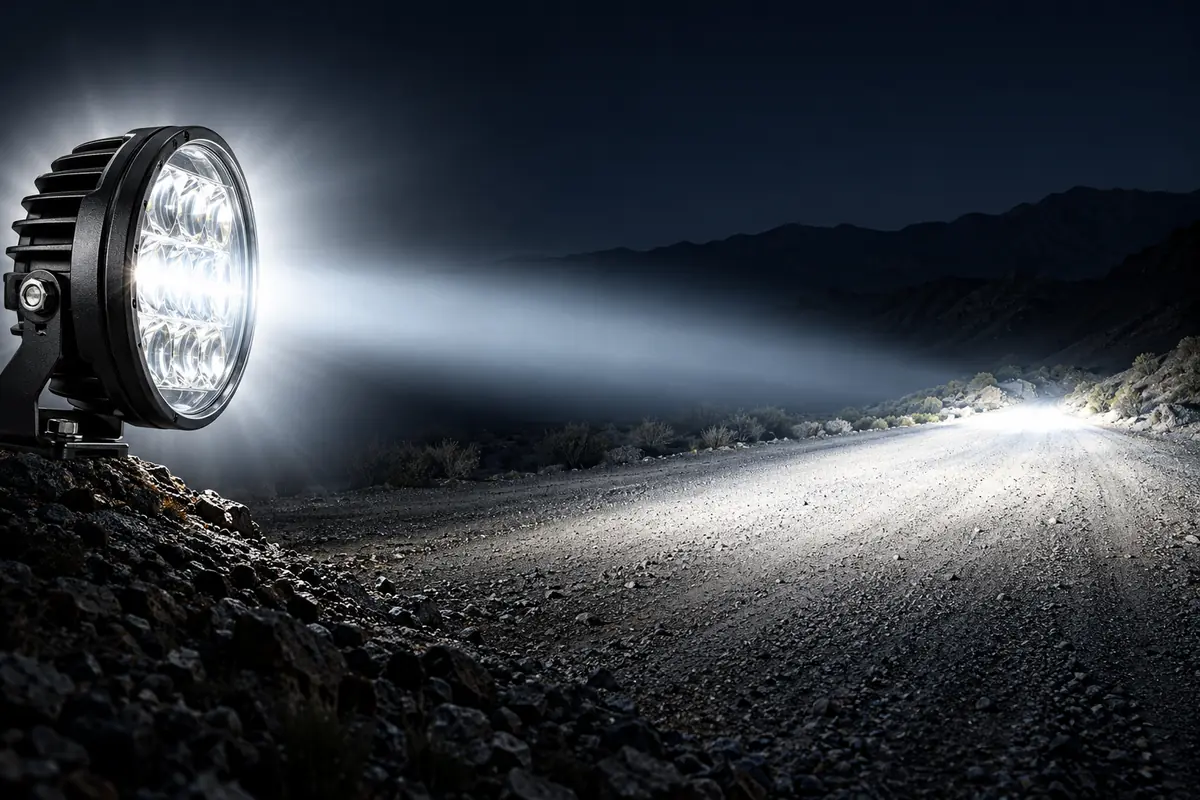
For an idealized point source, illuminance can be approximated as candela divided by distance squared. Real automotive auxiliary beams are not simple ideal point sources, however. Their output is shaped by reflectors, TIR optics, lenses, multiple emitters, and near-field geometry. Complete photometric data, beam plots, stated test distances, and controlled measurements provide a more reliable basis than calculations made from a single advertised number.
04 · Why More Lumens Do Not Always Mean Better Off-Road Visibility
A high-lumen lamp can spread much of its output into an overly bright foreground, uncontrolled side spill, or upward glare. That light still contributes to the lumen total, yet it may reduce visual comfort and make darker distant areas harder to interpret. A lower-lumen lamp with accurate optics can concentrate more intensity on a relevant target and produce higher lux at that location.
Optical design controls beam concentration, spread, uniformity, and transitions between bright and dark areas. Mounting height and aiming determine where the pattern lands. Thermal performance also matters because output can change as the lamp heats. The useful result is therefore a system property, not a simple consequence of adding LED package ratings.
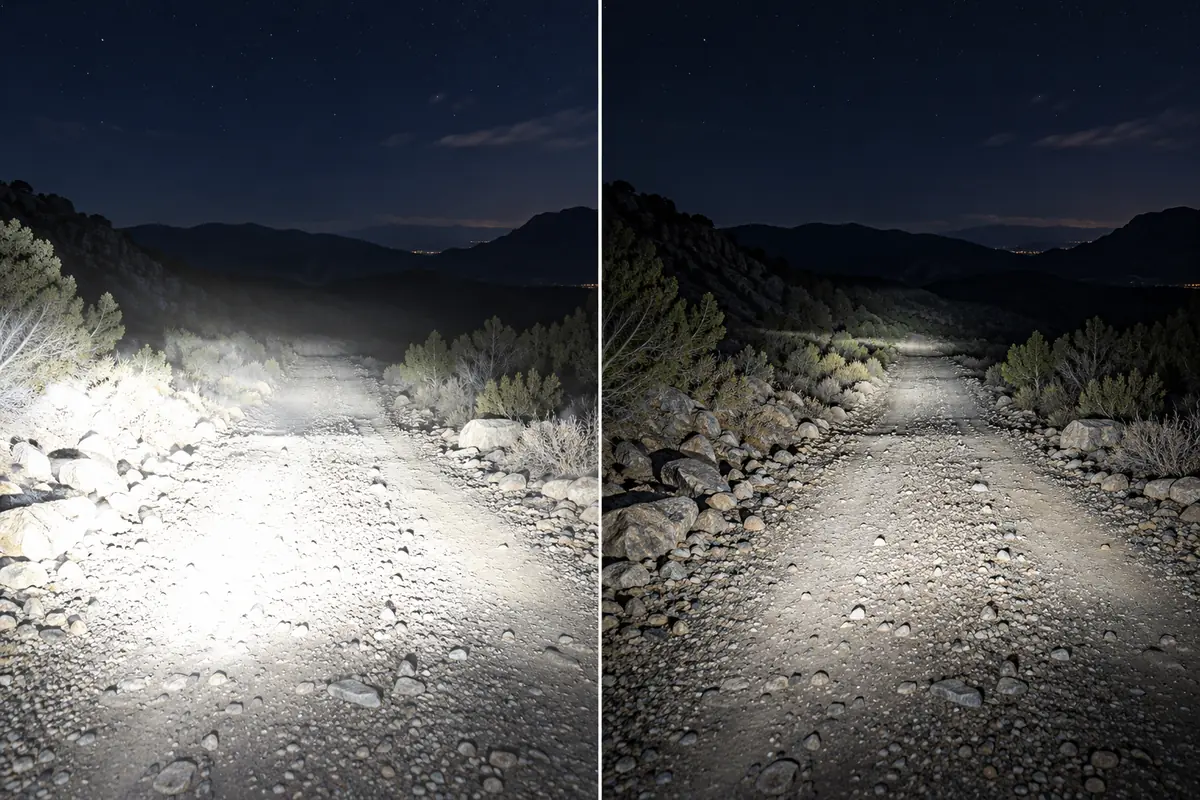
Conceptual comparison: Light A may have higher total lumen output but poorly controlled distribution. Light B may have lower total output but a more focused and uniform pattern. At a distant target, Light B can deliver greater illuminance without claiming more total lumens.
05 · How Beam Pattern Changes Useful Light
A spot beam concentrates directional intensity for greater forward reach. A flood beam spreads light across the near and peripheral field. A combo beam blends forward intensity with wider coverage. Each pattern can use a similar total lumen output while producing a very different lux distribution on the trail.
This article focuses on brightness measurements. For application-specific pattern selection, see NVEL’s guide to spot, flood and combo beam patterns. Keeping the measurement question separate from the pattern-selection question helps buyers avoid assuming that one beam type or one lumen number is universally superior.
How Bright Should Off-Road LED Lights Really Be?
There is no universal lumen target for every vehicle or route. Required performance changes with beam pattern, optical efficiency, lamp quantity, mounting height, aiming, vehicle speed, terrain, weather, and the measurement method used by the manufacturer.
Low-Speed Technical Trails
Prioritize wide usable illumination, foreground detail, peripheral visibility, and controlled glare. At low speed, seeing rocks, ruts, trail edges, and wheel-placement areas usually matters more than maximizing long-range center intensity.
General Overlanding and Dirt Roads
Look for a balanced combination of forward distance, beam width, and smooth transitions. A controlled combo pattern or a coordinated multi-lamp setup can support changing terrain without creating an excessively bright near field.
Higher-Speed Open Terrain or Desert Driving
Greater forward reach and controlled directional intensity become more important because the vehicle covers distance quickly. Beam stability, precise aiming, and adequate peripheral awareness remain essential. A large raw-lumen claim cannot substitute for verified reach and suitable distribution.
How to Compare Off-Road LED Light Brightness Before Buying
- Confirm the output type: Determine whether the lumen figure is theoretical, calculated, initial, or measured from the complete lamp.
- Review beam-pattern evidence: Ask for comparable beam images or photometric distribution data rather than judging total output alone.
- Check lux and distance together: A lux value should identify the distance, measurement point, voltage, orientation, and test conditions.
- Compare consistent methods: Results from different laboratories or procedures may not support a direct numerical comparison.
- Evaluate optics and thermal control: Lens transmission, reflector accuracy, driver efficiency, heat management, and stabilized output affect usable performance.
- Include the installation: Power consumption, wiring capacity, mounting position, lamp quantity, and aiming influence the final result on the vehicle.
Brightness is only one part of quality. Buyers evaluating durability, sealing, electronics, thermal management, and mounting should also review What Makes a Truly High Quality Off-Road LED Light? and compare suitable products in the NVEL LED Off-Road Lights range.
Common Mistakes When Comparing Off-Road Light Brightness
- Comparing raw lumen numbers without checking complete-lamp measurements.
- Ignoring beam pattern and assuming all output reaches the same area.
- Comparing lux values measured at different distances or positions.
- Treating results from different test methods as directly equivalent.
- Assuming wattage directly equals visible output or useful brightness.
- Ignoring glare, hot spots, and excessive foreground illumination.
Frequently Asked Questions
Are lumens or lux more important for off-road lights?
Both describe different aspects of performance. Lumens show total output, while lux shows light reaching a surface at a defined location. Buyers should evaluate them with candela, beam distribution, distance, and test conditions.
What does 1 lux distance mean?
It is the distance at which a specified point in the beam measures one lux. It can describe reach when test conditions are consistent, but it is not a universal safe-driving threshold.
Do more watts mean more lumens?
Not necessarily. Wattage describes electrical power consumption. LED efficiency, driver design, operating current, thermal conditions, and optical losses determine how much visible and useful light the system produces.
Can a lower-lumen light illuminate farther?
Yes. A lamp with lower total output can deliver higher illuminance at a distant target if its optics concentrate more intensity in that direction.
What is the difference between lux and candela?
Candela measures luminous intensity in a direction. Lux measures illuminance arriving on a surface. Distance and beam geometry connect the two, but real auxiliary lights should be assessed using measured photometric data.
How should I compare two off-road LED lights?
Compare complete-lamp measured output, beam pattern, lux data at stated distances, photometric test conditions, thermal stabilization, power consumption, and the intended mounting and driving application.
Does beam pattern affect lux?
Yes. Concentrating light into a smaller area can increase lux at points within that beam, while distributing the same output across a wider area changes the illuminance pattern and peripheral coverage.
Browse more practical lighting resources in the NVEL Technical Guides Hub.
Choose Off-Road Lighting Based on Useful Performance
Do not compare raw lumen claims alone. The right lighting choice should also account for beam pattern, optical performance, vehicle application, mounting position, and aiming. NVEL can help professional buyers evaluate suitable off-road lighting options for their project requirements.