
TECHNICAL GUIDES
Best H11 LED Headlight Bulb? How to Compare Brightness, Beam Data & OEM Evidence
Compare brightness claims using beam data, thermal stability and OEM evidence.
November 6, 2026
Introduction
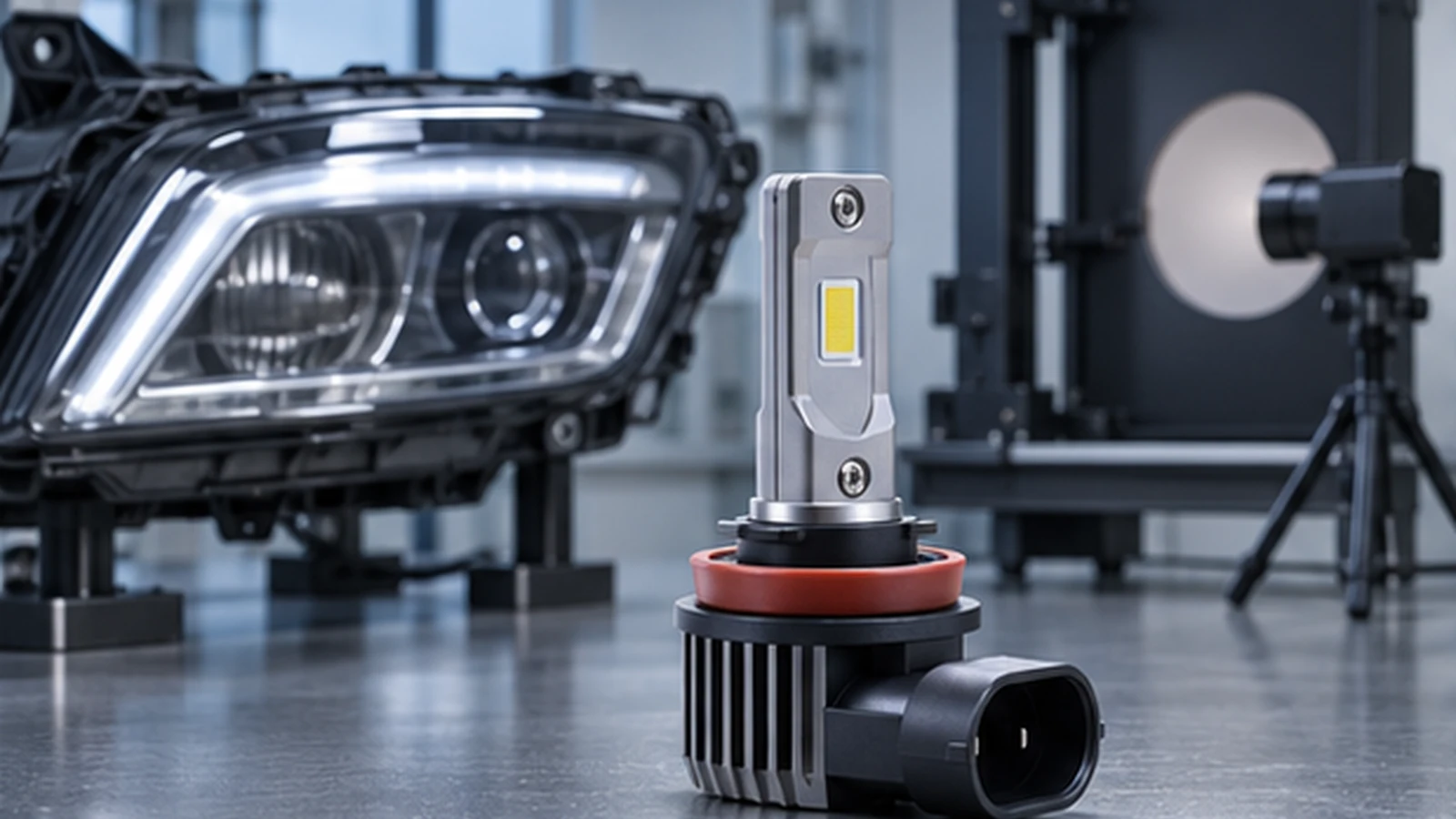
H11 LED headlight bulbs are often marketed with superlatives such as best, brightest, or ultra-high output. For a distributor, aftermarket brand, or OEM buyer, those words are useful search terms—but they are not engineering evidence. A bulb can post a large lumen figure yet deliver uneven illumination, excessive stray light, unstable output after warm-up, or an application that is not permitted for road use in the target market.
The right comparison starts with the exact H11 SKU and the exact headlamp system. Buyers need to know how the output was measured, whether the figure describes one bulb or a pair, what happens after the unit reaches thermal equilibrium, and whether the completed lamp is suitable for the intended vehicle and jurisdiction.
This guide focuses on performance evidence and sourcing decisions for H11 LED headlamp replacement programs. It does not repeat the H11 base, H8/H9 cross-reference, or basic fitment tutorial; use NVEL’s existing bulb-type and socket-fitment guides for those topics. It also does not assume an H11 headlight bulb is suitable for an H11 fog-lamp application. The exact lamp function, vehicle, and market must be defined first.
Table of Contents
H11 LED Headlight Bulb Performance
QUICK GUIDE
Define the H11 application and the evidence layers before comparing products.
Audit lumens, lux, candela, sample basis, and test conditions.
Evaluate the complete headlamp distribution, not a bare-bulb number.
Compare warm-state output and vehicle electrical behavior.
Verify compliance, traceability, and sample-to-production controls.
What Makes the Best H11 LED Headlight Bulb? Start With Evidence
There is no universal winner that can be called the best H11 LED headlight bulb for every vehicle, headlamp, and market. A useful product comparison asks whether a specific bulb revision performs consistently in a defined application and whether the evidence supports the intended use. A high wattage, a large LED-chip count, a high color-temperature number, or a headline lumen figure cannot answer that question by itself.
Define the comparison before ranking products
Start with the vehicle year, make, model, trim, destination region, headlamp assembly identification, original light-source designation, and intended beam function. Confirm whether the target lamp is a replaceable-bulb headlamp or an integrated LED assembly. H11 is a bulb category, not a universal vehicle-fitment list, and the same vehicle name can have different headlamp equipment across trims and markets.
For the basic differences among H4, H7, H11, 9005, and 9006, see NVEL’s existing bulb-type guide. Search listings may reverse the word order—“LED H11 headlight bulbs,” “H11 headlight bulb LED,” “LED H11 headlight bulb,” or “LED headlight bulb H11.” These are catalog and search-language variants, not separate bulb standards; compare the underlying SKU, base, driver, application, and test report rather than treating the wording as a different product category. For H11 base and retaining details, use the H7 vs. H11 vs. 9005 socket-fitment guide. This article deliberately leaves those foundational topics to the existing pages and concentrates on performance evidence.
Separate four evidence layers
- Application evidence: exact vehicle and headlamp identification, intended function, installation instructions, and any documented exclusions.
- Optical evidence: measured output and the complete headlamp’s beam distribution under a defined test method.
- Thermal and electrical evidence: input conditions, warm-state output, temperature behavior, startup, and vehicle-electronics response.
- Regulatory and production evidence: market-specific approval status, exact SKU/revision, sample records, and production change control.
Compare like with like
A meaningful comparison fixes the test article and test conditions before results are collected. Record the bulb SKU and revision, the headlamp part number, the supply voltage at the product terminals, ambient temperature, mounting orientation, aiming method, measurement distance, instrument and calibration status, and the time at which each reading is taken. State whether the result is for one bulb or a pair. If any of those conditions change, label the result as a different test rather than combining the numbers into one ranking.
What Common Specifications Can—and Cannot—Prove
| Claim or metric | What it can establish | What it cannot establish | Evidence to request |
|---|---|---|---|
| Rated watts | Electrical input under the stated test condition. | Useful beam brightness, efficiency, or road-use suitability. | Measured voltage, current, input power, and operating state. |
| Lumens | Total luminous flux under a defined measurement method. | Where the light is directed or whether the headlamp beam is controlled. | Measured value, method, sample identity, and one-bulb versus pair basis. |
| Lux | Illuminance at a stated point or surface. | The complete beam distribution or performance at other distances and angles. | Measurement distance, geometry, point location, and instrument details. |
| Candela | Luminous intensity in a specified direction. | Uniformity across the beam or the full application result. | Angular or test-point data and the applicable test procedure. |
| Color temperature | A description of the source’s apparent white-light color. | Brightness, beam quality, glare control, or legal approval. | Measured chromaticity or color data where required by the target market. |
| “Best” or “brightest” label | The seller’s positioning or comparison claim. | A verified winner without a comparable test protocol. | The exact competing SKUs, test conditions, raw results, and report scope. |
Brightest H11 LED Bulb Claims: Lumens, Lux & Candela
The phrase brightest H11 LED bulb is attractive because it appears to promise a simple ranking. Lighting performance is not a single number, however. Lumens, lux, and candela describe different aspects of light, and each must be read with its measurement conditions. A supplier that reports only one headline value has not yet provided enough information for a fair comparison.
Understand the three numbers
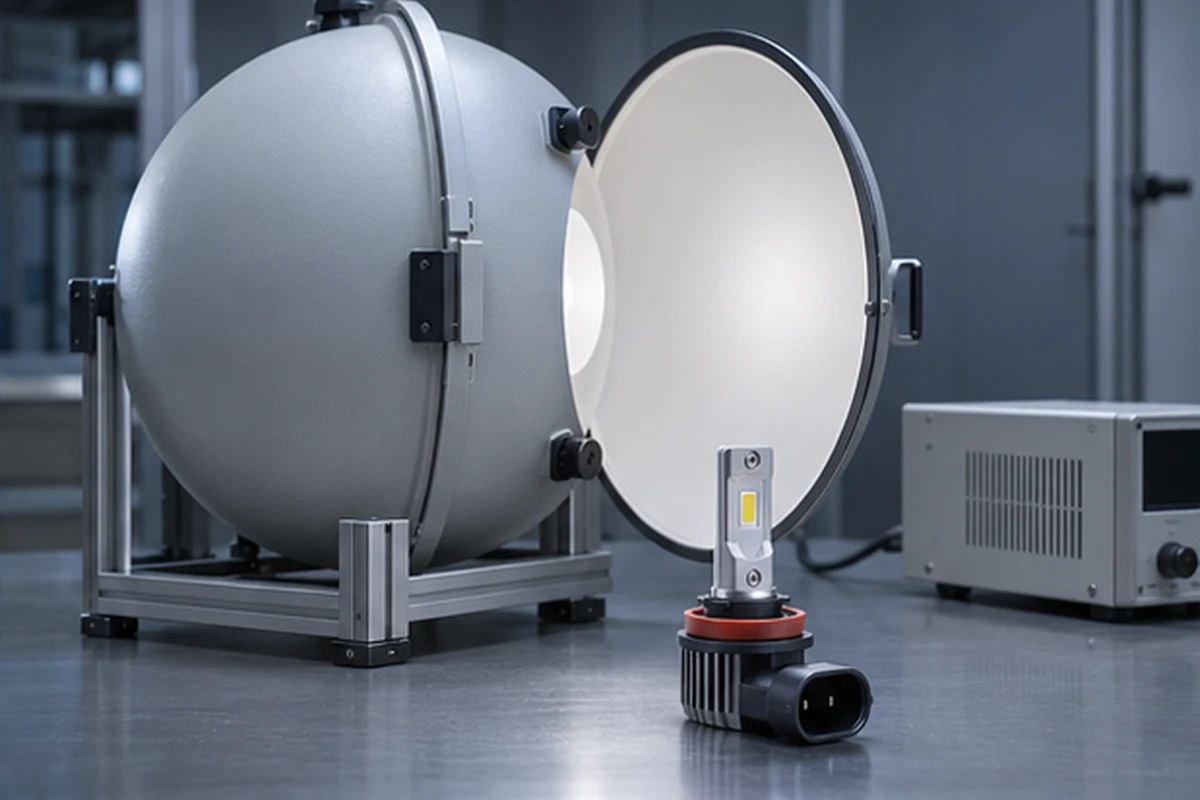
Lumens (lm) describe luminous flux: the total visible-light output measured from a source or product. Lux (lx) describes illuminance on a surface or at a measurement point; the result depends on distance, beam direction, and geometry. Candela (cd) describes luminous intensity in a particular direction. A product can have a high total-flux figure without placing more useful light at the directions that matter in the installed headlamp.
Ask whether a lumen value is measured from the complete bulb, calculated from LED-chip ratings, or quoted from a component supplier. Confirm whether it applies to one bulb or a pair, and whether the figure is a startup reading or a stabilized result. If the report does not identify the exact product revision and operating conditions, do not treat the value as a verified product comparison.
Audit the number behind the headline
- Product identity: exact model, SKU, revision, LED source, and driver configuration.
- Quantity basis: one bulb, a matched pair, or a complete kit.
- Measurement status: measured output or calculated/theoretical value.
- Method: integrating-sphere or other stated flux method, instrument, calibration, and uncertainty where available.
- Electrical condition: voltage measured at the product, current, and operating mode.
- Thermal condition: ambient temperature, warm-up or stabilization rule, and whether cooling parts were installed as intended.
- Sample basis: number of samples, sample selection, and whether the report matches the production revision.
Do not assume that a very high lumen claim means the bulb is the best choice. The useful question is whether the measured output is repeatable and whether the completed headlamp directs light into the required areas without unacceptable stray light. A single peak lux reading can hide weak lateral coverage, dark zones, or excessive intensity in the wrong direction.
Brightness-Claim Audit
| Supplier statement | Clarification required | Comparison rule |
|---|---|---|
| “Up to” a stated lumen figure | Is the value measured or calculated, and under what voltage and thermal condition? | Do not rank it with measured stabilized values unless the methods are comparable. |
| A pair-level output claim | Does the number describe two bulbs together or one bulb? | Normalize the basis before comparing products. |
| High lux at the center | What distance, angle, aiming condition, and test surface were used? | Treat it as one data point, not a complete beam score. |
| High wattage | What input power was measured after warm-up? | Do not assume more watts mean more useful illumination. |
| “Brightest” in a product title | Which competing models were tested under the same protocol? | Treat the superlative as unverified until comparable evidence is supplied. |
| A chart without a sample ID | Which SKU, revision, and sample does the chart represent? | Do not transfer results to a different model or production revision. |
Choose the best H11 LED bulb by evidence completeness
For B2B sourcing, the better comparison is not the product with the largest isolated number. It is the product with the clearest, repeatable evidence for the intended application: defined measurement methods, a traceable sample, complete-headlamp photometry, warm-state behavior, and a documented market-use decision. If two suppliers use different test methods, ask for a common protocol or arrange an independent comparison before making a ranking.
H11 LED Headlight Bulb Beam Evidence: Test the Complete Headlamp
A replacement LED source works inside an optical system designed around a particular light source. The reflector or projector, lens, shielding, source geometry, seating, and headlamp aim all influence the final distribution. For that reason, a bare-bulb lumen report cannot prove the beam quality of an H11 LED headlight bulb after installation.
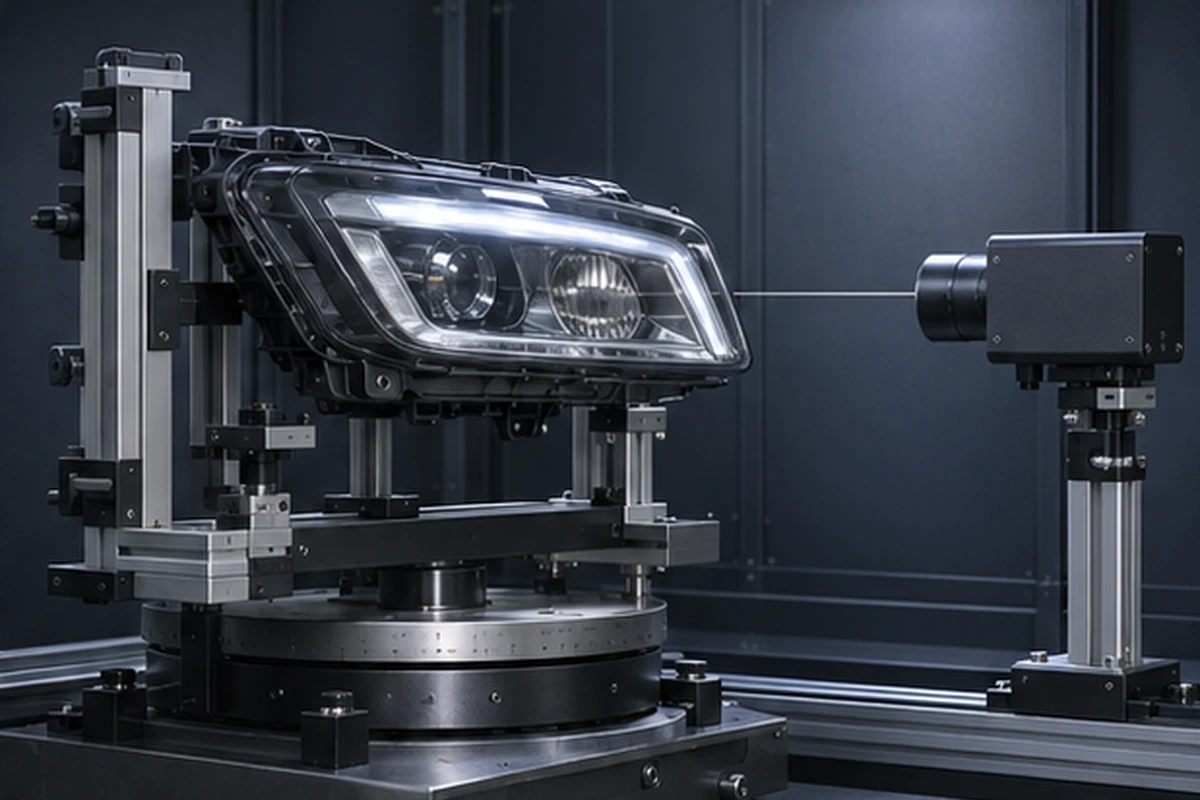
The test article should be the exact bulb installed in an identified, representative headlamp assembly. Record the assembly part number and condition, the bulb revision, the mounting procedure, and the aiming method. If a product is marketed for several vehicle applications, one successful test in one headlamp should not be presented as proof for every listed vehicle.
Use a repeatable headlamp-level test
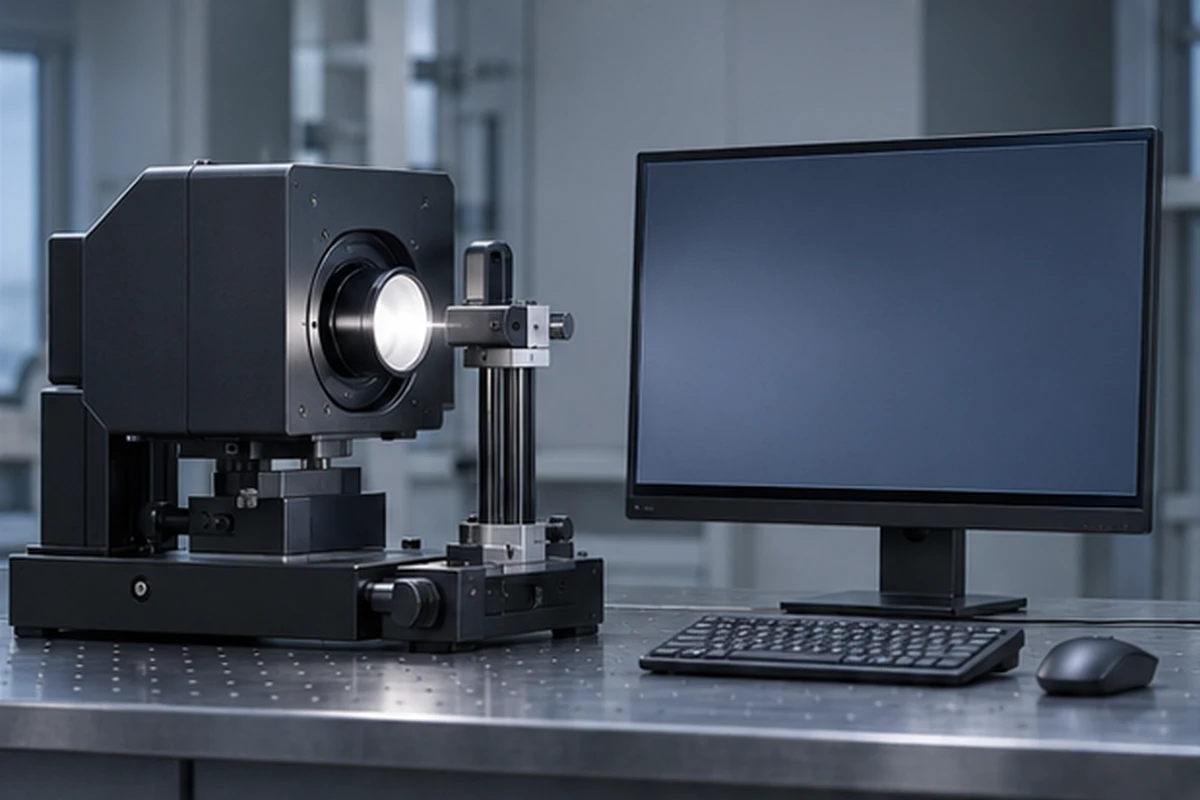
Use the photometric procedure required for the target market and product category. The test record should identify the measurement equipment, calibration status, test distance or geometry, reference axis, supply conditions, operating mode, ambient temperature, and headlamp aiming state. Where formal compliance is relevant, use the required laboratory procedure and applicable limits rather than inventing a universal lux threshold.
Read the distribution, not one bright point
Review the complete distribution and the test points that matter for the intended beam function. Depending on the headlamp and applicable procedure, this can include cutoff location and shape, intensity in glare-sensitive directions, useful forward coverage, lateral spread, hot spots, dark areas, and repeatability between samples. Do not promise “zero glare” from a photograph or a single measurement.
H11 is commonly found in low-beam and fog-lamp applications, but the actual function depends on the vehicle and lamp assembly. This guide addresses H11 headlamp evaluation only. A result from a fog-lamp housing must not be reused as evidence for a headlamp application, or vice versa.
H11 Headlamp Beam-Test Record
| Record item | Why it matters | Minimum information to retain |
|---|---|---|
| Headlamp identity | The optics define how the source is used. | Vehicle/application, headlamp manufacturer, assembly part number, and condition. |
| LED source identity | A changed SKU or emitter revision may change the result. | Bulb SKU, revision, sample ID, driver, and supplied accessories. |
| Test setup | Aim and geometry affect photometric readings. | Fixture, reference axis, aiming procedure, distance or geometry, and instrument. |
| Electrical condition | Output can change with supply and operating state. | Voltage at the product, current, operating mode, and warm/cold condition. |
| Beam distribution | A single hotspot does not describe the whole beam. | Full report or relevant test-point data, cutoff observations, and glare-sensitive areas. |
| Repeatability | One sample cannot establish production consistency. | Number of samples, variation, retest criteria, and approved revision. |
For the broader distinction between replacement bulbs and dedicated projector modules, see NVEL’s existing LED headlight bulbs vs. Bi-LED projector lenses guide. It explains why a product comparison must consider the complete optical system rather than a brightness headline.
Thermal and Electrical Stability: Compare Output After Warm-Up
An initial reading does not show how an H11 LED headlight bulb behaves after it has been operating inside a headlamp. LED output, driver behavior, and component temperatures can change as the assembly warms. A meaningful comparison records the operating conditions and follows the product through a defined warm-up and stabilization period.
Record the installed thermal condition
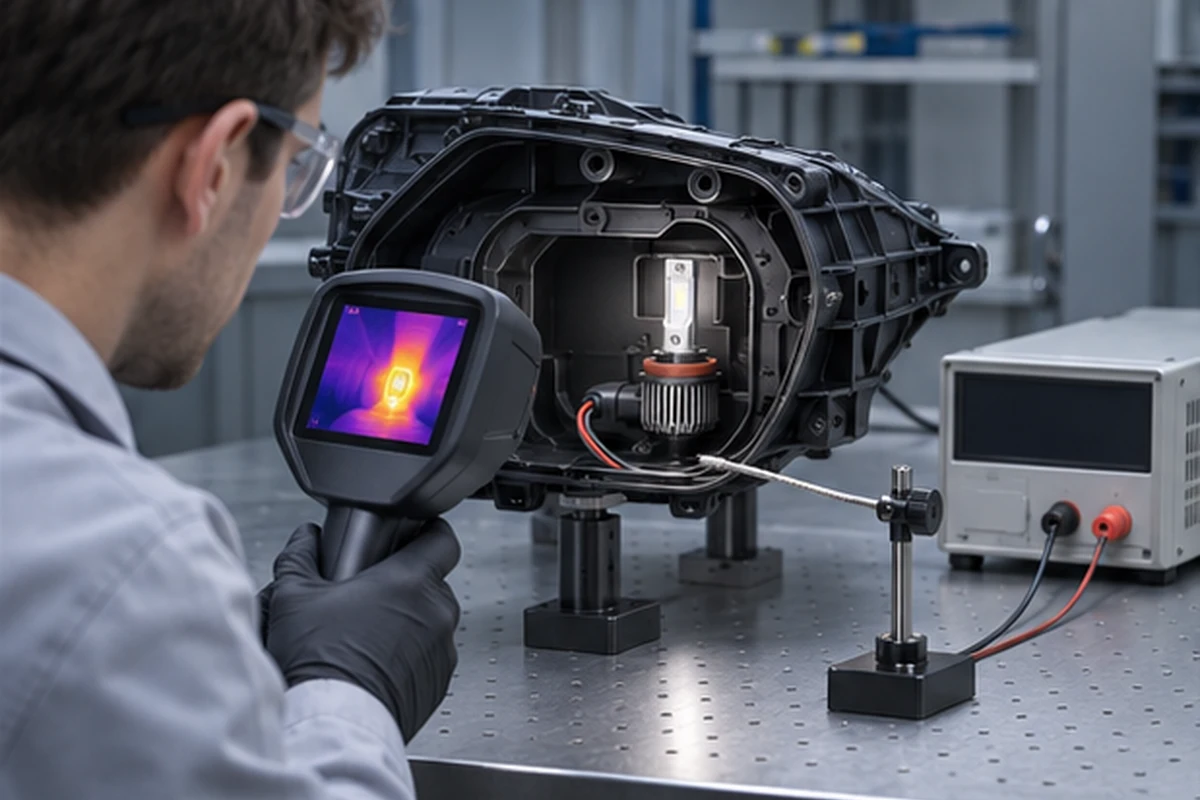
Test the bulb in the intended orientation and representative enclosure. Record ambient temperature, supply voltage, input current, input power, time from startup, measured output, and relevant component or housing temperatures. Include the actual dust cap or rear cover where the application requires one. A fan or heat sink that performs well in open air may behave differently when installed behind a sealed cover.
Look for output reduction, unstable operation, fan interruption, driver protection behavior, or a temperature rise that exceeds the project’s pre-agreed limits. Do not assume that a fan automatically makes a bulb more reliable, or that passive cooling is always safer. The relevant evidence is the complete design operating in the specified installation envelope.
Check the driver under real vehicle conditions
Electrical checks should cover the specified supply range, startup, warm restart, switching, and any relevant pulse-width modulation or lamp-monitoring behavior found in the target vehicle. Record flicker, warnings, intermittent shutdown, and abnormal current draw. A label such as CANBus-ready is not a universal guarantee; use vehicle-specific evidence and do not add a resistor or decoder unless the application and installation instructions justify it.
Warm-State and Electrical Test Plan
| Test area | Conditions to record | Evidence to review |
|---|---|---|
| Startup and restart | Ambient, supply voltage, initial state, and restart condition. | Consistent startup, no unintended dark interval, and defined recovery behavior. |
| Warm-up trend | Elapsed time, input voltage/current, output, and temperature readings. | Output and temperature trend through the agreed stabilization point. |
| Installed cooling | Orientation, enclosure, dust cap, airflow space, and cooling hardware. | No blocked airflow, cover interference, or unapproved thermal behavior. |
| Supply variation | Specified voltage points and any relevant transient or PWM condition. | Stable driver operation within the product’s declared operating range. |
| Vehicle diagnostics | Target vehicle/control module, monitoring behavior, and accessories. | No unsupported blanket claim; retain the exact vehicle-level result. |
| Sample repeatability | Sample IDs, revision, and repeated test sequence. | Comparable warm-state results across the approved sample set. |
Set acceptance limits before testing
There is no single warm-up duration, temperature ceiling, or output-retention percentage that should be copied into every H11 program. Define limits from the product design, target headlamp, applicable standard, intended duty cycle, and destination market. The supplier and buyer should agree on the measurement method and pass/fail criteria before the samples are tested. This prevents a result from being judged against a threshold selected only after the data are known.
H11 LED Headlight Bulb Buying Guide: OEM Scorecard & Compliance
A best H11 LED bulb decision for an OEM, importer, or distributor should end with a documented application and sample-approval record—not a screenshot of a product title. The following scorecard helps buyers decide whether a supplier has provided enough information to move from an initial sample to a controlled purchase program.
Nine checks before approving a supplier
- Exact product identity: confirm model, SKU, revision, single-bulb or pair configuration, driver, and all included accessories.
- Application definition: list vehicle year, make, model, trim, market, headlamp assembly, and intended light function; separate confirmed applications from pending tests.
- Mechanical evidence: obtain controlled drawings, dimensions, connector details, retention information, rear-clearance requirements, and installation instructions.
- Brightness evidence: request measured output, method, voltage/current, ambient condition, stabilization rule, sample size, and whether values are per bulb or pair.
- Complete-headlamp photometry: obtain the report for the exact source/headlamp combination and the relevant market procedure.
- Thermal and electrical evidence: review warm-state output, temperatures, supply behavior, startup/restart, and any vehicle-specific diagnostics.
- Reliability and EMC: request reports tied to the exact SKU and revision; distinguish a test performed from a test merely planned.
- Market-specific compliance: verify the legal status of the exact product and installation in each target territory; do not transfer one market’s approval to another.
- Traceability and change control: approve a golden sample, record BOM and drawing revisions, define lot identification, and require requalification after material or design changes.
U.S. road-use status: separate current rules from rulemaking news
The U.S. regulatory position requires particular care. In its December 8, 2022 Federal Register decision, NHTSA explained that the decision concerned integral-beam LED headlamps and did not change the separate requirements for replaceable-bulb headlamps. For replaceable-bulb headlamps, S11 of FMVSS No. 108 requires each replaceable light source to conform to dimensions and electrical specifications furnished under Part 564. NHTSA explained that the Part 564 submission information includes filament or discharge-arc and filament-capsule details; because an LED source lacks those components, it could not be submitted for inclusion in the Part 564 docket and therefore could not be used as an LED replacement source in a replaceable-bulb headlamp under that framework. NHTSA’s February 13, 2024 interpretation reaffirmed that no LED replaceable-light-source submission had been listed in the docket as of the date of that letter. This is a U.S.-specific regulatory position, not a global rule.
NHTSA announced on October 6, 2026 that it was beginning a modernization effort covering, among other subjects, LEDs and replaceable light sources. The October 8, 2026 Federal Register notice describes an intent to establish a negotiated rulemaking advisory committee and seek comments. Those announcements describe a rulemaking process; they do not themselves amend FMVSS No. 108 or grant road-use permission to any H11 LED retrofit bulb. As of November 6, 2026, buyers should not treat the modernization announcement as an effective approval pathway. Recheck the current regulation, docket, and any final effective rule before making U.S. road-use claims.
For international programs, check the exact product, lamp function, vehicle installation, and destination-market approval route. A DOT marking, E-mark, CE marking, EMC report, or laboratory result should not be treated as interchangeable proof of road-use approval. Ask what the document covers, who issued it, which model and revision it identifies, and whether it applies to the complete installed lighting system.
A practical supplier decision rule
Move a sample forward only when its identity, measurement conditions, installed beam evidence, warm-state behavior, and target-market status are documented. If the supplier can provide only a high lumen number or a “best” claim, keep the product at the information-request stage. If the evidence is incomplete, record the gap and define the next test; do not convert an unverified claim into a product promise.
NVEL’s existing guides cover the broader bulb-family, H11 socket-fitment, and bulb-versus-projector decisions. For this article, the new value is the H11-specific performance evidence packet and the controls needed to compare samples and approve a repeatable B2B program.
Frequently Asked Questions
Is the brightest H11 LED headlight bulb always the best?
No. A high lumen or peak-lux figure does not prove that the complete headlamp produces a useful, controlled distribution. Compare measured output, full beam evidence, warm-state behavior, exact application, and market eligibility under the same test conditions.
Are H11 LED headlight bulbs compatible with every vehicle that uses H11?
No. The H11 designation is only a starting point. Confirm the exact vehicle, trim, headlamp assembly, connector and retaining arrangement, rear clearance, electrical behavior, optical result, and destination-market requirements. Do not infer compatibility from a bulb code alone.
Do higher lumen numbers mean a brighter headlight beam?
Not necessarily. Lumens describe total luminous flux; lux describes illuminance at a point or surface; candela describes intensity in a direction. A higher total-flux figure does not show where the light goes or whether the installed beam is suitable.
What should buyers compare when choosing the best H11 LED bulb for B2B sourcing?
Compare exact SKU and revision, per-bulb or pair output, measurement method, complete-headlamp photometry, warm-state output, electrical and thermal records, vehicle application evidence, market-specific compliance, sample traceability, and production change control.
How should buyers assess the search phrase “Auxbeam best H11 LED headlight bulb”?
Treat it as a brand-comparison query, not a verified ranking. A 2020 laboratory report prepared for NHTSA (Report 108-CAN-20-006) evaluated 16 submitted Auxbeam LED H11 samples; its summary recorded failures for dimensions, markings, and electrical characteristics/luminous flux, while seal and deflection tests were not performed. The report says its results apply only to the submitted tested samples. It is not a blanket assessment of every Auxbeam product or any current SKU. Buyers should compare the exact model and revision using current, comparable evidence.
Can an H11 LED replacement bulb be used for U.S. public-road headlamp use?
Do not assume so. In its December 8, 2022 Federal Register decision, NHTSA explained that the Part 564 submission framework for replaceable-bulb headlamps required filament or discharge-arc and filament-capsule information that an LED source does not have; under that framework, an LED source could not be submitted for inclusion in the docket and could not be used as an LED replacement source in a replaceable-bulb headlamp. NHTSA’s February 13, 2024 interpretation reaffirmed that no LED replaceable-light-source submission was listed as of that letter. The October 2026 modernization announcement and committee notice describe a rulemaking process; they are not themselves an effective rule change or product approval. Check the current federal rule and state requirements before making a U.S. road-use decision.
Conclusion
The best H11 LED headlight bulb is not the one with the largest unqualified number in a product listing. It is the exact product revision supported by repeatable measurements, complete-headlamp beam evidence, stable thermal and electrical behavior, a defined vehicle application, and a valid market-use decision.
For OEM and B2B buyers, the practical advantage comes from a controlled evidence process: define the application, compare like with like, test the installed system, approve a traceable sample, and manage every production change. That is how a “best” or “brightest” claim becomes a defensible purchasing decision rather than an unsupported marketing promise.