
TECHNICAL GUIDES · LED HEADLIGHTS
H4 vs H7 vs H11 vs 9005 vs 9006: LED Headlight Bulb Types Explained
Understand bulb bases, beam functions and the checks that matter before an LED replacement.
October 8, 2026 · 10 min read
H4, H7, H11, 9005 and 9006 are bulb specifications, not five brightness levels. Choosing between them starts with the light source required by a particular headlamp or fog lamp. A similar-looking bulb can have a different connector, locking arrangement, electrical rating or light-source position.
This guide explains the main differences for distributors, aftermarket brands, installers and vehicle owners. Bulb base compatibility ≠ optical compatibility ≠ road-legal compatibility. An LED bulb may fit the socket yet produce an unsuitable beam, trigger electrical faults, run too hot or lack approval for that application. Treat fitment as a complete system check.
LED Headlight Bulb Types
QUICK GUIDE
What Do H4, H7, H11, 9005 and 9006 Mean?
These names identify defined replaceable light-source categories. They relate to features such as base geometry, electrical contacts and the position of the original halogen filament. The headlamp optical system is designed around those characteristics; the code is not a universal description of brightness, color or vehicle brand.
The naming systems overlap across markets. H4, H7 and H11 are familiar international halogen categories, while 9005 and 9006 are commonly associated with HB3 and HB4 respectively. H4 products are frequently cross-referenced with 9003 or HB2, but specifications and approval requirements still need checking. Do not assume that every marketing label describes an identical, approved product.
An LED replacement using one of these names is offering a stated fitment relationship. It does not become the original halogen design merely because it carries that code. Confirm the manufacturer’s specific application information.
Quick Comparison: Five Common Headlight Bulb Types
| Bulb Type | Common Designation | Typical Halogen Design | Connection | Common Applications |
|---|---|---|---|---|
| H4 | Often 9003 / HB2; verify specification | Dual-filament | Three contacts | Combined low / high beam |
| H7 | H7 | Single-filament | Two contacts | Low or high beam |
| H11 | H11 | Single-filament | Two contacts | Common low beam / fog lamp |
| 9005 | HB3 | Single-filament | Two contacts | Common high beam; assembly dependent |
| 9006 | HB4 | Single-filament | Two contacts | Common low beam; other specified uses |
The table summarizes common original halogen designs, not guaranteed LED replacement behavior or vehicle coverage. Beam function depends on the lamp assembly. For an LED product, verify its mounting, driver, optical layout and intended use separately.
H4 / 9003 / HB2: Dual-Beam Halogen Design
A typical H4 halogen bulb has two filaments and three electrical contacts: one common connection and separate low-beam and high-beam circuits. The filament positions and shielding allow a compatible headlamp to produce two different distributions from one bulb. Correct seating and orientation are essential for both functions.
H4, 9003 and HB2 are often grouped in replacement catalogs because of their closely related fitment. However, market-specific specifications, tolerances and approvals can differ. Read the actual bulb markings and application documentation rather than treating every product bearing any of these labels as unconditionally equivalent.
For an LED replacement, check that both beam commands operate correctly and that each distribution works in the intended headlamp. Two selectable modes alone do not establish correct low-beam glare control or useful high-beam reach.
H7: Single-Filament Bulb Applications
H7 is a single-filament halogen specification with two electrical contacts and a locating metal flange. The headlamp may retain it with a spring clip, a holder or a vehicle-specific mounting adapter. A bulb can have the correct electrical connection while failing to sit flush in the original retainer.
An H7 bulb may serve low beam or high beam, depending on the assembly’s optical design. It is not limited to one function or used by all European vehicles. When replacing it with LED, confirm adapter requirements, emitter orientation and rear clearance. A loose or tilted mounting can change the beam even when the bulb lights normally.
H11: Common Low-Beam and Fog-Light Applications
H11 commonly uses a plastic twist-lock base, a sealing ring and a two-contact connector. Its locating tabs position the bulb in the lamp, while the seal helps protect the assembly from moisture and dust. Common applications include low-beam headlamps and fog lamps, but the vehicle documentation remains the deciding reference.
Check that an LED replacement locks fully, preserves the seal and connects without tension on the wiring. Similar appearance to H8, H9 or certain H16 products does not establish interchangeability. Different keys, ratings and approved applications matter; a lamp opening is not permission to fit a different specification.
9005 / HB3: Common High-Beam Applications
9005, commonly designated HB3, is a single-filament halogen type with a keyed twist-lock base and two electrical contacts. It is widely encountered in high-beam applications. Some assemblies use it for other functions, so “9005 means high beam” is a useful starting point rather than a universal vehicle rule.
For an LED upgrade, identify the actual circuit and operating conditions. A bulb used in a daytime running light circuit may encounter reduced voltage or pulse-width modulation. Check driver behavior, switching and physical clearance in the specific vehicle. No single 9005 product should be assumed to cover every brand, trim or headlamp version.
9006 / HB4: Low-Beam and Other Applications
9006, commonly designated HB4, is another single-filament halogen type with two contacts and a sealed twist-lock mounting. It is common in low-beam headlamps and appears in other specified lighting applications. Although it resembles 9005, its keyed base and connector arrangement are different.
Choose it from verified application data and the installed assembly, not the vehicle year alone. A replacement or optional headlamp can differ from the version shown in a broad catalog. With LED, assess the resulting low-beam distribution and glare as well as whether the base locks into place.
H11 vs H8 vs H9 vs H16: Are They Interchangeable?
Not automatically. These families can look similar, but locating tabs, connector keys, electrical ratings and thermal requirements may differ. Their original halogen power requirements are not all the same. Cutting a tab or forcing a connector removes the intended protection against fitting the wrong bulb.
H16 deserves particular attention because marketplace terminology can refer to different regional fitment conventions. Ask for the original marking, a clear base photograph and the exact application. A seller’s combined “H11/H8/H9/H16” title is insufficient evidence by itself.
Some LED products are deliberately engineered for several listed applications. Evaluate that claim using the product’s mechanical design, driver specification and verified compatibility documentation. Multi-fit hardware does not make all original halogen bulbs interchangeable, and it does not establish road-use approval for every listed vehicle.
9005 vs 9006: Why the Bases Are Different
The different locating features and connector keys help maintain the intended bulb-to-lamp relationship. Both families commonly use twist-lock mounting, but their physical coding is not identical. The original optical and electrical specifications also differ; the lamp is designed around a particular source.
Do not trim locking tabs or alter connectors to force a 9005 into a 9006 application, or vice versa. A supplier may offer an LED design with documented support for both, but that is a specific product claim requiring verification. Request the exact supported bases and applications rather than relying on resemblance.
Single-Beam vs Dual-Beam: What Changes?
In this comparison, “single” and “dual” describe the usual original halogen arrangement. H4 commonly provides separate low- and high-beam filaments in one bulb. H7, H11, 9005 and 9006 commonly use one filament each; the headlamp system determines the light function.
LED replacements can create selectable output using separate emitter positions or other electronic and optical arrangements. The original filament count is not a rule for the number of LED chips. Confirm the product’s actual beam operation, electrical switching and distribution in the intended assembly, especially for combined low/high-beam applications.
How to Identify the Correct Bulb Type for Your Vehicle
- Owner’s manual: Find the replacement specification for the exact light function.
- Existing bulb marking: Read the code on the original bulb; cross-check it because a previous owner may have installed an incorrect part.
- Verified fitment database: Use a reliable manufacturer or vehicle-parts application tool, including its exclusions.
- Year, make, model and trim: Record the full vehicle details and production information where relevant.
- Headlamp assembly version: Confirm halogen, HID or integrated LED equipment and any replacement assembly part number.
- Regional market: Verify the market specification; similarly named vehicles may have different lighting systems.
If the manual, installed bulb and database disagree, resolve the mismatch before ordering. Photographs of the bulb base, connector, retainer and assembly label can help a supplier identify the correct specification. Integrated LED headlamps may not accept a conventional replaceable bulb at all.
What to Check Before Upgrading from Halogen to LED
A matching bulb base does not guarantee a safe or compliant LED retrofit. Review mechanical installation, electrical operation, heat rejection and optical performance together. A brighter-looking foreground is not evidence of better overall visibility.
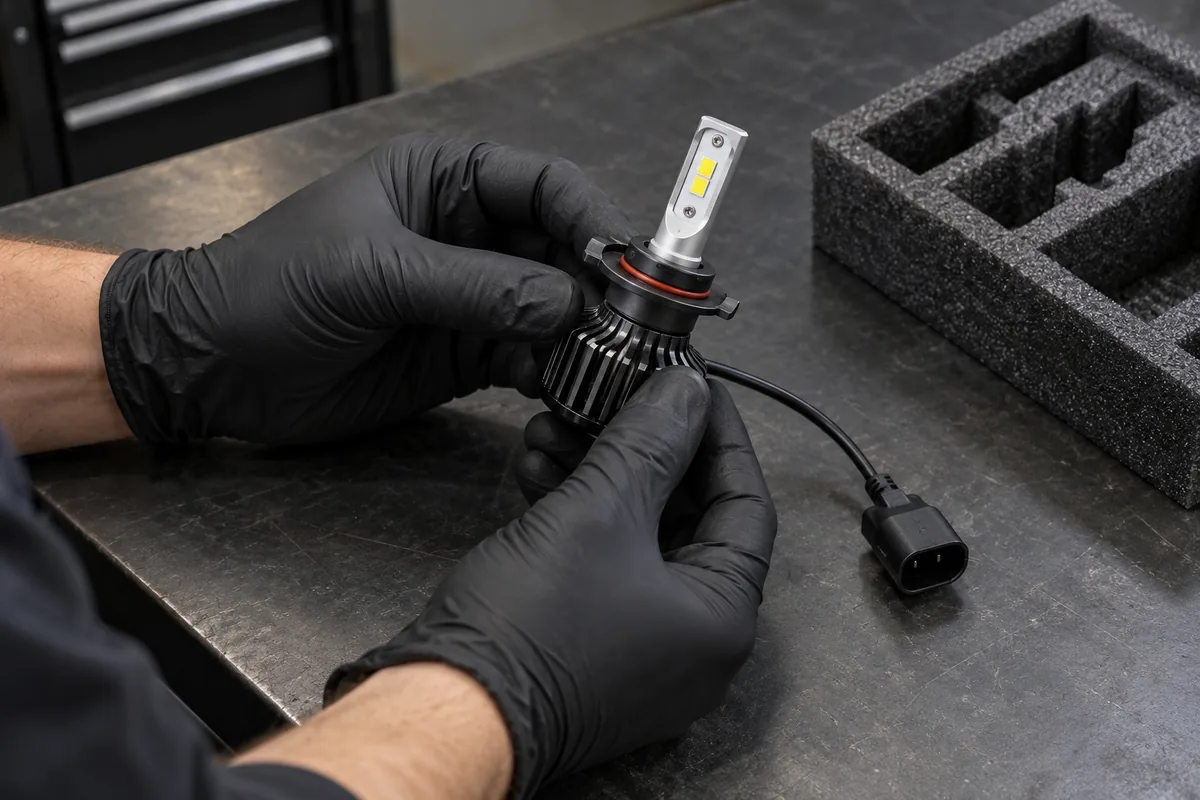
- Base and connector: Confirm positive retention, correct orientation, an intact seal and the specified electrical connection.
- Driver and vehicle electronics: Check voltage range, polarity, dimming or PWM behavior and bulb-monitoring faults. “CANbus compatible” is not a guarantee across vehicles; resistors also generate heat.
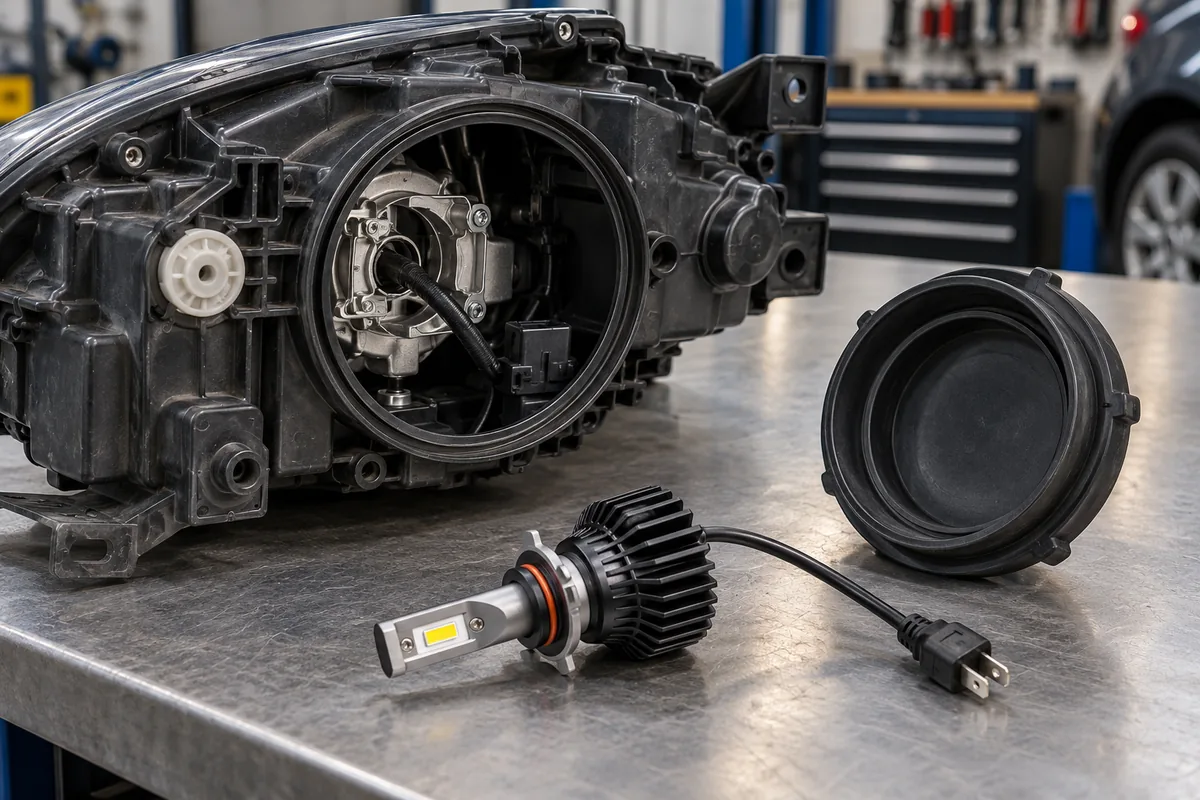
- Rear housing clearance: Measure space for the heat sink, fan, driver and wiring with the dust cap installed. Do not compromise the housing seal.
- Cooling: Follow the product’s ventilation and temperature requirements. A fan or heat sink needs suitable operating space.
- Beam pattern and glare: Evaluate the actual headlamp combination, including cutoff, intensity distribution and unwanted light toward other road users.
- Headlight aiming: Recheck aim using the vehicle procedure. Adjustment cannot correct a fundamentally mismatched light source.
- Road-use requirements: Confirm approval for the destination market, bulb product, vehicle or headlamp and light function as applicable. A socket match or general compliance logo is insufficient.
Manufacturer compatibility documentation should state any required adapters or electrical accessories. For further lighting fundamentals, visit the NVEL Technical Guides hub.
Buyer Checklist for Distributors and Installers
Before building a range or placing a volume order, create a fitment record for each intended application. Separate confirmed compatibility from applications that still require testing. This reduces avoidable returns and gives installers useful information beyond the bulb code.
- Verified bulb types and vehicle data: Document model, trim, region, assembly version and light function.
- Physical dimensions and connectors: Obtain drawings, rear clearance requirements, retainer details and adapter information.
- Optical evaluation: Request evidence for the intended lamp combination and record beam and aiming checks.
- Thermal and electrical design: Review cooling constraints, driver specifications and vehicle-monitoring behavior.
- Documentation: Verify installation instructions, compatibility exclusions, product identification and applicable approval evidence.
- Warranty and support: Confirm written terms, claim procedures and the information needed to investigate fitment problems.
- OEM / ODM requirements: Define target applications, packaging, labeling and validation responsibilities before approving samples.
Use the NVEL LED Headlights range as a starting point for product discussions, then confirm the specification and supporting evidence for the exact model under consideration.
Frequently Asked Questions
Are H4 and H7 headlight bulbs interchangeable?
No. Their bases, contacts and usual beam arrangements differ. H4 commonly combines low and high beam; H7 is a single-filament specification. Use the type required by the actual headlamp.
Is H4 the same as 9003 or HB2?
They are commonly cross-referenced because of closely related fitment, but market specifications and approvals can differ. Check the bulb marking and the supplier’s exact compatibility documentation rather than assuming all labeled products are identical.
Can H11, H8, H9 and H16 bulbs be used interchangeably?
Not as a general rule. Keys, ratings and regional naming can differ. A particular multi-fit LED product needs documented support for the specific application; it does not make the original halogen types universally interchangeable.
What is the difference between 9005 and 9006?
9005/HB3 and 9006/HB4 differ in their keyed base, connector and original specifications. High beam is common for 9005 and low beam for 9006, but the assembly determines actual use. Do not force-fit them.
Can an H7 bulb be used for both low and high beams?
H7 can be specified for either function in different assemblies. One ordinary H7 halogen bulb has one filament; its designation does not mean it switches between two filament positions like an H4.
Does matching the bulb socket guarantee LED compatibility?
No. Retention, electronics, rear clearance, cooling, beam distribution, glare and road-use approval require separate checks. Successful installation and illumination alone do not verify the complete retrofit.
What vehicle information should distributors confirm before ordering LED replacement bulbs?
Confirm year, make, model, trim, regional market, headlamp version and light function. Cross-check the existing bulb marking and obtain connector, retainer and clearance details when fitment is uncertain.
Conclusion
Start with the bulb specification required by the vehicle and installed lamp. Then check the exact LED product’s mechanical fit, electrical behavior, thermal space and optical performance. Verify applicable approval separately. A complete fitment record is more useful than choosing by brightness claims or assuming similar bases are interchangeable.
Need the Right LED Headlight Bulb Type for Your Market?
Discuss bulb base compatibility, target vehicle applications, optical performance, electrical requirements and product specifications with NVEL. For distributor ranges or OEM / ODM projects, share your market and application details so our team can review the requirements and available options.