
TECHNICAL GUIDES · B2B COMPLIANCE GUIDE
Automotive LED Lighting Certifications Explained: DOT, E-Mark, CE, RoHS, and EMC
Understand road-lighting approval, EMC testing and model-specific compliance evidence.
October 12, 2026 · 10 min read
Introduction
Automotive LED lighting certifications can be confusing for brands, distributors and importers. This guide explains the main regulatory routes and supplier evidence. Start with the exact product, destination and intended use; a familiar mark alone is insufficient.
Quick Guide
What “Certifications” Actually Mean
Buyers often search for automotive led lighting certifications, but the documents behind that phrase have different legal meanings. FMVSS 108 is a regulatory requirement; SAE and CISPR publications are technical standards; a manufacturer’s declaration records responsibility for conformity; UN type approval is an authority-issued approval for a defined type. A laboratory report records tests on identified samples. A product mark communicates a claim or approval under its applicable rules.
1. DOT / SAE — North American Road Lighting Requirements
United States: FMVSS 108 and self-certification
FMVSS No. 108, in 49 CFR 571.108, governs specified vehicle lamps, reflective devices and associated equipment. Manufacturers certify applicable products to the requirements; DOT and NHTSA do not issue an ordinary “DOT Approval Certificate” for vehicle lamps. Testing can support the manufacturer’s decision, but a laboratory cannot turn its report into government approval.
Required markings depend on the device. DOT marking is mandatory for specified headlamp items, while the rule treats some other lamps differently. Check the applicable marking provisions rather than requiring DOT on every automotive light. Identify the responsible manufacturer, the model tested and the evidence supporting the compliance claim.
SAE standards can specify engineering or test requirements, and particular versions may be incorporated into regulation or procurement specifications. A generic “SAE tested” statement does not establish full FMVSS 108 compliance. Ask which document, edition, lighting function and tests are covered. Avoid treating color temperature, lumens or a visual cutoff photograph as substitutes for regulatory photometry.
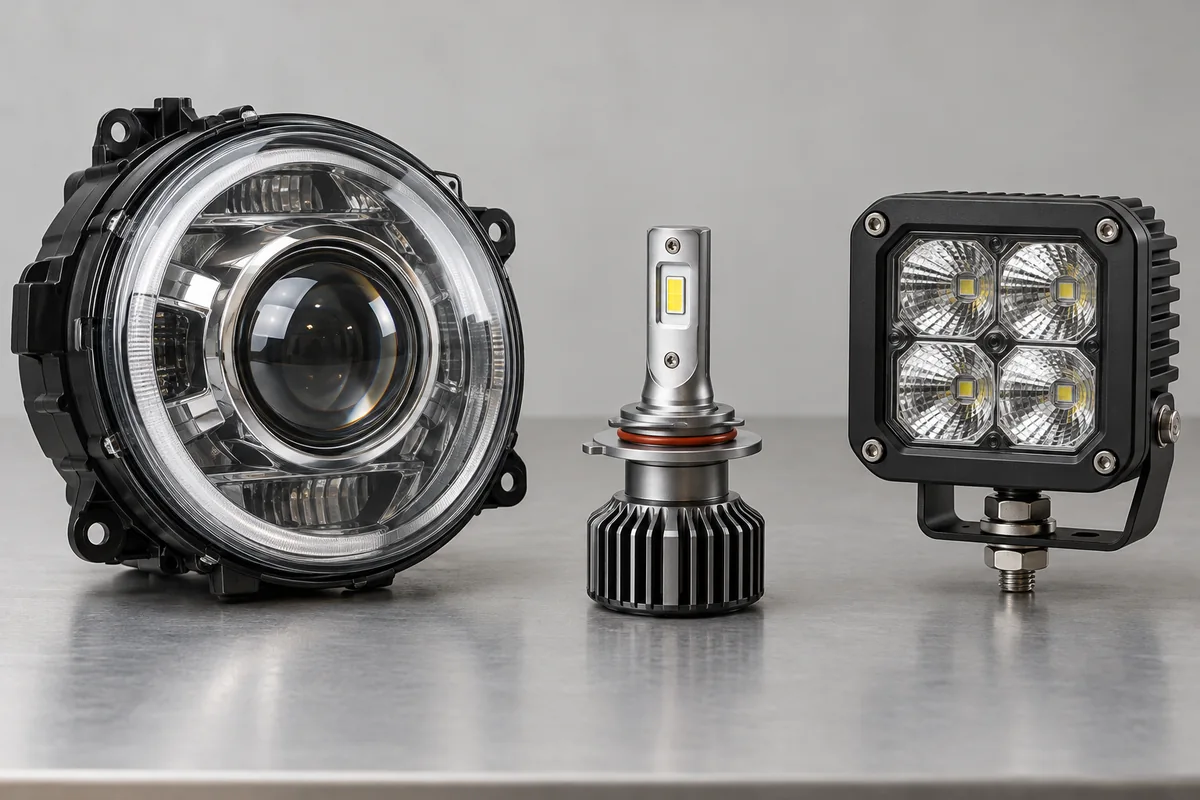
Complete lamps, replacement sources and off-road products
A complete LED headlamp must meet the requirements applicable to its design. A replacement light source has its own regulatory constraints and must be suitable for the headlamp system concerned. Physical fitment of an H11 or H7 LED retrofit does not demonstrate that a halogen-designed headlamp remains compliant. NHTSA’s February 2024 interpretation stated that LED sources were not then permitted in replaceable-bulb headlamps; confirm current rules and any later changes before making a US road-use claim.
Auxiliary lamps and off-road work lights require a separate applicability assessment. They must not impair required lighting when installed on regulated vehicles, and state rules may restrict their road use, mounting or operation. “Off-road only” is an intended-use restriction, not permission to market a nonconforming replacement headlamp for road use.
Canada requires a separate review
Canada uses its Motor Vehicle Safety Act and Motor Vehicle Safety Regulations, including CMVSS 108 and Technical Standards Document 108. Canadian requirements and permitted alternatives must be checked separately. A US DOT claim is not automatic proof of Canadian compliance; also review applicable provincial or territorial rules for installation and use.
2. E-Mark / UNECE — European and International Type Approval
Under the UNECE 1958 Agreement, an approval authority grants type approval under a particular UN Regulation. Designated technical services perform or oversee the required assessment and testing within their designation. A commercial laboratory may produce useful data, but laboratory accreditation alone does not authorize it to issue UN type approval. Some organizations hold several roles; verify the role used for the specific approval.
Choose the regulation by lighting function
- UN R148 covers light-signalling devices, such as applicable position, stop, direction-indicator and daytime-running lamp functions.
- UN R149 covers road illumination devices, including applicable headlamps and front fog lamps.
- UN R150 covers retro-reflective devices, which are distinct from light-emitting lamps.
- UN R10 addresses electromagnetic compatibility for vehicles and relevant electrical/electronic subassemblies. R10 approval alone does not approve the lamp’s optical road-lighting function.
R148, R149 and R150 consolidated earlier device regulations. Historical approvals under regulations such as R112 or R87 should not be dismissed automatically, nor presented as the only current route. Their acceptance depends on the regulation’s amendment series, transitional provisions, approval history, product and destination. Check the adopted text and effective dates: a proposed amendment is not an in-force requirement.
Device approval also does not establish compliant installation on every vehicle. Relevant installation rules, such as UN R48 where applicable, light-source provisions, mounting, aiming and traffic direction may need separate review. A projector module report cannot automatically be extended to any housing assembled around it.
E-mark and e-mark are different
An uppercase E approval mark, normally with a country number in a circle, belongs to the UN approval framework. A lowercase e mark, normally in a rectangle, has an EU/EC type-approval background. They are not the CE mark and should not be used interchangeably. The country number identifies the granting jurisdiction, not the manufacturing location or universal worldwide acceptance.
Request the approval communication, relevant annexes, extensions and marking drawings. Match the manufacturer, approval number, device functions and covered types to the delivered product. Confirm acceptance with the destination authority when the scope or transition is unclear. Approval maintenance includes conformity of production; purchasing a tested sample is not enough.
3. EMC and CISPR 25 — Electromagnetic Compatibility
Switching LED drivers can generate conducted noise on wiring and radiated noise through components and cables. Installation, grounding, harness routing and operating mode can influence radio reception. EMC therefore needs a defined test configuration and, where appropriate, evaluation in the intended vehicle. CANBus compatibility or the absence of a dashboard warning is a different question from EMC compliance.
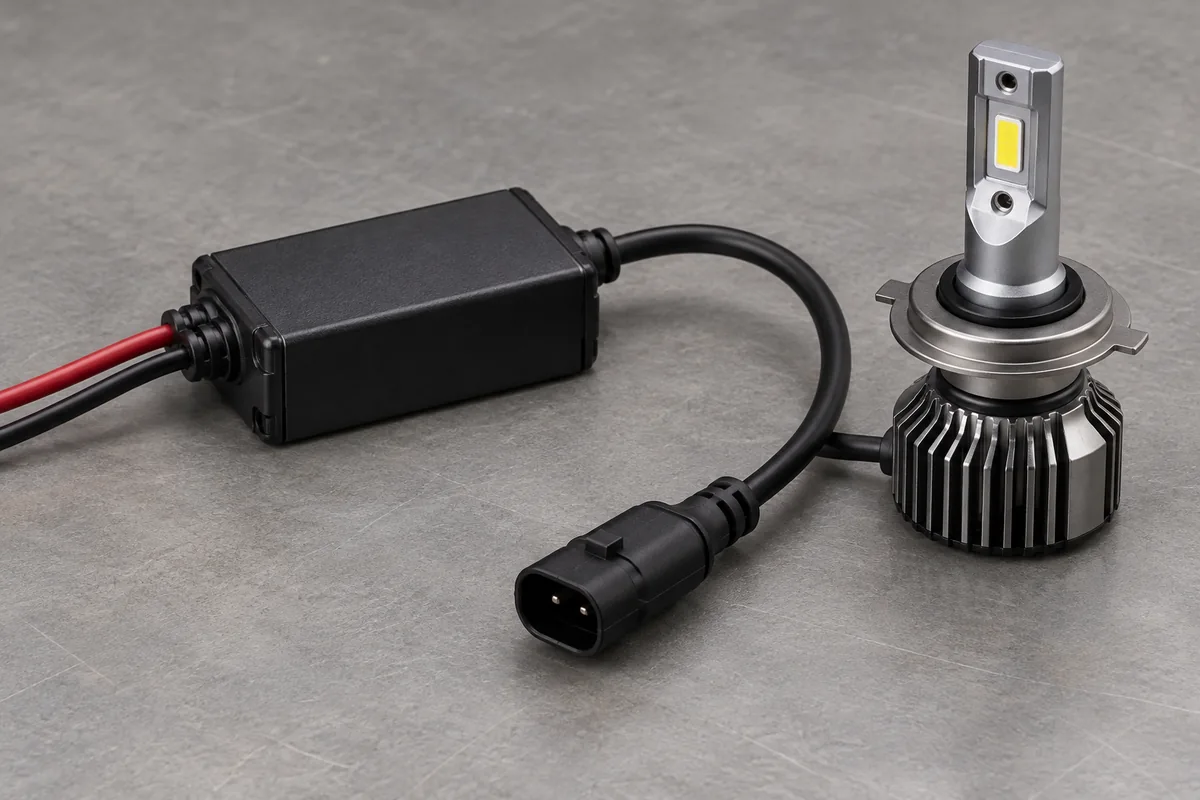
CISPR 25:2021, edition 5, provides radio-disturbance measurement methods and limits to protect on-board receivers. Conducted and radiated emissions are assessed using specified setups. A Class 3 or Class 5 result means the reported sample met the selected limits for the stated methods, bands and operating conditions. It does not guarantee zero interference in every installation.
CISPR 25 is not a complete EMC type approval. Its scope does not establish immunity of electronic control systems or immunity to voltage transients. Depending on the product and contract, additional assessments may involve UN R10, relevant ISO 11452 immunity methods, ISO 7637 electrical transients or OEM-specific requirements. Specify applicable parts and editions instead of demanding an undefined “full EMC certificate.”
4. CE, RoHS and FCC — Product-Specific Applicability
CE marking depends on applicable EU legislation
CE marking applies only when relevant EU harmonisation legislation requires it. Where applicable, the manufacturer assesses conformity, prepares technical documentation and an EU Declaration of Conformity, and affixes CE marking. An independent certificate is not universally required. The applicable route and any third-party involvement depend on the legislation and product.
Vehicle-specific equipment may be covered by sector legislation or particular exclusions and arrangements. A wireless-enabled lighting controller may introduce Radio Equipment Directive considerations; separate mains-powered accessories may require another assessment. Do not apply the EMC or Low Voltage Directive automatically to every low-voltage vehicle lamp. CE conformity does not replace road-lighting type approval.
RoHS scope and material evidence
RoHS Directive 2011/65/EU, as amended, restricts specified hazardous substances in in-scope electrical and electronic equipment. The framework now includes ten restricted substances, subject to applicable exclusions and exemptions, rather than only the original six. Means of transport and certain equipment specifically designed for excluded products require careful scope analysis; not every automotive accessory is automatically excluded.
If RoHS applies, review material declarations, relevant test evidence and any claimed exemption against the specific construction and current conditions. If it does not apply, contractual material restrictions or other chemical legislation may still matter. A voluntary supplier statement is useful evidence but does not establish road legality. There is no general obligation to print a separate “RoHS” logo on every lamp.
FCC and quality management systems
US FCC obligations depend on device classification and applicable rules. Radio transmitters, including wireless controllers, may require equipment authorization. Certain digital devices used exclusively in transportation vehicles have a Part 15 exemption, subject to its conditions; this is not a blanket exemption for every driver or intentional transmitter. Determine the relevant certification, Supplier’s Declaration of Conformity or exemption route before requesting documents.
ISO 9001 and IATF 16949 address quality management systems. Check certificate scope, manufacturing site and validity, but do not use them as evidence of an individual product’s photometric compliance, EMC approval or permission for road use.
Compliance Comparison for B2B Buyers
| Regulation / Standard | Main Purpose | Typical Applicability | Buyer Verification |
|---|---|---|---|
| FMVSS 108 / SAE | US legal requirements / technical standards | Specified lamps and sources | Model, certification basis, applicable tests and marks |
| UN R148 / R149 / R150 | Device type approval | Signalling / illumination / retro-reflectors | Authority, functions, series, annexes and production conformity |
| UN R10 | EMC type approval | Relevant vehicles and subassemblies | Scope, series and approval communication |
| CISPR 25 | On-board receiver emissions tests | Components and vehicles per test plan | Edition, methods, limits and configuration |
| CE / RoHS | Applicable EU conformity / substance rules | Only products within legal scope | Declaration, exclusions, technical/material evidence |
| FCC | US radio-frequency rules | Device-specific authorization or exemption | Classification, applicable route and conditions |
5. Importer Compliance Checklist
Before approving a bulk order, create a model-by-market evidence matrix. Give engineering, purchasing and the importer the same product revision and intended-use definition. Resolve gaps before accepting artwork, advertising road legality or releasing a shipment.
- Identify the exact model, hardware/firmware revision, lighting function, light source, operating voltage and intended vehicle application.
- Name each destination country and distinguish road-use, auxiliary and off-road applications. Define the importer and other responsible economic operators.
- Record applicable laws, technical standards, amendment series, editions, effective dates and any transition or exclusion relied upon.
- Request the relevant approval communication or manufacturer declaration and supporting reports. Check approval/report numbers, annexes, extensions and covered variants.
- Match tested samples, photographs, drawings and bill-of-material revisions to the quotation and production units. A similar model name is insufficient.
- Verify the issuing authority and technical-service designation. For accredited tests, confirm the laboratory’s ISO/IEC 17025 accreditation scope covers the actual methods.
- Inspect required physical markings against the approved drawing or regulatory rules. Do not demand DOT, E, CE and RoHS marks simultaneously on every product.
- Confirm document authenticity, approval status and applicable exemption conditions. Reports do not universally expire on a fixed schedule; changes in product or requirements can affect their usefulness.
- Agree conformity-of-production controls, batch traceability, inspection records and handling of nonconforming products. Check current management-system certificate scope separately.
- Require written change notification for optics, LEDs, drivers, materials, firmware and manufacturing sites. Decide who reviews approval extensions or retesting before changes ship.
- Retain the evidence matrix, approved labeling and purchasing records. Make instructions and marketing claims consistent with the verified scope.
Frequently Asked Questions
1. What is the main difference between DOT and E-Mark?
US FMVSS 108 uses manufacturer certification for applicable equipment; DOT is not a government lamp approval certificate. UN E-mark approval is granted by an authorized approval authority under a specified regulation. Neither route automatically satisfies the other jurisdiction’s requirements.
2. Can a product comply with both US and European requirements?
Potentially, but each configuration and route needs independent verification. Beam pattern, traffic direction, light source and installation can differ. Do not infer dual-market legality from a shared housing, a switchable beam or two logos, especially for LED retrofit bulbs.
3. What happens when non-compliant products are imported?
Depending on the product, jurisdiction and violation, consequences can include rejected entry, detention, corrective action, recalls, penalties or liability. These outcomes are not automatic in every case. Verify import, sale and intended-use requirements before shipping; customs clearance alone does not establish road legality.
4. Does CISPR 25 Class 5 guarantee no interference?
No. It demonstrates the selected emissions limits were met under reported test conditions. It does not establish complete EMC approval, immunity or transient resistance. Vehicle installation and other operating modes can still require assessment.
5. Is CE marking enough for road use in Europe?
No. CE applies where the relevant EU legislation requires it. Road-lighting approval and installation requirements must be assessed separately. RoHS material conformity also does not approve a beam pattern or vehicle application.
6. How can buyers verify E-Mark documents?
Match the complete approval number, authority, regulation, amendment series, functions, annexes and extensions to the product markings and exact type. Contact the granting authority through independently verified details if authenticity or scope is unclear. A laboratory report alone is not the approval communication.
7. What compliance documents can NVEL provide?
Ask NVEL about the specific model, revision and destination market. Available approvals and reports must be confirmed for that product; this guide does not promise every model has DOT, E-mark, CE, RoHS, FCC or CISPR 25 evidence. Identify any documentation or testing gaps before ordering.
Discuss Your Model and Target Market With NVEL
NVEL has 25+ years of automotive lighting manufacturing experience, ISO 9001 and IATF 16949, and provides B2B products and OEM/ODM services. These management-system credentials do not establish universal product road-use approval. Request current certificates and confirm their scope during supplier evaluation.
Review the automotive lighting manufacturer website and OEM/ODM automotive lighting solutions, then send the model list, intended installation, destination countries and required evidence. Confirm available documents and any further assessment with the team. Explore LED headlights and LED fog lights, then confirm model-specific evidence.
Official References
- FMVSS No. 108 and NHTSA LED headlight interpretation.
- Canadian Motor Vehicle Safety Regulations.
- UNECE UN Regulations and VCA type approval guidance.
- IEC CISPR 25:2021.
- European Commission CE guidance and RoHS Directive.
- FCC Part 15.103 exemptions.
Discuss Your Automotive Lighting Compliance Requirements
Send the exact model, intended application and target markets. Confirm available compliance evidence and any further assessment before committing to production.