
TECHNICAL GUIDES · D SERIES LED HEADLIGHTS
D1S vs. D2S vs. D3S vs. D4S: What’s the Difference?
A Technical Compatibility Guide for Correct D-Series Replacement
October 7, 2026 · 10 min read
D1S, D2S, D3S and D4S xenon bulbs can look deceptively similar, but they belong to different electrical, mechanical, ignition and chemical systems. Choosing a replacement by appearance alone can lead to a bulb that does not fit, does not ignite, operates incorrectly or is electrically incompatible with the ballast.
This guide explains the practical differences among the four D-series families, including nominal lamp voltage, mercury design, igniter arrangement, base keying and optical application. It also shows buyers how to identify the correct replacement without relying only on vehicle year or bulb shape.
D-Series HID Bulbs at a Glance
QUICK GUIDE
01 · Quick Answer: D1S vs. D2S vs. D3S vs. D4S
D1S and D2S belong to the earlier mercury-containing 85 V nominal lamp family, while D3S and D4S are mercury-free designs with a nominal lamp voltage of 42 V. D1S and D3S use an integrated igniter arrangement at the bulb base; D2S and D4S use a different external ignition arrangement. These voltages describe lamp operating characteristics—not the vehicle battery voltage.
The correct replacement must match the original bulb designation, keyed base, connector, ballast and headlamp design. D1S is not a direct substitute for D3S, and D2S is not a direct substitute for D4S, even where the overall shapes appear related.
D1S vs. D2S vs. D3S vs. D4S: Quick Comparison
| Specification | D1S | D2S | D3S | D4S |
|---|---|---|---|---|
| Technology | HID / xenon | HID / xenon | HID / xenon | HID / xenon |
| Nominal lamp voltage | 85 V | 85 V | 42 V | 42 V |
| Mercury design | Contains mercury | Contains mercury | Mercury-free | Mercury-free |
| Ignition arrangement | Integrated igniter | External/separate arrangement | Integrated igniter | External/separate arrangement |
| Base designation | PK32d-2 | P32d-2 | PK32d-5 | P32d-5 |
| Mechanical interchangeability | Use D1S only | Use D2S only | Use D3S only | Use D4S only |
| Replacement rule | Match original specification | Match original specification | Match original specification | Match original specification |
02 · Understanding Each D-Series Bulb Type
What Is a D1S HID Bulb?
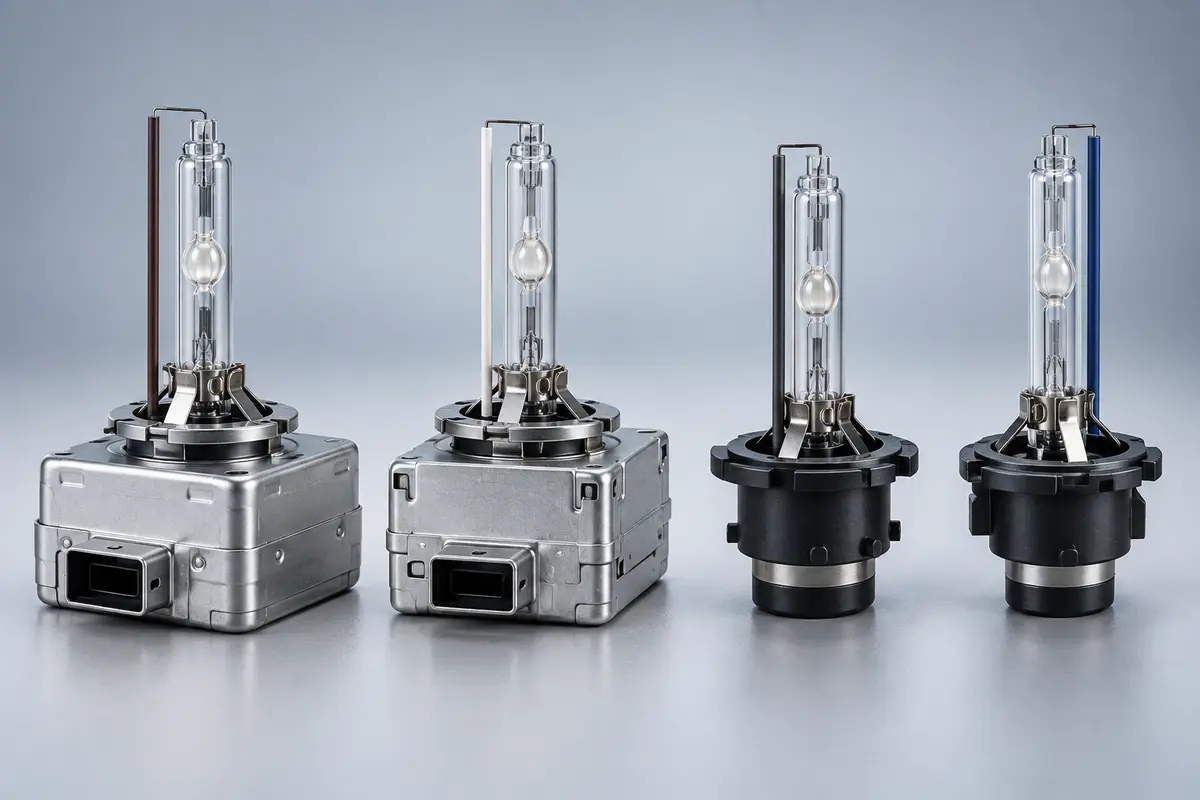
D1S is an 85 V nominal HID lamp with a PK32d-2 base and an integrated high-voltage starting component at the base. It is intended for headlamp systems engineered specifically around the D1S lamp, its connector and the corresponding ballast. The “S” version is designed for projector-type optics. D1S belongs to the traditional mercury-containing HID family.
What Is a D2S HID Bulb?
D2S is also an 85 V nominal, mercury-containing HID lamp, but it uses a P32d-2 base and a separate ignition arrangement rather than the larger integrated-igniter base found on D1S. Sharing a nominal voltage does not make D1S and D2S interchangeable: the bases, electrical interfaces and headlamp systems differ.
What Is a D3S HID Bulb?
D3S is a mercury-free, 42 V nominal HID lamp using a PK32d-5 base and an integrated igniter arrangement. Its overall form resembles D1S, but its electrical family and mechanical keying are different. A D3S lamp must be paired with a system designed for D3S rather than assumed to fit because the base assembly looks similar.
What Is a D4S HID Bulb?
D4S is the mercury-free, 42 V nominal counterpart within the separate-ignition group. It uses a P32d-5 base and is designed for D4S-specific ballast and headlamp systems. D4S and D2S may look closely related, but the electrical characteristics and mechanical keying prevent them from being treated as direct substitutes.
Key takeaway: Similarity in name or shape is not a compatibility test. Always use the exact D-series designation specified for the vehicle’s original headlamp system.
03 · Igniter and Base Design: Why the Bulbs Look Different
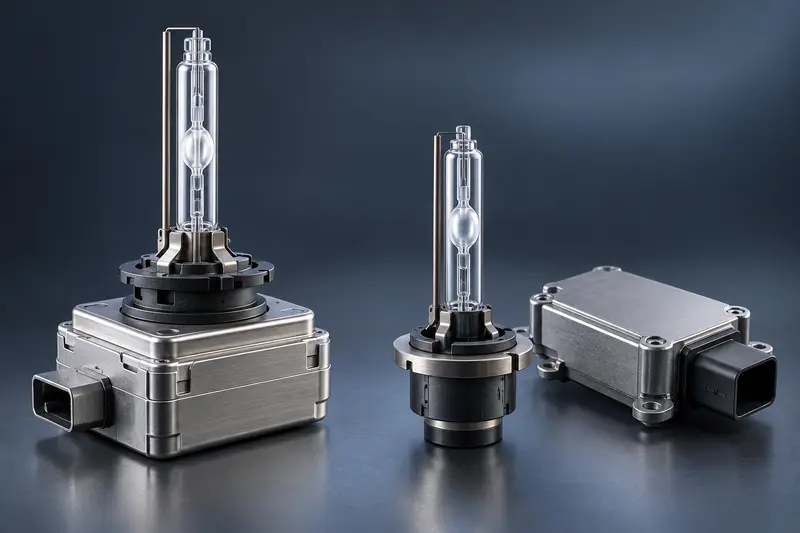
An HID system has distinct components: the lamp creates the arc, the igniter supplies the high-voltage pulse needed to start it, and the ballast regulates power during operation. Depending on the bulb family, the ignition component is integrated with the bulb base or arranged separately in the headlamp system.
- D1S and D3S: the integrated igniter arrangement gives the base assembly a larger, box-like appearance.
- D2S and D4S: the lamp uses a different connection and separate ignition arrangement within the headlamp system.
Base codes and keyed features also differ: D1S uses PK32d-2, D2S uses P32d-2, D3S uses PK32d-5 and D4S uses P32d-5. These are functional distinctions intended to prevent an incompatible lamp from being installed. Do not grind, modify or force the base to make a bulb fit.
04 · 85V vs. 42V HID Systems: Why Electrical Compatibility Matters
The commonly quoted 85 V and 42 V figures are nominal lamp operating values. They do not mean that the vehicle has an 85-volt or 42-volt battery. The vehicle’s low-voltage electrical supply feeds the ballast, which then generates and regulates the electrical conditions required by the HID lamp.
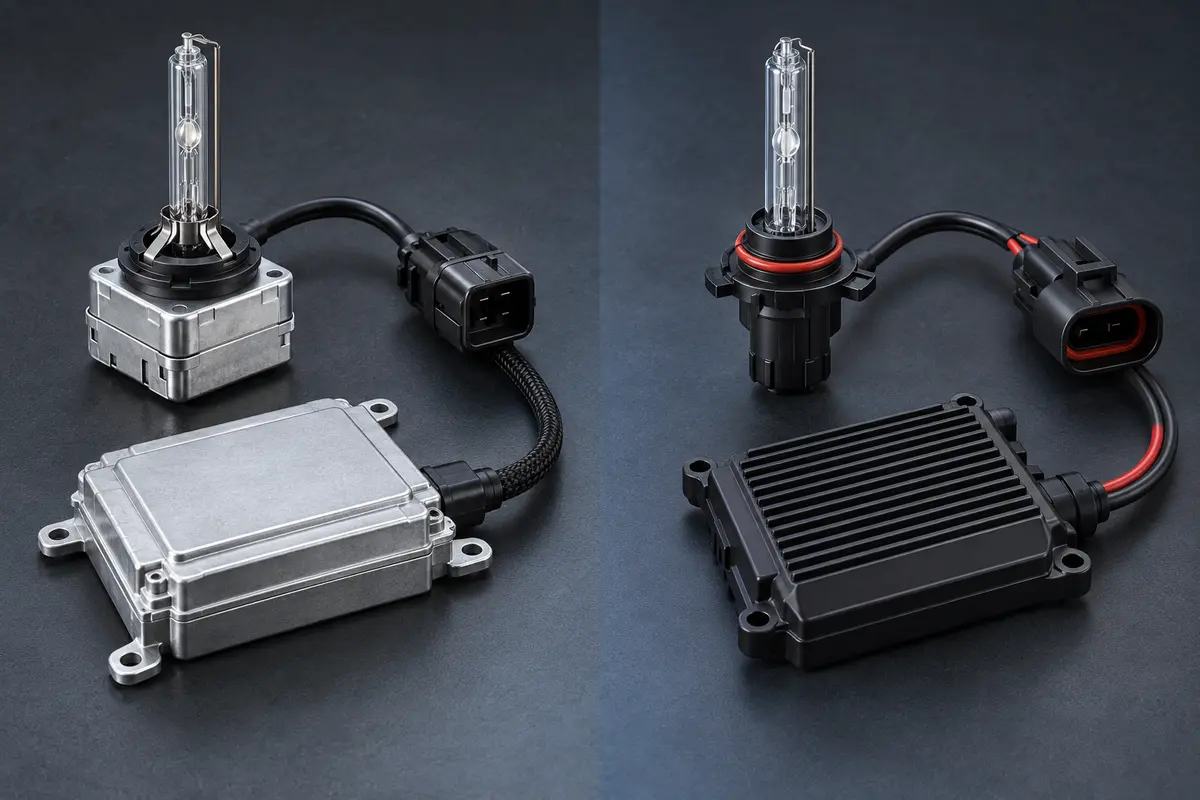
D1S and D2S are designed around the 85 V nominal lamp family; D3S and D4S use the 42 V mercury-free family. Because the lamp and ballast form a matched system, an electrically incompatible combination may fail to ignite, operate incorrectly or potentially damage components. Avoid rewiring, adapter bypasses or ballast modifications unless the complete system has been specifically engineered and validated for the conversion.
05 · Interchangeability: Similar Shape Does Not Mean Compatible
D1S vs. D3S: Are They Interchangeable?
No. Both use an integrated igniter arrangement, but D1S and D3S differ in nominal lamp voltage, mercury design, base designation and mechanical keying. D1S belongs to the 85 V mercury-containing family; D3S belongs to the 42 V mercury-free family. Use the exact type specified by the original headlamp and ballast.
D2S vs. D4S: Can You Swap Them?
No. D2S and D4S both use an external ignition arrangement, but they belong to different electrical and chemical families and use differently keyed bases. Apparent physical similarity does not establish connector, ballast or optical compatibility.
06 · What Does the “S” Mean? D-Series S vs. R Bulbs
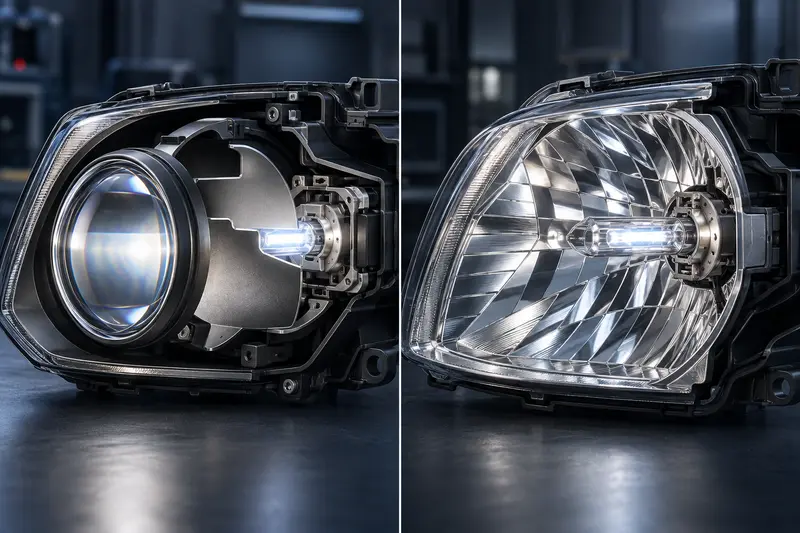
The suffix identifies the optical application. “S” lamps are intended for projector-type headlamps, where the projector optics shape and control the beam. “R” lamps are intended for reflector-type headlamps and commonly include an opaque shield or coating pattern that helps control stray light in the reflector system.
S and R are not styling choices. The arc position, shielding and headlamp optics work together as a system. Installing the wrong optical type can degrade the beam pattern and increase glare, even if the lamp appears to mount. Match both the number and suffix shown on the original bulb or headlamp specification.
07 · How to Identify the Correct D-Series Bulb for Your Vehicle
- Check the owner’s manual or reliable fitment data. Use the exact vehicle year, model, trim, market and headlamp option.
- Read the existing bulb designation. Confirm the complete code, including the S or R suffix.
- Check the headlamp and ballast labels. Their specifications should agree with the lamp family.
- Verify the base and connector. Compare keying and contact arrangement, not just overall shape.
- Confirm the complete vehicle configuration. The same model can use different headlamps across trims, markets and production dates.
- Never force an incompatible bulb. Stop if the base, connector or retaining mechanism does not align correctly.
Should HID Bulbs Be Replaced in Pairs?
HID lamps can gradually change in output and color appearance as they age. When one lamp fails or both are visibly aged, replacing the pair may improve left-to-right consistency. It is not a universal requirement, however; follow the vehicle or lamp manufacturer’s service guidance and assess the condition of the remaining lamp.
08 · HID Replacement vs. LED Upgrade: What Should Buyers Check?
A vehicle originally equipped with D-series HID may have an LED replacement option, but compatibility must be verified at the complete-system level. A matching base alone does not guarantee correct electrical behavior or beam performance.
- Correct D-series fitment and connector design
- Ballast or driver compatibility and CANBus behavior where applicable
- Thermal management and clearance inside the housing
- LED emitter position relative to the original HID arc
- Beam pattern, glare control and headlamp housing compatibility
- Applicable road-use and inspection requirements in the destination market
LED is not automatically brighter or optically better than HID. The result depends on the headlamp design and how accurately the replacement recreates the original light-source geometry. Buyers can review NVEL’s D Series LED Headlights and confirm the specific application before selection.
09 · D-Series Replacement Checklist
- Original bulb designation, including S or R suffix
- Base/socket code and mechanical keying
- Nominal lamp electrical family
- Ballast, igniter or LED driver compatibility
- Projector or reflector headlamp type
- Vehicle year, model, trim, market and headlamp package
- Housing clearance and thermal requirements
- Beam pattern check after installation
- Applicable road-use requirements
Buyer rule: Never identify a D-series bulb from vehicle year, brand or appearance alone. Verify the lamp, headlamp and electrical system together.
10 · Frequently Asked Questions
Are D1S and D3S interchangeable?
No. They differ in nominal lamp voltage, mercury design and keyed base. Use the exact bulb and ballast family specified by the vehicle.
Are D2S and D4S interchangeable?
No. D2S is an 85 V nominal mercury-containing lamp, while D4S is a 42 V nominal mercury-free lamp with different mechanical keying.
What is the difference between D1S and D2S?
Both are from the 85 V nominal HID family, but D1S uses an integrated igniter arrangement and PK32d-2 base, while D2S uses a separate ignition arrangement and P32d-2 base.
What is the difference between D3S and D4S?
Both are mercury-free 42 V nominal HID lamps. D3S uses an integrated igniter arrangement and PK32d-5 base; D4S uses a separate ignition arrangement and P32d-5 base.
Why are D3S and D4S mercury-free?
They are later HID lamp families engineered without mercury. Their different electrical characteristics require compatible ballasts and prevent direct substitution for D1S or D2S.
What does the S mean in D1S or D2S?
The S suffix identifies a lamp intended for projector-type optics. R versions are intended for reflector systems and use optical shielding suited to that application.
How do I know which D-series bulb my vehicle uses?
Check the owner’s manual or reliable fitment data, read the existing bulb code, and verify the headlamp and ballast labels. Include the exact year, model, trim, market and headlamp option.
Looking for a Compatible D-Series LED Replacement?
NVEL provides D-series LED replacement solutions for verified vehicle applications. Correct fitment, electrical compatibility, thermal control and beam performance should all be confirmed before product selection. Share the original bulb type and complete vehicle information with our team for application support.