
TECHNICAL GUIDES · LED PROJECTOR LENS
What Is a Bi-LED Projector Lens and How Does It Work?
Components, Optics and Low/High Beam Operation
October 7, 2026 · 10 min read
What is a Bi-LED projector lens? It is an LED-based projector assembly that provides both low beam and high beam. The name describes two lighting functions, rather than a required number of LED chips, reflectors or lenses.
For a headlight retrofit or a B2B sourcing project, understanding the complete module matters more than recognizing its round front lens. Light-source placement, optics, beam control, electronics and cooling must work together to deliver useful illumination.
This guide explains the components and switching sequence, compares Bi-LED with HID and halogen systems, and outlines practical purchasing checks. Product-specific specifications should always be verified for the exact model and installation.
Five Essentials of a Bi-LED Projector
QUICK GUIDE
Quick Answer: What Is a Bi-LED Projector Lens?
A Bi-LED projector integrates an LED light source, optical system, projector lens and low/high beam control within one assembly. Low beam uses the internal optics and cutoff mechanism to limit light above the intended beam boundary. High beam extends illumination into the upper or distance region through a movable shield, another optical path, additional LED emitters, or a combination of these methods.
“Bi” means dual function. It does not mean two LED chips, two color temperatures or one mandatory mechanical design. “Projector lens” is also commonly used for the entire module; the front lens itself is only one component.
01 · Inside a Bi-LED Projector: The Main Components
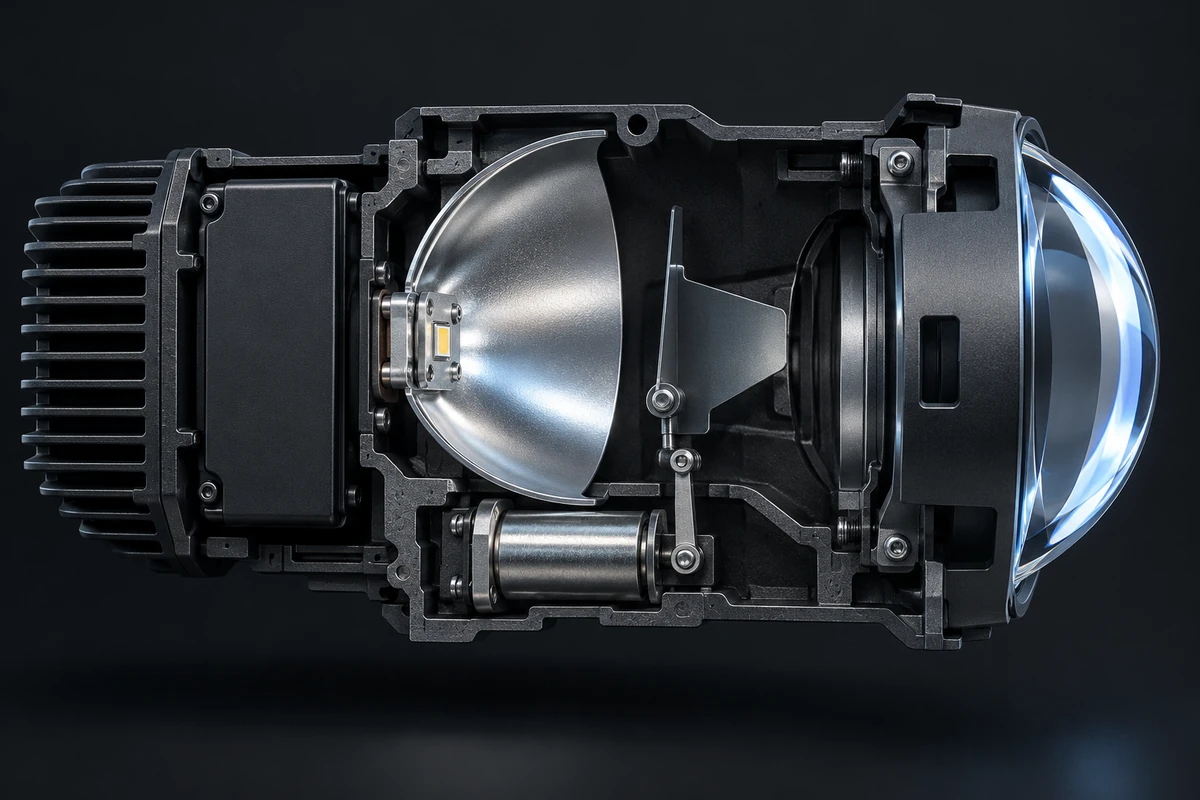
The following parts describe a typical projector system. Their arrangement and the number of optical paths vary between models.
LED Light Source
One or more LED emitters generate light. Emitter size, position and orientation determine how the optics collect it and form the hot spot and surrounding distribution. The thermal interface carries heat away from the LED board. Adding more emitters does not by itself prove higher useful intensity or better efficiency.
Reflector / Optical Collector
The reflector or optical collector captures and redirects a useful portion of LED output toward the projector lens. Its shape, surface quality and relationship to the source influence beam width, intensity and optical losses. A reflector cannot be assumed to collect all emitted light.
Cutoff Shield or Shutter
In many designs, a shaped shield helps define the low-beam boundary. A movable shutter changes the permitted optical path when high beam is requested. The terms can overlap in product descriptions, but not every cutoff-forming component moves.
High-Beam Actuation Mechanism
An actuator creates movement; a solenoid is one type of electromagnetic actuator. The shutter or shield is the mechanical part that changes the light path. These are distinct functions, even when supplied as a compact mechanism. Some modules add electronically controlled high-beam emitters or optical channels.
Projector Lens
The front lens projects the optical distribution forward. Lens geometry, material, transmission and alignment affect the result. Glass is common in projector optics, but buyers should confirm the material for the selected model rather than assume every optical element is glass.
Driver Electronics
The driver regulates LED current and interfaces with the vehicle supply. It may be integrated or external. Input-voltage range, high-beam control signals, connector pinout and electrical protection require model-specific checks; an existing HID ballast is not automatically compatible.
Thermal Management System
Heat sinks and thermal interfaces dissipate heat from the LEDs and electronics. Designs may use passive cooling, fans or both. Cooling space and airflow inside the completed headlamp matter as much as the appearance of the exposed module.
02 · How the Low-Beam Cutoff Is Created
In a conventional shield-based projector, the source and collector direct light through a controlled optical region. A shaped shield limits selected rays, and the lens projects the resulting boundary. The shield does not universally block exactly half the emitted light; the result depends on the geometry of the complete system.
A clear cutoff is useful, but it does not automatically eliminate glare. Light above the boundary, local intensity, beam width, uniformity and foreground brightness all affect performance. Incorrect aim or mounting can direct an otherwise controlled beam toward other road users. Traffic-side requirements also need to match the intended market.
03 · How a Bi-LED Projector Switches to High Beam
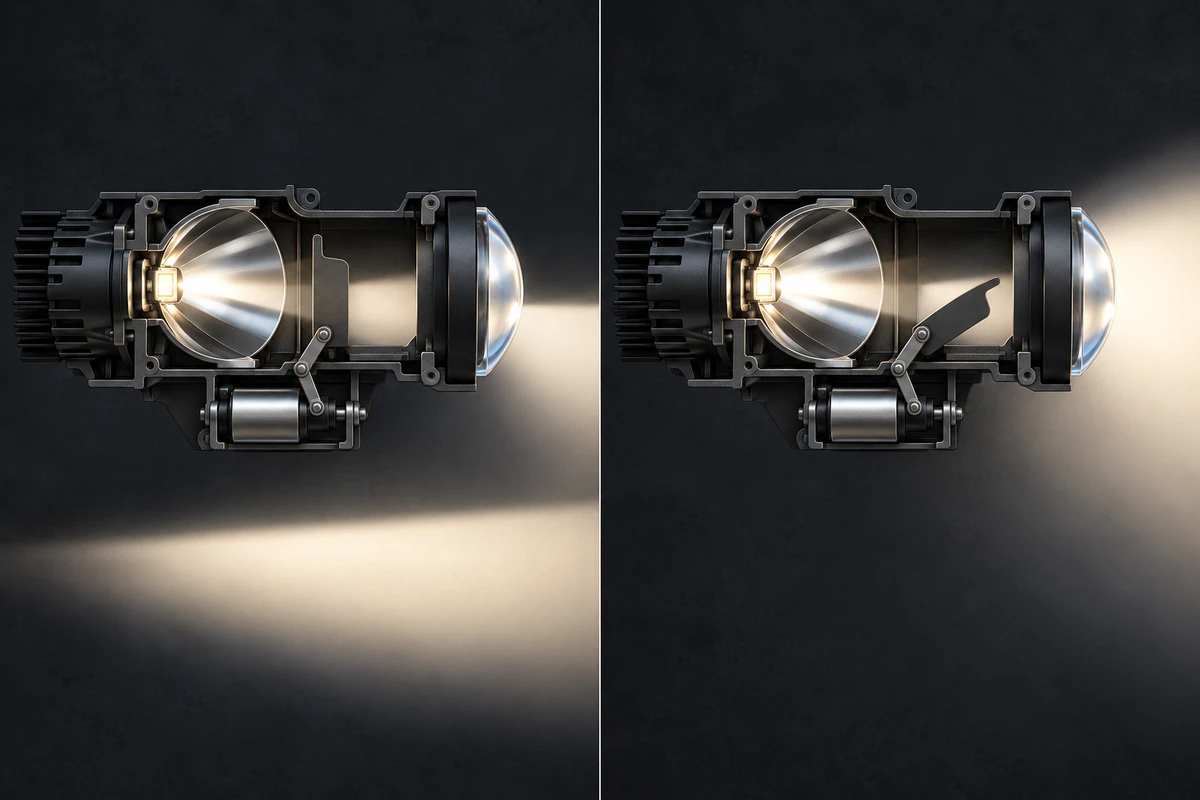
A common design uses a solenoid-actuated shutter. When high beam is requested, the actuator changes the shield position so more optical output reaches the upper or high-beam region. The LED source may remain illuminated while the distribution changes.
Specific architecture varies by projector design. A shutter can pivot or move through another arrangement; it should not always be described as “dropping downward.” Other designs activate additional emitters or combine mechanical movement with a dedicated high-beam path. High-beam power consumption can therefore differ from low-beam consumption.
NVEL’s published N40D Matrix Bi-LED projector specifications list low-beam 6-core and high-beam 3-core LED configurations, plus 30W low-beam and 40W high-beam operation. This is a model-specific example of why a single-emitter definition is too narrow. The specification does not establish that every NVEL projector uses the same switching mechanism.
Bi-LED Low Beam vs. High Beam: Step by Step
For a typical shutter-based module, the sequence is:
- Low Beam Mode: The driver powers the low-beam source and the optics maintain the designed cutoff distribution.
- High Beam Command: The vehicle sends a high-beam request through the intended electrical connection.
- Actuator Response: The actuator moves the shutter or shield to its high-beam position.
- Optical Distribution Change: The revised opening permits additional light into the upper or distance region.
- High Beam Output: The module produces its high-beam distribution; additional emitters may also operate where designed.
- Return to Low Beam: The mechanism returns to the low-beam position and any dedicated high-beam channel switches off according to the module design.
This sequence explains one common architecture. Use the supplier’s wiring and functional documentation to identify the actual behavior of a selected projector.
Bi-LED vs. HID Projector vs. Halogen Headlight
These are system-level differences, not a brightness ranking. HID and halogen systems can also use projector optics, and their low/high arrangements vary.
| Feature | Bi-LED Projector | HID Projector | Halogen System |
|---|---|---|---|
| Light Source | One or more LED emitters | Gas-discharge arc bulb | Tungsten filament bulb |
| Low / High Beam Architecture | Shutter, separate optical paths or additional emitters | Bi-xenon shutter or separate low/high modules | Separate bulbs, dual filaments or bi-halogen shutter |
| Start-Up Behavior | Near-instantaneous illumination | Ignition and warm-up behavior vary by system | Near-instantaneous illumination |
| External Components | LED driver; integrated or external | Ballast and ignition components; arrangement varies | Bulb connections and vehicle switching circuit |
| Thermal Management | LED junction and driver cooling | Arc-bulb heat and ballast temperature | Hot bulb and surrounding housing |
| Maintenance Considerations | Driver, cooling and module serviceability | Bulb aging, ballast and igniter condition | Bulb replacement and connector condition |
| Optical Integration | Source matched to module optics | Arc position matched to reflector and lens | Filament position matched to reflector or projector |
| Retrofit Considerations | Mounts, depth, cooling and electrical control | Bulb/ballast compatibility, mounts and space | Housing optics and bulb fitment |
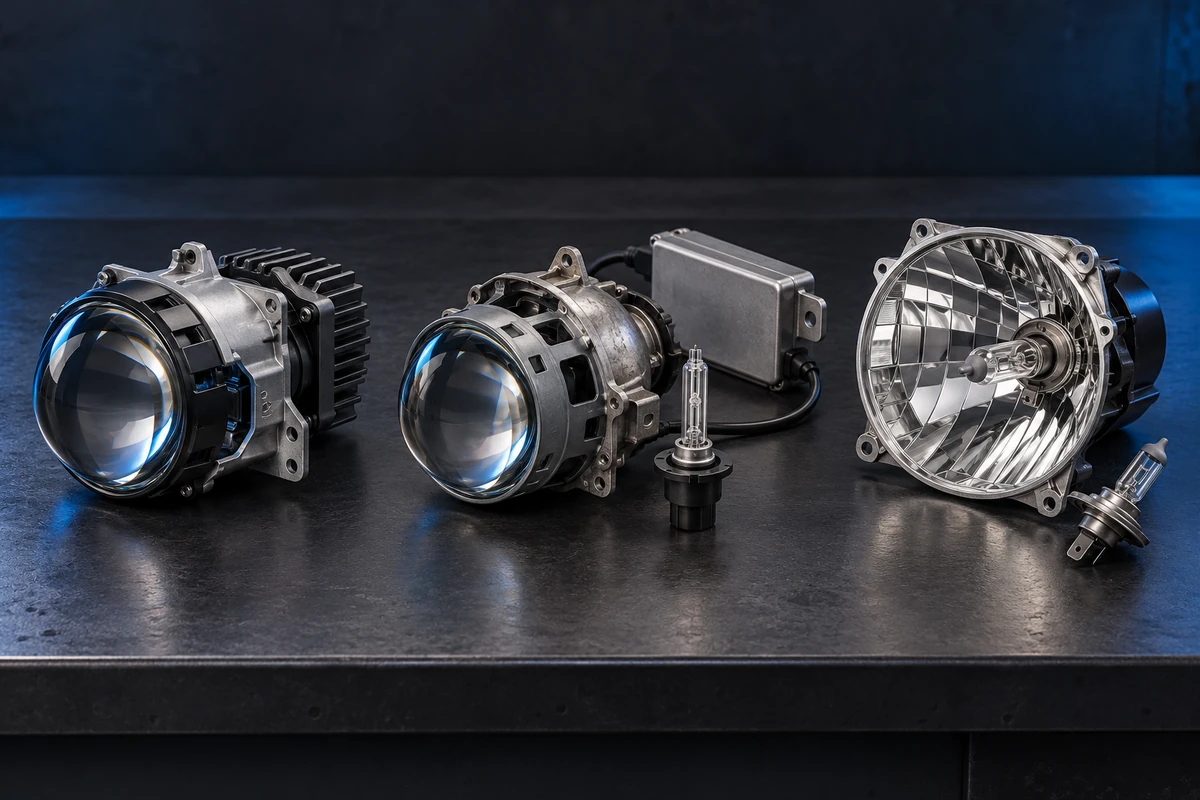
Bi-LED offers integration and control advantages when properly designed and matched to the application. Actual optical performance depends on the source, optics, thermal behavior and aim. Technology labels alone cannot establish that one complete headlamp outperforms another.
04 · What Determines a Good Bi-LED Projector Beam Pattern?
Source position and optical geometry establish where intensity is concentrated. Cutoff control limits unwanted upward light, while the hot spot supports distance visibility. Width and uniformity help the driver read road edges and transitions without distracting bright and dark patches.
Foreground distribution should support nearby awareness without dominating the view. High beam needs useful distance coverage and appropriate spread. Evaluate both modes at a stated distance, supply voltage and stabilized operating condition. A wall photograph can show shape, but photometric data is needed to compare intensity accurately.
Final aim remains critical. Neither a sharp cutoff nor a high lumen figure proves that the installed beam is suitable for the vehicle.
05 · Why Thermal Management Matters in a Bi-LED Projector
LED junction temperature affects output and component aging. Driver electronics also generate heat, so the thermal path must serve the complete assembly. Effective contact between the LED board, interface material and heat sink helps control temperature; a fan can assist airflow where the design requires it.
Passive systems avoid a fan component but still need sufficient heat rejection. Fan-cooled modules require clearance and a suitable air path. Request output and temperature behavior after the module reaches a stable condition inside a representative housing. A short test on an open bench does not reproduce every installation.
NVEL’s N76D4-MINI-H product page specifies dual fans and an aluminum heat sink. That cooling arrangement is specific to that model, not a universal Bi-LED requirement.
Advantages and Limitations of Bi-LED Projector Retrofits
An integrated projector can combine purpose-designed optics with low/high functionality and near-instant LED response. Compact options can help packaging, and LED modules reduce dependence on replaceable HID arc bulbs. These advantages still depend on the quality and suitability of the complete design.
Installation may require opening or modifying the headlamp housing, adapting brackets and aligning the module. Depth, front-lens clearance, cooling space and electrical integration can limit fitment. Resealing, aiming and checking vehicle control compatibility are essential parts of a retrofit, rather than optional finishing steps.
Nominal sizes such as 2-inch, 2.5-inch and 3-inch help describe packaging, but do not specify overall depth, mounting dimensions or beam quality. Choose from a dimensional drawing and application requirements rather than lens diameter alone.
What Should Buyers Check When Choosing a Bi-LED Projector?
Start with the intended vehicle, housing and destination market. Then request enough technical data to assess the full module:
- Optics: Low/high architecture, traffic-side beam pattern, photometric data and stabilized performance.
- Mechanical fit: Lens size, overall dimensions, mounting holes, adjustment range and housing clearance.
- Electrical integration: Supply voltage, steady power/current, driver compatibility, control signal and connector pinout.
- Cooling and environment: Heat-sink clearance, fan requirements, enclosure protection and applicable test configuration.
- Documentation: Vehicle application, installation instructions, model-specific approval evidence and service arrangements.
For B2B purchasing, evaluate samples against agreed beam and thermal criteria. Compare paired lamps, ask about production consistency and document component-change expectations. A sample approval should identify the exact configuration that subsequent shipments must match.
NVEL’s LED Projector Lens product range provides starting points for model evaluation. Its Bi-LED fog-light projector range serves a different installation context; headlamp and fog-lamp suitability should not be treated as interchangeable. Visit the Technical Guides hub for additional automotive-lighting guidance.
Road-Use and Compliance Considerations
Road-use legality depends on the market, vehicle, headlamp assembly, projector, installation and applicable regulations. A component claim does not automatically approve a modified complete headlamp. Request evidence for the exact configuration and verify the requirements for the destination market. A sharp cutoff alone proves neither legality nor absence of glare.
Frequently Asked Questions
What does Bi-LED mean in a projector lens?
It means an LED-based projector assembly provides both low and high beam. It does not specify a universal number of LEDs, lenses or reflectors.
How does a Bi-LED projector switch between low and high beam?
Many modules use an actuator to move a shutter or shield. Others use additional LED emitters, another optical path or a combination. Confirm the selected model’s architecture.
Does a Bi-LED projector use one LED for both beams?
Some share a source between functions; others use multiple emitters or dedicated channels. A single LED source is not required by the Bi-LED definition.
What is the cutoff shield in a Bi-LED projector?
It is an optical-path component that helps shape the low-beam boundary. Where movable, it may also support high-beam switching. The actuator moves it; the two are distinct parts.
Is Bi-LED better than HID?
It can offer near-instant response and integrated control, but results depend on the complete design. Compare actual beam performance, thermal stability, fitment and serviceability.
Can a Bi-LED projector replace a halogen or HID projector?
Sometimes, with appropriate mounts, space, cooling and electrical integration. Housing modification may be required, and road-use requirements must be checked for the complete installation.
What size Bi-LED projector should I choose?
Choose a module that fits the housing and mounting arrangement while meeting beam and cooling requirements. Nominal lens diameter alone cannot establish compatibility.
Looking for a Bi-LED Projector Lens for Your Application?
Share your projector size, desired beam performance, housing dimensions and vehicle application with NVEL. The team can discuss product options and OEM/ODM requirements; final specifications, fitment and market requirements should be confirmed for your project.