
TECHNICAL GUIDES · LED HEADLIGHTS
What Is CANBus for LED Headlights and When Do You Need It?
Understand bulb warnings, flickering and compatibility adapters before upgrading your headlights.
October 8, 2026 · 10 min read
An LED headlight upgrade can illuminate the road while still triggering a dashboard bulb warning. Some installations also flicker, flash when switched off, or shut down intermittently. These symptoms can involve different parts of the vehicle and should not all be called a CANBus fault.
This guide explains canbus for led headlights, how bulb monitoring differs from CAN communication, and when an adapter may help. Distributors, aftermarket brands, installers and vehicle owners can use the troubleshooting sequence to identify the cause before choosing a bulb, driver or accessory.
LED Headlight Compatibility
QUICK GUIDE
What Is CANBus in a Vehicle?
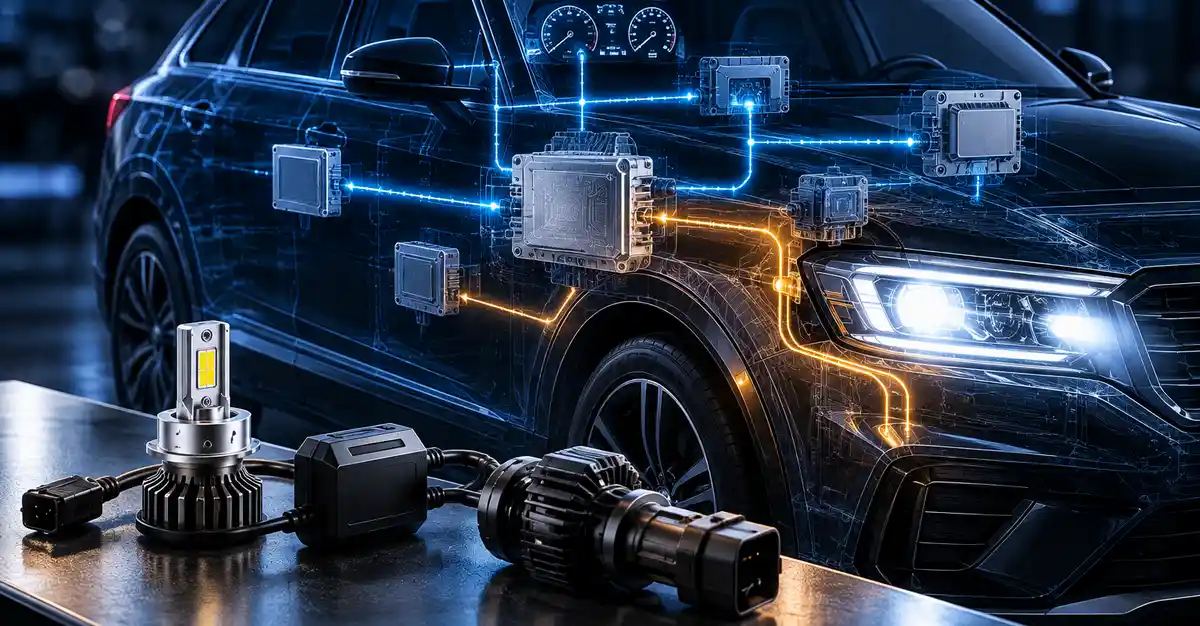
CAN stands for Controller Area Network. It is a communication network that allows vehicle electronic control units to exchange messages. A body control module (BCM), instrument cluster and other controllers may use the network to share commands, operating states and fault information. CAN communication and the electrical supply to a headlight are separate functions.
A conventional replacement bulb receives power through its lamp connector. Monitoring electronics check that circuit and may report findings through CAN. The network itself does not measure bulb resistance. Networked complete lighting assemblies are a different application from conventional bulb retrofits.
The aftermarket uses “CANBus decoder” as a convenient compatibility label. Many such products modify the load or power input presented to an LED driver; they do not read and decode CAN messages. CAN network ≠ bulb monitoring circuit ≠ CANBus decoder. Understanding this distinction prevents choosing a communication-related accessory for an unrelated wiring or thermal fault.
How Do Vehicles Monitor Headlight Bulbs?
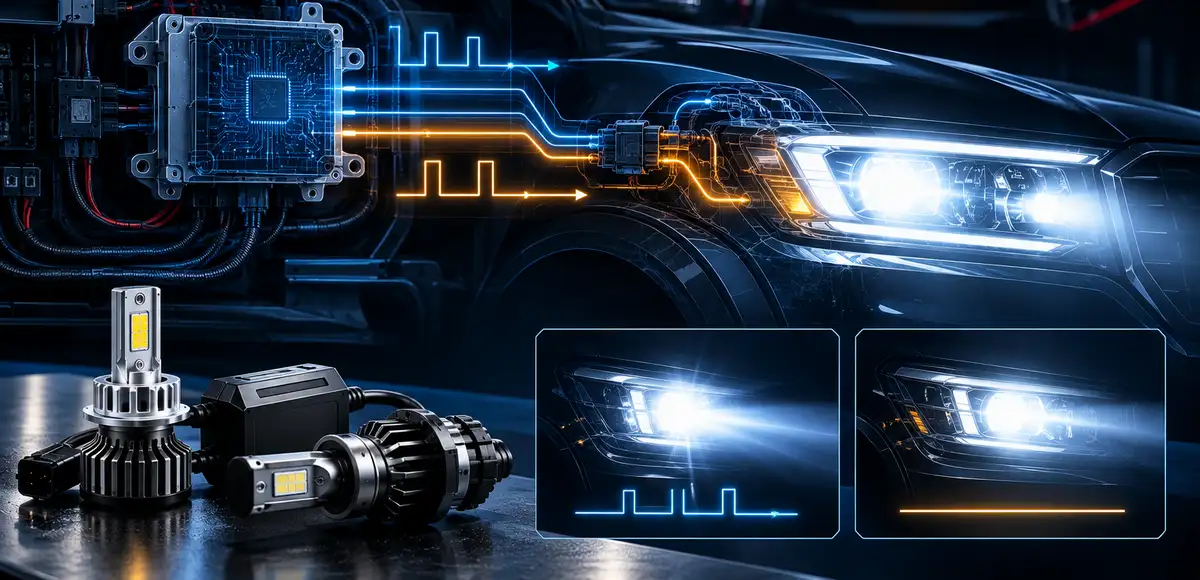
Bulb-out detection helps a vehicle identify a lamp that may no longer operate. A BCM or dedicated lighting controller can check current, voltage or another electrical response against expected limits. The exact circuit, thresholds and fault logic differ between vehicle generations, equipment packages and lighting functions.
Cold bulb monitoring generally means checking a lamp circuit while the lamp is commanded off. Brief diagnostic pulses may be too short to visibly illuminate a filament but can produce a noticeable flash from a responsive LED driver. Warm bulb monitoring checks the circuit during operation; a load outside the expected range may trigger a warning even when the LED emits light.
Monitoring pulses and measurements originate in control electronics, not the CAN bus. Methods differ between vehicles; consult application-specific service information.
Why Can LED Upgrades Trigger Dashboard Warnings?
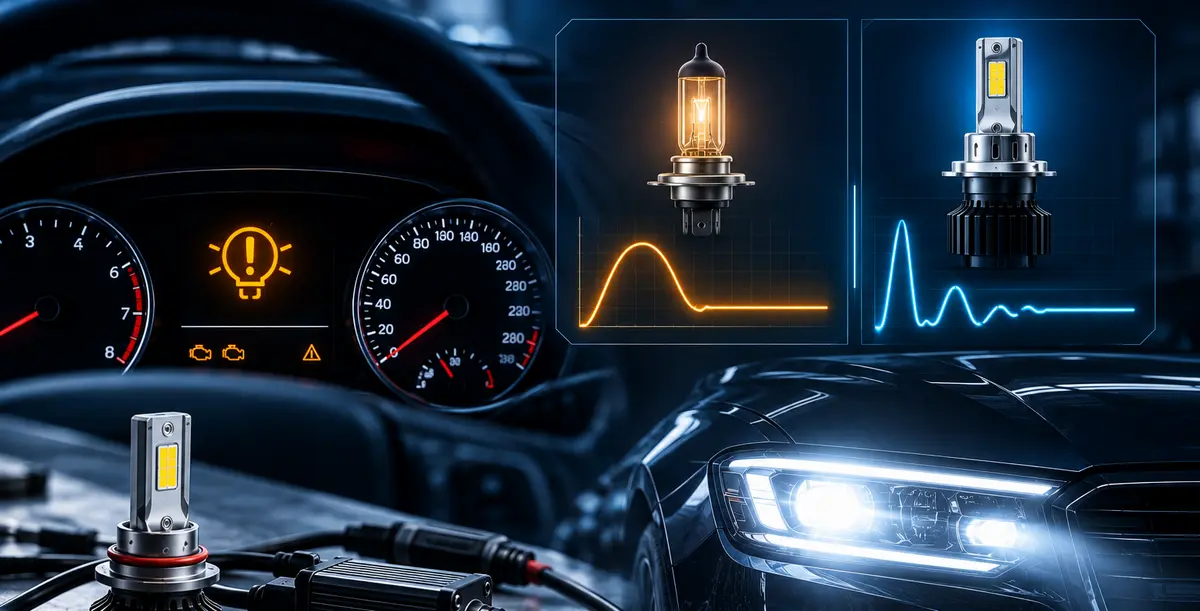
An LED retrofit changes the electrical behavior of the original lamp circuit. LEDs often require less input power than the filament lamp they replace, but power varies considerably with bulb type, operating mode and driver design. There is no universal wattage for halogen bulbs or replacement LEDs. Compare the actual electrical specifications for the original and proposed products.
The LED driver also behaves differently from a filament. Startup current, input capacitance and current consumption during diagnostic pulses can influence what the controller detects. If the response falls outside a programmed threshold, the system may interpret a working LED as an open circuit or failed bulb.
A warning warrants diagnosis, not an automatic resistor installation. Incorrect connections or a defective LED can also cause abnormal readings. A technician can compare a known-good original bulb and review fault codes first.
Why Do LED Headlights Flicker or Shut Off?
Flickering is repeated variation in brightness during operation. A pulse-width-modulated (PWM) supply switches rapidly to control a lamp function. A filament smooths some of that behavior through its thermal inertia; an incompatible LED driver may respond visibly. PWM frequency, duty cycle and the driver’s input requirements all matter.
Flashing can describe distinct brief bursts, including diagnostic pulses when the headlight is off. Intermittent shutdown means the lamp goes dark for a period and may recover after restarting or cooling. These symptoms should be recorded separately because they do not necessarily share a cause.
Loose connections, weak grounds and voltage variation can interrupt power. Driver protection may respond to unsuitable input conditions, while inadequate cooling can cause thermal reduction or shutdown. A lamp that fails only after warming up deserves a cooling and installation check. Adding load to an already stressed circuit can make matters worse; an adapter cannot repair damaged wiring or unblock a cooling fan.
What Is a CANBus-Ready LED Headlight Bulb?
“CANBus ready” is a market description for a product designed to improve compatibility with specified vehicle systems. It is not a universal vehicle compatibility certification. The design may involve LED driver behavior, diagnostic pulse tolerance, load adaptation or a combination of these features.
CANBus-ready bulbs use different designs; not all contain fixed-power resistors. Ask whether the claim covers warnings, flashing or PWM operation, and whether the application still needs accessories.
CANBus ready does not mean compatible with every vehicle. Validation should identify the make, model, year, headlamp configuration and lighting function, together with the exact bulb and driver version. Electrical compatibility also does not establish optical suitability or road-use approval for the headlamp and destination market.
How Do External CANBus Decoders Work?
An external adapter is installed according to its specific instructions between, or alongside, the relevant components. Load matching changes the current drawn from the supply so a monitoring circuit sees a more suitable load. A resistive approach dissipates added electrical power as heat.
Signal filtering may reduce the effect of certain diagnostic pulses or pulsed supply behavior. Input stabilization can help a compatible driver receive a more usable input under defined conditions. Some modules combine these functions. Their capabilities depend on circuit design, ratings and the vehicle signal they were designed to handle.
The word “decoder” does not prove that a module communicates with CAN. Confirm its intended function and installation topology before purchase. A load accessory may resolve one warning but leave flickering unchanged; a filter may improve flickering without satisfying a load threshold. A module should be chosen for the verified symptom and electrical conditions.
CANBus Decoder vs. Load Resistor vs. Anti-Flicker Adapter
These terms overlap in product listings. Compare the documented function rather than relying on the name. A simple load resistor adds electrical load; an anti-flicker adapter generally targets particular power-input behavior. A CANBus-labeled adapter may perform either function or combine them.
The table compares typical functions, not guaranteed results. Verify product ratings, connectors, mounting instructions and validated applications.
| Solution | Primary Purpose | Common Limitation |
|---|---|---|
| CANBus-Ready LED Bulb | Improve compatibility with specified monitoring or supply conditions | Not universally compatible |
| External CANBus Adapter | Address specified load or signal compatibility issues | Function varies by design |
| Load Resistor | Increase the load seen by a monitoring circuit | Generates heat; does not inherently filter PWM |
| Anti-Flicker Adapter | Help manage certain pulsed or unstable inputs | May not remove bulb warnings |
| Combined Compatibility Module | Address multiple specified compatibility issues | Requires application verification |
When Do You Actually Need a CANBus Decoder?
An adapter may be appropriate when a correctly installed, working LED produces a confirmed bulb-monitoring warning, or when testing shows that a particular supply signal is incompatible with its driver. The strongest basis is an already verified solution for the exact vehicle, bulb and lighting function.
If the LED operates reliably without warnings or abnormal behavior, extra accessories are not automatically needed. If a symptom points to wiring, a defective driver or overheating, repair that cause first. A decoder should not be used to hide a genuine circuit fault.
Do not decide from a brand name alone. BMW, Audi, Ford and Toyota each cover many generations and lighting configurations. A useful compatibility statement identifies the specific application and test conditions. Brand-wide promises and unsupported compatibility percentages do not substitute for evidence.
How to Troubleshoot LED Headlight Warnings and Flickering
Diagnose the cause before choosing an adapter. Record whether the symptom occurs with ignition on, engine running, lights off, low beam, high beam or after warming up. Have a qualified technician perform circuit diagnosis and measurements using the vehicle’s service procedures.
- Verify correct bulb type. Check the original specification, connector, lighting function and physical fit. Confirm that the retrofit is suitable for that headlamp.
- Check connectors and polarity where applicable. Inspect seating, corrosion and damaged terminals. Follow product instructions; do not force connectors or alter keyed fittings.
- Confirm supply voltage and ground. Have a technician check circuit operation under load, not just an unloaded voltage reading.
- Identify warning vs. flickering vs. shutdown. Record timing, operating mode and whether one or both lamps are affected.
- Check vehicle monitoring and PWM behavior. Consult service information and use appropriate diagnostic equipment. A basic meter may not show brief pulses accurately.
- Review LED driver compatibility. Confirm input ratings, supported supply behavior and cooling clearance. Rule out a defective bulb or driver.
- Select a verified adapter only if needed. Match its documented function to the diagnosed cause and confirm the exact application.
- Recheck operation and heat. Test relevant lighting modes, warning behavior and restart conditions. Inspect mounting and temperature after sustained operation.
Heat, Electrical Load and EMC Considerations
Load resistors can become very hot. Added current is converted into heat whenever the load is energized. Follow the manufacturer’s mounting instructions, keep the component away from plastics and wiring, and use the specified mounting surface. Do not leave a heat-producing resistor loose inside a headlamp or tie it to a cable harness.
The total load must remain suitable for the circuit, connectors and protection devices. Do not increase a fuse rating to compensate for an unsuitable accessory. Additional current can reduce the energy-saving benefit of an LED retrofit and create thermal demands that did not exist with the LED alone.
LED drivers can also generate electromagnetic interference. Radio noise is not automatically a CANBus fault, and a decoder is not guaranteed to remove it. Ask for product-specific EMC documentation relevant to the target application and market. Wiring routing, grounding, driver design and filtering can all affect the result. A generic claim of “EMC compatible” needs supporting test information.
Buyer Checklist for Distributors and Installers
For B2B sourcing, document application requirements before approving products. A steady-DC bench demonstration cannot establish compatibility with monitored or PWM-controlled vehicle circuits.
Confirm the following with your supplier and installer before ordering:
- Vehicle applications: Make, model, year, equipment version and tested lighting functions.
- Bulb base type: Correct fit, retaining hardware, housing space and beam suitability.
- Driver specifications: Voltage range, current behavior, PWM capability and protection features.
- Monitoring compatibility: Cold and warm checks, warning behavior and known exclusions.
- Adapter type: Load, filtering, stabilization or combined functions, with ratings and instructions.
- Wiring and connectors: Pin arrangement, sealing, secure connections and circuit capacity.
- Thermal design: Driver and accessory placement, cooling clearance and sustained-operation results.
- EMC documentation: Applicable test reports and traceable product or driver versions.
- Validation evidence: Vehicle test records, sample evaluation and clear limitations.
- OEM / ODM requirements: Specifications, packaging, application documentation and change-control expectations.
For product selection, review the NVEL LED Headlights range and discuss application-specific requirements. Ask for evidence relevant to the selected model rather than assuming that every NVEL bulb has the same compatibility features.
Frequently Asked Questions
What does CANBus mean for LED headlights?
CAN is a vehicle communication network. In LED retrofit listings, “CANBus” usually refers to compatibility with lamp monitoring or power-input behavior, rather than proof that the bulb or adapter decodes CAN messages.
Do all cars need CANBus decoders for LED headlights?
No. The need depends on the specific vehicle circuit and LED product. Correctly operating lamps without warnings or abnormal behavior do not automatically require an adapter.
Why does my dashboard show a bulb-out warning after an LED upgrade?
The monitoring circuit may see an unexpected current or diagnostic response from the LED driver. Incorrect connections and genuine faults are also possible, so investigate before adding load.
Can a CANBus decoder stop LED headlight flickering?
It may help if its function matches a confirmed supply or monitoring incompatibility. It will not reliably fix loose wiring, a defective driver or thermal shutdown.
What is the difference between a CANBus decoder and an anti-flicker adapter?
CANBus decoder is a broad market label. An anti-flicker adapter generally targets certain pulsed or unstable power inputs; it may not address bulb-out warnings. Check each product’s documented functions.
Can a load resistor overheat?
A load resistor intentionally produces heat and can become hot enough to damage nearby materials. Use the specified rating and mounting method, and keep it away from plastics and wiring.
How can distributors verify CANBus compatibility before ordering LED headlights?
Request exact vehicle application lists, driver and adapter specifications, test evidence and known limitations. Evaluate samples in representative vehicles across relevant lighting modes and sustained operation.
Conclusion
CANBus for LED headlights is best understood as a compatibility topic involving vehicle lighting controls and LED electrical behavior. The communication network, bulb-monitoring circuit and aftermarket adapter serve different roles. Warnings, flickering and shutdowns require accurate diagnosis because their causes can differ.
Not every vehicle needs a decoder. A suitable LED product and a verified application-specific solution are more valuable than adding accessories without understanding the fault. For more selection and installation topics, explore the NVEL Technical Guides.
Need Compatible LED Headlights for Your Market?
Discuss vehicle applications, LED driver design and product specifications with NVEL. Our team can support product selection, OEM / ODM requirements and technical consultation. Share your target vehicles and compatibility expectations so the requirements for the selected product can be reviewed.