
TECHNICAL GUIDES · QUALITY CONTROL
Automotive Lighting Quality Control: What Should Be Tested Before Mass Production?
A practical buyer’s guide to validation evidence, production consistency and supplier acceptance criteria.
11 min read
Introduction
Automotive lighting quality control starts before the first commercial batch leaves the factory. For distributors, importers, wholesalers and aftermarket brands, a bright sample is only the beginning: the product must also maintain its beam, electrical function and structural integrity under the conditions expected in service.
This guide helps B2B buyers evaluate pre-production evidence and set acceptance criteria across optical, thermal, environmental, electrical and mechanical testing. It distinguishes design verification, process validation, outgoing inspection and sampled reliability testing.
Table of Contents
- Why Pre-Production Validation Matters
- Optical Performance and Beam Pattern Testing
- Thermal Reliability and Temperature Cycling
- Environmental Protection and Mechanical Durability
- Electrical Reliability and EMC Testing
- Design Verification vs. Process Validation
- Automotive Lighting QC Test Comparison Table
- Pre-Production Quality Control Checklist for Buyers
- How to Review Supplier Test Reports
- NVEL’s Approach to Automotive Lighting Quality
- Frequently Asked Questions
- Conclusion
Pre-Production Quality Control
QUICK GUIDE
Why Pre-Production Validation Matters
A carefully assembled sample can perform well while production units vary. Validation checks the design and whether manufacturing can reproduce it. Early corrective action helps limit warranty exposure.
Start with a written requirements matrix covering the intended application, destination market, installation, supply system and operating environment. Assign a test, acceptance limit, sample quantity and responsible party to each requirement. Define what constitutes failure, including excessive output loss, beam movement, water ingress, intermittent operation and physical damage.
Validation reduces risk; it cannot guarantee zero defects or eliminate recalls. Results support only the tested configuration and conditions. Changes to LED sources, drivers, optics, sealants, tooling or assembly locations should trigger a documented review of which checks must be repeated.
Optical Performance and Beam Pattern Testing
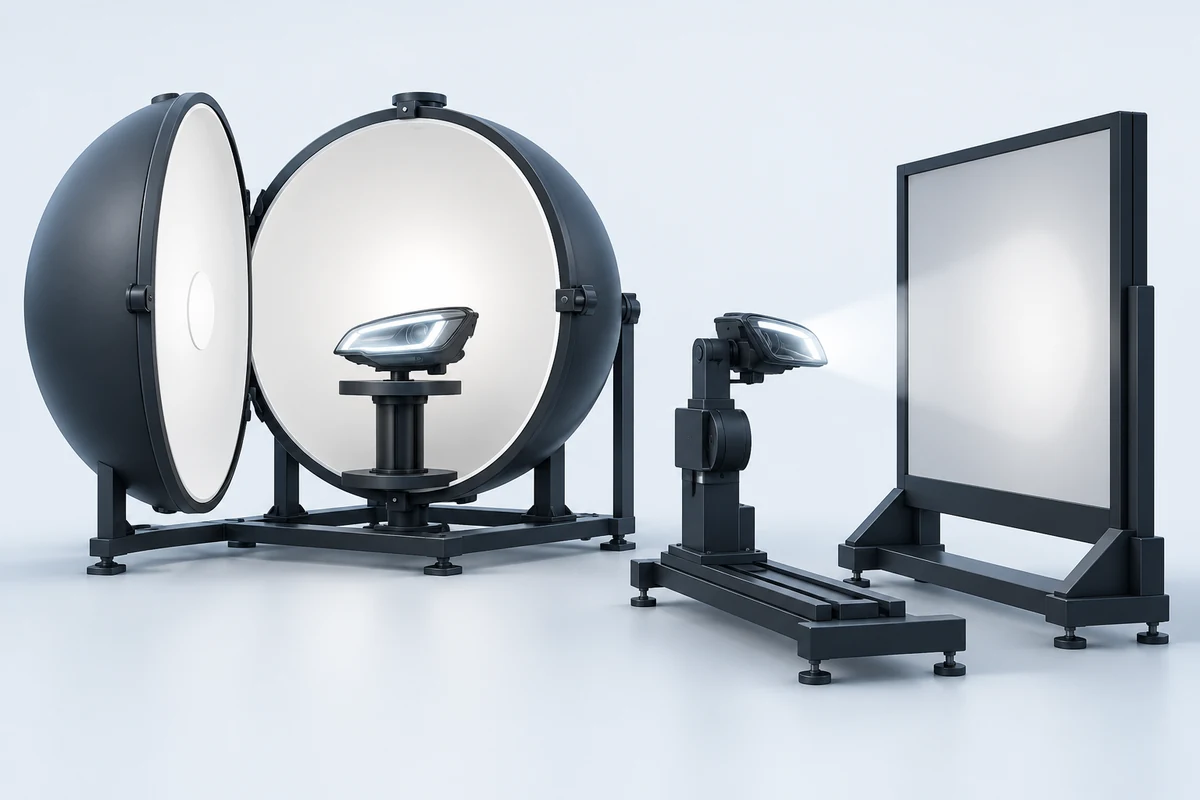
Photometric validation should evaluate the finished lighting assembly rather than adding together theoretical LED chip lumen ratings. An integrating sphere can measure total luminous flux and color characteristics. A goniophotometer measures luminous intensity distribution, typically expressed in candela; illuminance in lux is measured at defined positions and distances. These quantities answer different questions.
Request stabilized output alongside startup measurements, with the supply voltage, ambient temperature, mounting arrangement and stabilization criterion stated. A fixed warm-up duration is not suitable for every design. The report should also identify whether measurements cover one lamp, a pair, a bare module or a complete headlamp, including any outer lens.
For low beams, review the applicable measurement points, cutoff positioning, useful distribution and limits controlling glare. For high beams and auxiliary lamps, evaluate the relevant intensity distribution. A photograph or one peak lux reading cannot establish overall beam quality. Agree model-specific color and output tolerances rather than imposing a universal CCT allowance.
Road-use requirements depend on the market and product category. SAE documents provide technical standards; applicable U.S. requirements are set through FMVSS, including FMVSS No. 108. UNECE regulations use relevant approval frameworks in participating jurisdictions. A component test, SAE reference or marketing label does not make every replacement LED bulb or modified headlamp road legal. For measurement background, read our lumens vs. lux guide.
Thermal Reliability and Temperature Cycling
Thermal validation examines the complete heat path from the LED and driver to the surrounding environment. Assess output stability, power consumption, protective behavior and critical component temperatures in a representative installation. An exposed sample on a bench may run cooler than the same unit behind a closed headlamp cap.
Judge LED junction temperature against the selected component rating and design reliability targets. Thermal-camera surface images are useful, but they do not directly prove junction temperature. Ask how temperature was measured or estimated, where sensors were placed and what uncertainty applies. No single junction-temperature number is a universal pass limit for automotive lighting.
Temperature cycling examines repeated expansion and contraction; thermal shock uses more rapid transitions where specified. Either can expose solder, seal and material weaknesses. For example, a project might specify cycling between −40°C and +85°C, but temperature endpoints, ramp rate, dwell time, power state and cycle count must follow the applicable specification and intended use.
Define high-temperature and humidity exposure separately or together. Record performance before and after testing, including fan or derating behavior where relevant. Accelerated tests do not automatically prove service life.
Environmental Protection and Mechanical Durability
Ingress testing must match the claimed protection grade and the actual product boundary. A sealed auxiliary lamp, an external driver and a replacement bulb installed inside a headlamp do not necessarily need identical protection. Specify whether connectors, cable entries, caps and vents are included in the tested assembly.
IP67, IP68 and IPX9 describe different ingress test categories. Apply the relevant standard, edition and declared grade; do not use one immersion depth for all ratings. IP68 conditions should be documented for the product. High-pressure water testing is distinct from immersion, and IPX9 under IEC terminology should not be casually substituted for an IPX9K claim under another specification.
Condensation assessment should distinguish temporary fogging from damaging or persistent water accumulation. Check sealing, venting, pressure changes and recovery under the specified environmental sequence. Salt spray evaluates corrosion resistance under a defined method and duration; it does not directly convert into years of road service. Agree acceptance criteria for coatings, fasteners and electrical connections.
Mechanical and vibration validation checks mounting points, optical alignment, solder joints, connectors and any cooling fan. The mounting fixture, axes, vibration spectrum, acceleration, duration and powered state should represent the installation or customer specification. There is no universal frequency range or acceleration for all LED lamps.
Inspect function, retention, cracking and beam shift after exposure. Where risk warrants, test combinations or sequences of temperature, vibration and ingress to reveal interactions. These are usually validation or sampled reliability activities; destructive or lengthy environmental tests should not be described as mandatory checks on every shipped unit.
Electrical Reliability and EMC Testing
Define the nominal vehicle system and supported voltage range before selecting electrical tests. Evaluate startup, steady operation, current draw and relevant dimming or control modes. Depending on the specification, the plan may include reverse polarity, voltage interruptions, transient disturbances and electrostatic discharge. Test levels and allowable recovery behavior must be agreed for the exact application.
Electrical protection and electromagnetic compatibility are related but distinct. CISPR 25 provides methods and limits for radio disturbances from vehicles and electronic or electrical components to help protect onboard receivers. A report should identify the edition, methods, applicable limits, frequency ranges, operating modes and setup. It is not a universal product certification or a promise of zero interference.
Emissions testing does not establish immunity. Request separate immunity evidence and required approvals. Preliminary bench checks cannot replace specified test methods.
Vehicle compatibility also needs application checks. Flicker, diagnostic warnings and control behavior can depend on the vehicle electronics and installation. A passing EMC report does not establish universal CANBus compatibility. Ask the supplier which vehicle configurations were tested and which functions remain unverified.
Design Verification vs. Process Validation
Design verification (DV) asks whether the design satisfies its requirements. It can involve prototypes or engineering samples, provided their configuration and limitations are recorded. Optical performance, thermal behavior and electrical protection belong here, together with relevant durability tests.
Process validation (PV) asks whether the intended production process can consistently make conforming products. Terminology varies between customers, so define PV in the project plan. Use production-intent tooling, components, operators and assembly conditions. Review several units or pilot batches for variation, traceability, assembly controls and repeatability.
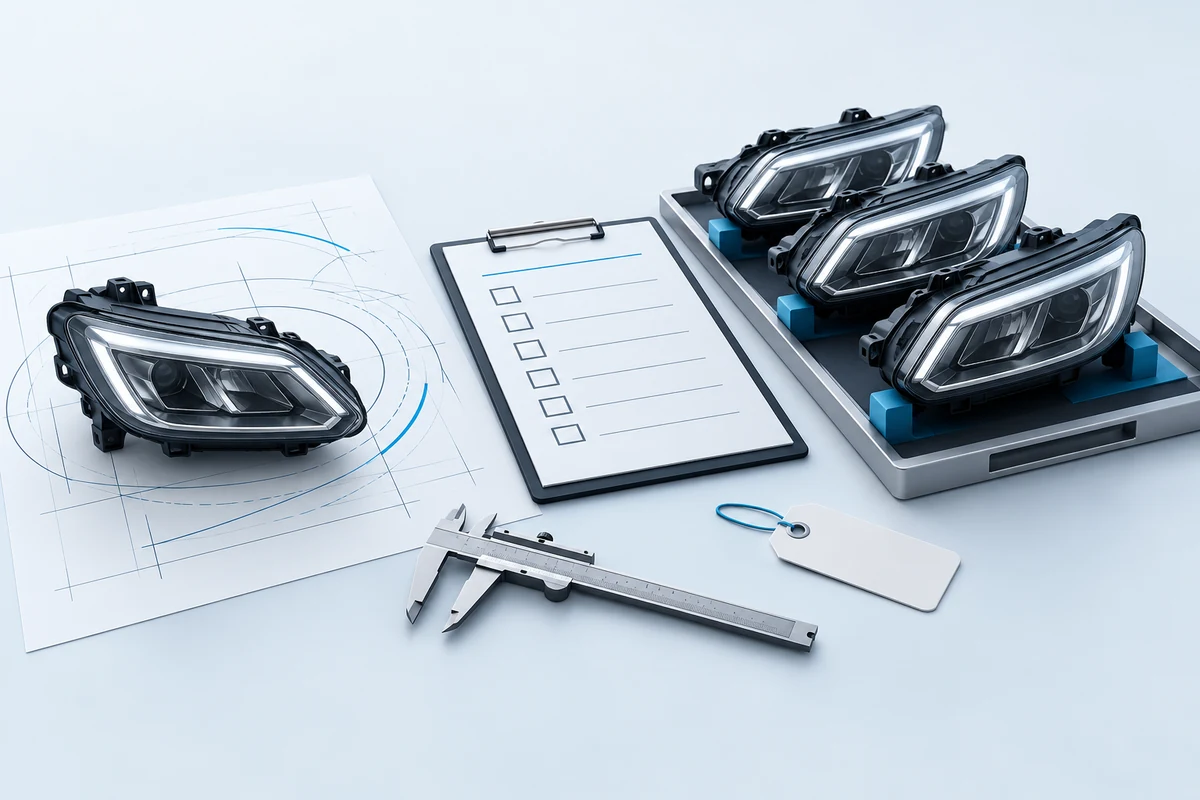
Routine outgoing inspection covers the agreed checks at shipment: identification, workmanship, operation, packaging and selected measurements. Some checks may be performed on every unit, while others use a defined sampling plan. Periodic sampled reliability tests monitor continuing performance or investigate changes.
Burn-in is a possible screening method, not a universal requirement for a two-to-four-hour test on every LED product. Its duration, stress conditions, coverage and failure criteria should reflect the design and risk analysis. An effective control plan explains which tests occur at each stage and what happens when a result fails.
Automotive Lighting QC Test Comparison Table
Use this comparison to organize evidence requests. Actual methods, sample sizes and limits should be documented in the agreed validation plan; the categories below do not prescribe identical testing for every product.
| Test Category | What It Evaluates | Evidence Buyers Should Request |
|---|---|---|
| Optical | Stabilized flux, color and beam distribution | Photometric results, setup, supply conditions and limits |
| Thermal | Temperature margins, derating and cycling durability | Temperature method, installation, cycle profile and before/after results |
| Environmental | Ingress, condensation and corrosion behavior | Declared IP grade, tested boundary, exposure conditions and inspections |
| Electrical / EMC | Supply behavior, protection, emissions and immunity | Applicable methods, limits, operating modes and measured data |
| Mechanical / Vibration | Retention, structural integrity and beam stability | Fixture, axes, profile, duration and post-test measurements |
| Process / Outgoing QC | Production consistency and shipment acceptance | Pilot records, control plan, sampling rules and batch traceability |
Pre-Production Quality Control Checklist for Buyers
Before authorizing mass production, turn the quotation and sample approval into a controlled quality agreement. Purchasing, engineering and supplier quality teams should confirm the following items together.
- Product definition: exact model, revision, bill-of-material controls, drawings, installation and destination market.
- Validation plan: methods, conditions, sample quantities, acceptance limits and responsibility for outstanding tests.
- Pilot approval: production-intent samples, recorded results and closure of nonconformities before release.
- Inspection agreement: defect classifications, sampling scheme, inspection level and rejection or rework rules.
- Evidence and traceability: model-specific reports, batch identification, records retention and approved reference samples.
- Change control: notification, review and revalidation rules for component, design or manufacturing changes.
AQL-based inspection, such as an agreed ISO 2859-1 scheme, provides lot acceptance rules rather than proof that each unit is defect-free. Select the plan with consideration of defect severity and buyer risk; do not impose an unsupported universal AQL target.
How to Review Supplier Test Reports
First check identity: the report number, issue date, tested model, revision, sample identifiers and issuing organization should be clear. Match photographs and component descriptions to the approved product. A report for a visually similar lamp is not evidence for an untested model.
Next review methods, conditions and results. Look for the applicable standard and edition, test setup, calibration information, individual measurements, acceptance limits, deviations and final conclusions. Ask about uncertainty where it affects a borderline pass. A one-page summary without traceable supporting data may leave important questions unanswered.
Finally distinguish document types. An internal report records supplier testing. A third-party report records work by an external organization; check its relevant laboratory accreditation and scope when required. A certification certificate relates to a defined certification scheme. A type-approval document is issued within a regulatory approval framework. These documents have different purposes and cannot substitute for one another.
If samples failed and were redesigned, request the corrective-action record and the retest evidence for the final revision. Agree how future material or process changes will be notified. Keep the signed requirements, approved samples and reports together so shipment acceptance can be traced to the same configuration.
NVEL’s Approach to Automotive Lighting Quality
NVEL is an automotive lighting manufacturer with more than 25 years of industry experience and holds ISO 9001 and IATF 16949 certificates. These quality management system credentials provide context for supplier evaluation; they do not certify every lighting product or establish a particular model’s regulatory approval.
For a sourcing project, discuss the intended application, target market, approved product configuration and required QC documents with NVEL. Ask which model-specific evidence is available and agree any additional validation before production approval. Certificate scope, current validity and testing arrangements should be checked from the relevant documents rather than assumed.
Review our manufacturing and testing equipment and explore more topics in our Technical Guides Hub.
Frequently Asked Questions
What is the difference between DV and PV?
DV verifies design requirements. PV validates that production-intent processes can repeatedly produce conforming units. Define the terminology, sample configuration and approval criteria in the project plan.
Do measured lumens prove that a headlight has a good beam?
No. Lumens describe total luminous flux. Beam assessment also needs intensity distribution, relevant photometric limits and aiming conditions. Compare stabilized measurements under equivalent electrical and thermal conditions.
Are temperature cycling and vibration tests required on every unit?
Generally, these are validation or sampled reliability tests. Their profiles and sample sizes follow the applicable specification and product risk. Routine outgoing checks serve a different purpose.
Does an IP68 rating cover pressure washing?
Not automatically. Immersion and high-pressure water exposure are different tests. Request the exact standard, claimed grades, tested assembly and conditions, including connectors and cable entries.
What should a CISPR 25 report show?
It should identify the product revision, standard edition, methods, limits, operating modes, setup and measured results. It supports emissions assessment, not a guarantee of zero interference or proof of all EMC requirements.
Is AQL the actual defect rate of a shipment?
No. Acceptance quality limit is used to index sampling schemes; it is not the measured defect percentage or a guarantee for an accepted lot. Agree defect classes, inspection level, sample size and acceptance rules.
Which QC documents should buyers request before a volume order?
Request approved specifications and samples, relevant DV and PV evidence, a control plan, sampling agreement, traceability and change-control arrangements. Add product-specific test reports and applicable approval documents as required.
Conclusion
Effective automotive lighting quality control combines verified design performance with repeatable production and clear shipment acceptance. Choose tests around the actual product, environment and market requirements, then review evidence against agreed limits. Keep configuration, results and corrective actions traceable so a passing sample can support a controlled production decision.
Planning Your Next Automotive Lighting Order?
Share your target market, application and quality requirements with NVEL. Discuss available products, model-specific documentation and the acceptance criteria for your OEM / ODM project before approving production.