TECHNICAL GUIDES · LED FOG LIGHTS
Direct-Fit vs. Universal LED Fog Light Assemblies: Direct-Fit Housing and Waterproof Engineering
Compare mounting architecture, housing durability, sealing and pressure management.
Technical engineering guide · 15 min read
Introduction
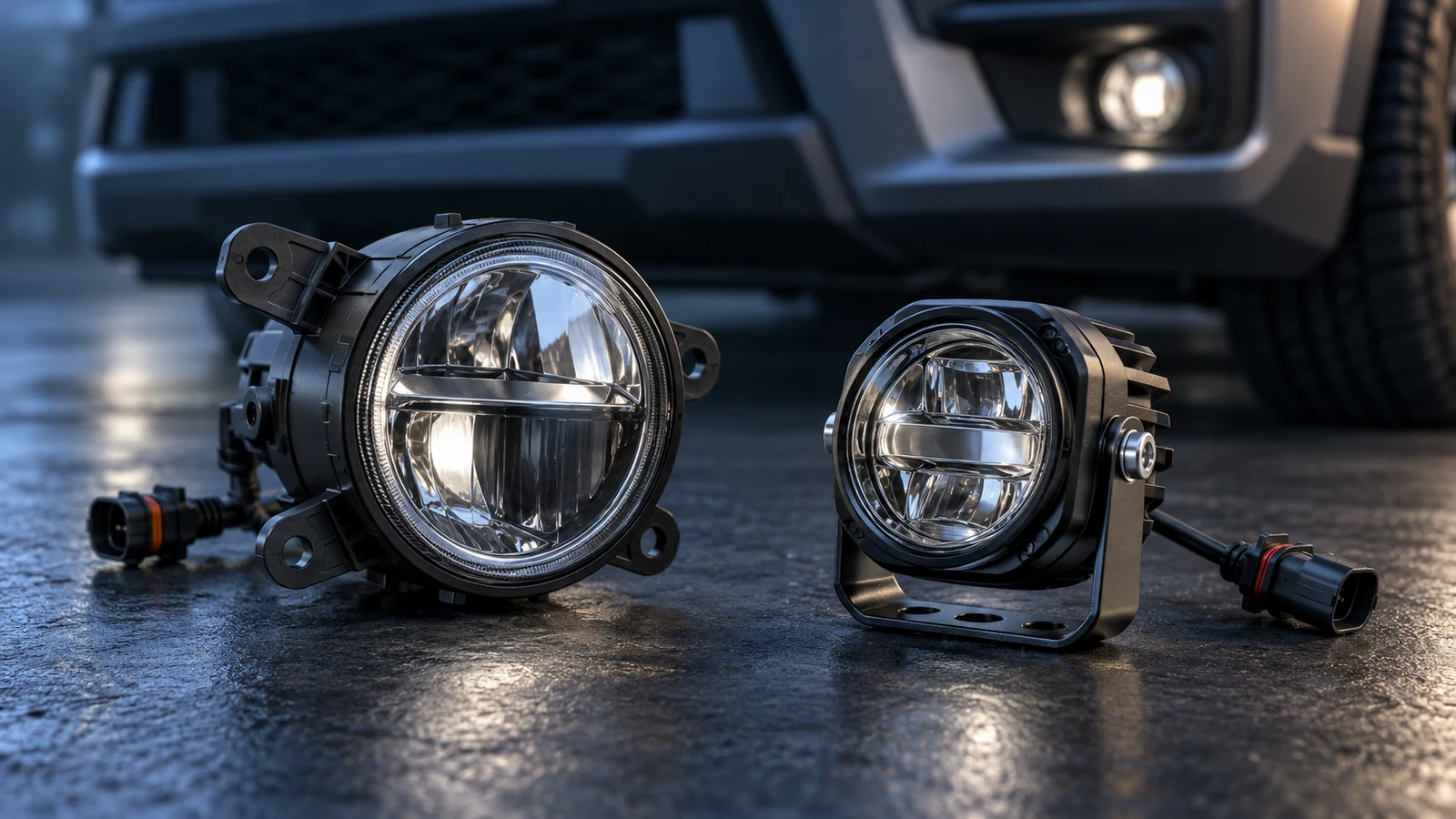
A direct-fit LED fog lamp and a universal fog pod can both illuminate the road ahead, but they pose very different engineering and sourcing challenges. Vehicle-specific replacement assemblies must match an existing bumper opening, fastening pattern, aiming mechanism and wiring interface. Universal lamps offer flexibility for custom builds but place more responsibility on the installer to design a secure mount and compatible electrical connection.
In the low bumper position, neither format is protected from road spray, grit, temperature cycles or vibration. A convincing product photograph cannot show whether a mounting tab will survive repeated service, whether the lens seal will remain compressed, or whether a vent is appropriate for the enclosure.
This guide explains how to compare direct fit led fog light assemblies with universal alternatives through fitment control, material selection, mounting durability, ingress-protection evidence and pressure management. It is written for OEM/ODM buyers, distributors, private-label teams and engineers reviewing actual samples and supplier documentation.
Table of Contents
Quick Guide: Five Engineering Checks
QUICK GUIDE
01
Direct-Fit vs Universal Architecture
OEM mounting geometry and wiring
02
Housing Materials & Brackets
Materials, bracket strength and heat path
Separate IP68 and IPX9K evidence
ePTFE airflow and condensation management
Documents, testing and change control
1. Direct-Fit vs. Universal: Fitment and Integration Architecture
1.1 Vehicle-specific geometry is more than a matching outline
A direct-fit assembly is intended to work within a defined vehicle application. Its housing, tabs, bosses, adjustment points and gasket contact surfaces must be checked against the actual mounting interface. Matching the appearance of the factory lamp is not sufficient: fastener access, bumper retention, installed clearances and optical aim are equally important.
For an OEM-style replacement project, establish a vehicle application list before tooling. Capture the relevant production years, trim variants, left- and right-hand configurations, bumper revisions and any vehicle-specific bracket differences. A CAD overlay or 3D scan is useful evidence, but a representative vehicle installation is still required to confirm the final fit.
1.2 Universal pods trade integration for flexibility
Universal fog pods generally use adjustable mounts that can suit custom vehicle installations, agricultural equipment or off-road builds. The installation may require additional brackets, wiring adapters or changes to the vehicle mounting surface. That flexibility is valuable, but it can also increase labor time and introduce new vibration, alignment and corrosion risks if mounting hardware is poorly selected.
Do not assume every direct-fit lamp is plug-and-play or every universal lamp requires wire splicing. Connector compatibility, driver electronics, polarity, electrical load and available adapters must be verified for the actual vehicle and product.
Engineering comparison: direct-fit versus universal fog lamps
| Review point | Direct-fit assembly | Universal fog pod |
|---|---|---|
| Mounting | Vehicle/application-specific retention geometry | Adaptable bracket; installation design varies |
| Bumper finish | Can integrate with factory recess and trim | Often visible or requires custom integration |
| Harness | May match OE connector; verify part number and pinout | Often requires harness/adapter selection |
| Aim and service | Must preserve adjustment and service access | Adjustability depends on mount and clearance |
| Vibration risk | Localized tab/boss and bracket fatigue | Bracket, bolt preload and pivot movement |
| Validation evidence | Application fit-check and tolerance stack | Installed mount evaluation and wiring review |
| Best-fit buyer | Vehicle-specific replacement/private label | Custom retrofit, specialty and off-road projects |
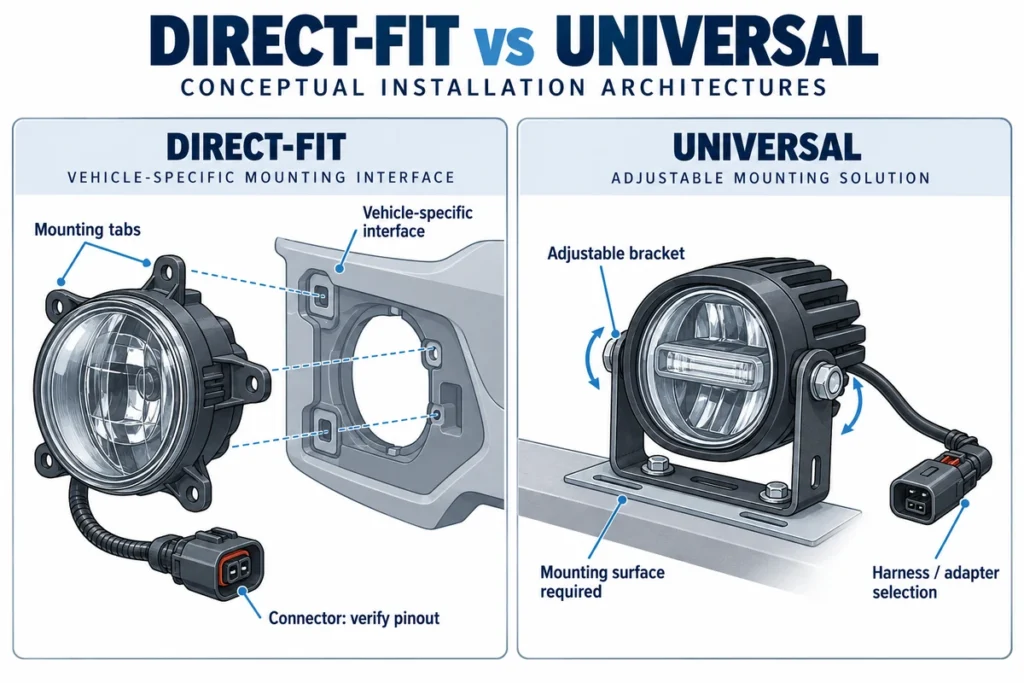
Buyer takeaway: a “direct-fit” label should be supported by a vehicle-application matrix and an installation sample, not treated as a universal guarantee of interchangeability.
2. Housing Materials, Mounting Tabs and Bracket Durability
2.1 Choose the material grade for the actual load case
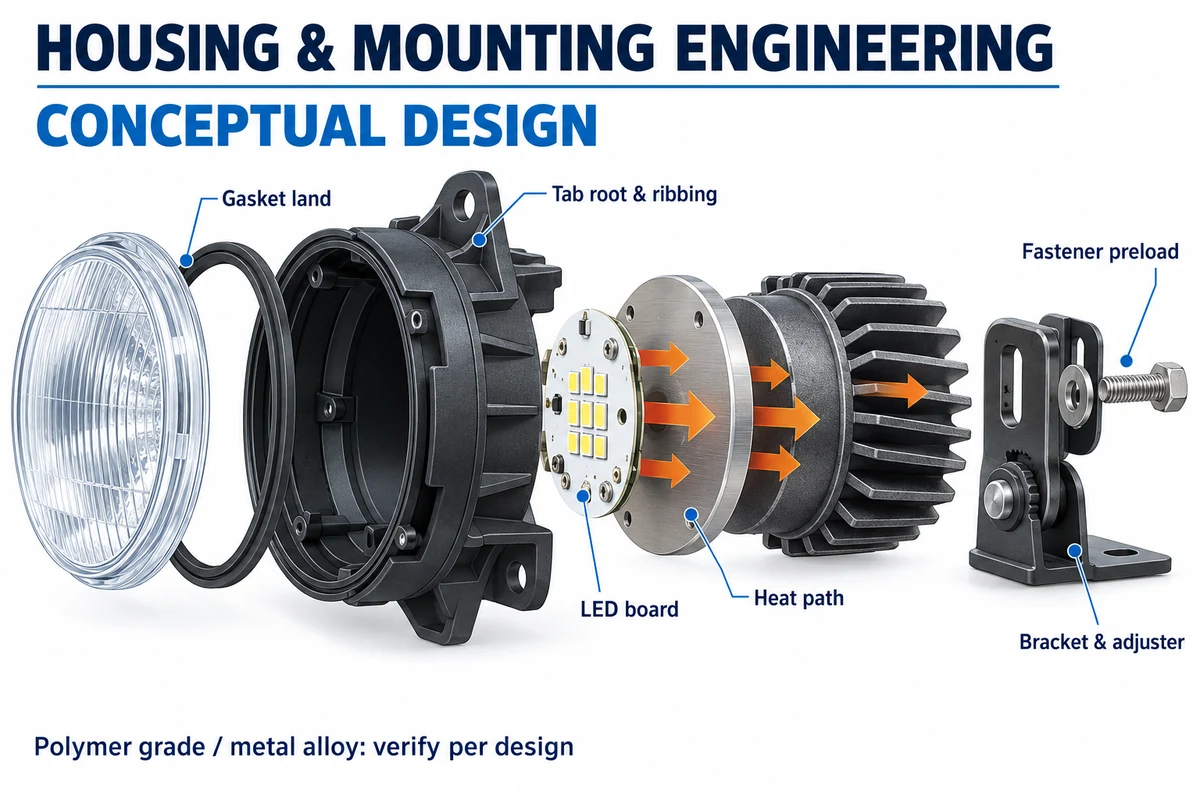
Glass-fiber-reinforced PBT, including grades described as PBT-GF30, can provide useful stiffness, dimensional control and temperature performance in an engineered lamp housing. Its suitability depends on the exact resin grade, moisture exposure, molding process, glass-fiber orientation, notch sensitivity and geometry at the tab roots. A nominal “30% glass fiber” description is not a replacement for a material data sheet or part-level fatigue evaluation.
ADC12 aluminum die casting is another design option, particularly where a housing or insert also supports thermal conduction. Die casting, however, introduces its own considerations: alloy properties, wall thickness, porosity, corrosion protection and gasket-surface quality. Polymer and metal solutions should be compared against the same mechanical, thermal and ingress requirements rather than ranked by material name alone.
2.2 Tab geometry and hardware determine service durability
Mounting tabs tend to fail where local bending, sharp root transitions and assembly stresses concentrate. Design reviews should check fillet radii, rib transitions, fastener preload, interference during installation, cold-temperature impact and repeated removal and reinstallation. The mating bumper or bracket must be included in validation because a strong housing can still fail at an unsupported attachment point.
Corrosion-resistant adjusters and fasteners can improve serviceability where the environment warrants them, but grade 304 stainless steel is not a universal requirement. Choose hardware based on documented corrosion exposure, galvanic compatibility, torque retention, thread engagement and adjustment precision. Aiming access must remain practical after bumper installation.
2.3 Treat thermal management as a complete assembly problem
LED junction temperature cannot be guaranteed from housing alloy alone. Actual temperature depends on electrical power, optical and driver losses, interface resistance, ambient airflow, mounting configuration and duty cycle. Verify the representative assembly through thermal measurement or a qualified model correlated with test results, especially when a plastic housing, metallic heatsink and sealed driver share limited packaging space.
A stronger design is one in which fitment and heat flow are solved together: mounting features retain alignment, gasket landings remain stable, and the thermal path does not introduce distortion that compromises sealing.
3. Low-Bumper Waterproofing: IP68 and IPX9K Are Different Tests
3.1 Immersion and high-pressure spray are not interchangeable
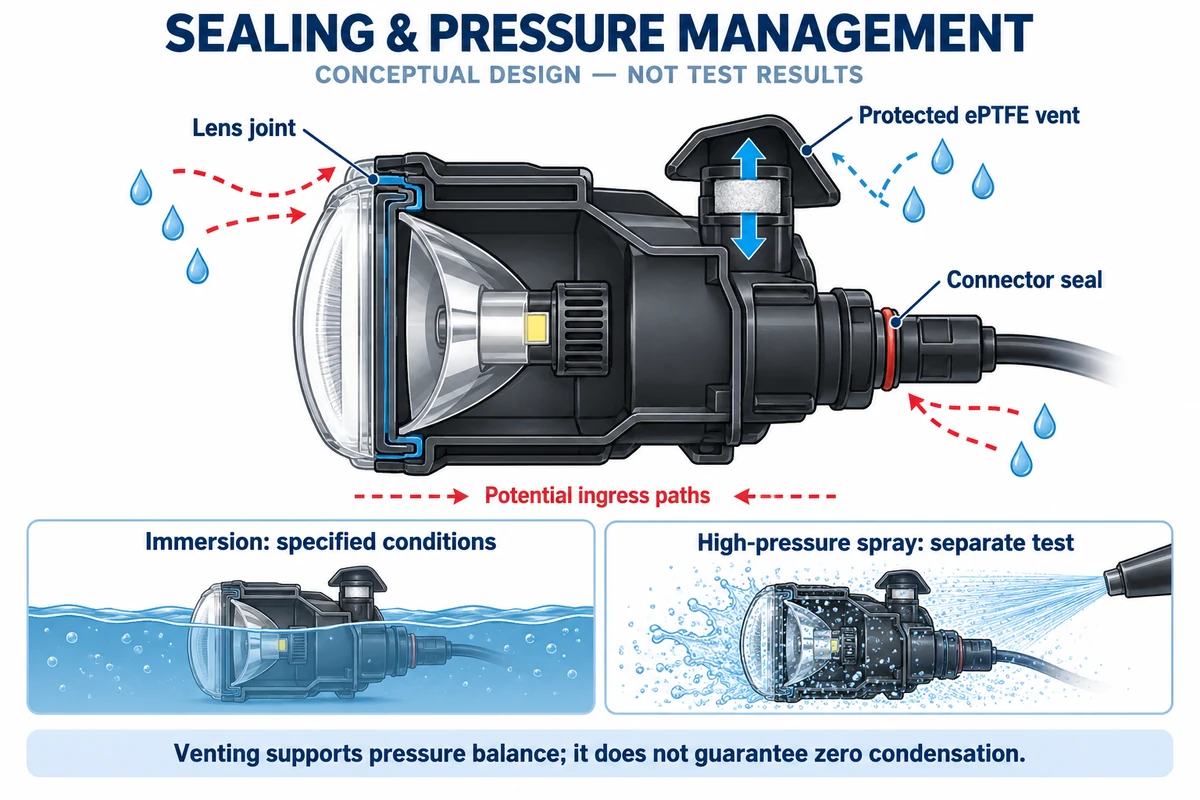
Low-mounted fog lamps may experience standing water, road splash and directed wash water, but the correct ingress-protection claim depends on a specified test. IP68 addresses dust protection and immersion under stated conditions; an IP68 marking alone does not establish a universal depth or unlimited exposure time. Buyers should request the actual depth, duration, orientation, test sample and acceptance criteria used for the claimed rating.
For road-vehicle electrical enclosures, ISO 20653 includes an IPX9K high-pressure/high-temperature spray category. It is a separate exposure from immersion. A product that passes an immersion test must not automatically be described as IPX9K-compliant, nor should a high-pressure spray result be treated as proof of prolonged immersion resistance.
3.2 Build a sealing system, not a single-gasket claim
A robust enclosure often needs multiple coordinated barriers: a continuous lens-to-housing joint, controlled gasket compression, sealed fastener penetrations or interfaces where relevant, and a protected electrical connector. The exact combination may include silicone or EPDM gaskets, molded features, suitable welds or validated adhesives, depending on the assembly design.
Conformal coating or selective encapsulation can reduce the consequences of limited internal moisture exposure, but neither replaces a validated enclosure seal. Fully potted electronics may complicate repair, thermal transfer and rework. The chosen protective strategy should follow the electrical layout and service requirements, not a blanket rule to fill every cavity with compound.
3.3 Validate the whole configured product
A component-level seal certificate is not sufficient evidence for the finished fog lamp. Test scope should identify the actual lens, housing, vent, connector, wiring, adjuster and installed orientation. Include thermal cycling, vibration or strain exposures before post-exposure water testing when those stresses reflect the intended environment.
A useful supplier report records the standard and edition, tested configuration, sample count, equipment and exposure conditions, pass/fail criteria and post-test functional checks. Ask whether the same construction is used in the shipment offered for purchase.
4. Hydrophobic Vents and Pressure Equalization
4.1 Why a sealed lamp may still experience condensation
When a lamp heats and cools, the air inside the enclosure expands and contracts. Ambient humidity, moisture absorbed by materials and water vapor entering or leaving an enclosure can contribute to temporary condensation on a cool lens. A brief mist that clears may have a different cause from persistent droplets, pooling water or electrical corrosion; these conditions should not be treated as equivalent failure evidence.
Pressure differentials can also increase mechanical loading on seals and interfaces. A correctly selected breathable membrane helps equalize the pressure between the lamp cavity and its surroundings while providing a barrier to liquid water and particulates within the product’s specified performance limits.
4.2 Specify the vent rather than the brand name
Hydrophobic ePTFE vent technologies, including commercial automotive vent products, are candidates for pressure management in exterior lighting. Gore is one well-known supplier, but “GORE vent” should appear in an NVEL product specification only when that exact component has been confirmed. Different membranes offer different airflow, liquid-entry resistance, contamination protection and moisture-transport behavior.
Vent placement matters. Avoid locations where standing water, direct impact spray, adhesive contamination or bumper debris could obstruct the membrane. Buyers should verify membrane material and part number, airflow, water-entry-pressure evidence, operating temperature, mounting method and application-specific aging or chemical exposure.
4.3 A vent is not a zero-condensation guarantee
A breathable membrane can reduce pressure-induced seal stress and help moisture move out of the enclosure, but it does not guarantee a permanently clear lens in every combination of climate, duty cycle and vehicle orientation. Evaluate condensation clearing after controlled temperature/humidity cycling and confirm the lamp still meets its optical and electrical requirements.
The complete design must balance vent permeability against water and contamination resistance. Excessive or poorly protected venting can undermine the ingress performance that the rest of the housing was built to achieve.
5. B2B Sourcing Checklist and OEM/ODM Verification
For importers, distributors and private-label programs, the commercial risk is rarely limited to a single failed part. Wrong-fit variants, inconsistent bracket tooling and inadequately documented ingress claims can produce returns across an entire vehicle-application range. Qualifying the production configuration is therefore as important as reviewing a laboratory sample.
5.1 Request evidence before quotation approval
- Vehicle application and dimensional fit: confirmed model-year/trim coverage, left/right references, CAD or controlled drawings, and at least one representative installation record.
- Mounting durability: tab/root geometry, fastening method, vibration/impact criteria, aiming retention and post-test inspection.
- Materials: exact polymer or alloy designation, supplier data sheets, process controls, color/UV and chemical-resistance requirements as applicable.
- Electrical interface: OE connector cross-reference where applicable, polarity, voltage range, harness sealing and electrical protection details.
- Environmental sealing: identify each claimed IP test, standard edition, exposure level, test configuration and acceptance criteria.
- Venting and condensation: confirmed vent supplier/part number if used, location, airflow and water-entry evidence, condensation/aging validation.
- Thermal performance: duty-cycle and ambient assumptions, measured temperatures and test configuration, not an unverified universal temperature limit.
- Optical/legal fit: beam pattern, aim procedure and the model-specific SAE/UN approval or other jurisdictional evidence needed for the intended market.
- Quality and traceability: production inspection plan, change-control procedure, sample-to-shipment consistency and available factory certificates (verify authenticity and scope).
- Commercial readiness: sample approval, packaging, spare parts, warranty handling, MOQ and change notification for vehicle-specific tooling.
5.2 Supplier verification matrix
| Topic | Documents to request | Common warning sign |
|---|---|---|
| Vehicle fit | Application list, drawing revision, installation photos | “Fits all” without year/trim evidence |
| Material | Grade/datasheet, process traceability | Only a generic PBT/ADC12 label |
| Mechanical | Fixture definition, fatigue or vibration report | No tested bracket or fastener configuration |
| Ingress | IP report and full configuration details | IP68 claimed without depth/time or IPX9K assumed |
| Vent / condensation | Vent spec, placement drawing, cycle results | Brand names used without a confirmed part |
| Optical / legal | Beam report, approval marking and market scope | Generic “DOT/E-mark certified” claim |
| Production quality | Inspection plan, change record, certificate if claimed | Sample and production assembly differ |
5.3 Separate the product claim from supplier capability
NVEL offers OEM/ODM discussions and automotive lighting sourcing support; the exact production route, tooling work, validated material, test capability and certificate scope must be confirmed for each quotation or model. Ask the supplier to identify which steps are performed in-house, which are supported by qualified manufacturing partners, and which reports relate to the precise part offered.
A practical qualification sequence is: agree the vehicle application → approve a controlled sample → review dimensional, mechanical, ingress and optical evidence → confirm the pilot build → lock the production configuration and change-control rules. This reduces the risk that a good-looking sample will become a recurring field complaint.
Frequently Asked Questions
Q1. Why do some direct-fit fog lights crack at their mounting tabs?
Tab cracks can result from local stress concentration, insufficient support, material or molding variation, incorrect installation force, temperature exposure or cyclic vibration. Reinforced polymers may improve performance, but no material grade eliminates fatigue without sound geometry and part-level validation.
Q2. Are direct-fit fog lamps always plug-and-play?
No. Direct-fit generally describes compatibility with a defined vehicle mounting interface. Electrical connectors, driver electronics, trim variations and aiming procedures must also be checked. Some approved applications use an adapter harness or different bracket.
Q3. Does IP68 automatically mean the lamp withstands IPX9K washdown?
No. Immersion and high-pressure spray evaluate different exposure conditions. Ask for separate, configuration-specific evidence if both claims are required for the intended market or duty cycle.
Q4. Does temporary lens condensation always mean a waterproofing failure?
Not necessarily. Short-lived fogging may arise during temperature and humidity changes. Persistent droplets, pooling or corrosion call for further inspection of seals, vent function and the complete enclosure. The relevant acceptance criteria should be agreed before testing.
Q5. Are aftermarket direct-fit fog lamps automatically street legal?
No. Road use depends on the market, lamp category, optical performance, required approvals or markings, vehicle installation and local rules. SAE J583 is a technical standard, while UN R19 and UN R149 concern lamp approval under applicable regulatory arrangements; neither a product description nor a generic marking proves suitability for every vehicle or jurisdiction.
Q6. Can NVEL support a vehicle-specific OEM/ODM fog lamp project?
NVEL publicly offers OEM/ODM support and customized automotive lighting solutions. For a particular vehicle platform, buyers should confirm project scope, available fitment data, tooling responsibility, material options, validation plan, manufacturing partner roles, MOQ and delivery conditions directly with the NVEL team.
Conclusion
The choice between direct-fit and universal LED fog lamps is ultimately a choice about interfaces and evidence. Direct-fit products must meet vehicle-specific geometry and service expectations, while universal pods require a disciplined mounting and electrical integration plan. In either case, housing materials, fasteners, gasket design, venting and validation should be evaluated as one assembly.
For B2B buyers, reliable sourcing comes from application-controlled samples and credible test documentation—not “100% fit,” “zero condensation” or unqualified certification promises. Share your target vehicles, market requirements, expected order volumes and engineering constraints with NVEL to discuss a suitable OEM/ODM approach.
Explore NVEL Automotive LED Lighting Solutions
Review NVEL universal Bi-LED fog light projector range or contact the NVEL team with your vehicle application, target market, fitment information and OEM/ODM requirements. We can discuss the appropriate sourcing and project scope before samples or production are committed.