TECHNICAL GUIDES · MARINE & WINTER FLEETS
Marine-Grade LED Work Light Corrosion Protection for Saltwater and Winter Fleets
Coatings, stainless hardware, galvanic isolation and corrosion qualification for B2B sourcing.
October 28, 2026 · 12 min read
Introduction
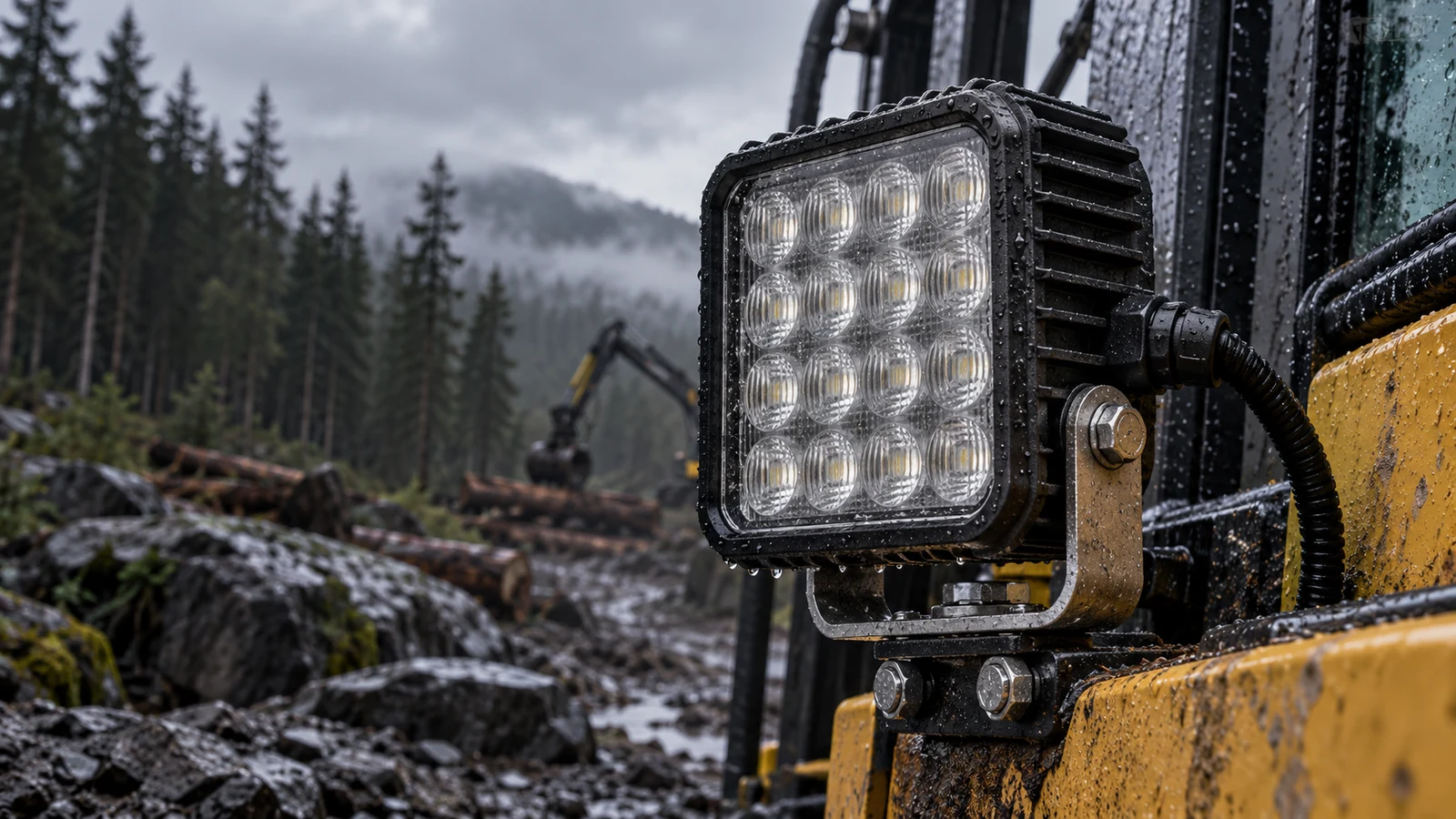
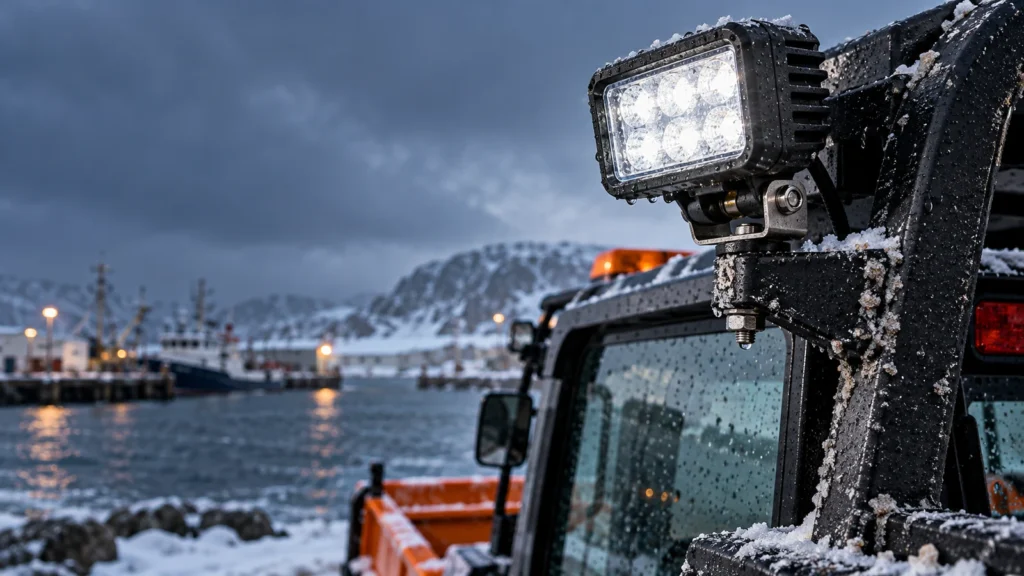
Marine-grade LED work lights are exposed to a combination of salt, moisture, vibration and mechanical wear that ordinary workshop fixtures may never encounter. A lamp mounted on a harbor service vehicle can receive salt-laden spray every day. A snowplow or de-icing truck may face repeated wet–dry cycles with sodium, calcium or magnesium chloride deposits around brackets and electrical connectors. In both applications, a bright initial beam tells a buyer very little about the durability of the complete assembly.
Corrosion-related failures rarely begin at just one component. A chipped coating exposes aluminum; chloride-rich moisture reaches a fastener joint; oxidation develops near a seal groove; or an adjuster seizes before the lamp reaches its expected service interval. A reliable marine grade LED work light therefore requires a coordinated design covering the housing, surface treatment, hardware, electrical interfaces and verification plan.
This guide explains how B2B buyers can compare coating systems, distinguish 304 from 316 stainless hardware, manage galvanic couples and interpret salt-spray reports without mistaking laboratory exposure hours for a field-life guarantee.
Table of Contents
Corrosion Protection at a Glance
QUICK GUIDE
01
Galvanic Corrosion & Salt Exposure
Trace metal contact, saltwater entry and drainage.
Evaluate preparation, coating coverage and cure control.
03
316 Stainless Steel Hardware
Review alloy selection and complete joint isolation.
04
ASTM B117 & ISO 9227 Testing
Define laboratory conditions and acceptance criteria.
Request traceable specifications and qualification evidence.
1. Galvanic Corrosion and Salt Exposure
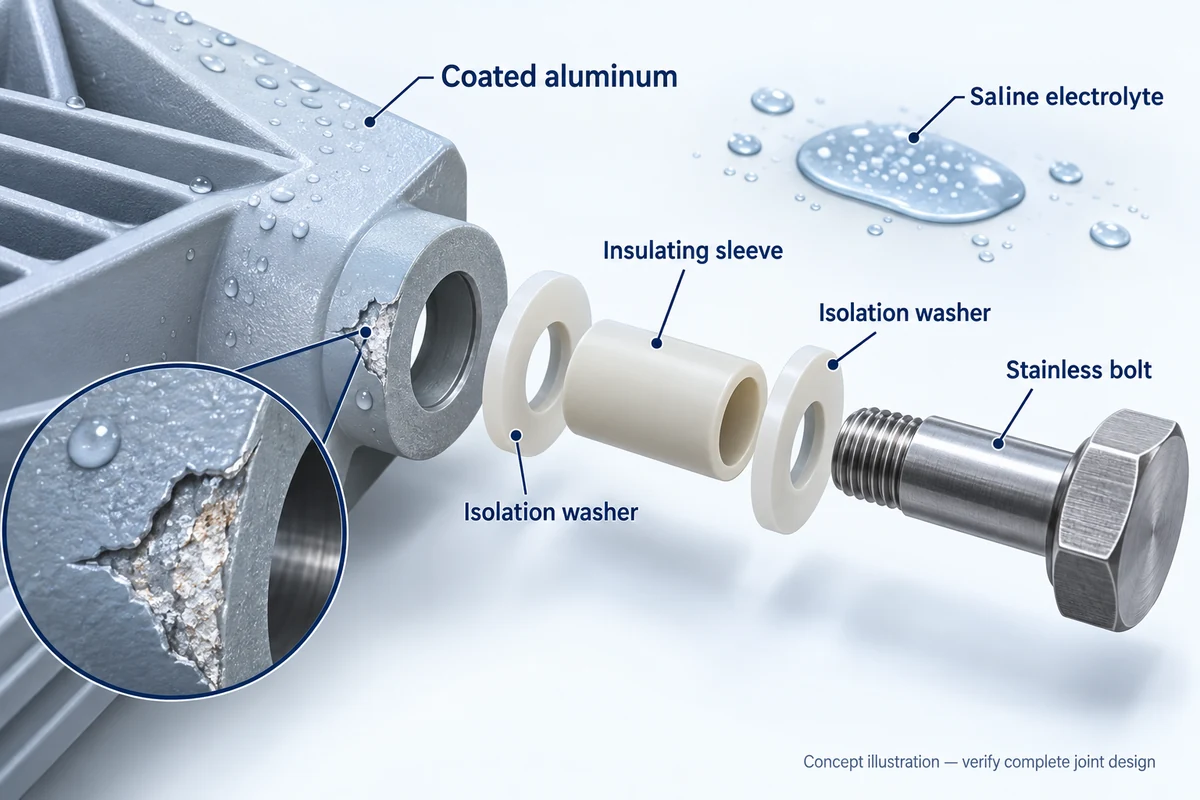
A galvanic cell can form when dissimilar conductive materials are electrically connected in the presence of an electrolyte such as saltwater. The more active metal tends to corrode preferentially. In a lighting assembly, that may be aluminum around a stainless-steel fastener or bracket. Actual severity depends on alloy condition, exposed surface-area ratio, electrolyte, joint geometry and how long moisture remains trapped.
The environment matters as much as the metal pair. Road-deicing salts can remain hygroscopic and keep joints damp long after a vehicle looks dry. Crevices around washers, bracket slots and cable glands retain concentrated deposits, while gravel impact or handling damage can breach a protective film. Thread seizure, localized pitting and coating undercutting may follow; none has a universal failure time.
Where corrosion tends to start
- Housing-to-bracket interfaces: damaged paint and persistent moisture create opportunities for local attack around fasteners.
- Adjuster screws and threaded inserts: crevices, contamination and incompatible materials can make service adjustment difficult.
- Lens and gasket interfaces: corrosion products near sealing surfaces can compromise compression or create leak paths.
- Connectors and cable exits: road spray and accumulated salt can attack terminals, clamps and cable-gland hardware.
A practical design review should trace three things: the electrical contact path, the route by which saline water reaches it, and the path by which the assembly drains and dries. Breaking the electrical path with properly engineered isolation components, protecting edges and reducing water retention are often more useful than selecting a premium alloy in isolation.
2. Pretreatment and Powder-Coating System Design
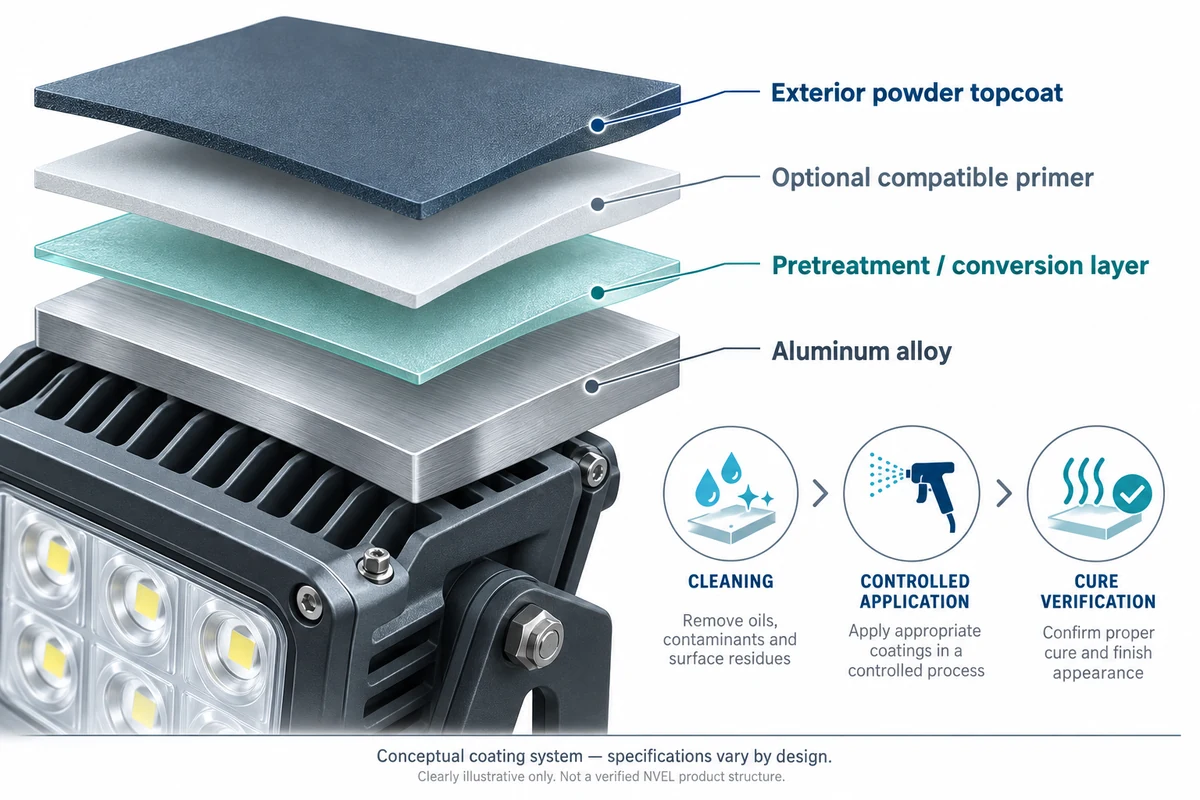
A powder-coated aluminum housing is only as reliable as the whole coating system. Surface cleaning, conversion treatment, optional sealing or primer, coating selection and cure control work together. A nominal thickness value or an attractive finish cannot prove corrosion performance on its own.
Build the barrier from the substrate outward
First, remove oils, casting release agents and process contamination. Next, select a qualified pretreatment appropriate for the aluminum alloy and coating chemistry. Chromium-free zirconium-based conversion processes are among the options, but they must be validated for the actual substrate and supplier line. On porous die-cast surfaces or highly exposed edges, an approved sealer or compatible primer may improve the system if supported by testing.
Outdoor-grade polyester and polyurethane powder formulations are both available, with different weathering, handling and chemical-resistance characteristics. A supplier should disclose the precise coating specification and target dry-film thickness rather than market an unspecified “marine coating.” Application coverage around corners, screw seats and heat-sink fins must be evaluated along with cure temperature and time according to the powder manufacturer’s technical data.
Coating-system comparison for sourcing teams
| Design element | Basic purchasing description | Engineering evidence to request |
|---|---|---|
| Die-cast housing | “Aluminum, painted black” | Alloy designation, casting surface quality and edge/porosity inspection |
| Surface preparation | “Cleaned before coating” | Degreasing and conversion-treatment process records, bath controls and compatibility tests |
| Powder topcoat | “Weatherproof powder paint” | Coating formulation, supplier data sheet, UV/weathering requirements and dry-film thickness range |
| Application and cure | “Powder coated” | Thickness map at critical features, cure record and adhesion checks |
| Corrosion acceptance | “Salt spray passed” | Defined test method, exposure duration, specimen condition and explicit pass/fail criteria |
Do not copy a building-product AAMA coating designation onto a vehicle lamp without establishing that the project specification actually requires it. Similarly, avoid assuming that one fixed powder thickness, cure temperature or number of pretreatment stages is appropriate for every housing design.
3. 316 Stainless Steel Hardware and Galvanic Isolation
Type 316 stainless steel contains molybdenum, which generally improves resistance to chloride-related pitting and crevice corrosion relative to common Type 304. That makes 316 a useful candidate for marine and winter-fleet mounting brackets, bolts and adjusters. It does not make the material immune to corrosion, especially where warm chloride solution remains trapped in tight crevices.
Material selection is not the complete joint design
When stainless hardware contacts an aluminum housing, the stainless surface can act as the more noble member of a galvanic couple. Design risk is influenced by the exposed areas of the two metals and by how much wet electrolyte can bridge them. In aggressive marine applications, a nonconductive washer may help, but an isolation washer alone does not necessarily break the circuit if the bolt shank still contacts the housing bore.
Specify a complete isolation strategy when required: suitable nonconductive sleeves or bushings, washers, compatible sealants, protected hole edges and drainage geometry. Verify the assembly after torque is applied. A crushed insulator, exposed washer edge or metal-to-metal path can defeat an otherwise sensible specification.
Fastener details worth auditing
- Verify 316/316L grades from traceable material documentation where chloride resistance is a procurement requirement.
- Check thread fit, tightening torque, service accessibility and the risk of stainless-on-stainless galling.
- Specify compatible anti-seize or thread protection only where approved for the design and electrical requirements.
- Examine brackets and adjusters as assembled systems, not only as isolated fastener samples.
- Inspect drainage gaps and crevices that can trap salts during washdowns and freeze–thaw cycles.
For some applications, a well-engineered 304 assembly with effective protection may outperform a poorly detailed 316 assembly. Supplier comparison should therefore consider both alloy selection and the joint’s real exposure.
4. ASTM B117, ISO 9227 and Meaningful Corrosion Qualification
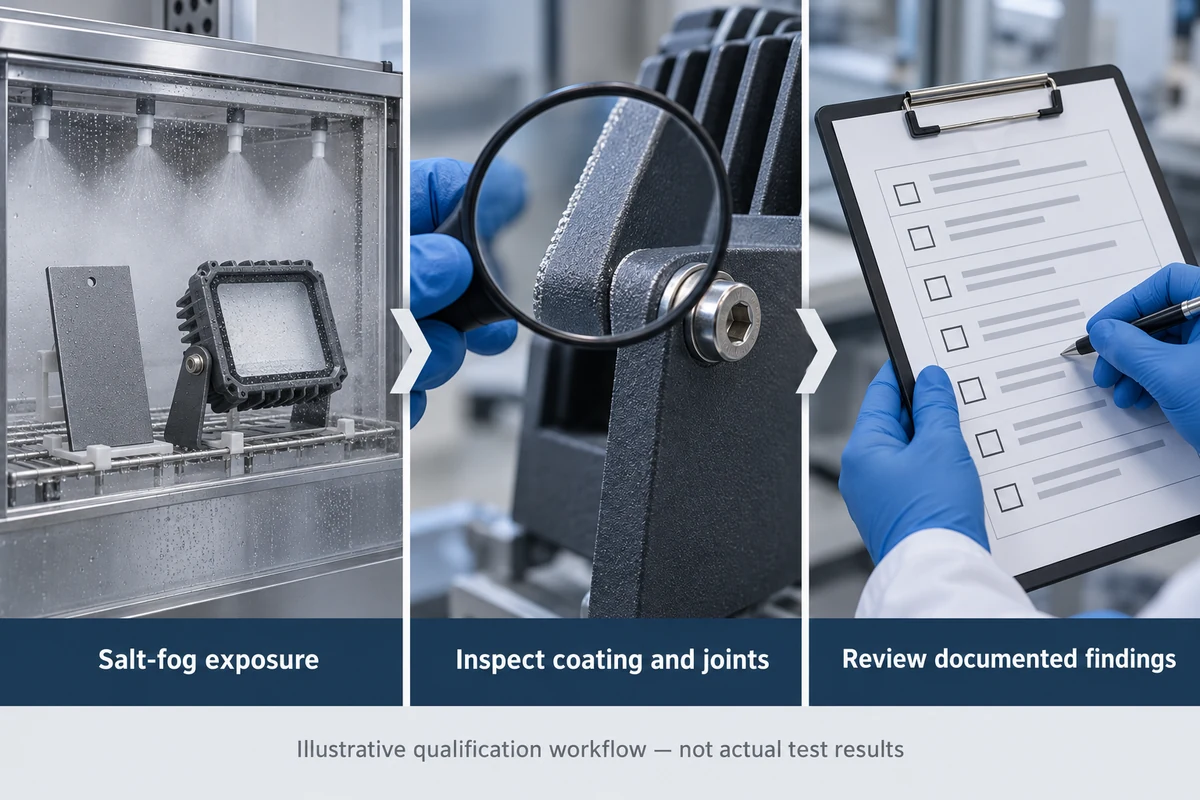
Salt-spray testing is useful for comparing corrosion-protection systems under specified laboratory conditions, but a test report is not a direct prediction of years in service. ASTM B117 addresses the operation of the salt-fog apparatus; ISO 9227 describes salt-spray methods, including neutral salt spray. Neither standard sets one universal exposure duration or acceptance criterion for every LED work light.
A requirement for 500 or 1,000 hours can be appropriate when it is explicitly defined in the buyer’s qualification plan. The buyer should also specify which specimens are tested, whether coatings are intentionally scribed, what constitutes unacceptable blistering or underfilm corrosion, and whether electrical and sealing performance is rechecked after exposure. ASTM D1654 provides a method for evaluating coated specimens after corrosive exposure.
A practical verification matrix
| Qualification step | What to specify or examine | What it cannot prove by itself |
|---|---|---|
| Neutral salt spray | ASTM B117 or ISO 9227 method, agreed duration, sample count and exposure orientation | A fixed number of real-world service years |
| Coating inspection | Blistering, adhesion loss, corrosion from a deliberate scribe and damage at edges | That every production unit has identical protection |
| Assembled lamp review | Fastener operability, bracket integrity, connector condition and visible housing attack | Long-term reliability under every road-chemical mixture |
| Post-exposure electrical checks | Light output/function, driver operation and connector continuity against project limits | Compliance with an unrelated photometric regulation |
| Separate water-ingress test | Applicable IP method, defined acceptance and test sequence if required | That salt-spray exposure automatically establishes IP68 or IPX9K |
For road-vehicle enclosures, water-ingress testing may be specified under ISO 20653; it addresses protection against water and foreign objects, not chloride corrosion. A post-corrosion water-ingress sequence can be useful, but it must be designed and reported as a separate qualification activity.
What a credible report contains
Ask for laboratory identification, specimen and product revision, exposure conditions, actual duration, pretest photographs, posttest photographs, evaluation method and recorded findings. Where a project calls for coating-creep limits or functional pass/fail criteria, those thresholds must be documented before testing rather than chosen after results are known.
5. B2B Sourcing and OEM/ODM Checklist
For a fleet procurement program or private-label work-light range, the most valuable quality question is not “Is this marine grade?” but “Which assembly revision was tested, against which acceptance criteria, and can the supplier repeat that build consistently?” Use this checklist before approving tooling, samples or bulk orders.
- ☐ Define exposure: distinguish coastal spray, vessel-deck use, road-deicing washdowns and mining chemical exposure.
- ☐ Verify housing/coating specification: request alloy identification, pretreatment details, powder formulation, critical film-thickness controls and cure records.
- ☐ Inspect hardware and isolation: confirm fastener grades, sleeve/washer geometry, torque requirements and protection at aluminum contact points.
- ☐ Review salt-spray evidence: obtain reports with the agreed ASTM B117 or ISO 9227 method, duration, specimen condition and measurable acceptance criteria.
- ☐ Separate sealing from corrosion: request any relevant water-ingress test reports and confirm the correct edition and product revision.
- ☐ Check connectors and pressure vents: examine materials, sealing arrangements, placement and their suitability for salt-rich environments.
- ☐ Audit production consistency: confirm process controls for coating, incoming fasteners, assembly torque, traceability and change management.
- ☐ Agree on maintenance guidance: specify rinsing, inspection, bracket adjustment and replacement procedures where the operating environment requires them.
Supplier questions that improve the RFQ
Request the intended application, working voltage, installation orientation, lamp dimensions, bracket material, approved surface finish, target validation sequence and order quantities. A supplier should then identify what is standard, what requires a custom configuration and which tests remain to be performed. This reduces the risk of receiving an attractive prototype that has not been qualified for the actual vehicle fleet.
Frequently Asked Questions
1. What distinguishes a marine-grade LED work light from a standard off-road lamp?
“Marine grade” is not one universal certification. For procurement purposes it should describe a documented combination of corrosion-resistant housing protection, suitable fasteners, careful galvanic isolation, environmental sealing and qualification against agreed conditions. The test evidence matters more than the marketing label.
2. Is 316 stainless steel always better than 304 for LED work-light brackets?
316 generally offers improved resistance to chloride pitting because of its molybdenum content. However, both grades can corrode in aggressive crevices, and either can contribute to galvanic attack on exposed aluminum when the joint remains wet. Select and test the complete bracket assembly.
3. How can galvanic corrosion between stainless hardware and aluminum be reduced?
Engineers can control galvanic corrosion by maintaining protective coatings, interrupting electrical contact where appropriate, using insulating sleeves and washers, avoiding exposed damaged edges and designing joints to drain and dry. Isolation details must still work after the bracket is tightened.
4. Does a 1,000-hour ASTM B117 salt-spray result guarantee several years of service?
No. The test gives comparative laboratory evidence under defined conditions. It does not establish a universal conversion to outdoor service life or guarantee that a product will remain free of corrosion in every marine or winter-road environment. Ask for the actual acceptance criteria and supporting field or cyclic test evidence where needed.
5. Are IP68 and IPX9K ratings the same as corrosion protection?
No. Ingress-protection ratings concern resistance to water and other specified environmental entry conditions. Salt-driven galvanic corrosion, coating degradation and thread seizure are different failure mechanisms. A demanding project may need both ingress-protection and corrosion-qualification tests, each with its own report.
6. How can NVEL support buyers sourcing corrosion-resistant work lights?
NVEL can help B2B buyers define application requirements, compare available work-light configurations and coordinate requests for material, coating and relevant test documentation with manufacturing partners. Any specific alloy, coating, IP rating or certification should be confirmed for the proposed model and production source before it is included in a purchase specification.
Conclusion
Specifying a reliable marine grade LED work light means treating corrosion protection as a complete assembly-design problem. Surface pretreatment and powder coating protect the aluminum housing; properly chosen fasteners and isolation features reduce joint risks; and documented salt-spray, sealing and functional tests help buyers evaluate whether the design is fit for a defined environment.
For marine operators, winter maintenance fleets and industrial distributors, the strongest OEM/ODM sourcing decisions come from traceable material choices, meaningful acceptance criteria and consistent production controls—not from a single claim of “1,000-hour salt spray” or “marine-grade stainless.” Explore suitable NVEL lighting categories or contact the team to discuss application requirements and request documentation for a specific configuration.
Discuss Your Fleet Lighting Requirements
Explore NVEL lighting categories or contact our team to discuss application requirements and request documentation for a specific configuration.