TECHNICAL GUIDES
H3 LED Fog Light Bulb: PK22s Fitment, Yellow/White Beam & OEM Validation
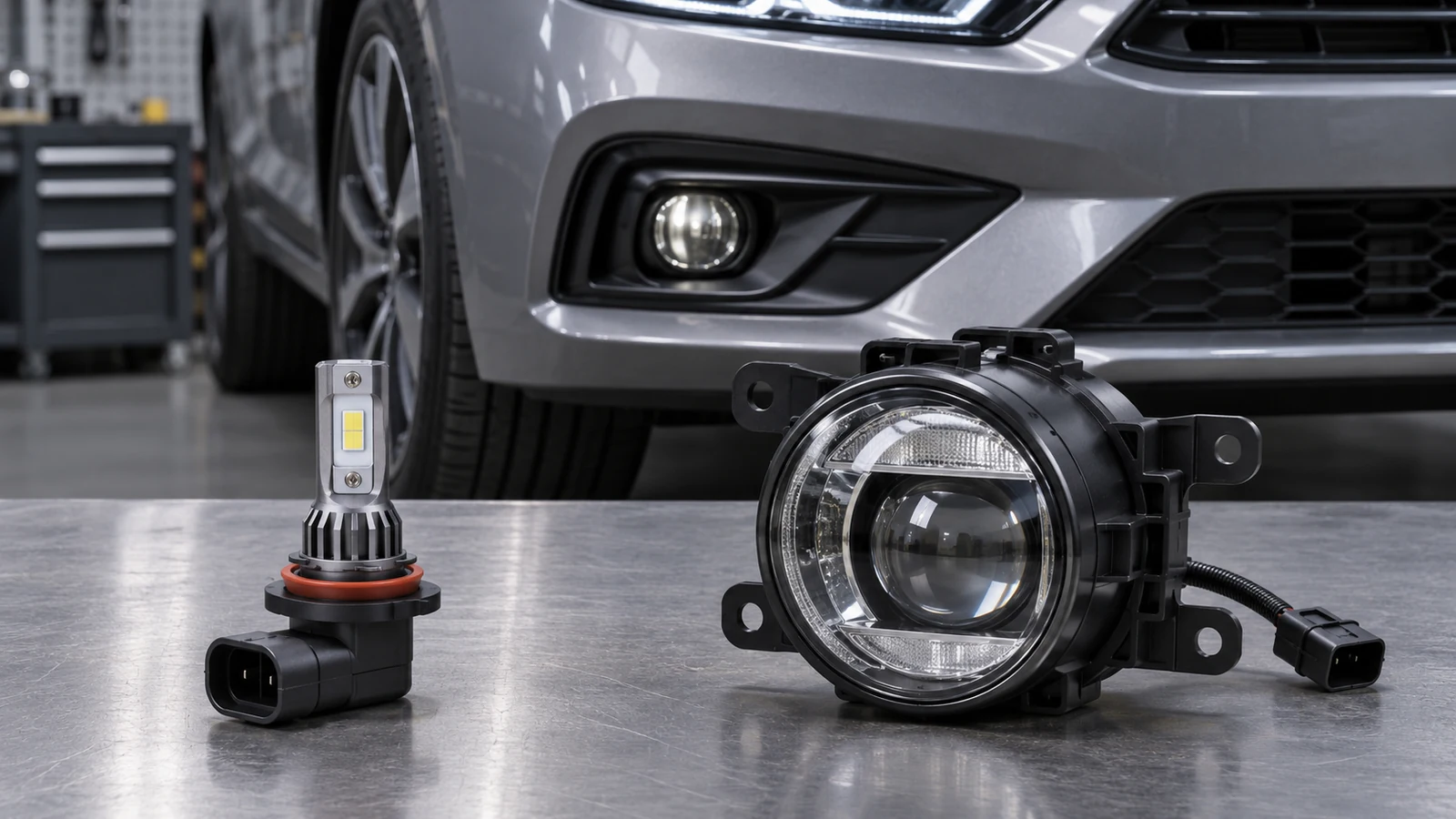
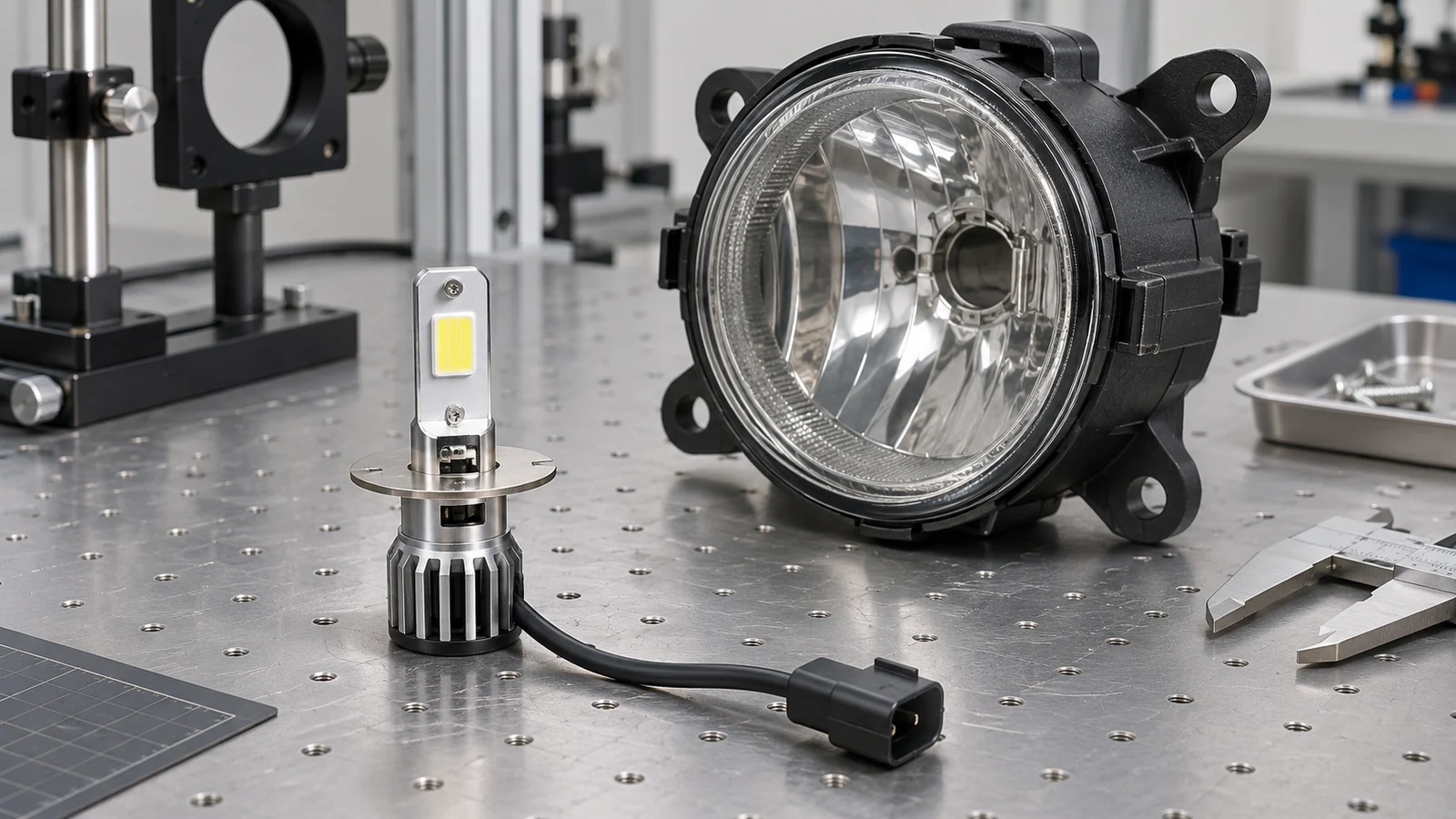
PK22s fitment, installed beam evidence and sample validation for B2B buyers.
November 6, 2026
Introduction
A search for an H3 LED fog light bulb often starts with a bulb code, a yellow-or-white color choice and a large advertised lumen figure. Those details cannot, by themselves, establish a usable replacement. A buyer also needs to identify the actual lamp function and housing, the original H3 interface, the way the lead wire connects, the available space behind the lamp and the resulting beam once the LED source is installed.
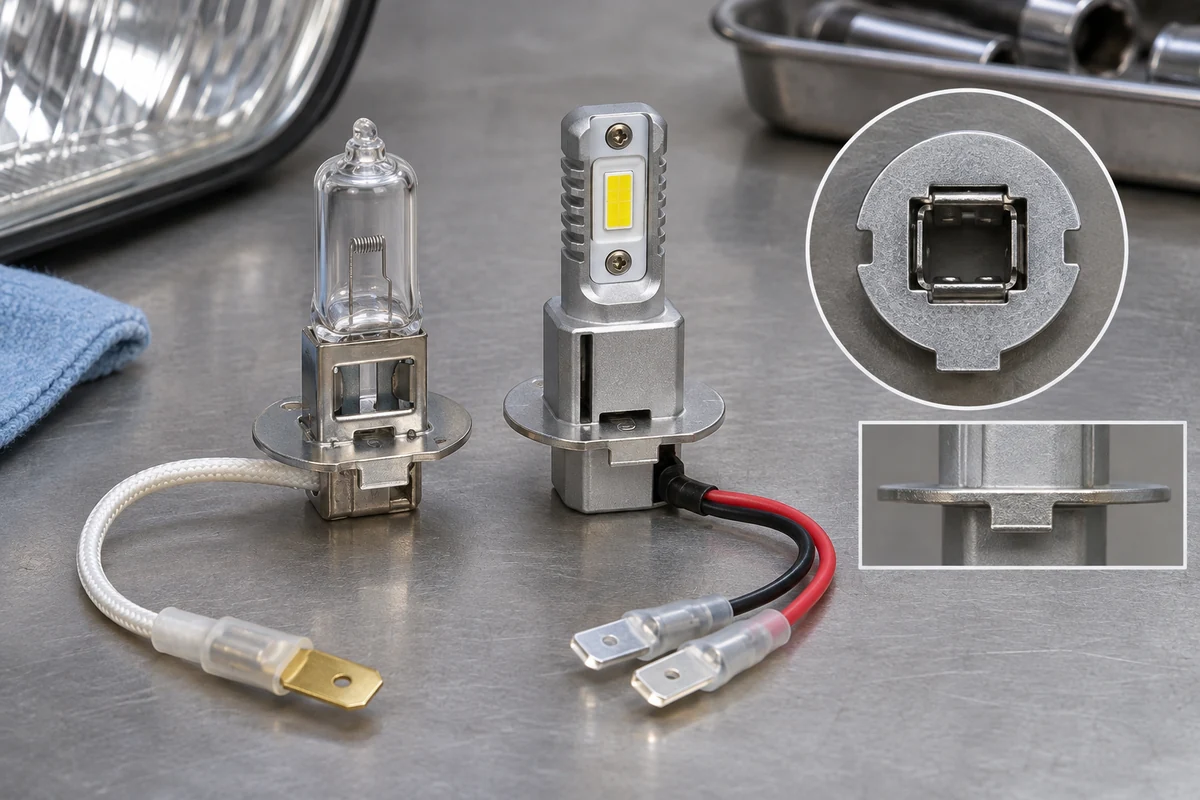
H3 is a defined halogen source category commonly associated with a PK22s base and a separate lead connection. In its bulb catalogue, HELLA lists a common H3 12 V / 55 W halogen reference and a 24 V / 70 W version. These numbers describe halogen reference products; they are not LED power ratings, lumen figures or evidence of LED retrofit approval. H3C is a different interface and must not be assumed interchangeable with H3.
This guide focuses on H3 replacement programs in existing fog-lamp housings, where source position, retention, lead routing, heat-sink clearance and installed photometry can decide whether a proposed SKU is suitable. It also distinguishes H3 fog-lamp projects from H3 headlamp uses, explains how to compare yellow and white versions, and provides an OEM evidence checklist. The available NVEL product inventory does not establish a specific H3 LED bulb SKU, so no model or performance specification is invented here.
Table of Contents
Quick Guide
QUICK GUIDE
Identify the PK22s interface.
Check holder, wiring and clearance.
Compare installed color and beam.
Measure output after warm-up.
Approve traceable samples.
H3 LED Fog Light Bulb Basics: PK22s, Lead Wire and H3C
The H3 marking describes a source family; it does not identify a vehicle, a lamp assembly or a guaranteed LED retrofit. For the common halogen reference, HELLA lists the H3 base as PK22s, with examples at 12 V / 55 W and 24 V / 70 W. The 24 V example is especially relevant when commercial-vehicle buyers request H3 lighting, because a replacement LED driver must be verified for the actual vehicle supply rather than assumed to support 24 V from the word “H3.”
Identify the original source and the complete lamp
Read the source marking or the vehicle service information, then record the lamp manufacturer, complete assembly part number, vehicle year and trim, market, intended lighting function and original retaining hardware. A fog lamp may use an H3 halogen source, but a visually similar light in the bumper may have a different replaceable source or an integrated LED assembly. Before a buyer orders a sample, confirm which component is actually designed to be replaced.
H3 and H3C are not interchangeable by name
In the HELLA reference catalogue, standard H3 examples use a PK22s base, while the listed H3C examples use a P22d base. Their electrical contacts and mechanical interfaces differ. A seller may advertise a specifically engineered dual-compatible LED kit, but compatibility must be demonstrated for that exact kit and holder; it must not be inferred from similar product labels. Cutting or bending an original retainer to force a mismatch is not a substitute for a controlled fitment design.
An H3 halogen bulb usually has a separate lead coming from the bulb assembly. For an LED replacement, the supplier must define the power and return paths, connector geometry, wire exit and any driver module. Do not assume that a generic two-wire LED harness uses the same return path as a particular original halogen holder.
Table 1 — H3 and H3C Reference and Fitment Differences
| Item | Reference or issue | Buyer verification |
|---|---|---|
| H3 halogen base | PK22s in the listed HELLA reference | Confirm original H3 marking, mounting datum and correct retainer. |
| Common H3 halogen example | 12 V / 55 W; 24 V / 70 W variant listed | Never transfer these wattages to a replacement LED specification. |
| H3 electrical connection | Often a separate power lead, with application-specific return path | Document terminal, polarity and ground/return circuit from the vehicle diagram. |
| H3C reference | P22d in the listed HELLA examples | Treat H3C as a different interface unless the exact product proves dual compatibility. |
| LED light-source position | LED emitter geometry differs from a halogen filament | Request emitter datum, orientation and installed beam evidence. |
| Vehicle or lamp function | Fog, driving or headlamp usage varies by application | Identify the complete lamp before applying fitment or legal conclusions. |
H3 LED Bulb Fitment: Holder, Wiring and Rear Clearance
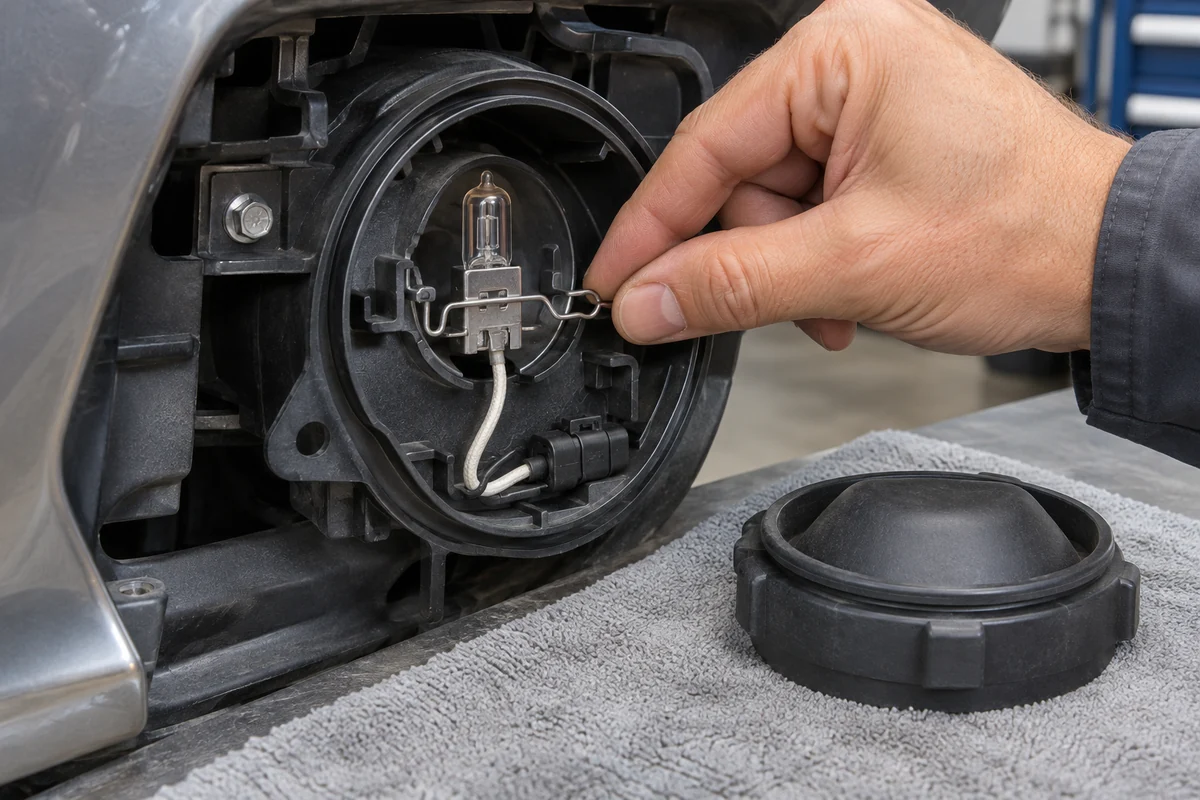
An H3 LED light bulb may be physically short at the base yet still require more installation volume than the original halogen source. LED emitters, heat sinks, fans, external drivers and cable strain relief can occupy space inside or behind the lamp. A sample should be evaluated in the intended housing, including the original rear cover and sealing arrangement where applicable.
Use the original retaining datum, not visual similarity
Check the PK22s seating surface, locating features and spring or clip preload. The source must remain seated and repeatably oriented after installation, vibration and removal/reinstallation. A spacer or adapter can move the LED emitting surface along the optical axis; if an adapter is required, identify its material, dimensions, part number and approved installation procedure. The fixture must not depend on friction from a loose retainer or on bending the holder into shape.
Verify the single-lead circuit and the LED driver
The original H3 connection commonly brings a lead from the source, while the return path depends on the lamp design. The LED product may have its own driver and different lead arrangement. Confirm the wire diagram for the target vehicle, the defined positive and return connections, polarity behavior, terminal retention, insulation and whether any chassis or reflector return path is used. Power must be disconnected for fitting work; wiring modifications should follow an approved vehicle procedure rather than an improvised splice.
Before closing the lamp, verify that the harness does not touch moving parts, hot components, sharp metal edges or the cooling fan. If a cable passes through a housing seal, obtain a suitable approved grommet or connector solution. A drilled cover or permanently open dust cap may create water-entry and thermal problems and should not be treated as an acceptable universal workaround.
Check closed-housing thermal conditions
Record the lamp orientation, rear cover condition, ambient temperature, ventilation clearance, supply voltage, input current, LED output trend and temperatures of the driver, heat sink and adjacent components. A product that works on an open bench can behave differently after a closed-cover warm-up. “Fanless” and “fan-cooled” are construction descriptions, not proof of sufficient thermal performance in every fog-lamp housing.
Table 2 — H3 LED Installation and Electrical Checklist
| Check | Potential failure mode | Required evidence |
|---|---|---|
| Holder and seat | Incorrect datum or loose spring shifts the emitter | Close-up installation photos, measured dimensions and repeat fitment. |
| Lead and terminals | Miswired return, weak crimp or wrong connector | Target vehicle wiring diagram and connector/terminal specification. |
| Polarity and driver | No light, reverse connection fault or unstable startup | Declared input range, polarity behavior and powered test record. |
| Rear cover and seals | Cap interference or moisture entry | Installed clearance drawing and intact sealing inspection. |
| Cable routing | Insulation damage, fan interference or vibration fatigue | Routing photos, strain-relief details and vibration plan. |
| Thermal envelope | Warm-state output drop or driver protection | Time-based temperature/output record in the intended enclosure. |
| Vehicle diagnostics | Bulb warning, flicker or intermittent switching | Vehicle-specific startup, monitoring and PWM observations. |
Yellow vs White H3 LED Fog Light Bulbs: Color and Beam Use
A customer searching for a “car lamp H3 yellow LED” usually wants a warm-looking fog-light option. Another customer may prefer a cool-white appearance that visually coordinates with existing headlamps. Neither color choice can be approved by its name or nominal Kelvin number alone. The complete lamp must provide useful beam control, measured color and an application that is permitted in its destination market.
Treat 3000K, 4300K and 6000K as descriptions of appearance
A nominal 3000 K lamp is generally warm and yellowish, 4300 K is typically neutral-to-warm white, and 6000 K is often cool white. Actual color depends on the LED package and its measured chromaticity, not only the printed correlated color temperature. Two samples marked 3000 K can differ in tint and spectrum. A claim that every yellow H3 LED bulb “penetrates fog better” is not established by CCT alone.
For a deeper discussion of color appearance and weather use, refer to NVEL’s 3000K vs. 4300K vs. 6000K fog-light guide. This H3 article keeps the focus on whether a specific yellow or white replacement bulb performs correctly inside the original H3 fog-lamp optics.
Yellow, amber and selective yellow are different terms
Do not assume that a marketing label such as “yellow,” a warm CCT claim, or a photograph proves compliance with a particular regulated color category. The correct proof is a measured chromaticity result assessed against the applicable target-market requirement. A dual-color H3 LED product adds another approval question: each available operating mode and the switching behavior must be documented for the target application.
Compare both color versions in the same lamp
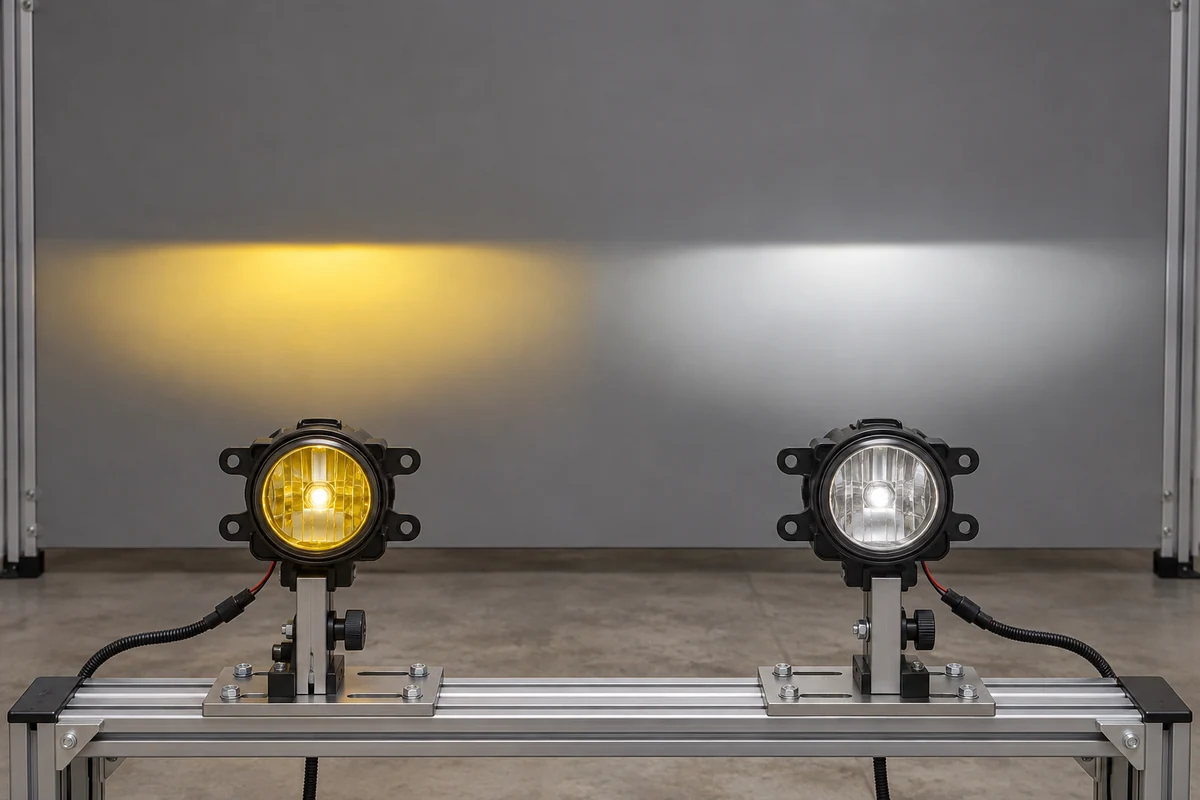
For a fair product comparison, use the same model of fog-lamp housing, mounting orientation, aiming procedure, measurement geometry and electrical conditions. Record the exact yellow and white product revisions; changing emitter size or board orientation between variants can change the beam itself. Evaluate useful lateral spread, upward stray light, hot spots and color after warm-up rather than choosing on the basis of roadside photographs.
Table 3 — Yellow and White H3 Fog-Bulb Evaluation
| Evaluation item | Yellow or warm-white option | Cool-white option / decision rule |
|---|---|---|
| Color appearance | Commonly selected for warm-looking output; measure actual chromaticity. | Often selected for white-light styling; measure actual chromaticity. |
| Fog performance | No universal penetration advantage from nominal CCT alone. | No universal disadvantage from nominal CCT alone. |
| Beam pattern | Test the complete H3 fog lamp with the actual yellow LED emitter. | Test the same lamp with the exact white LED emitter. |
| Brightness data | Compare stabilized output and directional photometry. | Keep voltage, time, geometry and sample basis identical. |
| Legal color | Verify the exact regulated color category in each market. | Check the same rules for white and any switchable mode. |
| Purchasing evidence | Record SKU, batch and yellow version test report. | Record separate SKU, batch and white version report. |
Are Brighter H3 LED Fog Lights Better? Installed Beam Testing
The phrase “H3 LED bright fog lights” suggests that maximum light output should decide the purchase. That is not how a fog beam should be evaluated. The existing reflector or projector determines how the light is distributed; a replacement LED changes the source size, position and directional output. More total lumens can coexist with an unfocused hotspot, insufficient lateral coverage or excessive light above the intended beam.
Do not confuse lumens with installed-road illumination
Lumens describe total luminous flux under a stated test method; candela expresses intensity in a direction, and lux describes illuminance at a defined point or surface. For an H3 replacement, a bare-bulb figure cannot establish the distribution produced by the original fog-lamp housing. Record whether advertised lumens describe a single bulb or a pair, whether the figure is calculated or measured, and whether the reading represents startup or a stabilized operating state.
Test the complete H3 fog-lamp assembly
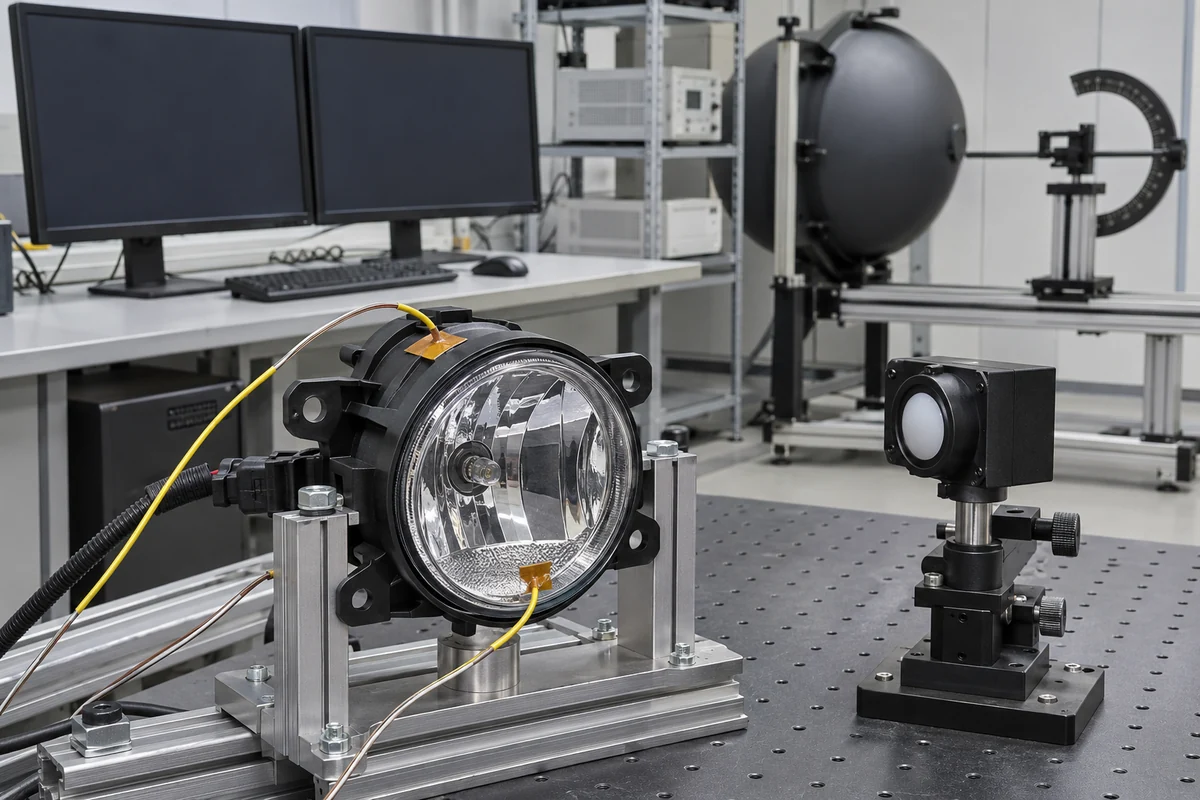
Identify the lamp part number and mount the assembly at a controlled reference axis. Aim according to the applicable procedure and document the measurement distance or geometry, instrument calibration, operating voltage, ambient condition and stabilization rule. Screen-wall photographs may help reveal a gross mistake, but they are not a substitute for the applicable photometric report. Review glare-sensitive upward directions, horizontal coverage, foreground distribution, peak location and sample-to-sample repeatability.
NVEL already explains the broader principles in its fog-light beam-pattern guide. The H3-specific task is to compare the original lamp with the proposed H3 LED replacement under controlled conditions while preserving the housing, mounting datum and aim.
Create a fair reference-to-sample test sequence
- Record the original lamp, original H3 halogen source, target vehicle, lens condition, housing part number and reference aim.
- Measure the original configuration using the target-market procedure or a documented internal comparison method.
- Install the proposed LED without modifying the reflector, retainer, seal or rear cover; document every adapter.
- Measure the LED configuration with the same headlamp aim and electrical test conditions, recording any necessary re-aim separately.
- Check beam distribution, directional photometry, stabilized electrical input, output trend and applicable color requirements.
- Repeat with multiple traceable samples and retain photographs as supporting—not primary—evidence.
Check performance after warm-up
A high first-minute reading can decline as the LED board or driver heats. Record output and temperature at defined intervals until the project-specific stabilization criterion is reached. Test in the installed enclosure, not only with unrestricted bench airflow. Do not invent a universal lumen-retention percentage or temperature limit; the buyer and supplier should agree on the applicable acceptance method and limits before the samples arrive.
H3 Fog Light vs Headlight Use: OEM Sample Approval and Market Rules
H3 can appear in different automotive lamp functions, but the same replaceable source code does not make those functions interchangeable. A fog lamp is evaluated for a controlled, generally low and wide distribution; a headlamp high- or low-beam application has its own optical and regulatory requirements. When an inquiry says “H3 LED headlight bulb,” first determine whether the vehicle actually has an H3 headlamp position or whether the customer is referring to an H3 auxiliary fog or driving lamp.
Separate U.S. auxiliary-fog and replaceable-headlamp requirements
In an August 30, 1995 NHTSA interpretation, the agency distinguished H1 and H3 light sources intended for auxiliary fog lamps from H1 and H3 intended for headlamps. It explained that the federal certification treatment for auxiliary use differed from headlamp use. This is a historical agency interpretation: it is not a blanket permission for every LED retrofit, vehicle installation, color or state. Confirm current federal, state and local conditions for the actual auxiliary-lamp application.
For a replaceable-bulb headlamp, the current U.S. framework instead involves FMVSS No. 108 S11 and the Part 564 replaceable-light-source requirements. NHTSA’s February 13, 2024 interpretation described the LED replacement-light-source issue under that framework. The October 8, 2026 Federal Register notice launched a negotiated-rulemaking process; it was not itself an effective change granting road-use permission. Do not claim that a generic H3 LED replacement is U.S.-road-legal as a headlamp source.
For non-U.S. applications, verify current destination-market rules and the exact lamp, color, mounting and vehicle context. A halogen H3 certificate, a generic EMC report, an E-mark on a different device or an unrelated LED product approval cannot be transferred automatically to the proposed H3 LED replacement.
Use one evidence pack for sample-to-production approval
A reliable B2B RFQ should include the lighting function, original source code, housing drawing or part number, source holder and lead connection, voltage range, target yellow/white versions, environmental conditions, test protocol, expected quantity and destination markets. Require the supplier to connect every result to a revision-controlled SKU, sample ID and test configuration.
Table 4 — H3 LED OEM Sample Approval Matrix
| Approval item | Evidence required | Decision rule |
|---|---|---|
| Application and lamp type | Vehicle/trim, lamp function, housing part number and original H3 marking. | Do not use fog-lamp evidence for an H3 headlamp application. |
| PK22s and H3/H3C fit | Dimensioned base drawing, holder test and adapter record. | No forced retainer, mis-seating or unsupported cross-fit. |
| Lead-wire and driver | Circuit diagram, polarity, connector, voltage/current and diagnostic results. | Power and return paths verified on the target application. |
| Yellow/white variants | Measured color and separate beam reports per configuration. | Each intended mode assessed against applicable requirements. |
| Complete-lamp optics | Photometric data, aim, sample ID and defined pass/fail limits. | Acceptable useful distribution and glare-sensitive readings. |
| Installed thermal/sealing | Warm-state output/temperature, cap closure and cable routing. | No unapproved interference, overheating or sealing compromise. |
| Market status and traceability | Current requirement review, sample report, BOM/revision, lot and change control. | Do not make unsupported road-use or certification claims. |
Link technical evidence to a realistic NVEL inquiry
NVEL’s Automotive LED Fog Lights range presents existing fog-lamp assemblies and projector products, not a verified standalone H3 LED replacement-bulb SKU. Buyers planning an H3 application can send the original lamp information, wiring diagram, target color, estimated volume and testing requirements through NVEL’s OEM/ODM inquiry page. Do not represent an unverified H3 bulb as stocked, certified or available for immediate shipment.
Frequently Asked Questions
Is an H3 LED fog light bulb the same as an H3C LED bulb?
No. The HELLA reference catalogue lists H3 with a PK22s base and H3C with a P22d base. Their holder and contact arrangements are different. Use only an exact, documented dual-compatible product if the supplier has verified it for the target lamp.
Can I replace an H3 halogen fog bulb with an H3 LED light bulb?
A matching label is not enough. Verify the original source, base and retainer, lead/return circuit, driver voltage, rear clearance, sealing, installed fog-beam distribution and destination-market rules. A bulb that turns on or fits physically is not automatically an acceptable replacement.
Are H3 yellow LED fog lights brighter or better in fog?
Not necessarily. Yellow or approximately 3000 K describes a warm-looking color, not guaranteed visibility or greater fog penetration. Compare measured color, directional photometry, aim, upward spill and warm-state output in the same lamp.
Does an H3 LED bulb fit any H3 headlight?
No. H3 may be used in different lamp functions. A replaceable-headlamp application needs its own exact-vehicle, optical and regulatory assessment. In the United States, FMVSS No. 108 and Part 564 can apply to replaceable-bulb headlamps; a generic H3 LED bulb label does not establish road-use approval.
Why does an H3 LED bulb flicker or trigger a bulb warning?
Potential causes include incompatible driver behavior, vehicle lamp monitoring, PWM supply, poor terminal retention, insufficient power or an incorrect return connection. Diagnose the exact vehicle circuit first; the phrase CANBus-ready or a universal decoder is not a proven fix.
What should OEM buyers request for an H3 LED fog-light project?
Request the exact SKU and revision, PK22s/holder drawing, lead-wire and driver diagram, voltage range, rear-clearance and sealing record, yellow/white color measurement, installed beam photometry, warm-state and vehicle electrical results, market-specific review, golden-sample approval and production change control.
Conclusion
The strongest H3 LED fog light bulb choice is not the highest advertised lumen number or the first yellow option in a catalog. It is the exact source-and-housing combination that seats correctly in the PK22s holder, makes safe and repeatable electrical connections, fits within the original enclosure, and produces a controlled fog beam after warm-up.
For distributors and OEM buyers, the practical next step is to define the application, compare separate yellow and white revisions using the same installed test method, record the intended market and approve traceable samples. That protects product consistency without assuming that every H3, H3C, headlamp and auxiliary fog lamp shares the same fitment or regulatory status.
Fog Lamp Sourcing Support
Explore NVEL fog lamp assemblies or contact the OEM team to discuss your application and sample validation requirements.