TECHNICAL GUIDES · LED FOG LIGHTS
LED Fog Lamp Bulbs vs. Complete Assemblies: H11 Fitment & B2B Selection Guide
Separate H11 bulb fitment from complete-assembly selection, with checks for optics, electrical behavior and B2B sample approval.
November 4, 2026 · 14 min read
Introduction
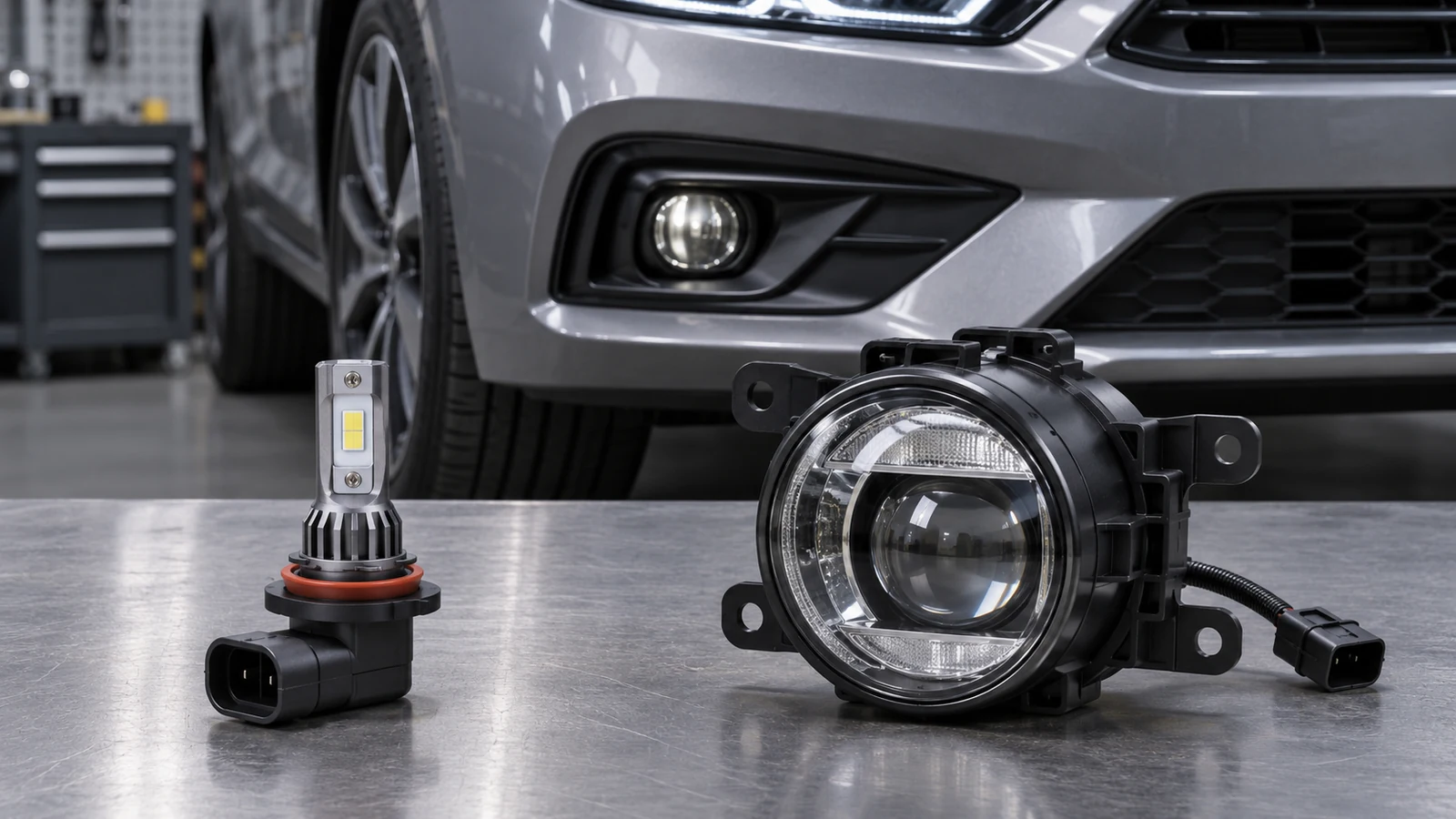
An LED fog lamp upgrade can mean two very different products: an LED replacement bulb inserted into an existing fog-lamp housing, or a complete lamp assembly with its own optics, housing, electronics and mounting interface. The distinction matters to distributors, aftermarket brands and OEM sourcing teams because the approval evidence, installation risks and bill of materials are not the same.
For example, a vehicle that originally uses a removable H11 halogen source may allow an LED bulb to be physically installed. That does not establish that its original reflector or projector will produce an appropriate beam with the new source. Replacing the complete unit may give a supplier greater control over the optical system, but requires a different set of mounting, sealing and vehicle-integration checks.
This guide separates those two upgrade routes and shows how to document H11 compatibility, photometric performance, electrical behavior and target-market requirements before sample approval. It is a technical purchasing guide, not a claim that any LED fog lamp bulb or complete assembly is universally compatible or approved for public-road use.
Table of Contents
LED Fog Lamp Bulbs vs. Complete Assemblies
QUICK GUIDE
Define whether the original housing stays or the complete lamp is replaced.
Verify the exact source, holder, connector and rear clearance.
Evaluate the complete installed optical system with traceable evidence.
Check diagnostics, thermal packaging and the target-market approval route.
Approve controlled samples and document fitment, revisions and exclusions.
LED Fog Lamp Bulbs vs. Integrated Fog Lamp Assemblies
The first decision is whether the vehicle retains its existing fog-lamp optics or replaces the whole lighting device. The term LED fog lamp is often used for both, although the engineering scope is different. An LED bulb is one component in a larger optical system; an integrated assembly is designed and evaluated as a complete unit.
What changes in a bulb-only conversion?
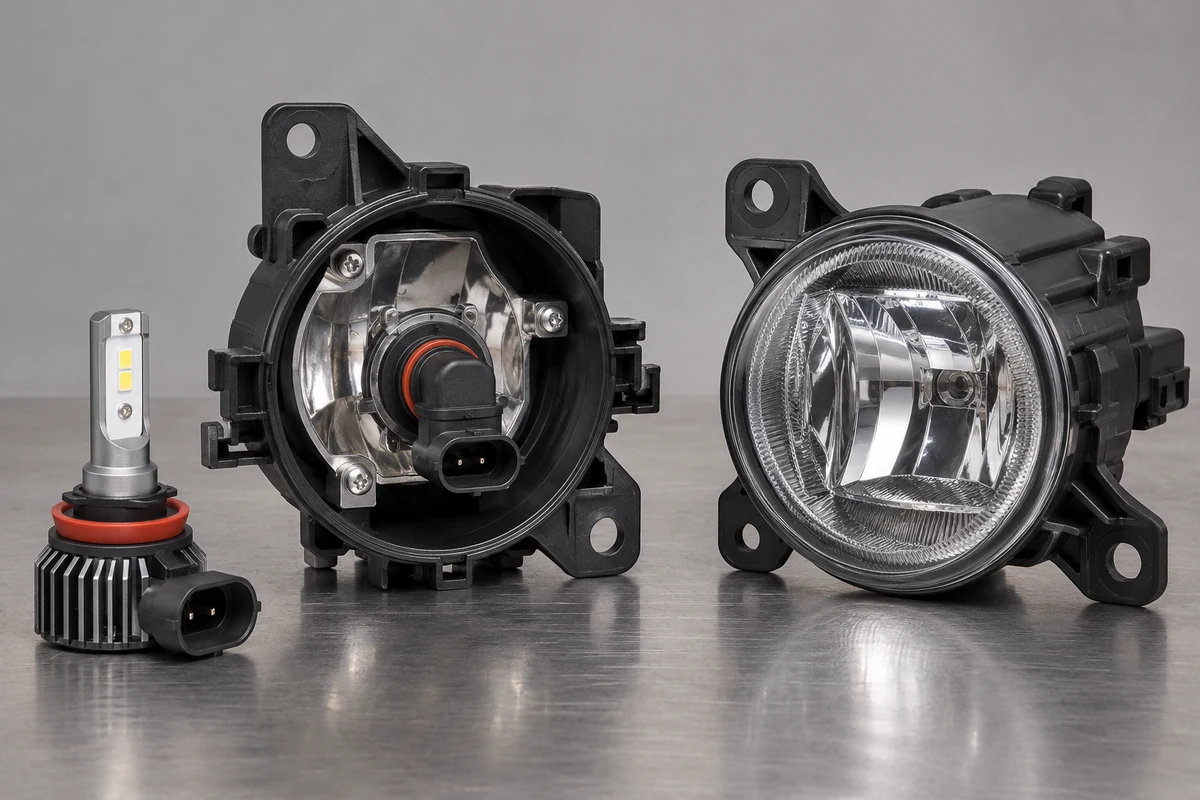
A removable LED source must work within the original housing envelope. Source geometry, rotational orientation, power leads, rear-cap clearance and heat-sink location all influence the installed result. The original lens and reflector remain in place, so the supplier cannot treat the LED emitter specification alone as evidence of a suitable fog beam.
What changes in a complete lamp replacement?
A complete assembly usually brings its own optical surfaces, thermal path, seal strategy, connector and mounting geometry. The buyer can review assembly-level photometry and dimensional drawings, but must verify bracket positions, adjustment range, bumper clearance, vehicle wiring and whether the offered design is appropriate for the intended application.
| Decision factor | H11-type LED replacement bulb | Complete LED fog lamp assembly |
|---|---|---|
| Components replaced | Removable light source; original lamp housing remains | Complete lighting device, potentially including lens, driver and mounting hardware |
| Fitment evidence | Bulb designation, base keying, connector, heat-sink envelope and rear clearance | Outer dimensions, mounting points, aiming access, connectors and bumper packaging |
| Optical evaluation | Exact LED source installed in the intended original fog-lamp housing | Exact assembled lamp design and specified configuration |
| Thermal design | Heat must escape within the constraints of the original installation | Heat flow is designed around the complete assembly, subject to vehicle installation |
| Service and inventory | Bulb SKU and vehicle/housing compatibility matrix | Assembly SKU, vehicle mounting kit and housing revision control |
| Approval question | Whether the particular replacement source and installed combination are lawful | Whether the complete device and installation meet the target-market requirements |
Neither approach is automatically superior. A bulb-only route may reduce installation scope in a compatible vehicle. A complete replacement may offer a more controlled system design but can be harder to package. For a car LED fog lamp program, the right choice follows the vehicle platform, permitted product configuration, measured beam and service requirements—not marketing terms such as plug-and-play or universal fit.
H11 LED Fog Lamp Bulbs: Socket Fitment and Application Checks
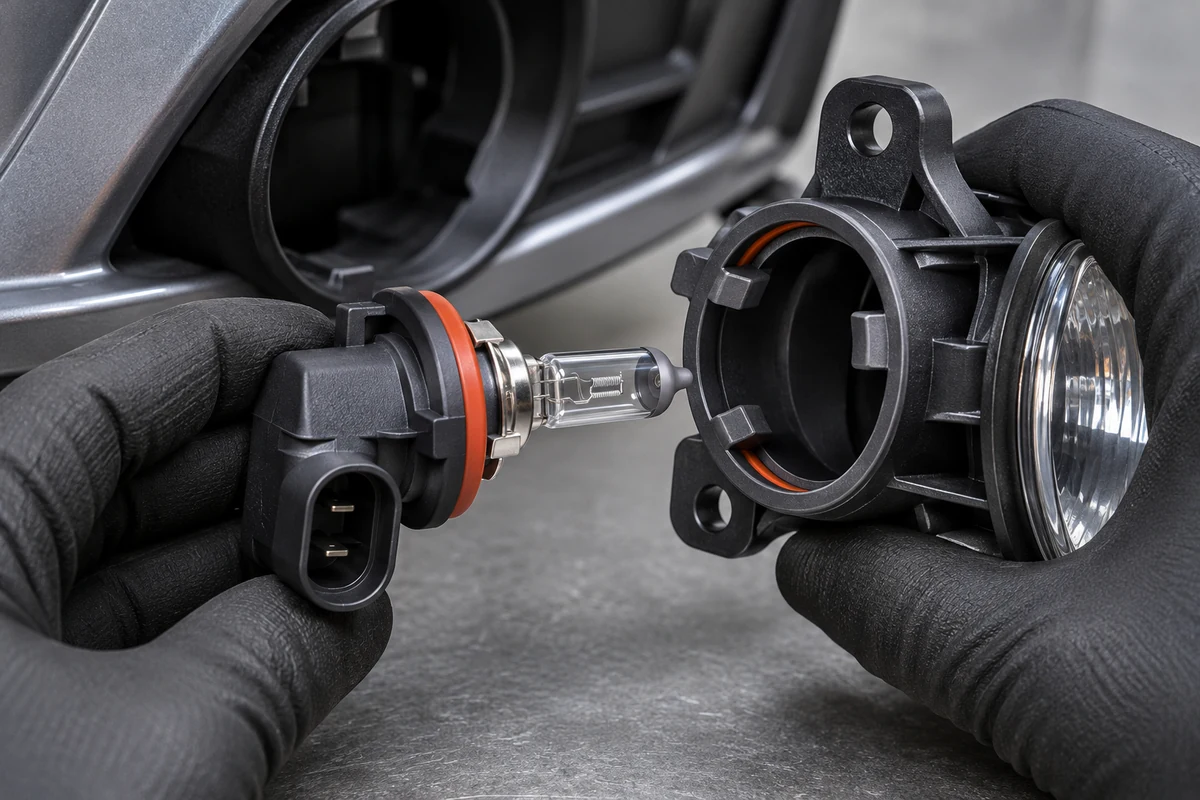
H11 LED fog lamp bulbs are commonly researched as substitutes for removable halogen sources, but the H11 label is only the starting point. The vehicle may use a different bulb family, the fog-lamp holder may be integrated with a connector, or the rear of the lamp may lack clearance for an LED driver, fan or passive heat sink.
Confirm the original lamp, not just the vehicle model
Record the exact vehicle model year, market, fog-lamp part number and original source designation. Some trims use removable H11 bulbs, while other trims use sealed or integrated LED fog-lamp assemblies. A catalog entry that lists a vehicle model without distinguishing its lamp hardware is not sufficient for an OEM or aftermarket compatibility claim.
Why H8, H11 and H16 should not be assumed interchangeable
Certain manufacturers sell retrofit products specified for multiple H8/H11/H16 applications, but the existence of one multi-application product does not make all bulbs, sockets, electrical loads and lamp housings interchangeable. Check the specific base/locking features, permitted replacement list, connector, cooling envelope and vehicle-level approval conditions for the exact SKU.
| Fitment checkpoint | Evidence to request | Why it matters |
|---|---|---|
| Bulb family and base | Original bulb designation, base drawings and keying check | A similar-looking connector is not proof of a correct mechanical interface |
| Holder and retention | Photos or drawings of the fog-lamp holder and locking method | Some installations require a particular retention interface |
| Rear clearance | Measured heat-sink/driver envelope and lamp-cap clearance | A bulb may seat at the front but interfere with wiring or bumper structure |
| Power and polarity | Input specification and vehicle electrical test | Controls starting, current draw and correct operation |
| Lamp-monitor diagnostics | Warning, PWM/flicker and switching test under representative conditions | Lower load or driver behavior may produce warnings or visible flicker |
| Optical orientation | Installed emitter alignment and measured lamp beam | Mechanical fit alone does not verify distribution |
| Market suitability | Exact product approval/limitations and target-country rules | A fitting retrofit may still be restricted for public-road use |
For distributors building a compatibility database, keep the H11 bulb part number separate from the vehicle/fixture identity and any required adapters. If a specific vehicle is untested, label it unverified rather than extending an existing fitment claim by analogy.
This guide focuses on fog-lamp applications. For a broader review of H11 alongside headlamp bulb families, NVEL has a separate H4/H7/H11/9005/9006 bulb-type guide.
Optical Performance: Retained Housings vs. Dedicated LED Assemblies
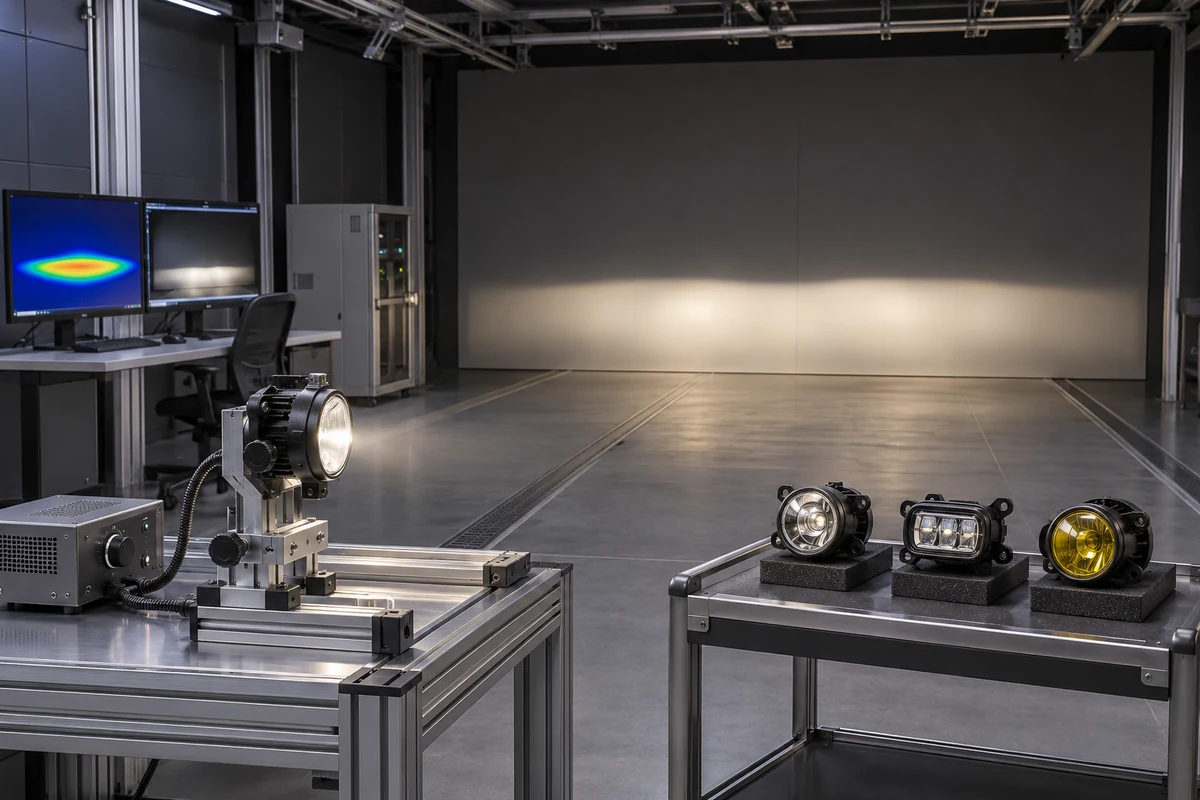
A fog lamp is defined by what the complete optical system sends toward the road—not by the LED chip count or the advertised lumen figure. A halogen filament and an LED emitter have different luminous geometries. Their placement relative to a reflector or projector can alter upward spill, beam width, edge definition and the balance between near-field intensity and roadside coverage.
Testing a replacement bulb in the original housing
A bulb-only conversion should be evaluated using the exact LED source inside the actual fog-lamp housing. Document seating and rotation, aim, supply voltage, thermal condition, measured distribution and the identity of the housing. A source-only lumen test or a wall photograph with automatic camera exposure cannot establish that the combined lamp meets a performance or legal requirement.
Testing a complete LED fog lamp assembly
For an integrated assembly, request photometric evidence for the final lamp design and the version intended for shipment. The lens, reflector, LED array, optical shield, driver current and thermal state can all affect the beam. A design change after testing can invalidate the comparison unless the supplier confirms that the evidence still covers the changed configuration.
- Compare the same installation orientation and aim procedure for the intended vehicle application.
- Check horizontal coverage, upper-beam control and useful foreground intensity, using defined measurement criteria.
- Request measured candela distributions or specified illuminance points when available; avoid interpreting a single beam photograph as certification.
- Document input conditions, warm-up/stabilization procedure and optical version so samples can be compared fairly.
- Review both left and right installations where the vehicle uses a paired system.
NVEL already explains fog-beam distribution in its Fog Light Beam Patterns guide. The decision here is narrower: which product configuration provides verifiable evidence in the retained housing or complete assembly, without repeating the fundamentals of spot, flood or fog beam design.
Electrical, Thermal and Road-Use Validation
An LED replacement changes the electrical load seen by the vehicle. Depending on the platform, a diagnostic circuit may report a failed bulb, or pulse-width modulation may interact with the driver and produce flicker. Neither issue should be labeled a universal CANbus defect: the fault mechanism must be identified from actual vehicle behavior and the lamp driver design.
Electrical and packaging checks
- Measure cold start, steady-state current and voltage behavior under the vehicle operating range.
- Check on/off switching, lamp monitoring and PWM response using representative vehicle configurations.
- Confirm connector retention, polarity, cable routing and any adapter or decoder specification.
- If a resistor or electronic decoder is proposed, evaluate its thermal load, wiring protection and electromagnetic compatibility rather than adding it by default.
- Verify that a fan or passive heat sink has physical clearance and does not compromise protective covers, seals or required service access.
Thermal behavior and environment
A low-mounted fog lamp can experience moisture, road spray, debris and limited airflow. The bulb heat sink may operate inside a constrained cavity, while an integrated assembly may rely on a housing-to-air thermal path. Request operating-temperature data and stabilized light-output information for the actual configuration. Do not infer a universal lifetime or IP rating from a component brochure.
Road-use eligibility is separate from physical fit
An LED fog lamp for a car may fit its mechanical opening but still require jurisdiction-specific approval or restrictions to be checked. In UNECE-type-approval markets, the scope can depend on the exact replacement source, vehicle or lamp combination and applicable approval route. Some specifically approved LED retrofit products exist, but this must not be generalized to every H11 replacement. In the United States, NHTSA treats front fog lamps as additional lighting rather than universally required lamps under FMVSS No. 108; restrictions on interference with required lighting, installation and state law still matter.
Do not advertise a product as DOT approved, ECE approved or road legal worldwide without the correct model-specific documentation. For more detail on complete fog-lamp optics and regulatory roles, read NVEL’s SAE J583 and UN fog-lamp compliance guide. Buyers should obtain current advice for their target market and precise configuration.
OEM and B2B Selection: Product Matrix and Sample Approval
B2B buyers should choose the product architecture before sending a final RFQ. A program that retains existing vehicle housings needs a documented bulb-and-housing fitment matrix; a program that replaces the entire lamp needs complete-assembly drawings and system-level approval evidence. The two sourcing tracks should not be mixed into one generic LED fog lamp SKU.
Which sourcing track fits the project?
| Buyer scenario | Preferred investigation path | Required proof before approval |
|---|---|---|
| Existing serviceable H11 fog lamp and minimal hardware change is desired | Evaluate a candidate H11 LED bulb only where a compliant route exists | Exact bulb/housing match, beam evidence, electronics check and market authorization |
| Sealed or integrated OEM fog lamp, no serviceable bulb | Evaluate a complete replacement assembly | Mounting dimensions, wiring, optical test and target-market installation evidence |
| Private-label line covering many vehicles | Separate bulb-application SKUs and assembly-application SKUs | Versioned compatibility matrix, revision control and negative fitment exclusions |
| Existing lamp cannot produce an acceptable beam with the candidate LED source | Reassess a dedicated complete assembly or retain the approved original lamp | Photometry, validated mounting, environmental data and applicable approval documents |
OEM sample approval checklist
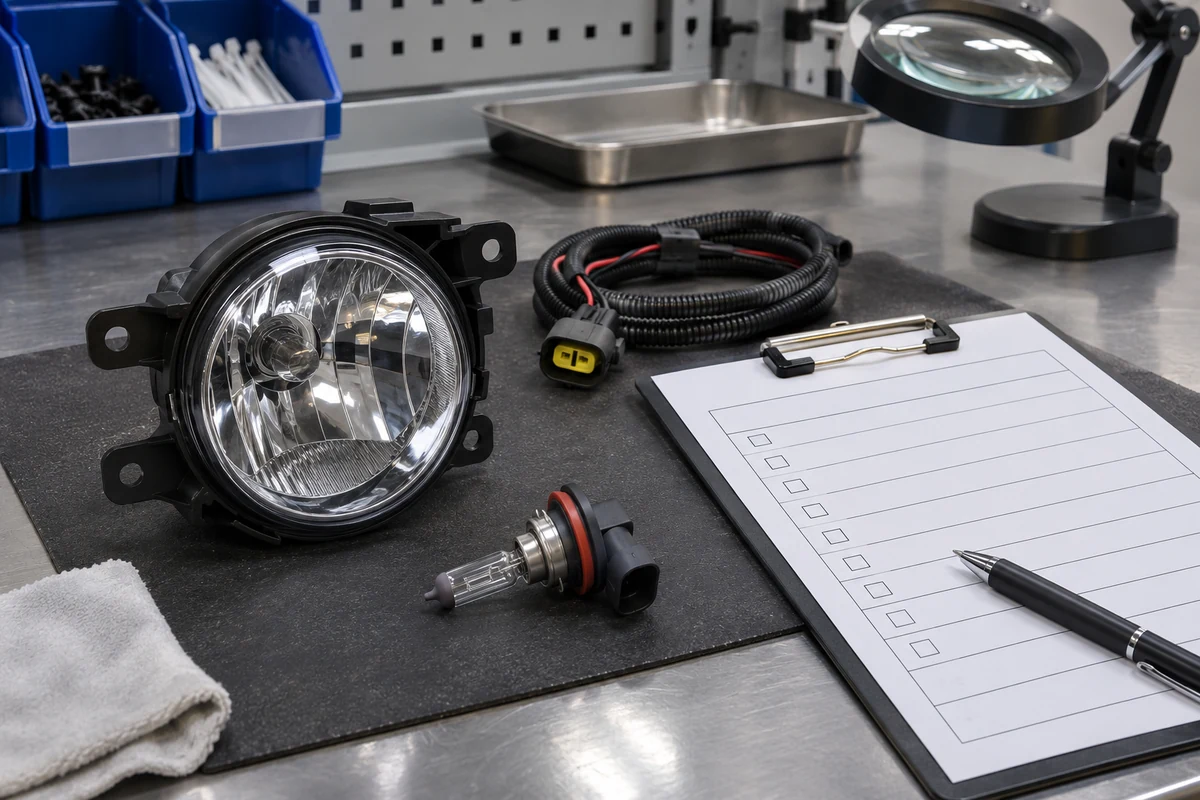
- Identify the marketed part number, exact product category, source or assembly revision, target vehicles and countries of sale.
- Collect approved drawings, connectors, retention features, mounting dimensions and all included adapters or wiring.
- Record evidence for each supported housing/vehicle combination; document exclusions and unverified applications.
- Test both physical integration and optical output in the exact representative installation.
- Check current draw, diagnostics, PWM response, thermal stabilization and relevant operating conditions.
- Request traceable photometric, environmental and approval documentation applicable to the exact product and market; distinguish claimed from verified evidence.
- Agree on golden samples, lot traceability, supplier change notifications, retest triggers and acceptance criteria before volume orders.
NVEL’s current Automotive LED Fog Lights range lists complete fog-lamp and projector-style solutions, including N90D and N60D series. Those products should be described as complete-lamp options, not as confirmed H11 replacement-bulb SKUs. A stand-alone NVEL H11 LED fog lamp bulb product was not verified in the checked product inventory, so this guide makes no claim that NVEL currently sells one.
If the project requires a complete fog-lamp solution, review the documented models, then contact NVEL with vehicle details, expected functions, sample requirements and target markets. For an H11 bulb-only proposal, request a verified, model-specific product offer before treating it as part of the catalog.
Frequently Asked Questions
Can H11 LED fog lamp bulbs replace halogen fog light bulbs?
Sometimes a candidate LED source can be installed in a serviceable H11 housing, but mechanical fit is only one check. Buyers must confirm the exact bulb/housing combination, beam performance, electrical behavior and applicable road-use restrictions before claiming compatibility.
Are H8, H11 and H16 LED fog lamp bulbs interchangeable?
Not as a universal rule. Some specific retrofit models cover more than one application, but base keying, power requirements, housing design and legal scope vary. Follow the particular product’s approved compatibility information.
Are LED fog lamp bulbs better than complete LED fog lamp assemblies?
Neither is inherently better. A bulb-only change can reduce hardware replacement when the retained housing is suitable, while a complete assembly can provide an integrated optical and thermal design. Compare measured installed performance and application-specific requirements.
Can an H11 LED bulb work in a factory fog light housing?
It may fit mechanically, but the factory housing was designed around a particular light source and optical geometry. Check installed beam distribution, seating, clearance and any necessary approvals before approving the combination.
Are aftermarket LED fog lamp bulbs legal for road use?
Legality is product- and jurisdiction-specific. A fitting H11 bulb is not automatically road legal, and approval of one retrofit model does not extend to another. Check the precise product, lamp/vehicle combination, approval route and local installation requirements.
What should B2B buyers request before ordering LED fog lamp bulbs or assemblies?
Ask for exact model identity, dimensional drawings, verified fitment coverage, installed photometric evidence, electrical and thermal results, target-market documentation, approved samples, change-control rules and an inspection plan for the actual items being purchased.
Conclusion
LED fog lamp bulbs and complete LED fog lamp assemblies are different engineering and procurement decisions. H11 source fitment matters only when the original lamp accepts a replaceable bulb; the complete installed beam, electrical behavior, thermal packaging and market requirements determine whether the proposed solution is suitable.
For distributors and OEM buyers, the most reliable process is to define the product architecture, verify the exact vehicle or lamp combination, request traceable evidence and approve controlled samples before ordering at scale. NVEL’s established fog-lamp assembly range offers one avenue for project evaluation; any separate H11 bulb-only offering must be verified by actual SKU and supporting data.
Discuss Your Fog-Lamp Sourcing Requirements
Explore NVEL’s complete-lamp range and share your vehicle, target-market and sample requirements with the OEM team. Request SKU-specific verification for any H11 bulb-only proposal.