TECHNICAL GUIDES · OFF-ROAD LED LIGHTING
Off Road LED Lights for Trucks: Round vs. Flush Mount, Brightness & OEM Selection Guide
Compare round pods, recessed fixtures and light bars for truck installation, beam performance and OEM sample approval.
November 4, 2026 · 12 min read
Introduction
Choosing off road LED lights for trucks involves more than comparing the largest lumen figure or the most rugged-looking housing. A round pod on an adjustable bumper bracket, a flush-mount lamp integrated into a rear panel, and a long LED light bar place different demands on the vehicle structure, electrical system and optical target. A light that performs well on a bench may deliver poor coverage or become difficult to service once it is installed.
For distributors, upfitters, fleet programs and OEM/ODM buyers, the useful question is how to specify a repeatable truck lighting configuration. This guide compares installation architectures, explains what credible brightness evidence looks like, and gives a sample-approval approach that connects the lamp, the vehicle and the purchasing specification. It is not a ranked list of untested products or a claim that any auxiliary lamp is automatically legal for highway use.
The discussion assumes auxiliary lighting for suitable off-road, work-site or otherwise permitted uses. A specific product, mounting location and market must be checked against applicable road-use rules before a supplier or installer makes compliance claims.
Table of Contents
Truck Lighting Selection at a Glance
QUICK GUIDE
Compare round pods, work pods, light bars and recessed fixtures.
Match bracket adjustability or a recessed flange to the vehicle interface.
Compare beam distribution, measured illuminance and stabilized output.
Plan mounting clearance, protected wiring and durability checks.
Turn vehicle requirements into a repeatable sample-approval checklist.
Off-Road LED Light Configurations for Trucks
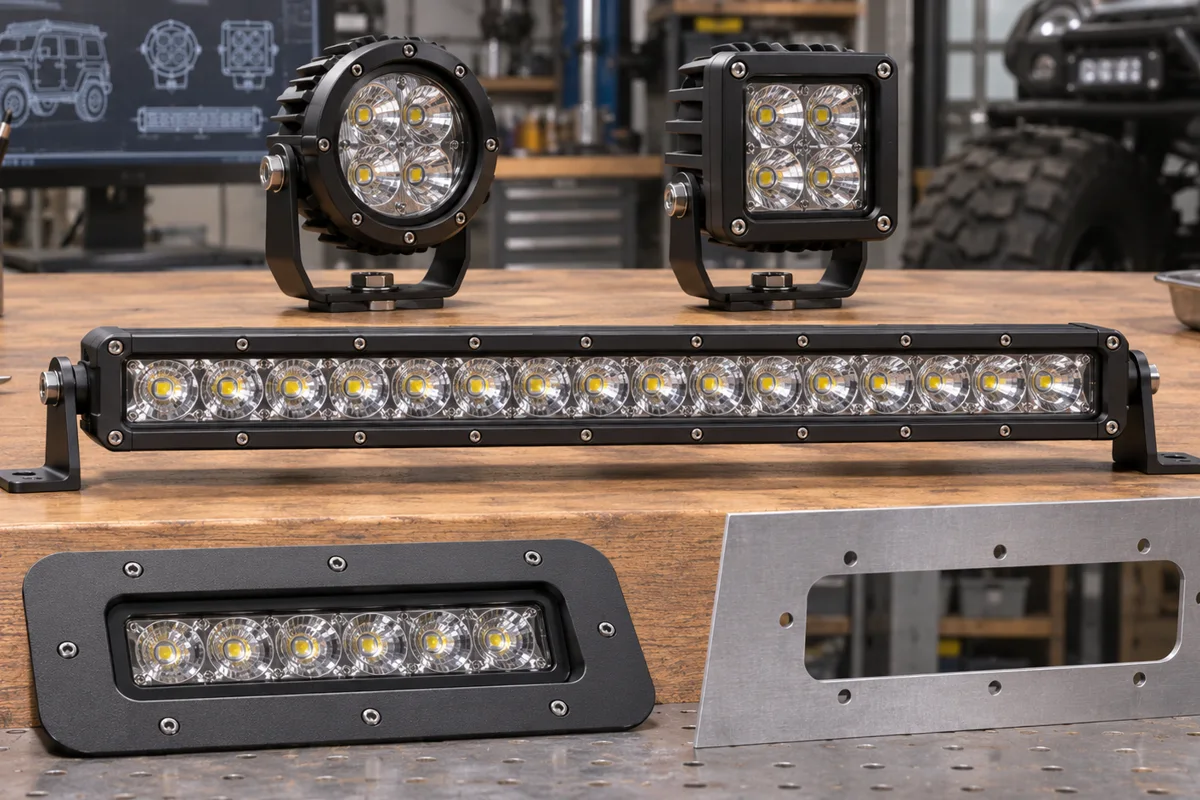
An installation architecture should be selected before an individual lamp model. Round pods are often bracket-mounted and aimable; a true flush-mount fixture sits in a prepared opening or panel interface; LED light bars distribute optical modules across a longer envelope; and compact square pods are useful where space or mounting features are constrained. Housing shape alone does not establish the beam pattern, the measured brightness or durability.
For a truck program, define the mounting zone and its purpose first: front auxiliary distance illumination, side task lighting, rear maneuvering assistance or equipment-area work light. Document usable envelope, driver sightlines, nearby reflective surfaces, cargo clearance and impact exposure. A roof installation, for instance, creates different aerodynamic and cab-reflection constraints from a bumper installation.
| Configuration | Typical mechanical interface | Primary integration check | Service consideration |
|---|---|---|---|
| Round off-road LED pod | External bracket or dedicated mount | Aiming clearance, bracket load and projection | Access to fasteners and connector |
| True flush-mount LED light | Panel cutout, flange or engineered recess | Cutout tolerance, back-depth, sealing and drain path | Removal without damaging trim or coating |
| LED light bar | Multiple brackets across a long housing | Support spacing, vibration and wind loading | Harness routing and access to brackets |
| Compact square work-light pod | Bracket, grille or special fixture | Heat clearance and obstruction by bodywork | Replacement accessibility |
The term “flush lens” describes a lens or front-face appearance and does not prove that a product is suitable for recessed, flush-mounted installation. Request a dimensioned installation drawing and mounting instructions for the actual SKU rather than classifying a lamp by its marketing photography.
For an overview of selecting beam patterns by application, see NVEL’s off-road application selection guide. This article instead concentrates on integration and acceptance after the general lighting task is defined.
Round Off Road LED Lights vs. Flush Mount Designs
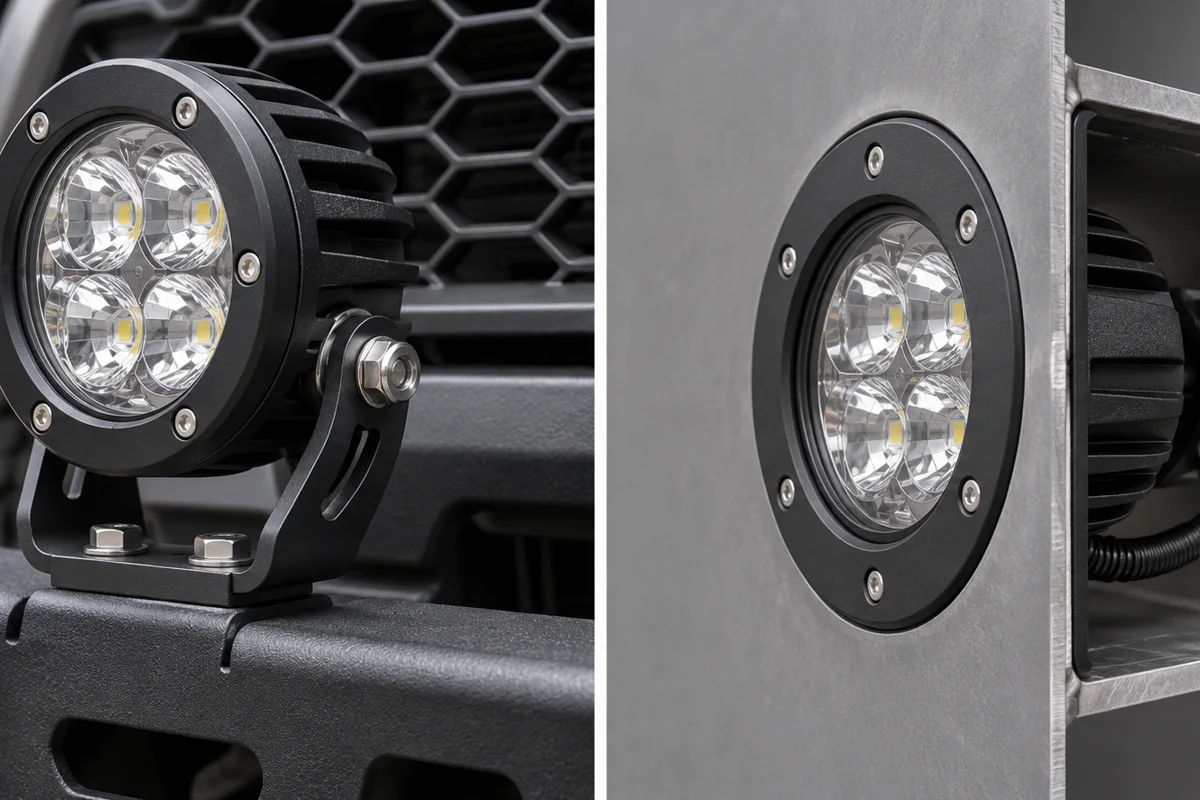
Round off road LED lights usually offer packaging flexibility when the mounting point permits a visible lamp body and an adjustable bracket. The installer may be able to tune the aim after assembly, which can be useful when ride height or accessories change. But a projecting lamp also requires checks for impact, contact with recovery equipment, vibration of the bracket and interference with the hood, grille or nearby panels.
Flush mount off road LED lights are attractive where a low-profile exterior and protected placement matter, such as selected rear bumper, utility body or equipment-panel applications. Their engineering challenge is not merely making the front face look neat: the installation must preserve panel strength, provide a correct cutout and gasket compression, avoid trapping water, and keep the lamp’s thermal path and wire exit within the available depth.
| Selection factor | Round bracket-mounted pod | True flush-mount fixture |
|---|---|---|
| Mounting geometry | Exposed housing and adjustable bracket | Controlled cutout, flange and rear cavity |
| Aiming | Often field-adjustable within bracket range | May be largely fixed by panel angle |
| Panel modification | Typically mounting holes or existing hard points | May require structural cutout and finish protection |
| Ingress protection | Lamp sealing plus connector and bracket interface | Lamp sealing plus panel/gasket integration |
| Thermal path | Surrounding air may aid cooling, subject to vehicle location | Rear cavity and panel can restrict convection |
| Service | Remove bolts or bracket | Verify trim and panel access before approval |
Neither round nor flush mounting is universally “better.” The correct comparison is between approved configurations at specified locations. A round pod may fit a space where a flush cutout is unacceptable; a properly engineered recessed fixture may reduce protrusion but still create a difficult maintenance or water-ingress problem.
Before signing off a flush-mount design, request the cutout drawing, flange dimensions, rear clearance, gasket installation procedure, fastener torque guidance, wire-exit orientation and environmental test scope for the intended installed assembly. Validate these details on a representative vehicle panel—not only on the lamp body.
Brightest Off Road LED Lights: What Should Buyers Measure?
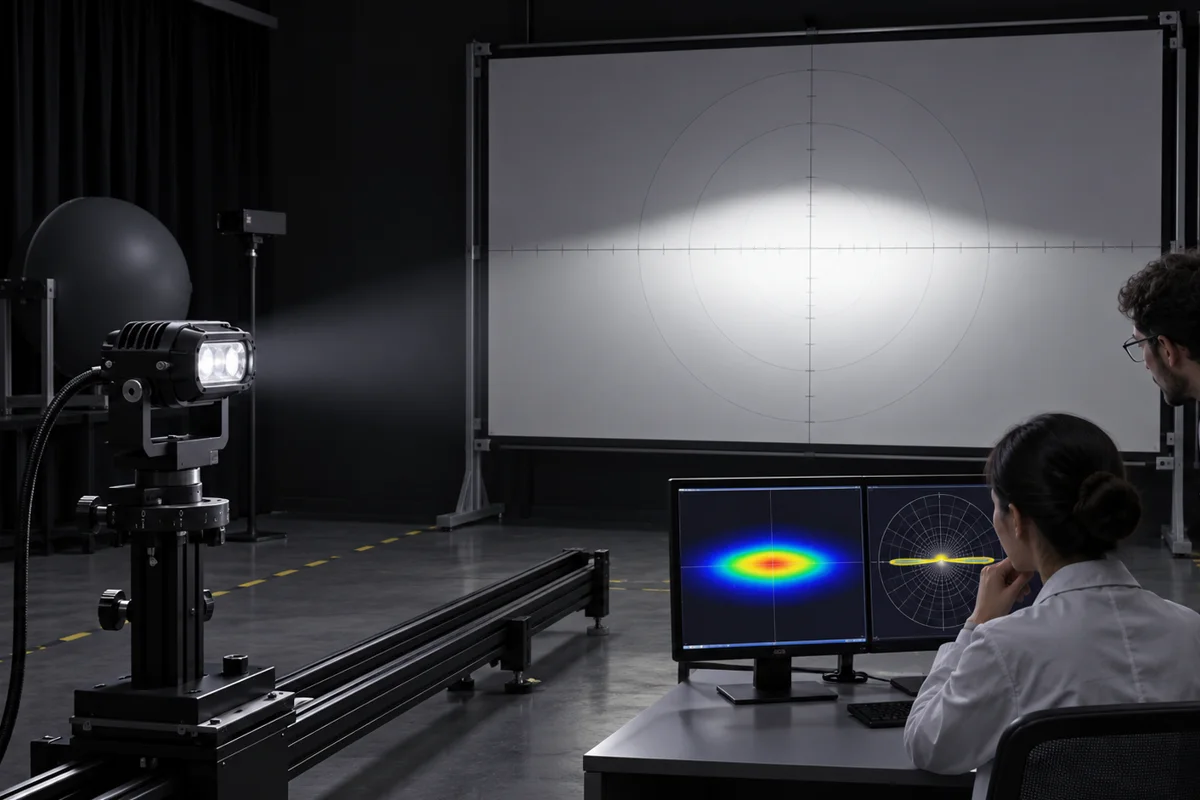
A search for the brightest off road LED lights often leads to claimed lumens or wattage. Neither alone establishes how much usable light reaches the target scene. Luminous flux (lumens), directional luminous intensity (candela) and illuminance at a specified plane (lux) describe different aspects of performance. An optical distribution suitable for a distant target may be a poor choice for a close-range work area, even when the published lumen figures are similar.
For a fair evaluation, require a measurement report for the exact lamp version and optics. It should identify the test method, voltage, operating condition, warm-up or stabilization procedure, photometric geometry, and what was measured at specified points or directions. Compare the intended truck installation height and aim with the test setup, and do not infer a universal throw distance from one promotional number.
| Evidence requested | Why it matters | Common mistake to avoid |
|---|---|---|
| Measured luminous flux | Quantifies total visible output under defined conditions | Comparing unqualified “theoretical lumens” to measured output |
| Intensity / photometric distribution | Shows where light is directed | Treating a peak number as useful scene coverage |
| Illuminance at stated locations | Connects light to an actual task plane | Omitting distance, aim or measurement geometry |
| Stabilized electrical / thermal condition | Reveals how output behaves after heating | Using only cold-start peak output |
| Representative installed evaluation | Checks shading, glare and reflections | Assuming bench output equals vehicle performance |
Ask suppliers to distinguish initial output from stabilized output if thermal behavior affects the comparison. Record voltage, ambient temperature and duration because a driver’s thermal protection may reduce output after warm-up. Comparisons made at different conditions should not be presented as evidence that one unit is objectively brighter.
Readers seeking the underlying measurement concepts can use NVEL’s lumens-versus-lux technical guide. The sourcing decision here is to establish measurable target-zone acceptance criteria and repeat them on production-representative samples.
Truck Installation Engineering: Mounting, Wiring & Durability
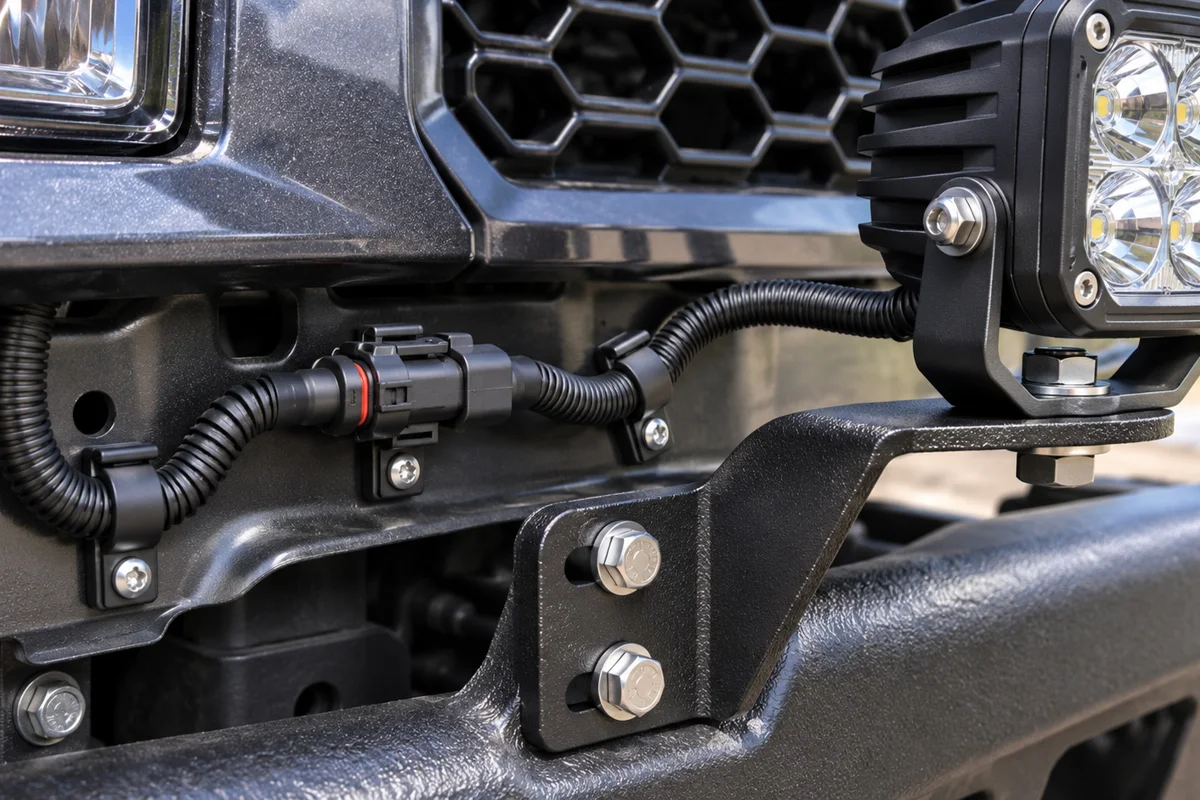
The truck is part of the lighting system. Bracket stiffness, vehicle vibration, available heat rejection, harness routing, supply-voltage transients and the placement of the lamp relative to bodywork can change the result. A supplier should confirm the intended installation envelope before recommending a mounting architecture or a particular light.
Mechanical packaging and structural interface
Document the actual mounting face, hole pattern or cutout, permitted protrusion, rear depth, required adjustment range and the position of adjacent components. Evaluate fastener retention, corrosion compatibility between dissimilar metals, abrasion at cable exits and service access. For an engineered panel recess, check that the opening does not compromise a structural or crash-relevant member; a vehicle integrator should approve modifications to load-bearing structures.
Electrical integration and harness protection
Specify the supply-voltage range and expected transient environment rather than assuming every vehicle uses identical electrical conditions. Identify the required fuse or circuit protection, wire gauge by verified load and run length, connector sealing, polarity protection and switching strategy. Measure current and power under stated operating conditions. Avoid making wiring or relay recommendations without the actual product and vehicle electrical specification.
Temperature, water and vibration
Check airflow and adjacent heat sources after final installation. A flush-mounted housing can have less open-air convection than the same light tested outside a vehicle. Compare relevant ingress test reports with the actual installed sealing strategy, connector orientation and splash exposure. A rated lamp body does not automatically certify the panel joint or full electrical installation.
Vibration, shock and corrosion requirements depend on the vehicle and mounting position. Ask for the test standard, severity, fixture, sample identity and observed failure criteria rather than relying on a generic “heavy-duty” claim. Where the lamp is auxiliary driving or work lighting, determine the applicable market-specific classification and approval path separately from engineering performance.
Off-road or work-site suitability does not automatically establish public-road legality. For example, SAE J581 concerns auxiliary high-beam lamps; the existence of a standard is not an approval mark for a specific product. Confirm the current legal requirements in each destination market and the specific use case before making a road-use claim.
Best Off Road LED Lights for OEM and B2B Buyers: Sample Approval
For procurement, “best off road LED lights” should mean the configuration that satisfies a documented task, mounting arrangement, photometric acceptance threshold and durability specification—not the item with the most aggressive marketing claim. Define those requirements before inviting quotes, then evaluate samples using the same conditions.
OEM RFQ and sample-approval checklist
- Identify intended truck platform, mounting zone, permitted use and target market; distinguish work-zone lighting from road-legal functions.
- Specify lamp type and genuine mounting architecture: round pod, true flush-mount fixture, light bar or another defined assembly.
- Collect dimensioned 2D/3D drawings, bracket or cutout details, rear clearance, thermal envelope and service-access requirements.
- Freeze the sample part number, optical revision, LED/driver configuration, finish, harness and connector configuration.
- Agree on measured output and photometric distribution, supply voltage, stabilization condition, installation aim and acceptable uniformity or glare.
- Request applicable electrical, ingress, vibration, corrosion and EMC test evidence with identified standards and test setups.
- Validate a representative vehicle or mounting fixture, including cable routing, retained aim, moisture paths and nearby reflections.
- Define the inspection plan, approved sample reference, change-control rules and batch traceability before purchase order release.
| Approval record | Minimum information to capture | Reason |
|---|---|---|
| Golden sample / version | Part number, revision and photographs | Prevents substitution of unapproved optics or hardware |
| Optical acceptance sheet | Test geometry and pass criteria | Makes brightness claims repeatable |
| Mounting interface drawing | Mount, cutout, bracket and fastener specification | Controls fitment and service access |
| Electrical / reliability report | Voltage, protection and relevant environmental testing | Documents project-specific qualification |
| Production control agreement | Change notice, inspections and traceability | Protects consistency after sample approval |
An approval process should also state what triggers revalidation: changes to LED emitters, optics, driver current, housing, lens, seal, bracket or critical process conditions may invalidate earlier evidence. Buyers should ask for samples drawn from production-representative builds rather than relying on a single specially prepared prototype.
To review actual catalog families, use NVEL’s automotive LED off-road lights range. Product availability and installation form should be verified by part number; an existing square pod or a flush-face lens must not be represented as a flush-mount model without its corresponding installation documentation.
Frequently Asked Questions
Are round off-road LED lights better than square pods?
Not inherently. Housing outline does not determine beam quality. Compare the exact optical distribution, mounting envelope, aim adjustment, bracket stiffness, serviceability and environmental evidence for the intended truck location.
Where should flush-mount off-road LED lights be installed?
Only in an approved panel or recess with a verified cutout, rear clearance, sealing and heat path. Rear bumper and equipment-body applications are possible examples, but fitment must be verified on the actual vehicle. Do not cut structural members without the vehicle integrator’s approval.
What makes an off-road LED light brighter in actual use?
Useful brightness depends on the measured light distribution, target distance, installation aim and operating state. Evaluate defined lux or intensity criteria, relevant beam coverage and stabilized output instead of relying on claimed lumens alone.
Are the brightest off-road LED lights always the best?
No. Excessive foreground intensity, inappropriate aiming or unwanted spill can reduce usefulness. A better specification balances coverage, glare control, electrical load, thermal behavior and the work or off-road task.
Can off-road LED lights be used on public roads?
Not automatically. Permission depends on the lamp function, approval status, vehicle installation and local rules. An off-road or work-light marketing description is not proof of legal public-road use.
What should OEM buyers check before ordering truck LED lights in bulk?
Approve the exact SKU and revision, mounting drawings, photometric data under repeatable test conditions, electrical and durability evidence, representative installation, agreed acceptance criteria and production change-control requirements.
Conclusion
Selecting off road LED lights for trucks begins with the installed configuration, not with a housing shape or an advertised peak lumen number. Round pods offer one set of aiming and mounting options; genuine flush-mount fixtures require a controlled panel interface; and light bars impose their own structural, wiring and aerodynamic considerations. The right choice depends on how the whole truck lighting system performs in its defined environment.
For OEM and B2B buyers, a defensible quotation links each lamp to drawings, a controlled optical version, repeatable performance evidence and an approved installation. Agree on the application, test conditions and production controls before comparing prices. That approach makes it easier to choose reliable lighting hardware and avoid expensive fitment changes after a bulk order.
Specify Off-Road Lighting for Your Truck Program
Share your mounting envelope, supply voltage, target beam coverage and sample validation requirements with our OEM team.