TECHNICAL GUIDES · PRODUCT COMPARISON
LED Headlight Bulbs vs. Bi-LED Projector Lenses: Which Is Better?
Evaluate optics, thermal reliability, fitment and total sourcing cost for your customer channel.
NVEL · B2B selection guide · 12 min read
Introduction
Comparing LED headlight bulbs vs Bi-LED projector lenses is a system-selection decision, not a contest decided by one brightness claim. Distributors, importers and brands need to match the product to the target headlamp, installation channel and destination-market requirements. Neither approach is the better choice for every vehicle or business model.
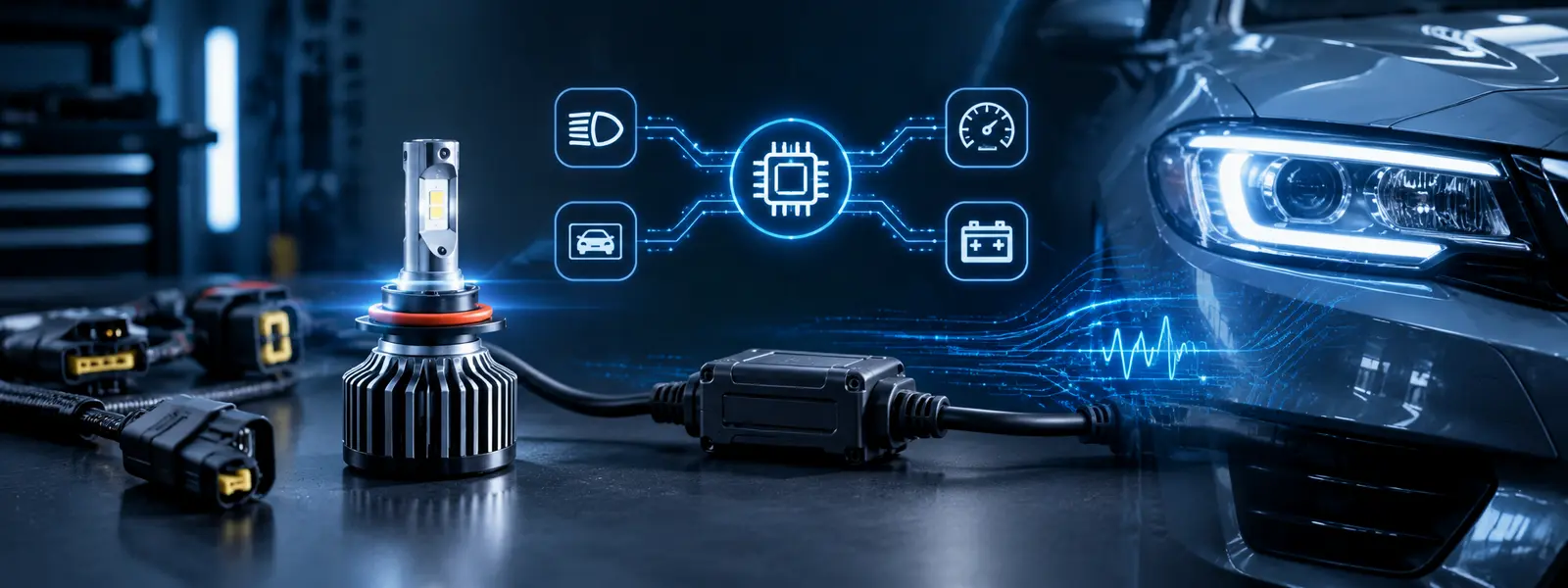
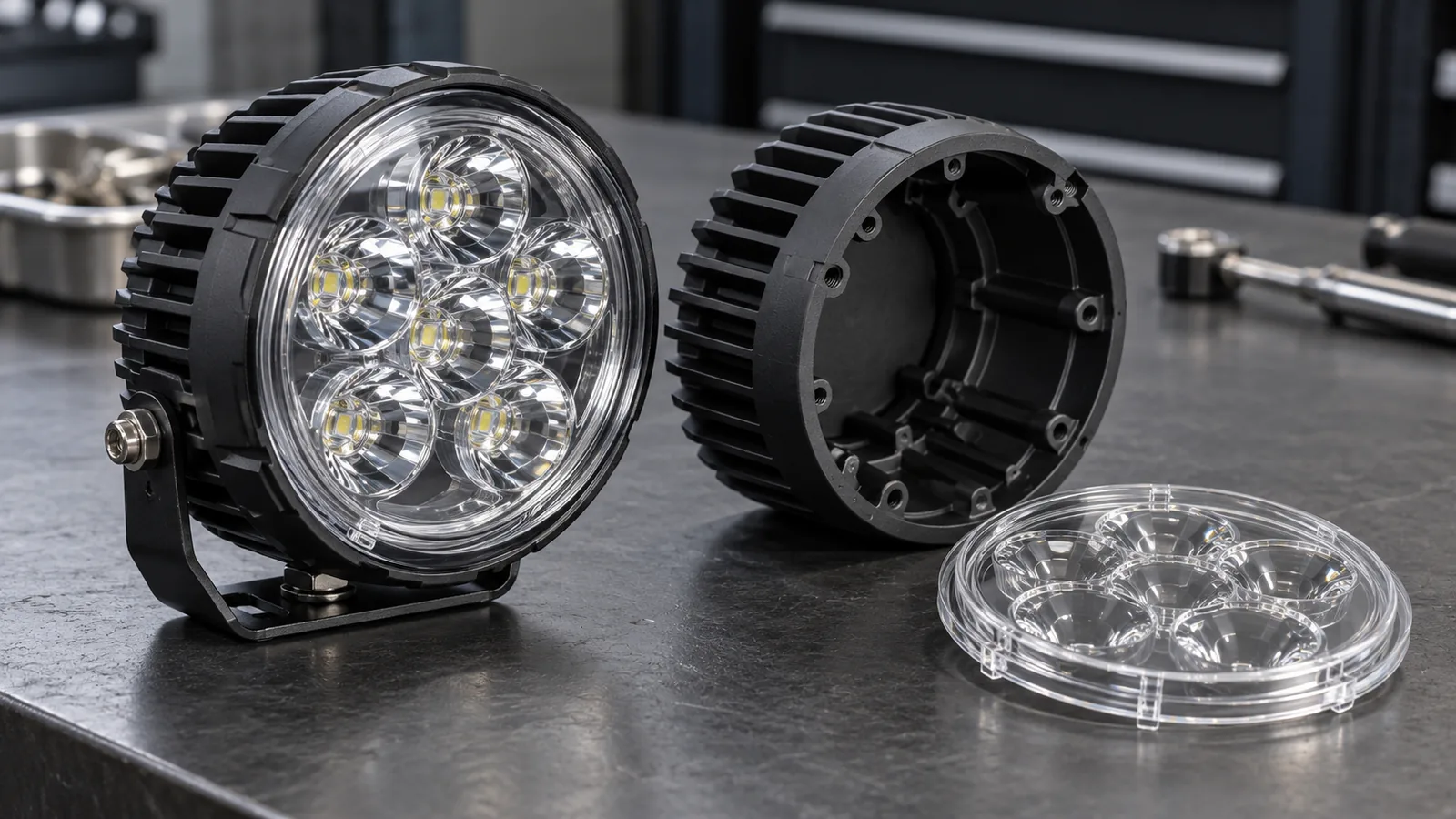
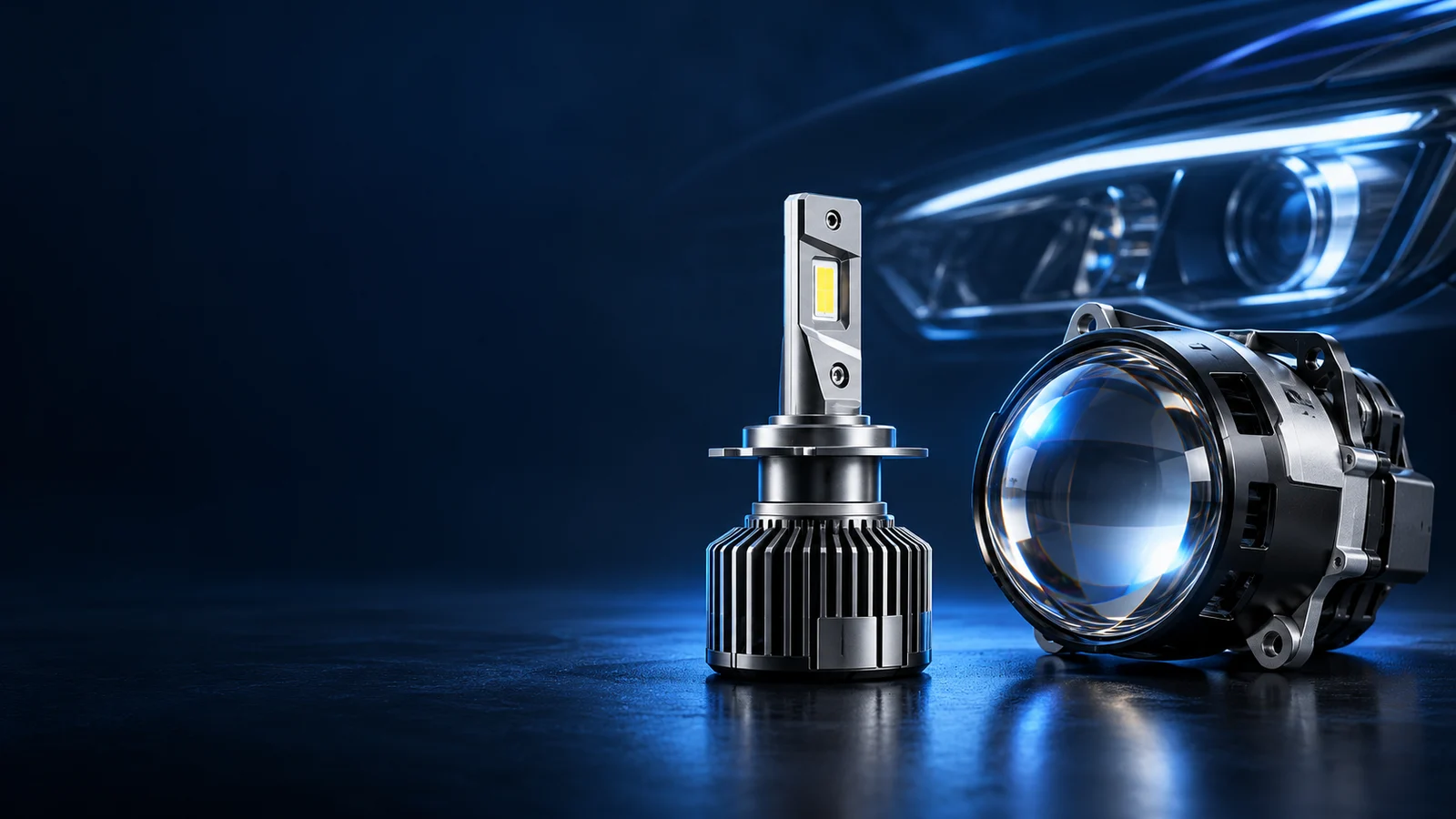
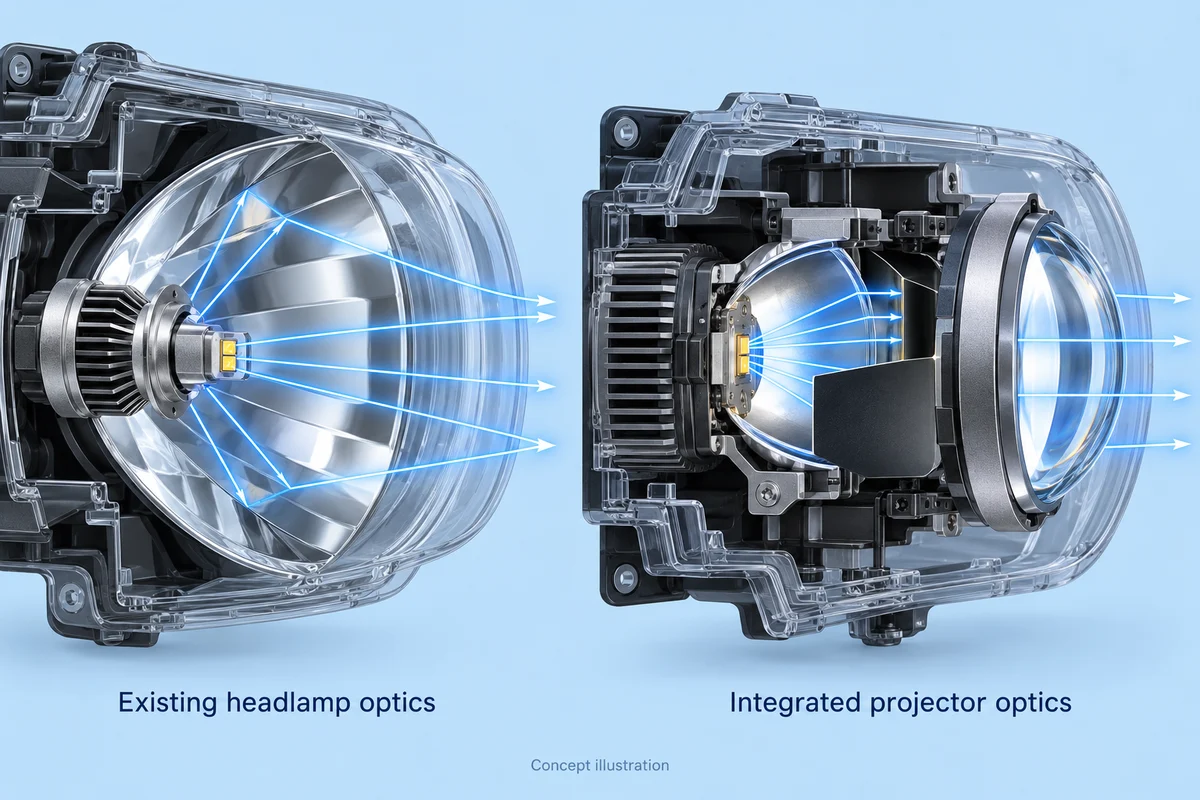
LED replacement bulbs retain the existing headlamp optics. Bi-LED projector modules combine a light source with dedicated optics and a low/high-beam function. The resulting differences affect validation, fitting work, service costs and inventory planning. This guide compares both approaches and explains the evidence buyers should request before placing an order.
LED Bulbs vs. Bi-LED Projectors: Buyer Priorities
QUICK GUIDE
Validate the LED emitter position and the existing headlamp pairing; assess projector modules as part of the complete installed assembly.
Compare useful coverage and glare-sensitive directions under equivalent conditions, rather than relying on one peak lux reading.
Check stabilized output and the cooling arrangement inside the intended enclosure, including dust-cap clearance and fan access.
Confirm mounting, sealing, wiring and vehicle electronics for the specific application before claiming compatibility.
Match total landed cost, installation labor and after-sales support to the customer channel and the evidence available.
1. Optical Architecture: LED Bulbs vs. Bi-LED Projectors
An LED replacement bulb places LED emitters in a socket originally specified for another light source, commonly a halogen filament. The vehicle’s existing reflector or projector remains responsible for collecting and directing light. Emitter size, spacing, orientation and focal position therefore matter as much as the nominal socket designation. A bulb can fit mechanically while producing a distribution that differs from the original lamp.
Thin emitter boards and carefully positioned LEDs may improve optical matching, but “filament-like” geometry alone is not proof of acceptable performance. The installed light source must be evaluated in the actual headlamp. Reflector condition, projector coatings, retaining adapters, seating accuracy and lens condition can all influence the result. Buyers should distinguish socket fitment from validated optical compatibility.
A typical Bi-LED projector module integrates an LED source, collection optics or a reflector, a projection lens, a driver and a mechanism for low/high-beam operation. Many designs use a movable shield actuated by a solenoid. Others add separately controlled emitters or different optical arrangements. “Bi” refers to the two beam functions, not necessarily two LEDs or two lenses.
Lens materials, cooling methods and mechanical designs vary. A dedicated module gives designers control over the relationship between source and optics, but the surrounding headlamp still affects packaging, temperature, sealing and alignment. The outer lens can also affect the installed beam. Module-level results should therefore be followed by complete-assembly validation.
2. Beam Pattern, Cutoff and Glare Control
Useful illumination requires the right amount of light in the right directions. A brighter-looking wall image, a sharper cutoff or a higher center lux reading does not independently establish better visibility or lower glare. Compare the complete low-beam and high-beam distributions, including useful lateral coverage, transition areas and light directed toward other road users.
- Raw lumens: a calculated or nominal source-output figure, sometimes obtained by adding LED chip ratings. It may not represent the assembled product.
- Measured lumens: luminous flux measured from a defined product under stated conditions. Optical losses and operating temperature affect the result.
- Illuminance, in lux: light incident on a measurement surface or point. Distance and geometry must be specified.
- Beam distribution: the pattern across relevant test points or angles, including central intensity and lateral spread.
- Cutoff: the transition between illuminated and darker regions of a low beam. Its position and distribution around it matter, not only visual sharpness.
- Glare: unwanted light reaching other road users. Aim, intensity, vehicle attitude and the installed optical system affect it.
Replacement bulbs can preserve an effective distribution when the source and headlamp are appropriately matched and validated. A mismatched emitter position can instead create dark zones or excess light above the intended low-beam boundary. A Bi-LED module may produce a different distribution because its source and optics are designed together; that does not guarantee zero glare, greater distance or a sharper cutoff in every installation.
Request comparable test reports using the same distance, supply voltage, operating mode, aiming method and measurement procedure. Confirm whether the output was recorded at startup or after thermal stabilization. Record ambient temperature and the tested housing. For formal photometry, use the angular or test-point method required for the applicable lamp standard; casual wall photographs cannot replace it.
3. Comparison at a Glance
| Comparison Factor | LED Headlight Bulbs | Bi-LED Projector Modules |
|---|---|---|
| Optical System | Uses the existing reflector or projector; source geometry must match. | Dedicated source and optics; complete housing still needs validation. |
| Beam Control | Depends on bulb/headlamp pairing, seating and aim. | Depends on module design, mounting, outer lens and aim. |
| Thermal Design | Compact packaging; rear clearance and airflow can be limiting. | Cooling varies; enclosure and operating power remain important. |
| Installation | May fit an existing socket; adapters or electrical work can be needed. | May require housing work, brackets, wiring and professional fitting. |
| Vehicle Compatibility | Validate socket, clearance, electronics and optical performance. | Validate mounting envelope, beam functions and vehicle electronics. |
| Maintenance | Replacement access depends on the vehicle and bulb arrangement. | Service can require opening or replacing the headlamp assembly. |
| Compliance Considerations | Check the permitted light-source/headlamp combination for the market. | Clear cutoff or module testing does not establish complete road approval. |
| Typical Buyer Channels | Parts distributors, retailers or service networks with validated applications. | Retrofit specialists or assembly developers with integration capability. |
4. Thermal Management and Long-Term Reliability
LED efficiency and output change with operating temperature. Heat must travel from the LED junction through the board and thermal interfaces to a heat sink, then into the surrounding environment. Heat-sink area, thermal resistance, airflow, driver power and enclosure temperature collectively determine stabilized performance. A large advertised wattage can increase the cooling burden without ensuring useful road illumination.
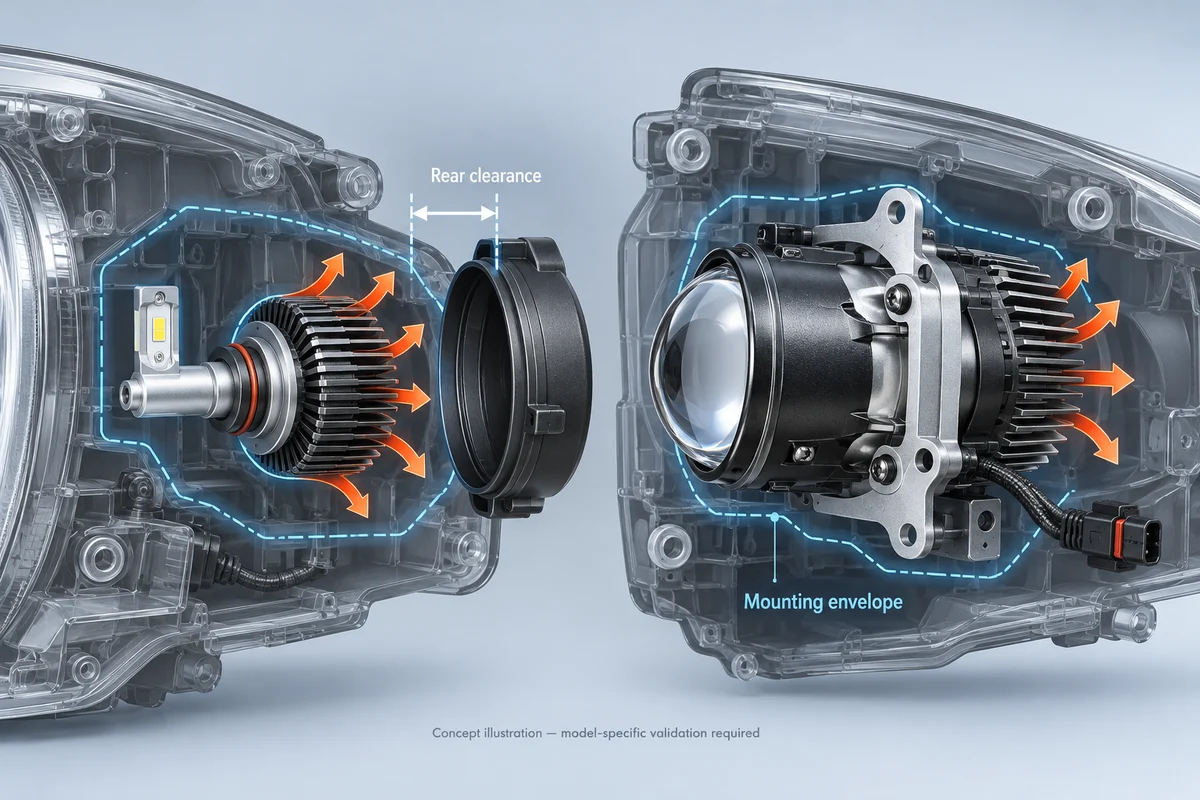
Replacement bulbs have limited space behind the socket. A fan may circulate hot air inside a closed headlamp rather than provide fresh cooling air. Dust-cap clearance, cable routing and nearby components can affect airflow. Passive cooling avoids a fan failure mode but still needs adequate heat-transfer area and space. Evaluate the design inside its intended enclosure, with the specified cap fitted.
Bi-LED modules can allocate space differently, but they are not inherently cooler. A tightly enclosed or high-power module can face significant thermal stress. Fans, heat pipes and large heat sinks are model-specific features rather than universal characteristics. Ask for stabilized output, electrical input and temperature measurements under representative mounting and ambient conditions, including any thermal protection behavior.
There is no fixed lifespan for either category. Reliability depends on the LED package, driver components, fan where fitted, switching mechanism, temperatures and duty cycle. A lumen-maintenance estimate is different from the service life of the whole product. Request the stated failure criterion, test duration, sample size and operating conditions; compare warranty coverage and replacement procedures alongside laboratory results.
5. Installation, Fitment and Vehicle Compatibility
For replacement bulbs, start with socket compatibility and the retaining mechanism. Check polarity, supply characteristics, connector condition, rear clearance and dust-cap fit. Confirm that cables and drivers can be secured without obstructing moving parts or trapping heat. Some installations require adapters; modifying a cap or housing can affect sealing and serviceability. Installation time should be estimated for the specific application.
Vehicle electronics may detect a different electrical load and trigger bulb-out warnings, flicker or shutdown. Radio interference is another separate concern. “CANBus compatible” is a marketing description, not a guarantee that a lamp directly communicates on the vehicle network or works with every control module. Confirm compatibility on the target vehicle and request evidence for electrical and electromagnetic performance.
Bi-LED retrofits may involve opening a housing, changing mounting points, fitting brackets, aligning the optical axis and integrating power and beam-switch wiring. Housing materials and sealing methods vary; heating is not appropriate for every assembly. Professional installation and a controlled resealing procedure may be needed. Check adjustment range, mounting strength, moisture protection and access for later servicing.
Neither product type universally eliminates decoders, harnesses or other adaptation parts. Load resistors, if required, introduce heat and need suitable mounting. Integrated drivers still need vehicle-level validation. Test low/high-beam operation, warning behavior, interference and aiming after installation, then document a repeatable fitting procedure for the supported applications.
6. Road-Use Compliance: Validate the Complete Application
Road-use eligibility depends on the destination market, headlamp type, light-source category and specific installation. In the United States, FMVSS No. 108 includes requirements for headlamps and replaceable light sources. DOT is not a government-issued universal lamp approval: the applicable system relies on manufacturer certification. A DOT claim does not establish that an LED bulb is a permitted replacement in a particular halogen headlamp.
For markets applying UNECE rules, check the relevant lamp, light-source and vehicle-installation requirements and the applicable approval scope. UN Regulation No. 149 covers road illumination devices; older R112 approvals and transitional provisions may remain relevant to particular products. Do not treat R112 as the sole basis for every current application. A module test, sharp cutoff or EMC result does not by itself approve a modified vehicle for road use.
Before purchasing, obtain documentation tied to the exact model and intended configuration, and confirm the permitted use with the relevant authority or qualified compliance specialist. Keep off-road and road-use sales descriptions consistent with that evidence. See the NHTSA interpretation on LED headlamp replacement sources and UNECE’s UN Regulation No. 149 reference.
7. B2B Buyer Decision Guide
Choose a product line around your customer channel and support capability. Compare landed cost, fitting labor, adaptation parts, training, returns and warranty handling. Inventory turnover and margin depend on demand and execution; neither bulbs nor projector modules always deliver a better commercial outcome. A limited range with documented applications may be more manageable than broad, unsupported compatibility claims.
Choose LED Headlight Bulbs When…
- Your channel needs socket-based replacement products for identified vehicles, and you can validate the optical and electrical pairing.
- Available clearance supports the specified cooling and dust-cap arrangement without compromising the installation.
- Your sales and service teams can explain supported applications, required adapters and destination-market restrictions.
- The expected total cost and after-sales workload suit your retail, distribution or workshop model.
Choose Bi-LED Projectors When…
- Your customers have the capability to integrate dedicated modules into a headlamp and validate the final assembly.
- Professional mounting, wiring, optical alignment and resealing are available where required.
- A documented beam-distribution requirement justifies the integration work, rather than an assumed universal performance advantage.
- The market’s approval pathway and service strategy are understood before inventory or development spending.
For either option, agree sample acceptance criteria before ordering. Identify the test vehicle or assembly, electrical conditions, stabilized photometry, installation procedure and documentation required. Approve a reference sample and clarify how production changes will be controlled. Evaluate a representative pilot batch before expanding the range.
Frequently Asked Questions
1. Can LED bulbs perform as well as Bi-LED projectors?
There is no universal ranking. A validated replacement-bulb/headlamp combination can suit its intended application. A dedicated projector may offer a different distribution, but compare complete installed systems under equivalent conditions.
2. Why may a Bi-LED projector deliver a different beam distribution?
Its source, collection optics and projection arrangement can be designed together. The actual result depends on the model and installation; a higher central lux figure does not prove better overall illumination.
3. How does Bi-LED high/low-beam switching work?
Many modules move a cutoff shield using a solenoid to change the distribution. Other designs also control additional emitters. Verify the model’s mechanism and wiring rather than assuming identical construction.
4. Are either of these upgrades road legal?
Only where the specific product and application meet the applicable requirements. Mechanical fitment or a clear cutoff is insufficient. Check the approved or certified configuration and local installation rules before making road-use claims.
5. Which option lasts longer?
Compare product-specific evidence. LEDs, drivers, fans and switching parts operate under different stresses. Ask what the lifespan figure measures and under which temperatures, duty cycle and failure criteria.
6. Do Bi-LED projectors need CANBus decoders?
Some applications need additional parts, while others do not. Integrated drivers cannot guarantee warning-free operation on every vehicle. Test the target electrical system, including monitoring, flicker and interference.
7. Does NVEL offer both product types?
NVEL’s published automotive LED lighting product catalog and LED Projector Lens pages show replacement bulbs and Bi-LED products. Ask the team to confirm current model availability, fitment information, project requirements and applicable documentation before ordering.
Conclusion: Choose the Validated System
LED replacement bulbs and Bi-LED projector modules address different installation methods and service channels. Select the option supported by evidence for the intended headlamp, vehicle and market. Compare stabilized photometry, thermal reliability, fitment, electrical behavior and the complete cost of installation and support before approving a product range.
Discuss Your Headlight Product Requirements
Tell NVEL whether your channel needs replacement bulbs or integrated projector modules. Include your target market, applications, expected order quantity and validation requirements.
Related Technical Guides
Technical Guides · LED Headlights