INDUSTRY INSIGHTS
Automotive Lighting Market 2026–2030: Trends, Technologies & B2B Opportunities
Introduction
The global automotive lighting market is evolving as vehicle manufacturers adopt new lighting technologies, update exterior designs, and respond to changing safety and regulatory requirements.
Automotive lighting is no longer limited to basic road illumination. Modern lighting systems contribute to vehicle visibility, brand identity, energy management, and, in some applications, adaptive driving functions. These developments are influencing both original equipment manufacturing (OEM) and the automotive aftermarket.
For distributors, wholesalers, automotive lighting brands, and importers, understanding these changes is essential. While LED technology is becoming increasingly important, market opportunities differ significantly across vehicle platforms, product categories, geographic regions, and distribution channels.
This article examines the automotive lighting market outlook for 2026–2030, covering key demand drivers, lighting technologies, regional considerations, regulatory requirements, and practical B2B sourcing strategies.
Table of Contents
Quick Guide: Five Factors Shaping the Automotive Lighting Market
QUICK GUIDE
01
Market Structure
The automotive lighting market includes OEM systems, aftermarket replacement products, exterior lighting, interior lighting, and specialized applications.
02
Technology Transition
LED technology is influencing new vehicle designs and replacement products, while halogen and HID systems remain relevant to parts of the existing vehicle fleet.
03
Intelligent Lighting
Adaptive driving beam systems, matrix lighting, and electronic integration are creating new technical requirements for advanced vehicle platforms.
04
Regional Regulations
Product suitability depends on the intended market, vehicle application, lighting function, and applicable regulatory requirements.
05
B2B Opportunities
Distributors and brands can differentiate through application coverage, reliable product information, quality consistency, and appropriate supplier partnerships.
1. Automotive Lighting Market Overview
The automotive lighting market encompasses a broad range of technologies, products, and commercial channels.
Major product categories include headlamps, fog lamps, daytime running lamps, turn signals, tail lamps, brake lamps, license plate lamps, interior lighting, and auxiliary lighting systems.
The market can also be divided into two important channels: OEM lighting supplied for new vehicle production and aftermarket products used for replacement, repair, or suitable upgrades.
These channels respond to different demand drivers.
OEM automotive lighting
OEM demand is closely connected to new vehicle production, vehicle platform development, styling decisions, electrical architecture, and supplier qualification.
Automakers may integrate multiple lighting functions into increasingly complex headlamp and rear lamp assemblies.
This creates opportunities for advanced lighting technologies, but it can also reduce demand for some traditional standalone components.
Automotive aftermarket lighting
The aftermarket serves vehicles already in operation.
Replacement demand can arise from component failure, physical damage, aging, maintenance, and customer preferences.
Because vehicle fleets contain different generations of lighting technology, halogen, HID, and LED products may continue to coexist in aftermarket distribution channels.
For B2B buyers, the commercial opportunity depends on actual vehicle applications rather than broad assumptions about technology adoption.
Understanding market forecasts
Published automotive lighting market forecasts may vary because research firms use different product definitions, geographic coverage, revenue categories, and forecasting methods.
Some studies include interior and exterior lighting, while others focus primarily on vehicle headlamps or LED-specific segments.
Therefore, buyers should confirm the scope of a market forecast before using it to support inventory planning or investment decisions.
The following outlook is a qualitative assessment of industry trends rather than a prediction of guaranteed market growth.
2. Key Drivers Influencing Automotive Lighting Demand
Several structural factors are influencing demand across the automotive lighting industry.
Vehicle safety and visibility requirements
Automotive lighting performs essential functions in road illumination, signaling, and vehicle conspicuity.
Regulatory requirements for beam distribution, luminous intensity, glare control, color, and installation continue to influence lighting system development.
These requirements encourage manufacturers and suppliers to consider complete-system performance rather than relying solely on advertised brightness.
Vehicle design and brand differentiation
Lighting has become an important part of automotive exterior design.
Distinctive daytime running light signatures, integrated rear light bars, and compact lighting modules can contribute to recognizable vehicle styling.
LED technology provides design flexibility, although implementation depends on vehicle architecture, thermal management, and regulatory constraints.
Electric vehicle development
Electric vehicles have increased attention to electrical efficiency, system integration, and packaging flexibility.
LED lighting can support efficient vehicle electrical design, but the effect of lighting power consumption on overall driving range should not be overstated.
For most vehicles, propulsion and other major energy loads are much larger factors in total energy consumption.
Replacement demand from the installed vehicle base
Existing vehicles remain an important source of aftermarket demand.
Even when new vehicle platforms adopt advanced integrated lighting, older vehicles may continue to require conventional replacement bulbs, dedicated lamp assemblies, and compatible electronic components.
This creates different product lifecycle opportunities for OEM suppliers and aftermarket distributors.
Increasing electronic integration
Modern vehicles use more sophisticated electrical and diagnostic systems.
Lighting products may need to interact with control modules, voltage monitoring, diagnostic functions, and communication networks.
For aftermarket suppliers, accurate electrical compatibility is an increasingly important consideration.
3. Automotive Lighting Technologies: Halogen, HID, LED and Advanced Systems
Different automotive lighting technologies serve different vehicle applications and market segments.
No single technology should be evaluated solely by its advertised luminous efficacy or maximum light output.
Optical performance, electrical compatibility, heat management, durability, and regulatory suitability must be considered together.
Halogen lighting
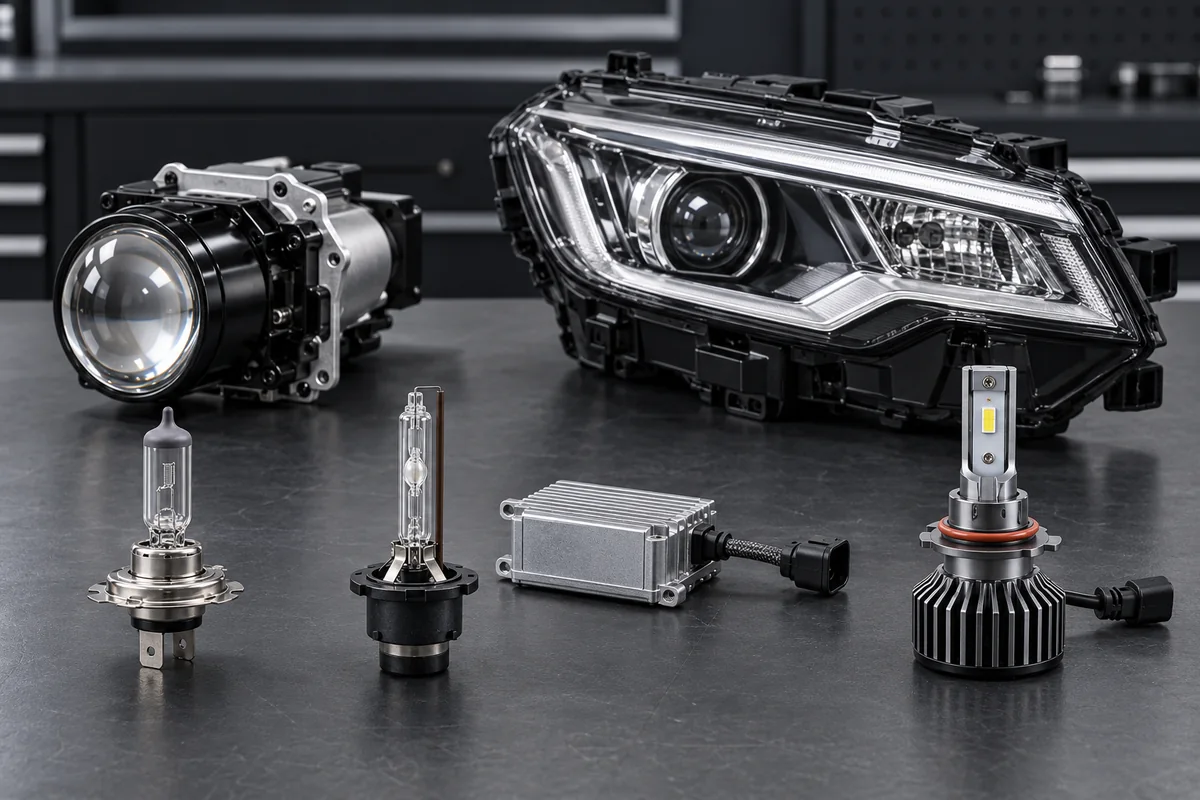
Halogen lamps use heated filaments to produce light.
They remain relevant to many existing vehicles because of their installed base, replacement availability, and relatively straightforward technology.
However, their electrical efficiency and packaging flexibility are generally more limited than those of properly designed LED systems.
HID and xenon lighting
High-intensity discharge (HID) systems produce light through an electrical discharge and require appropriate electronic control equipment.
HID systems remain relevant to vehicles originally designed for these light sources.
Replacement buyers must pay attention to the correct bulb type, base, electrical system, and ignition configuration.
LED automotive lighting
LED technology is used across a wide range of automotive lighting applications.
Potential advantages include compact packaging, design flexibility, and electrical efficiency.
However, the performance of a complete LED lamp depends on its optical design, driver electronics, thermal management, and installation environment.
A high-output LED chip does not automatically produce a compliant or effective automotive beam pattern.
Bi-LED projector systems
Bi-LED projector systems can combine low-beam and high-beam functions within a compact optical module.
Their optical design may include lenses, reflectors, shields, and mechanical or electronic beam-control components.
Performance varies by product and installation. A projector design alone does not guarantee correct beam distribution or the absence of glare.
Matrix and adaptive driving beam systems
Advanced headlamp systems can use individually controlled light sources or segments to adjust illumination according to driving conditions.
Adaptive driving beam technology is designed to improve usable illumination while managing light directed toward other road users.
These systems require coordinated optical, electronic, sensing, and vehicle-level integration.
They are not directly interchangeable with conventional aftermarket replacement bulbs.
Automotive Lighting Technology Comparison
| Technology | Typical Applications | Main Advantages | Key Limitations | B2B Market Considerations |
|---|---|---|---|---|
| Halogen | Existing vehicle headlamps and other replacement applications | Established technology and broad installed base | Lower electrical efficiency and limited design flexibility | Maintenance and replacement demand |
| HID / Xenon | Factory-equipped HID headlamp systems | Suitable for specific established vehicle applications | Requires compatible ignition and control equipment | Vehicle-specific replacement products |
| LED | Headlamps, fog lamps, signal lamps, interior lighting | Packaging flexibility and potential efficiency benefits | Performance depends on optics, electronics, and thermal design | OEM programs and compatible aftermarket products |
| Bi-LED Projector | Integrated headlamp modules and selected retrofit applications | Combined beam functions and controlled optical design | Installation complexity and application-specific compliance | Specialized products and technical support |
| Matrix / ADB | Advanced OEM headlamp systems | Dynamic control of light distribution | Complex system integration and regulatory requirements | Advanced OEM development and specialized supply chains |
4. Automotive Lighting Market Trends for 2026–2030
The following trends may influence product development and commercial decisions during the 2026–2030 period.
Trend 1: Continued LED integration
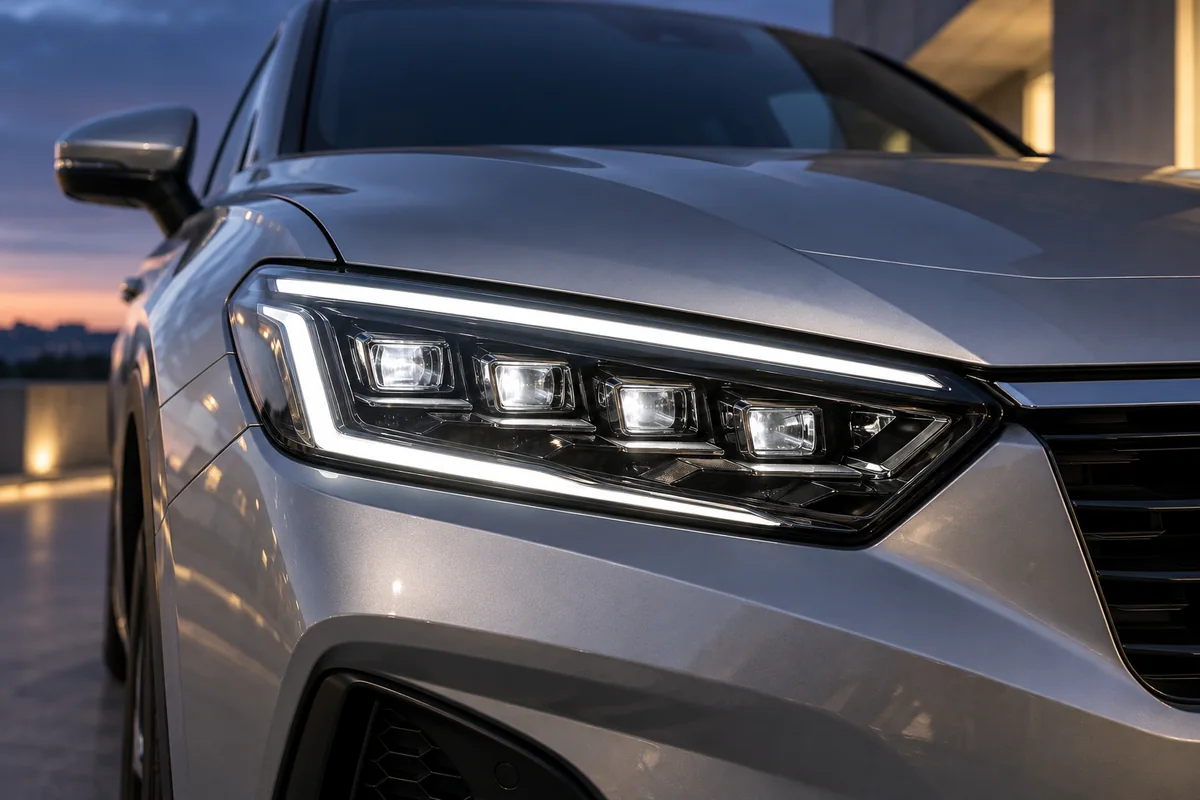
LED technology is expected to remain important in automotive lighting development because of its flexibility across different vehicle functions.
However, adoption patterns differ between new vehicles and the installed aftermarket fleet.
Distributors should not assume that all halogen and HID replacement demand will disappear during the forecast period.
Trend 2: More integrated lighting assemblies
Some new vehicle designs combine multiple lighting functions within shared front or rear assemblies.
This may create opportunities for sophisticated OEM systems while changing the replacement economics of individual lighting components.
For aftermarket businesses, assembly-level replacement and vehicle-specific fitment information may become increasingly important.
Trend 3: Advanced beam-control technologies
Adaptive driving beam and matrix lighting technologies are expanding the technical possibilities of vehicle headlamps.
Their development is influenced by optical performance, sensing, control software, electronics, and regulatory approval.
For B2B suppliers, these products require a different evaluation approach from conventional bulbs or standalone lamps.
Trend 4: Greater emphasis on electrical compatibility
Modern vehicle electronics can make lighting replacement more complex.
Issues such as diagnostic warnings, flickering, incorrect operating behavior, and incompatibility with vehicle control systems may arise when unsuitable products are installed.
Compatibility should be verified for specific vehicle applications.
A product labeled CANBus-compatible does not guarantee universal compatibility.
Trend 5: Increased demand for product documentation
Importers and distributors often need reliable application information, technical specifications, and relevant compliance documents.
Clear product identification and version control can reduce misunderstandings and support better after-sales service.
Trend 6: Portfolio specialization
Rather than offering an excessively broad catalog, some distributors may benefit from focusing on defined vehicle segments, lighting technologies, or regional markets.
Specialization can support more accurate fitment guidance, better inventory decisions, and clearer customer positioning.
5. Regional Market Opportunities and Considerations
Automotive lighting demand differs across regions because of vehicle populations, regulations, customer preferences, and distribution structures.
| Region | Market Considerations | Implications for B2B Buyers |
|---|---|---|
| North America | Diverse vehicle applications, established aftermarket channels, specific federal and national lighting requirements | Verify vehicle fitment and applicable U.S. or Canadian compliance requirements |
| Europe | Vehicle-specific applications, lighting approval requirements, advanced OEM lighting technologies | Prioritize relevant documentation, product identification, and regulatory suitability |
| Asia-Pacific | Diverse vehicle manufacturers, product segments, and distribution channels | Build country- and vehicle-specific sourcing strategies |
| Middle East | Varied vehicle fleets and operating environments | Review environmental suitability, electrical compatibility, and local requirements |
| Latin America and Africa | Mixed vehicle generations, replacement demand, and varying import conditions | Focus on relevant applications, supply reliability, and market-specific requirements |
These regional observations are qualitative. They should not be interpreted as rankings of market size or growth rates.
For distributors operating internationally, a product that is suitable for one destination market may not be appropriate for another.
6. Automotive Lighting Regulations and Compliance
Regulatory requirements are a major consideration for businesses sourcing automotive lighting products for road use.
Requirements vary by jurisdiction, product function, vehicle type, and installation.
United States: FMVSS No. 108
In the United States, Federal Motor Vehicle Safety Standard No. 108 addresses lamps, reflective devices, and associated equipment.
It establishes requirements for covered automotive lighting equipment and vehicle installations.
The U.S. regulatory framework also permits qualifying adaptive driving beam headlamp systems under applicable requirements.
However, this does not mean that every aftermarket LED replacement bulb or modified headlamp assembly is automatically compliant.
UN and European regulatory frameworks
Relevant United Nations vehicle regulations include:
- UN Regulation No. 149, addressing road illumination devices.
- UN Regulation No. 148, addressing light-signaling devices.
- UN Regulation No. 10, addressing electromagnetic compatibility.
Which requirements apply depends on the product and destination market.
Buyers should confirm the relevant approval framework for the exact product and intended application.
Understanding SAE, DOT and E-mark terminology
SAE standards, U.S. federal requirements, and UN type-approval systems are not interchangeable.
A product label or marketing description should not be treated as sufficient evidence of compliance.
Importers should request appropriate documentation and verify that it applies to the exact product configuration being purchased.
Why compliance matters for distributors
Incorrect product claims or unsuitable lighting applications can create commercial and legal risks.
Before placing an order, buyers should confirm intended road use, vehicle fitment, relevant technical requirements, and supporting documentation.
7. OEM vs. Aftermarket: Different Commercial Opportunities
The OEM and aftermarket channels require different sourcing strategies.
OEM channel
OEM lighting projects are generally tied to vehicle development programs, technical specifications, supplier qualification, and production schedules.
Product design may involve vehicle-level integration and validation.
Advanced lighting technologies can create opportunities for specialized suppliers, but entering OEM supply programs can require substantial technical and commercial preparation.
Aftermarket channel
Aftermarket demand is driven by existing vehicle applications, repair, replacement, and suitable upgrades.
Distributors may compete through application coverage, inventory availability, product quality, branding, and customer service.
However, aftermarket products must still meet relevant technical and regulatory requirements.
OEM and Aftermarket Comparison
| Factor | OEM Market | Automotive Aftermarket |
|---|---|---|
| Main customers | Vehicle manufacturers and qualified supply chains | Distributors, wholesalers, repair channels, and brands |
| Demand drivers | New vehicle programs and platform development | Installed vehicle base, replacement, repair, and suitable upgrades |
| Product development | Vehicle-specific engineering and validation | Fitment-focused products and application coverage |
| Commercial priorities | Program requirements, qualification, consistency | Availability, pricing, documentation, and after-sales support |
| Key risks | Long development cycles and platform changes | Inventory complexity, compatibility, and product returns |
For many independent B2B buyers, the aftermarket offers a more accessible commercial channel, although the best approach depends on product capabilities and target customers.
8. Challenges Facing Automotive Lighting Suppliers
Market opportunities should be evaluated alongside several important risks.
Regulatory uncertainty
Lighting rules and interpretations can change over time.
Products intended for multiple markets may require different configurations or supporting documentation.
Product commoditization
Products with similar advertised specifications can differ in optical performance, electrical design, material quality, and reliability.
Price-only sourcing can make it difficult to distinguish between suppliers.
Vehicle application complexity
Different vehicle platforms may require different connectors, mounting systems, electronic behavior, and optical configurations.
Incorrect application information can increase returns and customer complaints.
Quality consistency
Sample quality alone does not guarantee consistent production.
Buyers should discuss inspection criteria, product version control, warranty handling, and corrective action procedures.
Inventory management
Maintaining too many slow-moving SKUs can create financial pressure.
A focused assortment based on real vehicle demand may be more sustainable than an unnecessarily large product catalog.
9. B2B Sourcing Strategies for Automotive Lighting Buyers
For distributors, importers, and automotive lighting brands, a structured sourcing process can help reduce commercial risk.
Step 1: Define your target market
Identify the countries, vehicle models, lighting functions, and customer segments your business intends to serve.
Step 2: Select the right product categories
Determine whether your customers primarily need replacement bulbs, complete lamp assemblies, projector modules, fog lights, or other automotive lighting products.
Avoid selecting products based solely on headline specifications.
Step 3: Verify technical compatibility
Review mounting requirements, connectors, operating voltage, electrical behavior, optical characteristics, and vehicle application information.
Step 4: Request relevant documentation
Ask suppliers for available specifications, applicable compliance information, and product identification details.
Confirm that documents match the exact product version.
Step 5: Evaluate samples
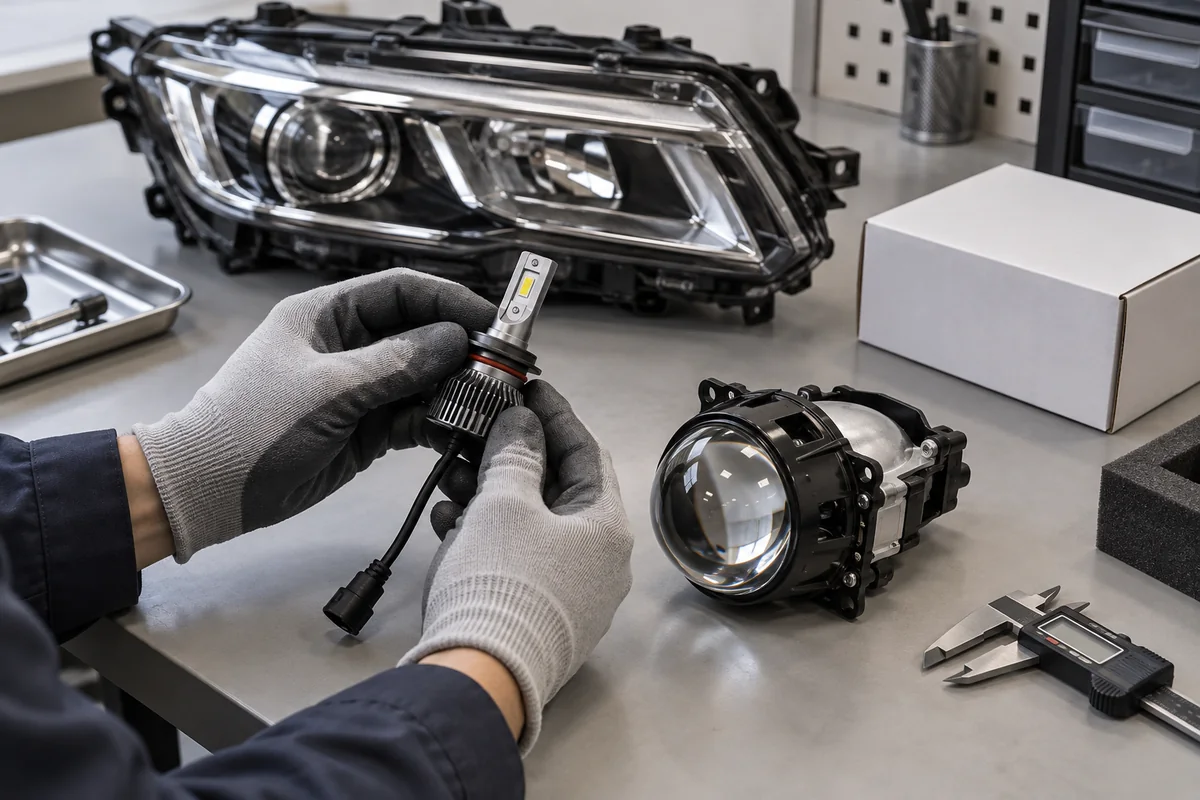
Assess physical quality, installation suitability, electrical operation, optical performance, and consistency under relevant conditions.
Step 6: Confirm commercial terms
Discuss minimum order quantities, packaging, lead times, warranty arrangements, payment terms, and after-sales communication.
Step 7: Review OEM/ODM possibilities
For brands seeking differentiation, discuss feasible packaging, branding, and product customization.
Technical changes may require additional engineering review, validation, and regulatory assessment.
Step 8: Build a long-term product strategy
Monitor vehicle applications, replacement demand, regulatory developments, and product lifecycle changes.
Adjust inventory and sourcing decisions based on actual market feedback.
Working with NVEL
NVEL focuses on automotive LED lighting products and works with international B2B customers, including distributors, wholesalers, importers, and automotive aftermarket brands.
Buyers can contact NVEL to discuss available product ranges, application requirements, commercial sourcing arrangements, and potential OEM/ODM cooperation.
Specific technical capabilities, customization options, compliance documentation, and commercial terms should be confirmed for each project.
10. Frequently Asked Questions
What is the outlook for the automotive lighting market from 2026 to 2030?
The market is influenced by LED adoption, advanced vehicle lighting systems, replacement demand, and changes in vehicle design. Opportunities differ between OEM and aftermarket channels. Published growth forecasts should be evaluated according to their scope, methodology, and time period.
How are electric vehicles influencing automotive lighting?
Electric vehicles encourage attention to electrical efficiency, packaging, and integrated electronic systems. LED lighting can support these design goals, although lighting power consumption is only one part of total vehicle energy use.
Are LED headlights replacing halogen and HID systems?
LED technology is widely used in modern automotive lighting, but many existing vehicles still rely on halogen or HID systems. Replacement demand depends on the installed vehicle fleet and compatible product availability.
What is the difference between Bi-LED projectors and matrix headlights?
Bi-LED projectors commonly combine low- and high-beam functions within an optical module. Matrix headlamp systems use controlled light segments to adjust illumination dynamically. Their architectures, electronic integration, and application requirements differ.
What regulations should automotive lighting importers consider?
Importers should identify the requirements applicable to the exact product and destination market. Examples include FMVSS No. 108 in the United States and relevant UN vehicle regulations in markets using those approval frameworks.
How can distributors reduce returns on automotive LED lighting products?
Accurate fitment information, appropriate product testing, clear documentation, consistent quality expectations, and responsive after-sales support can help reduce avoidable returns. No single feature, including CANBus compatibility or a cooling fan, guarantees trouble-free installation.
Is private label automotive lighting a suitable strategy for B2B brands?
Private label products can help businesses establish a differentiated catalog and brand identity. Commercial feasibility depends on product quality, customization scope, minimum order requirements, documentation, and supplier capabilities.
How can buyers evaluate an automotive lighting manufacturer?
Buyers should review relevant product experience, technical information, application support, sample consistency, quality processes, commercial terms, and communication. Claims about certifications or testing facilities should be verified rather than assumed.
Conclusion: Building a Stronger Position in the Automotive Lighting Market
The automotive lighting market is becoming more diverse as conventional replacement products coexist with advanced LED and electronically controlled lighting systems.
For B2B buyers, success is not simply about selecting the newest technology. It requires understanding target vehicle applications, regional regulations, product performance, and the commercial realities of each distribution channel.
Distributors and brands that build focused product portfolios, verify technical compatibility, and maintain dependable supplier relationships may be better positioned to respond to market changes between 2026 and 2030.
NVEL welcomes inquiries from automotive lighting distributors, wholesalers, importers, and brands interested in discussing LED lighting products and potential sourcing cooperation.
Sources and Further Reading
- NHTSA — Adaptive Driving Beam Headlamps
- U.S. Department of Transportation — FMVSS No. 108 Adaptive Driving Beam Final Rule
- UNECE — UN Regulation No. 149, Road Illumination Devices
This article provides general industry information. Product compliance and suitability must be assessed for the specific vehicle, lighting function, and destination market.