INDUSTRY INSIGHTS · OFF-ROAD LIGHTING
Automotive Off-Road Lighting Equipment Market: Technical Trends & B2B Sourcing Guide
Compare off-road LED light bars, pods and ditch lights by beam distribution, enclosure durability, electrical protection and sourcing evidence.
October 21, 2026 · 12 min read
Introduction
The automotive off-road lighting equipment market serves a diverse range of drivers and professional operators, from recreational 4×4 and overlanding enthusiasts to utility fleets, agricultural equipment and specialized work vehicles. LED light bars, auxiliary pods and ditch lights are often selected for different jobs: seeing farther down a trail, illuminating a broad working area or adding side visibility during low-speed maneuvers.
For distributors and private-label brands, demand is not simply a question of brightness. Products must match the operating environment, mounting location, electrical system and destination-market rules. An impressive lumen claim cannot substitute for a useful beam pattern, reliable sealing, secure installation or documented test results.
This guide explains how to compare off-road lighting equipment, evaluate engineering evidence and build a more defensible B2B sourcing specification. It discusses market opportunities qualitatively; it does not present unverified forecasts or profit-margin figures.
Off-Road Lighting Market & Engineering
QUICK GUIDE
Match the lighting range to recreational, overlanding, utility and agricultural applications.
Compare spot, flood and combo distributions using complete-lamp measurements.
Request separate evidence for ingress, vibration, corrosion and thermal exposures.
Review stabilized output, voltage compatibility, protective circuits and EMC evidence.
Qualify documentation, application samples and the approved production configuration.
1. Off-Road Lighting Market Landscape
Off-road auxiliary lighting supports several distinct purchasing segments. Recreational truck and SUV owners may favor modular pods, bumper light bars and A-pillar-mounted ditch lights. Overlanding customers may need both forward trail illumination and low-speed work or campsite lighting. Commercial and agricultural operators may prioritize broad illumination, robust brackets, replaceable components and dependable availability over cosmetic styling.
These segments have different decision criteria. A light designed for open-trail distance may not be the best option for slow technical driving. A rugged work light may be suitable for a utility vehicle yet lack the optical control or regulatory documentation required for a public-road application. Product positioning should therefore start with the lighting task and intended market, not with an unverified market-growth claim.
Three purchasing drivers to evaluate
- Application-specific visibility. Buyers compare forward range, lateral coverage, beam uniformity and glare control according to speed, terrain and mounting position.
- Environmental reliability. Water, dust, vibration, temperature cycling, corrosion and connector quality can determine whether a lamp performs consistently after installation.
- Catalog differentiation and support. Housing sizes, beam options, mounting accessories, electrical interfaces and replacement-part availability can matter as much as the lamp itself.
B2B takeaway: A well-structured range explains which lamp is for distance, which is for work-area coverage and which combines both. Keep performance claims tied to measured configurations and use cases.
2. Optical Beam Patterns: Spot, Flood, Driving and Combo
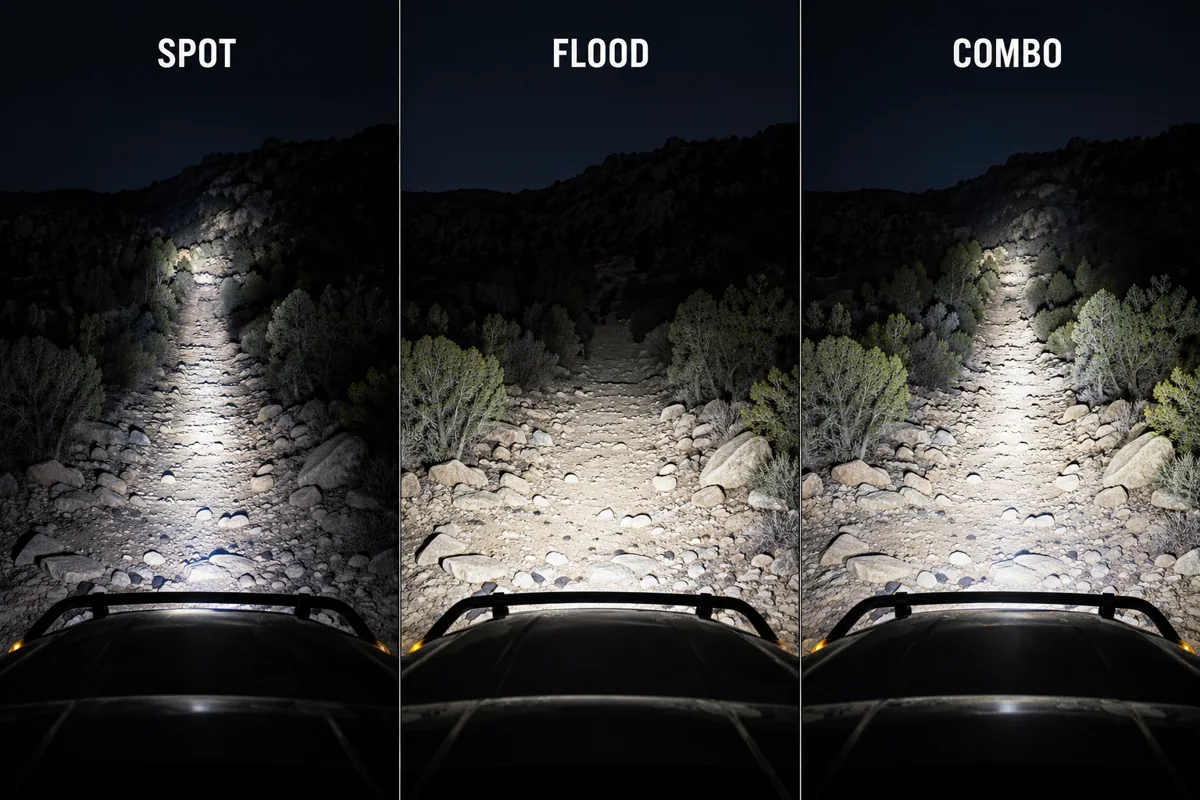
Optical distribution determines where the light goes. When comparing an LED light bar or pod, ask for a complete-lamp intensity distribution or beam measurement made under specified conditions. Nominal LED-chip lumens and a dramatic marketing photograph do not reveal usable distance, uniformity or glare outside the intended field.
Spot beams — concentrated forward reach
A spot optic concentrates more light around a comparatively narrow axis and can improve distance visibility where high-intensity forward illumination is appropriate. Reflector and total-internal-reflection (TIR) designs can both produce concentrated patterns. The actual beam width and peak intensity vary by model; a single degree value is not universal.
Flood and work beams — broad nearby coverage
Flood optics distribute light across a larger area, often supporting low-speed obstacle detection, maintenance tasks, camp setup and work-zone illumination. A wider pattern generally trades some peak intensity for coverage. Buyers should examine vertical spread, usable foreground illumination and mounting-induced glare, not only the advertised width.
Driving and combination beams — a balanced distribution
Driving or combo designs integrate distance-oriented and wider portions of the beam. Some assemblies use distinct optical elements, while others shape the distribution through the lens or reflector. A “combo” label alone does not guarantee a balanced result; inspect the measured pattern and the intended mounting height.
Beam-selection comparison
| Optical pattern | Main priority | Typical applications | What to request from the supplier |
|---|---|---|---|
| Spot | Concentrated forward intensity | Open trails, distance-oriented auxiliary lighting | Peak intensity, beam distribution, defined-distance readings |
| Flood / Work | Wide nearby illumination | Slow maneuvers, work zones, campsite or utility lighting | Coverage map, uniformity, stray-light and installation guidance |
| Driving / Combo | Forward reach plus peripheral coverage | Mixed-use trail setups | Complete-lamp beam data and actual mounting guidance |
Amber versus white: Amber or selective-yellow options can change perceived contrast and visual comfort in certain rain, snow or dust conditions, but wavelength alone does not establish universally better fog penetration. Beam direction, output, particle conditions and driver perception also matter. Select color options by the intended application and test them in relevant conditions rather than promising superior performance everywhere.
3. Environmental Durability and Relevant Standards
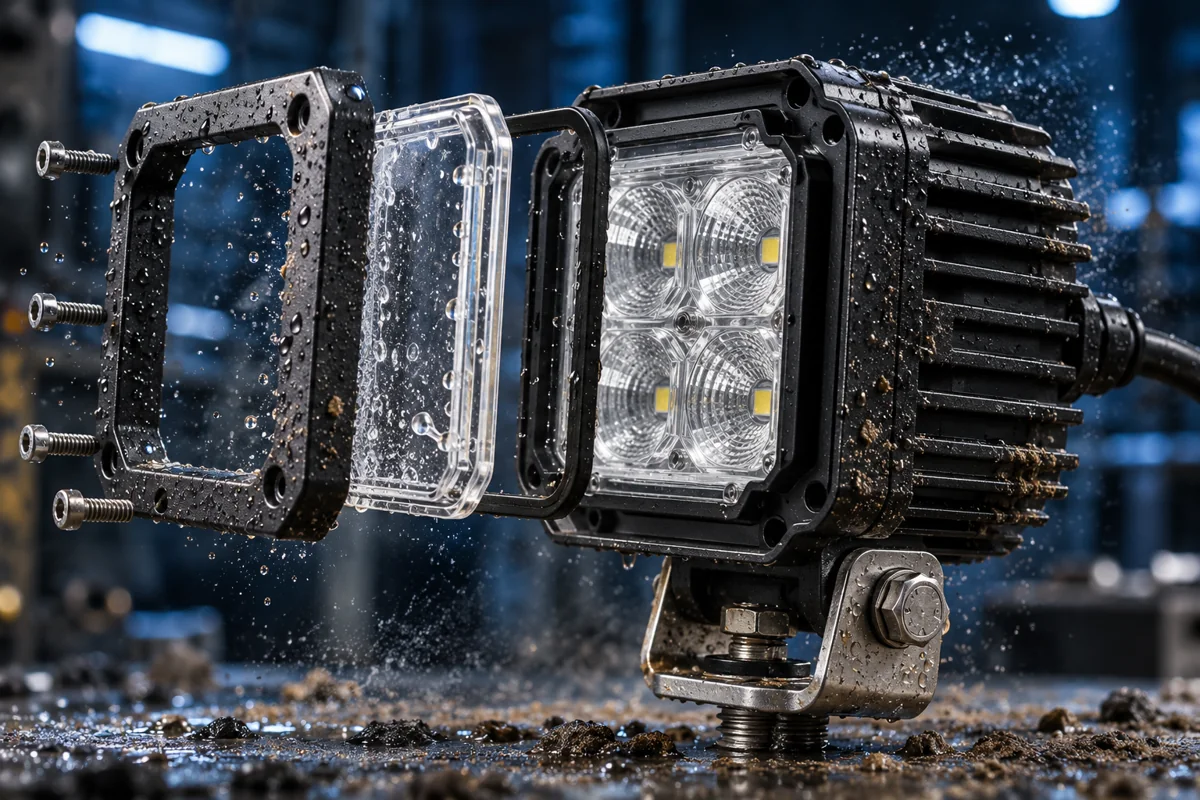
Off-road lighting can face splashing, temporary immersion, high-pressure cleaning, repeated shock, vibration and sustained exposure to sunlight or road salts. These stresses require different engineering and test methods. No single badge establishes total durability.
IP ratings: immersion is not washdown
Ingress-protection claims must name the applicable standard, rating and tested configuration. IP68 under IEC 60529 concerns immersion under specified conditions. Road-vehicle protection codes in ISO 20653, including K-designated hot-water spray tests, address other exposures. A high-pressure hot-water rating does not by itself prove extended immersion resistance, and an immersion result does not automatically prove hot-water jet performance.
Ask whether the rating covers the complete assembled lamp, cable exit, connectors and relevant mounting condition. Request the test report rather than relying on an isolated “IP69K” marketing label.
Vibration, shock and corrosion
MIL-STD-810 is a framework for tailoring environmental tests to relevant use conditions, not a universal, one-number “military-grade certification.” A credible supplier claim identifies the revision, method, procedure, test profile, fixture, sample configuration and results. Vibration resistance also depends on brackets, fasteners and the way a lamp is mounted to the vehicle.
Corrosion protection may require separate evaluation of coatings, fasteners, dissimilar metals and seals. A salt-spray report is useful only when its method, duration, sample condition and acceptance criteria are stated.
Environmental evidence comparison
| Engineering concern | Evidence to request | Why it matters |
|---|---|---|
| Water and dust ingress | Exact IP designation, standard edition, sample and report | Immersion and high-pressure spray are different tests |
| Vibration and shock | Defined profile, fixture, method and pass/fail criteria | Mounting hardware can be the weak point |
| Corrosion resistance | Coating specification and applicable corrosion-test report | Housing and bracket materials age differently |
| Lens durability | UV, abrasion and impact data where relevant | Optical performance can change over time |
| Operating temperature | Stabilized thermal and output data at defined ambient conditions | Peak output does not prove sustained performance |
4. Thermal Management and Electrical Protection
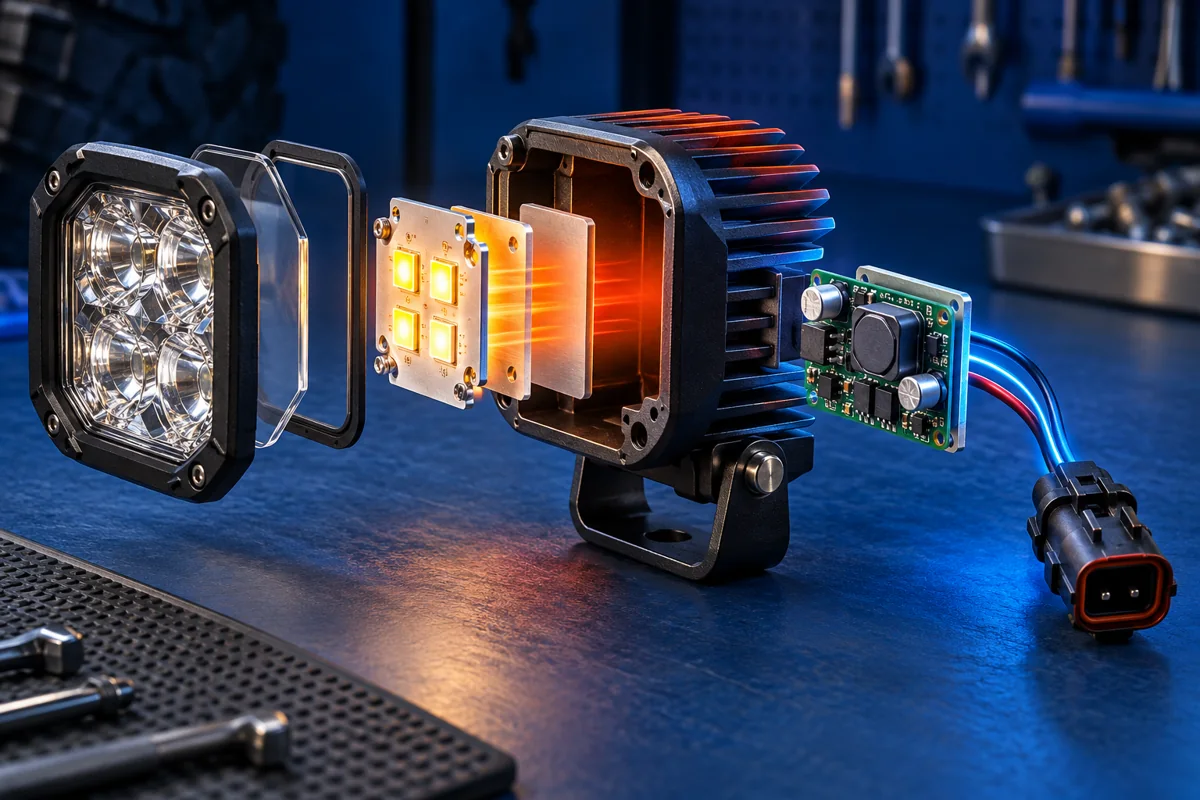
A high-output auxiliary lamp is an electrical and thermal system, not just a cluster of LED emitters. The complete assembly includes LEDs, driver electronics, a heat path, seals, connectors and mounting hardware. Poor coordination between these elements can shorten service life or cause field failures.
Sustained thermal performance
Evaluate LED drive current, driver efficiency, housing heat dissipation and measured stabilized output. Aluminum housings and fins can help move heat away from sensitive components, but fin size alone is not proof of effective cooling. Ask for temperature readings at defined ambient conditions and after sufficient operating time to reach a stable state.
Voltage input and transient protection
Vehicle power systems can expose auxiliary lamps to reverse polarity, cranking conditions and transient disturbances. Protection may include suitable surge-clamping components such as transient-voltage-suppression (TVS) devices, input filtering and driver controls. These features must be matched to the vehicle platform and supported by appropriate tests. Do not assume every 12 V/24 V vehicle requires or tolerates the same input range.
EMC: protect receivers without overclaiming
Switching LED drivers can create conducted or radiated electrical noise. CISPR 25 provides measurement methods and limits aimed at protecting onboard receivers, but a named class or test report does not guarantee the absence of all radio interference in every installation. Check the specified edition, test configuration, wiring harness, limits and results. Immunity and transient resilience may require separate tests.
Installation is part of reliability
Inspect wire gauge against current, cable length and temperature; verify fuse selection, connector sealing, bracket strength and strain relief. Appropriate harness components depend on the actual lamp draw and installation plan. Do not assume every kit must use a particular American Wire Gauge, connector brand or relay arrangement.
5. B2B Sourcing Roadmap and Buyer Checklist
The safest route to repeat orders is a controlled specification that distributors, engineering teams and suppliers can all review. Compare like-for-like samples rather than selecting a light bar solely by advertised watts, “raw lumens” or headline ingress-protection ratings.
Before sample approval
- ☐ Define the use case. Identify vehicle type, mounting location, trail or work function, destination market and any public-road restrictions.
- ☐ Specify the optical target. Request complete-lamp beam distributions, measurement conditions and relevant stabilized output data.
- ☐ Match the environment. List needed dust, immersion, spray, vibration, corrosion and thermal tests separately, with exact standards and acceptance criteria.
- ☐ Verify electrical compatibility. Confirm voltage range, current draw, start-up behavior, protective circuitry, connector pinout and any EMC requirements.
- ☐ Review mechanical integration. Compare housing dimensions, bracket geometry, fastener specifications, clearance and cable routing.
- ☐ Check compliance evidence. Determine whether the product is for off-road-only use or a regulated road-lighting function; request the correct model-specific evidence.
- ☐ Validate commercial terms. Confirm MOQ, samples, lead times, packaging options, warranty procedure, change control and traceability.
A practical three-stage qualification process
Stage 1 — Documentation review: Match supplier datasheets and reports to the exact model, revision and quotation. Identify missing evidence before paying for tooling or placing a bulk order.
Stage 2 — Application testing: Evaluate representative samples in the intended electrical and mechanical installation. Check beam aiming, vibration, connector sealing, thermal stability and driver behavior under realistic operating conditions.
Stage 3 — Pre-production approval: Lock the approved bill of materials, optical components, driver configuration, packaging and inspection criteria. Agree how changes and defects will be communicated and managed after delivery.
6. Building an OEM/ODM Off-Road Lighting Range
A practical portfolio may include compact work pods, narrow-pattern distance lights, versatile combo units and carefully specified light bars. The right assortment depends on the distributor’s customer base, installation constraints and return rates—not a generic claim that every off-road product has a high margin.
For private-label orders, clarify which customizations are cosmetic and which affect the qualified design. Changing a lens, LED package, driver, housing coating or mounting bracket can require renewed validation. Branding and packaging can be planned alongside product engineering, but neither replaces performance and compliance checks.
Ask NVEL to confirm the available off-road product models, customization scope and supporting documentation for the exact configuration being quoted. Do not assume that every design, process or certification applies to every catalog item.
Frequently Asked Questions
1. What is the difference between raw lumens and measured fixture output?
“Raw lumens” often represents a theoretical sum based on LED emitter specifications. Measured fixture output accounts for the complete optical and electrical assembly under defined conditions. Neither lumen total alone describes how far a light reaches; use intensity distribution and relevant distance measurements for that question. Avoid universal loss percentages unless supported by test data for the model.
2. Does an IP69K claim also guarantee IP68 immersion resistance?
No. High-pressure, high-temperature washdown and immersion are separate exposures. Ask for the exact standard and test results supporting each claimed rating. Evaluate the sealed lamp and its electrical interfaces as an assembly where applicable.
3. Are LED light bars legal to use on public roads?
Road-use rules differ by country, state or province, lamp function, mounting and installation. Many high-output off-road products are intended only for off-road use. A product described as an auxiliary driving or fog lamp must still satisfy the applicable legal requirements; a marketing label or SAE reference alone is not permission to use it on any public road. Confirm local requirements before advertising road use.
4. Are amber off-road lights always better in fog or dust?
No. Amber options may be preferred for comfort or contrast in certain conditions, but performance depends on beam placement, photometry, weather conditions and the complete system. Test the chosen lamp in representative situations rather than claiming that color alone guarantees deeper penetration.
5. Does CISPR 25 testing mean a light will never cause radio interference?
No. It provides defined methods and limits for radio-disturbance emissions affecting onboard receivers. Installation, grounding, harness routing and test scope still matter. Review the actual report and consider additional tests where required.
6. What should B2B buyers ask NVEL before ordering off-road lighting?
Share the intended vehicles, lighting function, destination markets, expected volume and branding requirements. Request available model specifications, sample options, beam and electrical evidence, relevant environmental test reports, lead times and the applicable customization terms. Validate the exact selected configuration before bulk purchase.
Conclusion: Prioritize Documented Performance
A competitive off-road lighting range is built around application-specific optics, durable construction, stable electrical behavior and supplier evidence that matches the product being sold. Rather than relying on unsupported market-growth claims or a single “military-grade” label, distributors can reduce sourcing risk by defining their use cases, comparing measured performance and approving representative samples.
For OEM/ODM and wholesale inquiries, NVEL can discuss suitable off-road lighting categories, available configurations and project requirements. Review the product documentation and market-specific obligations before finalizing specifications or promising particular use cases to customers.
Explore NVEL Automotive LED Lighting Products
Tell the NVEL team your target markets, preferred beam patterns, mounting requirements, projected order quantity and any OEM/ODM customization needs.
Technical and regulatory note: This guide provides general engineering and sourcing information, not a product-specific certification or legal approval. Verify optical performance, electrical compatibility, environmental ratings and road-use rules for the exact product, installation and destination market.