TECHNICAL GUIDES · LED HEADLIGHTS
H7 vs H11 vs 9005 LED Bulbs: Socket Fitment, Optical Alignment & B2B Selection Guide
Compare bulb bases, optical source alignment, adjustable collars and B2B fitment checks.
October 22, 2026 · 12 min read
Introduction
Choosing the correct bulb category is one of the first—and most frequently misunderstood—steps in sourcing replacement LED headlight products. H7, H11 and 9005 (HB3) are familiar names in automotive parts catalogs, yet they do not share the same bulb bases, mechanical retention systems or typical vehicle applications. A bulb that looks similar in a product photograph may not lock into the headlamp, clear its dust cap or match the vehicle’s electrical connector.
For distributors and private-label brands, a good fitment decision must go beyond the socket label. The replacement also needs suitable physical dimensions, reliable electrical operation and a light-emitting geometry that works with the original optical system. A secure installation and carefully adjusted bulb orientation are useful starting points—not proof of a correct beam pattern or permission for road use.
This guide compares H7 vs H11 LED bulb fitment, explains how 9005/HB3 differs from both, examines focal alignment and adjustable mounting collars, and sets out a practical validation checklist for B2B buyers.
H7 vs H11 vs 9005 LED Bulbs
QUICK GUIDE
Confirm the base, holder and electrical connector for each vehicle application.
Evaluate source position, emitting geometry and the complete headlamp beam.
Separate reference halogen specifications from actual LED product ratings.
Follow product instructions; seat, orient, lock and verify the installed assembly.
Validate fitment, optics, electrical operation, clearance and market requirements.
1. H7 vs H11 LED Bulb Fitment and 9005 Socket Architecture
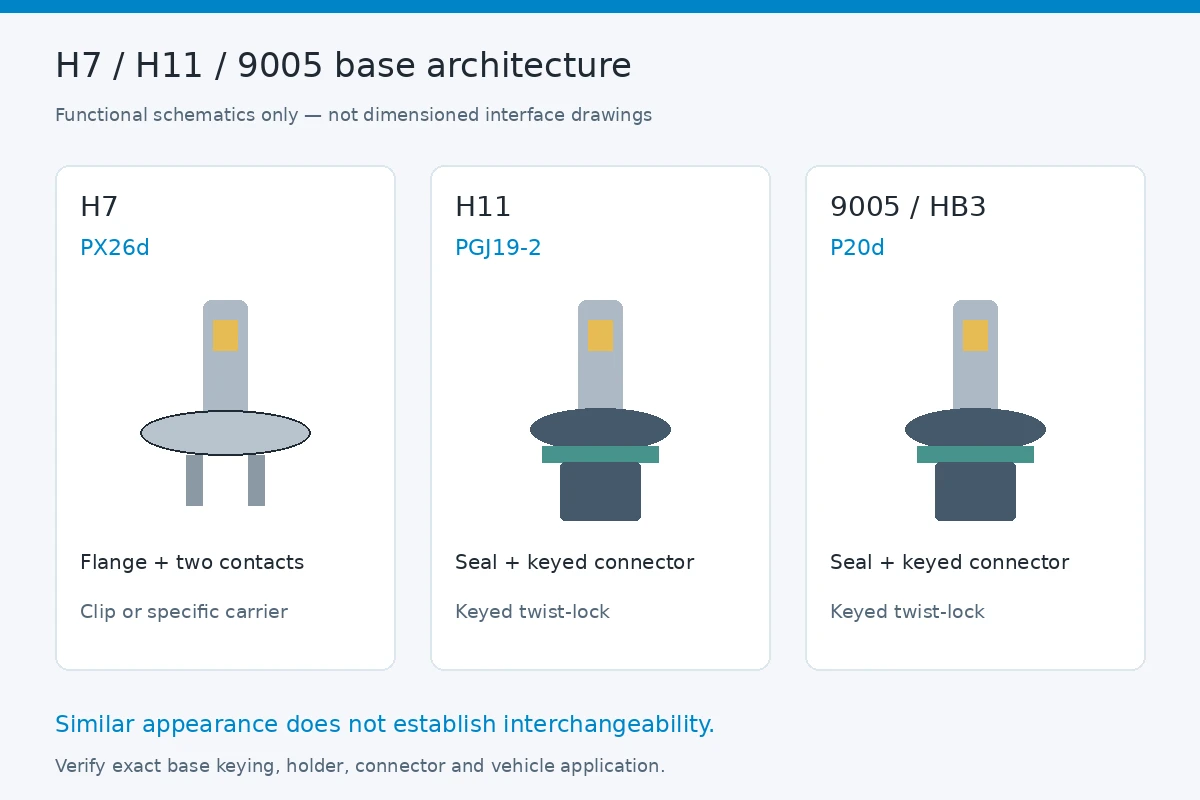
The term socket is common in aftermarket product listings, but a more precise comparison separates the standardized bulb base from the vehicle-side holder and electrical connector. Both matter: the base locates and retains the source, while the holder, connector and headlamp geometry determine whether the replacement can be installed properly.
H7: PX26d mounting flange
A conventional H7 halogen bulb uses a PX26d base with a metal mounting flange and two electrical contacts. Many headlamp housings secure it with a spring clip; some use a separate retaining adapter or proprietary carrier. The original bulb category is a single-filament light source that may serve a low-beam or high-beam function, depending on the headlamp.
For LED replacement programs, H7 often raises an accessory question: does the vehicle require a specific retaining ring, detachable collar or dust-cap extension? A generic H7 connector alone cannot answer that question. Record the headlamp manufacturer, mounting hardware and available rear space before confirming fitment.
H11: PGJ19-2 twist-lock base
A standard H11 halogen bulb uses the PGJ19-2 base, typically with a keyed twist-lock arrangement and an electrical plug interface. H11 is encountered in various low-beam and fog-lamp applications. The exact light function depends on the vehicle and housing; it should not be inferred from the bulb code alone.
The H11 family is a frequent source of incorrect cross-references. H8, H9, H11 and some H16 variants have different standardized base or keying details and different original halogen ratings. Some aftermarket LED products are deliberately engineered and labeled for multiple categories, but this is a product-specific claim to verify—not a universal interchangeability rule.
9005 / HB3: P20d twist-lock base
9005 is the common trade designation for HB3, whose standard halogen base is P20d. It is frequently used for high-beam applications, though model-year and market variations matter. A 9005 LED product must be matched to the actual connector and mounting geometry, not merely to a catalog phrase such as “high-beam LED.”
Do not treat 9005/HB3 and 9011/HIR1 as automatically interchangeable. Similar appearance does not establish identical keying, optical position, electrical requirements or headlamp approval. A distributor must verify each proposed substitute against the vehicle and manufacturer documentation.
B2B takeaway: Maintain separate SKU-level fields for bulb category, standardized base, connector style, retention method, compatible adapters and confirmed vehicle applications.
2. Why Optical Source Position Matters
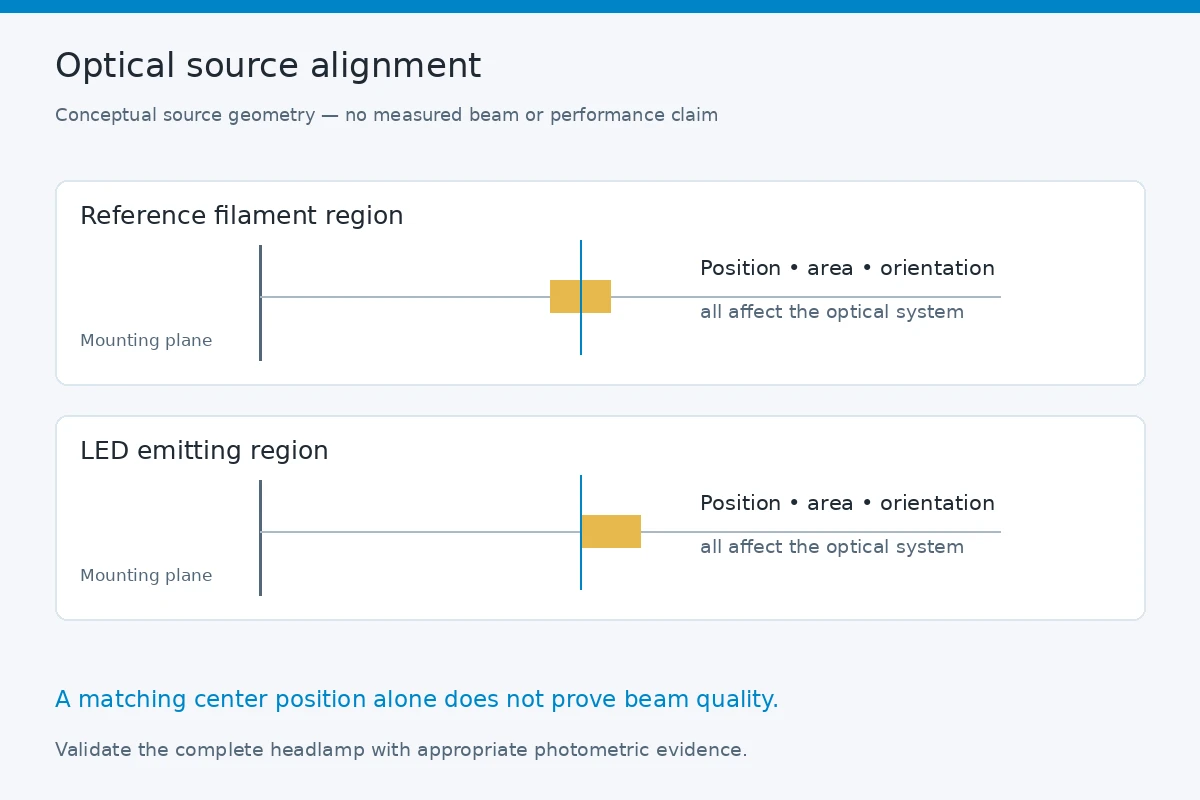
A halogen reflector or projector is engineered around a specified light-source location and emission geometry. Replacing its filament with an LED package changes more than brightness: the chip’s emitting area, spacing, orientation and distance from the mounting reference can all affect how rays reach the optical surfaces.
Focal position is not a single marketing ratio
Terms such as 1:1 filament simulation or perfect focal depth are useful design goals but not standalone measurements of beam quality. Optical performance depends on the three-dimensional source geometry and the characteristics of the original reflector or projector. Even if the LED chip center appears close to the halogen filament position, the emitting area, masking and angular distribution may differ.
A good supplier should therefore provide controlled dimensional drawings, assembly tolerances and photometric beam evidence from representative headlamp systems. Product photographs showing an LED beside a halogen bulb are not a substitute for measured light distribution.
Why glare and dark spots can appear
When the substitute source directs light into unintended parts of a reflector or projector, the resulting beam may show excessive light above a cutoff, uneven foreground brightness, hot spots, dark zones or insufficient useful distance illumination. Alignment errors are one possible cause, but optical mismatch, chip geometry and the headlamp’s original design may also contribute.
For an accurate assessment, measure the complete lamp-and-bulb combination rather than relying on bare-bulb lumen claims. Review headlamp aiming, beam cutoff where applicable, relevant test points and any local rules governing replacement light sources.
B2B takeaway: Document beam quality with a named headlamp reference, operating voltage, bulb orientation and consistent test conditions. Do not advertise “zero glare” without appropriate evidence.
3. H7 vs H11 vs 9005: Technical Comparison
The following values describe common reference halogen bulb categories, not the power draw of an LED replacement. The required LED driver characteristics and approval status must be determined separately.
| Engineering parameter | H7 | H11 | 9005 / HB3 |
|---|---|---|---|
| Standard halogen bulb base | PX26d | PGJ19-2 | P20d |
| Typical physical retention | Flange with spring clip or vehicle-specific adapter | Keyed twist-lock | Keyed twist-lock |
| Typical electrical interface | Two contacts; headlamp holder may vary | Vehicle plug matched to H11 application | Vehicle plug matched to HB3/9005 application |
| Reference halogen nominal wattage | 55 W | 55 W | 60 W |
| Common applications (not universal) | Low beam or high beam | Low beam or fog lamp | High beam |
| Frequent LED fitment concern | Retaining clips, adapters and rear clearance | Keying, seal, H8/H9/H16 cross-listings | Keying, connector, 9011/HIR1 confusion |
| What proves LED suitability | Vehicle fitment + holder + optical/electrical tests | Vehicle fitment + keying + optical/electrical tests | Vehicle fitment + keying + optical/electrical tests |
Important: Socket families are not universal vehicle-fitment approvals. For example, H8 uses PGJ19-1 and H9 uses PGJ19-5 rather than the H11 PGJ19-2 base. Compatibility among aftermarket LED versions must be confirmed for the exact product and vehicle. Likewise, reference halogen wattages should not be presented as the LED product’s own wattages.
Build a cleaner B2B product matrix
For every sellable H7, H11 or 9005 LED SKU, record at least these fields: electrical voltage range; measured power; mounting/connector interfaces; total installed depth; heatsink or fan envelope; adapter requirements; sealing design; optical test references; diagnostic behavior; approved vehicle and territory listings, if any; and the revision number of the fitment data.
This structured approach reduces returns caused by ambiguous category labels and helps sales teams distinguish a compatible installation from a legally permitted road-use application.
For reference halogen bases and nominal ratings, consult the OSRAM original equipment bulb catalog. For a broader introduction, see our headlight bulb types guide.
4. 360-Degree Adjustable Collars: Setup and Limits
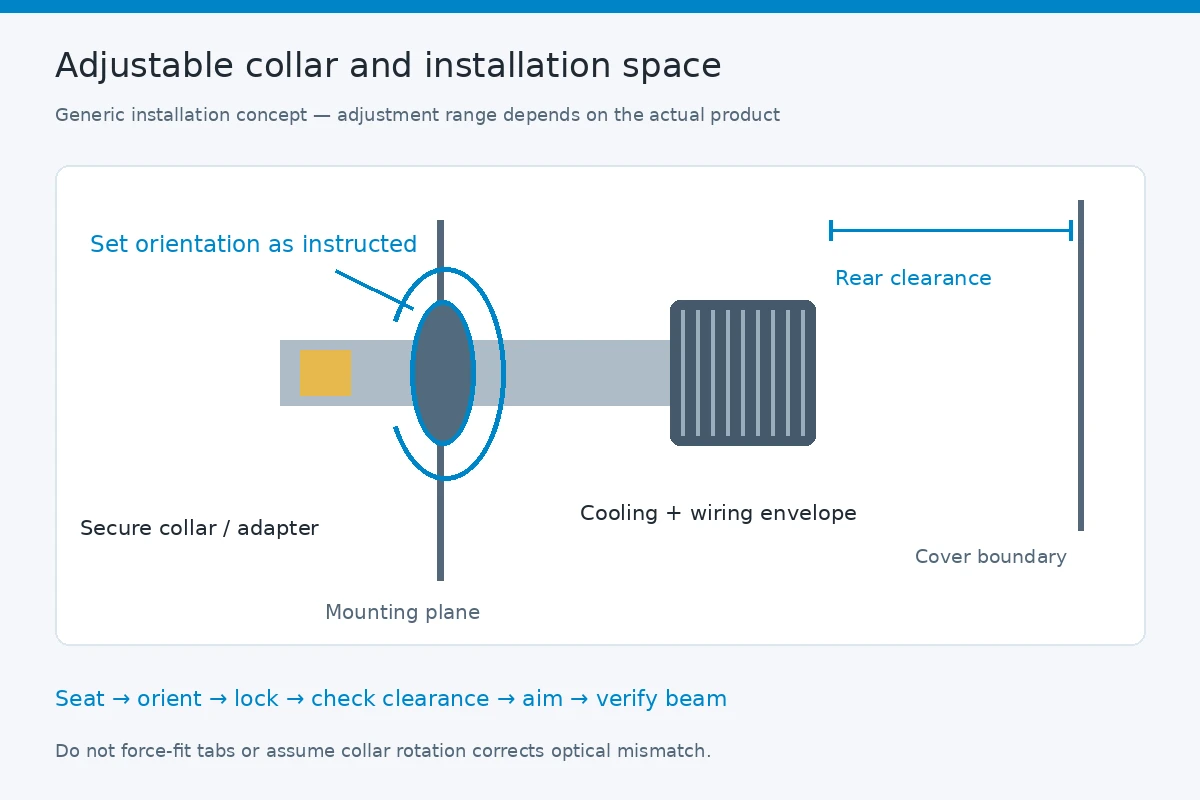
Some LED retrofit bulbs include a rotatable or removable mounting collar. This design can allow the bulb body to be oriented after the base or carrier is seated in the headlamp. It may be valuable when an LED product’s chip orientation would otherwise be inconvenient, but not every H7, H11 or 9005 product has this mechanism.
A controlled installation sequence
- Confirm the application first. Check the exact bulb SKU, vehicle, headlamp type, retention hardware and installation instructions. Do not modify base tabs, connectors or optical parts to force a fit.
- Secure the specified holder. Fit the collar or adapter as directed and confirm that all clips, locking features and seals are properly engaged.
- Set orientation per the product instructions. Some two-sided LED designs recommend a left/right chip orientation, often described as the 3 and 9 o’clock position. Other designs may require a different arrangement. This is not a universal rule.
- Lock the adjustment. Tighten the approved retention mechanism to the manufacturer’s instructions. Check that the stem cannot rotate loose and that wiring and cooling components have adequate clearance.
- Recheck the full assembly. Refit covers where required, confirm fan or heatsink clearance, check electrical/diagnostic behavior and aim the headlamps correctly.
- Verify the beam. Use a proper aiming method and, where required, documented photometric testing. If the beam is unsuitable, collar rotation alone does not make the retrofit acceptable.
What orientation adjustment cannot guarantee
A nominal 360-degree collar does not guarantee 360 degrees of usable adjustment once the lamp is installed. Wire exits, heatsinks, collars, headlamp housings and locking design can limit travel. More importantly, rotating a bulb cannot correct an inherently incompatible LED emitting pattern or establish legal approval.
B2B takeaway: Request installation videos, retention-cycle checks, vibration evaluations and beam measurements for representative headlamp applications—not only a “360° adjustable” badge.
5. B2B Sourcing and Quality-Control Checklist
For distributors, the most valuable product is not simply the brightest LED bulb but the one that can be accurately specified, installed, supported and sold within the rules of its target market.
- ☐ Verify socket and vehicle fitment. Match H7/PX26d, H11/PGJ19-2 or 9005/HB3/P20d against real application data. Review related codes such as H8, H9, H16 or 9011 individually, rather than assuming interchangeability.
- ☐ Inspect mounting hardware. Obtain H7 retaining-adapter options where necessary; test twist-lock engagement, base dimensions and seal compression for H11 and 9005 designs.
- ☐ Review LED emitting geometry. Request chip layout drawings, dimensional tolerances and optical test data. Do not impose a universal printed-circuit-board thickness without reference to a specific optical design.
- ☐ Evaluate complete optical performance. Test representative headlamp assemblies for cutoff, glare control, illuminated zones and aiming repeatability. Do not rely on raw lumens or a promotional wall photo alone.
- ☐ Check installed clearance and thermal design. Measure body length, fan/heatsink envelope, dust-cap compatibility and operating temperatures in realistic conditions.
- ☐ Confirm electrical operation. Verify voltage, startup behavior, PWM or lamp-out diagnostics and the correct wiring/interface for each listed vehicle. A “CANBus-ready” label is not a universal guarantee.
- ☐ Check legal-market applicability. Obtain product- and vehicle-specific road-use approvals where required. A bulb that fits mechanically may still be prohibited for public-road use in a given market.
- ☐ Audit documentation and traceability. Request test reports, revision-controlled fitment charts, installation guides, sample sign-off records, warranty terms and consistent lot identification.
- ☐ Validate supplier capabilities. Confirm the manufacturer’s actual support for private labeling, packaging, adapter kits and after-sales technical documentation before advertising those services.
Suggested sample evaluation workflow
Select representative H7, H11 and 9005 vehicles or headlamp assemblies. Check mechanical engagement and installed depth, then evaluate electrical operation at the specified supply voltage. Photograph the fitted assembly, record any adapter or dust-cap changes, perform beam and aiming checks and document any restrictions. Approve the SKU for distribution only after fitment, optical performance and target-market requirements are addressed.
Frequently Asked Questions
Q1. What is the difference between H7, H11 and 9005 headlight bulbs?
H7, H11 and 9005/HB3 use different standardized bases: PX26d, PGJ19-2 and P20d respectively. Their retention systems and connector arrangements also differ. The bulb designation alone does not identify the exact vehicle, headlamp function or suitable LED retrofit.
Q2. Are H8, H9 and H11 LED bulbs interchangeable?
Not automatically. The reference halogen categories use different bases or keyed variants and may have different electrical ratings. Some specially designed aftermarket LED products are listed for multiple categories, but you must verify the exact LED SKU, application, keying, thermal conditions and road-use restrictions rather than assuming universal interchangeability.
Q3. Can I replace a 9005 bulb with a 9011/HIR1 bulb?
Do not assume a direct substitution. Although the categories can look similar, they may differ in standardized keying and optical/application requirements. Follow the vehicle and lamp manufacturer’s approved replacement information; avoid cutting or modifying locating tabs to force a fit.
Q4. Do LED chips always need to face 3 and 9 o’clock?
No. That orientation is a common recommendation for certain two-sided LED bulb designs, but it is not universal. Follow the actual product instructions, secure the bulb, aim the headlamp and verify its beam. A nominal chip position alone does not guarantee acceptable glare control.
Q5. Does a 360-degree adjustable collar improve beam performance?
It can help position some LED designs as instructed and make installation more flexible. Its effectiveness depends on the bulb and headlamp combination. It cannot correct every optical mismatch, and it does not itself establish regulatory approval or street legality.
Q6. Why might an H7 LED bulb need an adapter?
Many H7 headlamps use a spring clip or vehicle-specific retaining carrier. Depending on the LED bulb’s mounting structure, a compatible adapter ring may be necessary to lock the bulb securely. Confirm the specific headlamp and adapter before ordering.
Q7. Does matching the H7, H11 or 9005 socket make an LED retrofit road legal?
No. Physical fitment is only one part of suitability. Public-road legality can depend on the country, bulb product, headlamp approval, vehicle model and intended light function. Check the applicable market requirements and any official approved-vehicle list or documentation before selling a retrofit for road use.
Q8. What should B2B buyers ask NVEL before ordering socket-based LED lighting?
Request the proposed SKU’s base drawings, connector details, vehicle application list, installation instructions, thermal/electrical test information, optical evidence and available product-specific approval documents. Confirm private-label options, samples, accessories and lead times with the NVEL team for the particular product rather than assuming identical capabilities across the catalog.
Conclusion: Fitment Is Only the First Step
A successful H7, H11 or 9005 LED offering requires precise mechanical fitment, controlled optical design and dependable electrical integration. Although these three categories are familiar to aftermarket buyers, their bases and applications are not interchangeable by default. Adjustable collars and careful installation can help with orientation, but they cannot replace beam testing or vehicle- and market-specific approval checks.
For distributors and brand owners, the most reliable purchasing process combines verified SKU documentation, representative installation samples, measurable optical performance and clear aftermarket application limits. That is a stronger foundation for long-term customer confidence than universal “plug-and-play” claims.
Explore NVEL Automotive LED Lighting Products
Review NVEL’s automotive LED lighting range and discuss your target socket categories, vehicle applications, packaging requirements, testing evidence and anticipated purchase quantities with our team.
Technical and regulatory note: This guide provides general fitment and sourcing information. Product-specific compatibility, photometric performance, installation requirements and road-use legality must be confirmed for the exact LED product, headlamp, vehicle and destination market.