TECHNICAL GUIDES · LED HEADLIGHTS
LED Headlight Conversion Kit Engineering: H11, H7, H4, 9005 & 9006 Validation for B2B Buyers
Kit components, application compatibility, engineering validation and OEM sample approval.
November 3, 2026 · 10 min read
Introduction
For an automotive aftermarket importer or OEM purchasing team, a compatible bulb designation is only the beginning of an LED headlight conversion kit approval. A kit may contain the correct nominal bulb type yet still need a vehicle-specific retaining adapter, a different driver arrangement, extra rear-housing clearance, or a different electrical interface. An incorrect accessory set can stop installation before optical performance is even evaluated.
A robust approval process therefore checks the entire supplied configuration: bulb and base, locking hardware, external or integrated driver, cables, cooling envelope, installation instructions, market restrictions, and the exact part number being ordered. The purpose is not to declare one replacement lamp suitable for all vehicles. It is to make the supplied kit, intended application, and acceptance evidence agree.
This guide concentrates on engineering validation and purchasing controls for H11, H7, H4, 9005/HB3, and 9006/HB4 kit programs. For a fundamental comparison of those bulb families, see NVEL’s existing bulb-type guide.
Table of Contents
LED Headlight Conversion Kit Engineering
QUICK GUIDE
Control the bulb, driver, wiring, retaining hardware and documentation as one defined configuration.
Verify each bulb family and its application-specific accessories without assuming interchangeability.
Test seating, service access, electrical behavior and cooling inside representative headlamps.
Evaluate the complete optical system and obtain product- and market-specific approval evidence.
Freeze the approved BOM, retain samples and control changes through production.
What Makes a Complete LED Headlight Conversion Kit?
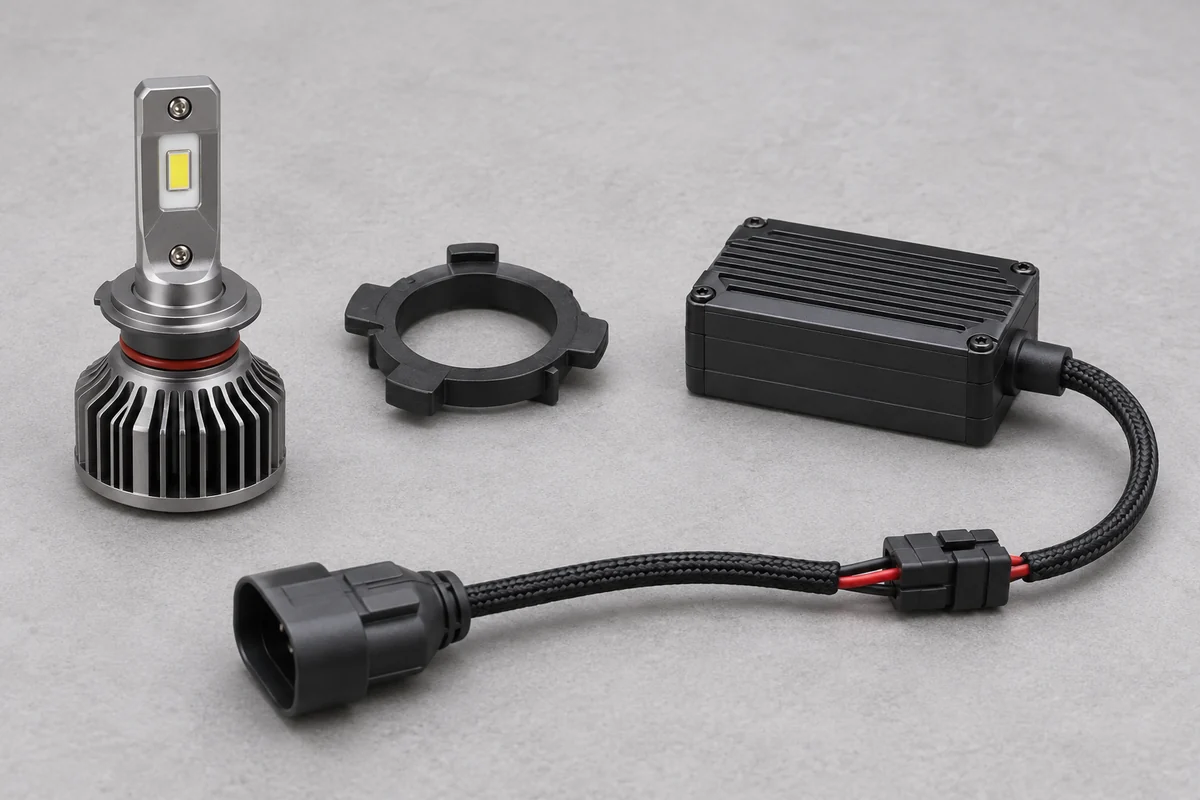
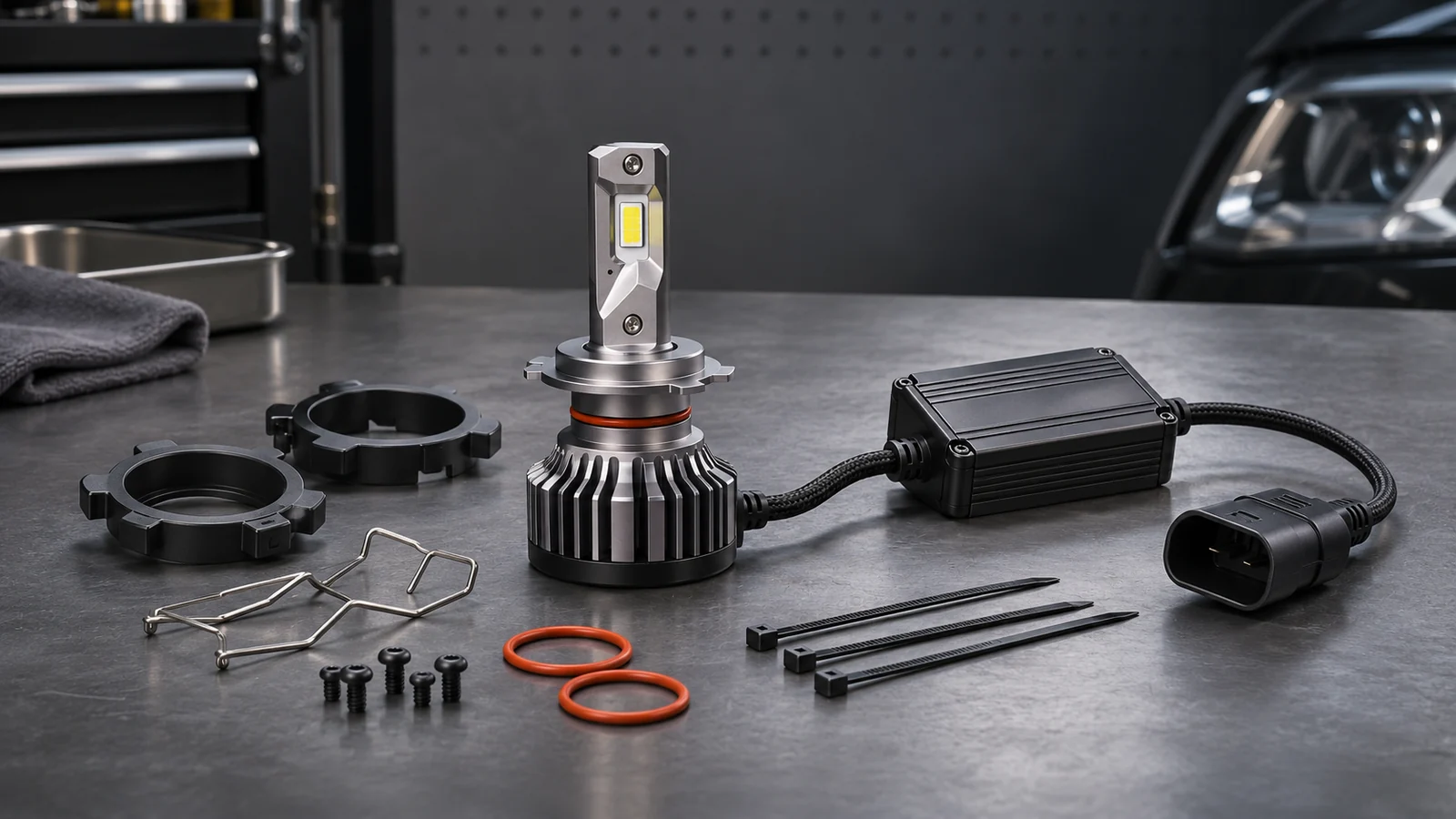
A conversion kit is a defined bill of materials (BOM), not merely a pair of LED emitters. Some products have an integrated driver and compact passive cooling; others ship with external electronics, active cooling, cables, or adapters. The correct package is determined by the approved product design and the intended headlamp assembly. Do not assume every kit needs every accessory.
| Kit element | Engineering control | Evidence to request |
|---|---|---|
| LED bulb and base | Correct keyed interface, mechanical datum, emitter position, traceable variant | Part drawing, sample identification, supported bulb designation |
| Driver and wiring | Integrated versus external driver, input limits, polarity, routing and strain relief | Electrical specification, connection diagram, BOM revision |
| Retaining hardware | Vehicle/headlamp-specific adapter ring or bracket when required | Fitment matrix, adapter part number, seating check |
| Cooling envelope | Heat sink or fan clearance, airflow path and rear-cover interference | Dimensioned envelope, thermal test condition |
| Documentation | Supported application, restrictions, carton contents and installation steps | Packing list, instructions, market-specific approval evidence if applicable |
An OEM purchase order should identify the main kit SKU and any required adapter or decoder SKU separately. If several hardware combinations are sold under a commercial series name, link each configuration to its own BOM and sample revision. “Plug and play” is meaningful only for a specified and tested application, not an unrestricted compatibility promise.
H11, H7, H4, 9005 and 9006: Kit Configuration Requirements
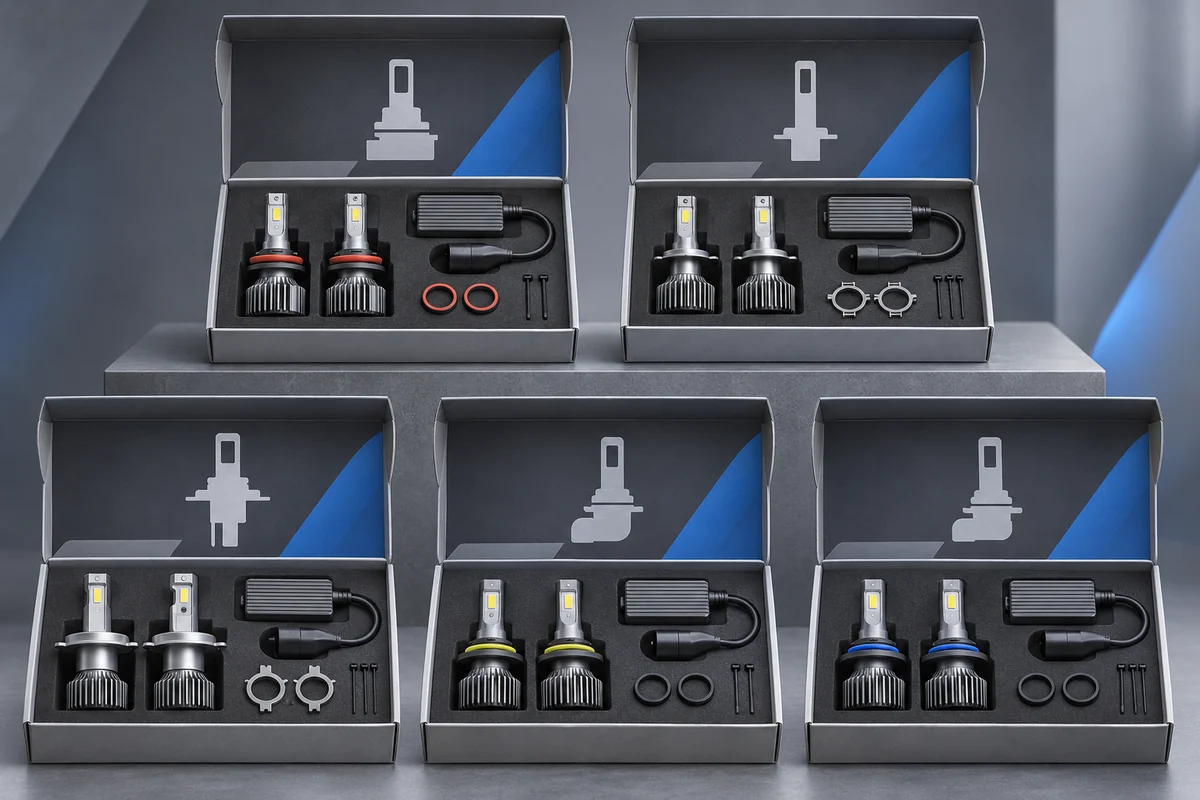
These common bulb designations describe different replaceable-source families; they are not interchangeable merely because an LED product can be marketed for multiple applications. The table below is a purchasing checklist, not a universal vehicle fitment chart. Confirm the original lamp designation, headlamp construction and vehicle-specific installation before approving any LED retrofit.
| Bulb family | Kit-level items to check | Typical validation concern |
|---|---|---|
| H11 | Keyed base, seal, connector, rear-cover clearance | Full seating, sealing and wiring path |
| H7 | Retaining clips or vehicle-specific adapter, driver position | Locking method, rotation and available depth |
| H4 | Dual-function control, connection mapping, mechanical orientation | High/low switching and the combined optical result |
| 9005 / HB3 | HB3 base keying, electrical connector and driver interface | Avoid mix-ups with superficially similar keyed families |
| 9006 / HB4 | HB4 base keying, connector and sealing arrangement | Correct identification and rejection of non-approved substitutions |
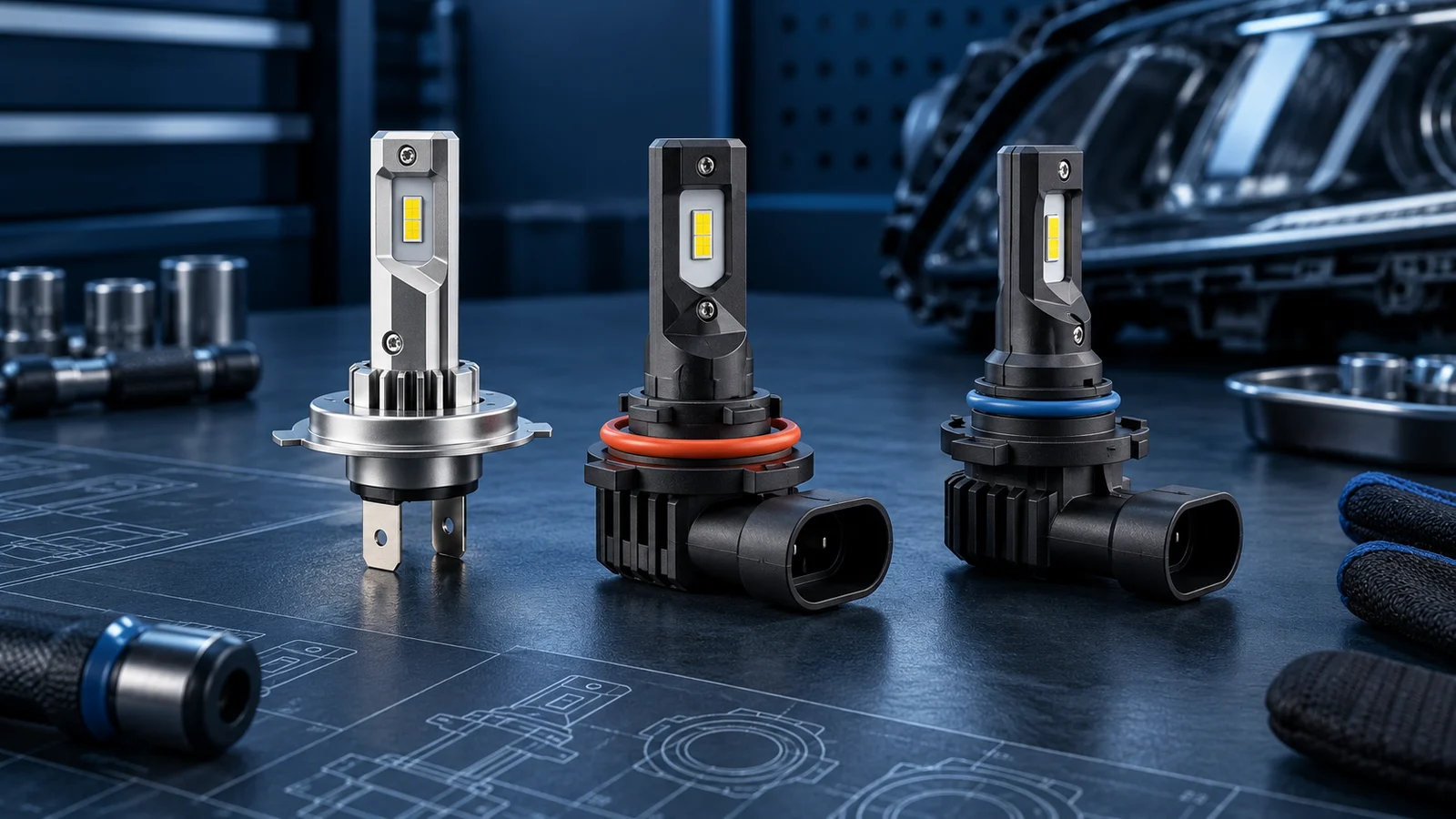
For an H11 led headlight bulb or H7 led headlight bulb project, the approved accessory list can vary between headlamp assemblies. The same is true for an H4 led headlight bulb when the vehicle requires both high- and low-beam operation. A 9005 led headlight bulb and a 9006 led headlight bulb should be managed as distinct SKU families unless the exact supplier design, headlamp and applicable approvals specifically support a combination.
Do not alter locating tabs, wiring or housings to force an unsuitable lamp to fit. Mechanical installation alone does not prove optical suitability or legal road use. Detailed socket and emitter-alignment fundamentals are covered in NVEL’s existing guide.
Mechanical, Electrical and Thermal Validation
Mechanical installation and service access
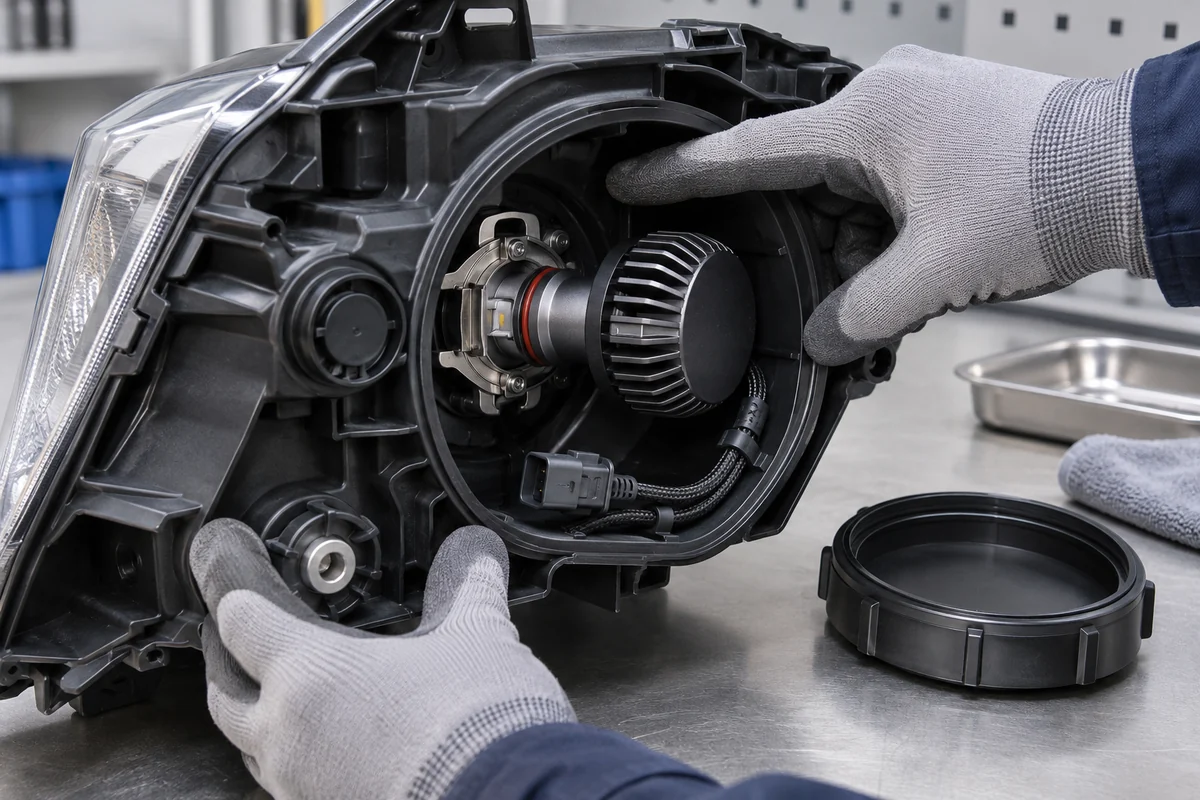
Approve the kit inside the representative headlamp, not only in a free-standing socket fixture. Record bulb locking engagement, seating depth, cable bend radius, gasket condition, driver mounting, fan intake or heat-sink clearance, and whether the rear cover closes without load on electrical parts. Review access for future service without cutting original wiring or distorting the enclosure.
Electrical compatibility and warning behavior
Compare the driver’s specified supply range and operating characteristics with the intended vehicle electrical system. Depending on the vehicle, pulse-width-modulated supply, lamp-out diagnostics, start-up transients or polarity can cause warnings, visible flicker or unstable operation. “CANbus compatible” is not a sufficient test result: require a defined vehicle and control state, and document whether any additional decoder or adapter is necessary.
An external resistor-based load solution can dissipate significant heat and can affect reliability or surrounding materials if poorly placed. Never specify it as a universal repair. Validate electrical and electromagnetic compatibility against the applicable vehicle, product and market requirements; do not claim certification without a genuine report for the exact configuration.
Thermal stability under realistic conditions
Record the test ambient, supply voltage, operating duration, orientation, enclosure condition and measurement method. Track stabilized input power, output behavior and key component temperatures where instrumented. For active cooling, check fan clearance and airflow obstruction. A short bench illumination test does not establish stable output, lifetime or performance inside a closed vehicle lamp housing.
Optical Performance and Market Compliance
The beam must be evaluated as a complete bulb-plus-headlamp system. Relative LED emitter location and size, orientation, reflector or projector geometry, and the final installed position can alter the light distribution, cutoff and stray light. More lumens or a visually brighter wall pattern does not establish that the target headlamp meets the applicable photometric requirements. Compare installed configurations using a documented test setup and the relevant standard or acceptance plan.
Ask for an identified headlamp assembly, sample revision, aim setting, test voltage, equipment method and photometric findings where available. Also record visual artifacts, glare risks and functional behavior of both beam modes where relevant. For the optical mechanism behind these effects, refer to NVEL’s beam-pattern guide rather than duplicating that technical article here.
Road-use approval is product- and market-specific
Engineering fitment, operational performance and road-use authorization are three separate decisions. In a February 13, 2024 interpretation of FMVSS No. 108, the U.S. National Highway Traffic Safety Administration distinguished compliant integral LED headlamps from LED light sources substituted into replaceable-bulb headlamps; it stated that LED replaceable light sources were not permitted for the latter under that interpretation. Do not describe a retrofit kit as U.S. road legal solely because it fits a halogen socket. Source: NHTSA interpretation.
In ECE markets, approval may depend on the actual approved retrofit lamp and its scope: some products require matching a vehicle and headlamp approval number and using listed accessories, while certain specifically ECE-approved products have broader approved applications. The existence of an approved product from one manufacturer does not authorize another supplier’s kit. Always verify current, product-specific, country-specific evidence before making road-use claims. Reference: OSRAM NIGHT BREAKER LED.
OEM Sample Approval and Production Consistency
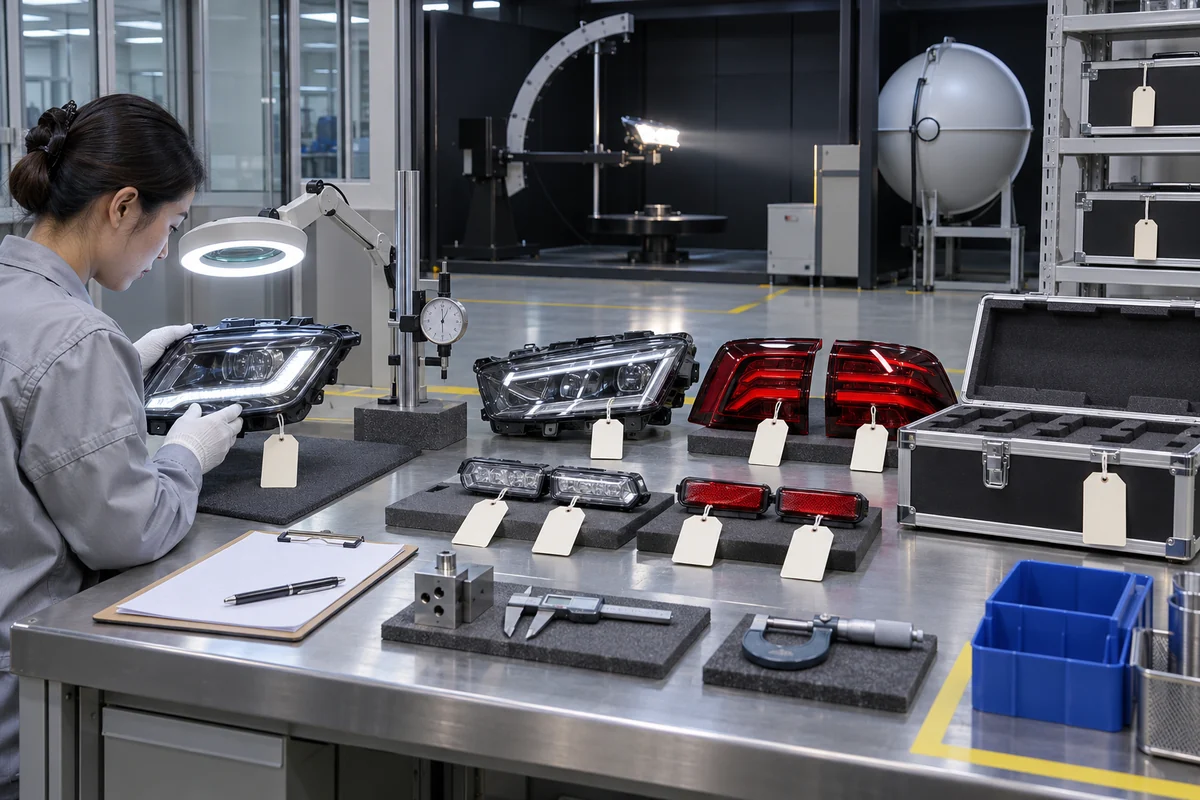
For volume orders, the buyer should approve a controlled configuration, not an attractive catalogue image. Create a sample-approval record that links the kit SKU, bulb base, driver revision, adapters, packaging, application statement and test evidence to the physical sample retained by both parties.
- Confirm the target market, permitted application, original bulb designation, vehicle/headlamp identity and any road-use restrictions before specifying the sample.
- Freeze an itemized BOM for each H11, H7, H4, 9005/HB3 or 9006/HB4 SKU, including optional accessories and packaging contents.
- Inspect mechanical seat, retention, rear-cover clearance, wiring route and cooling space in representative headlamp assemblies.
- Validate operating voltage and start-up behavior, diagnostic warnings, flicker, protective responses and applicable EMC requirements.
- Record thermal operating conditions and optical measurements for the installed assembly; do not substitute unverified lumen claims.
- Obtain authentic, product-specific compliance documentation where road-use claims are proposed; mark unsupported claims as prohibited.
- Compare representative production samples with approved master samples and maintain change-control records for LEDs, drivers, optics, base hardware and packaging.
A practical approval sheet should provide pass/fail criteria, test method, test sample ID, revision number, responsible reviewer and the disposition of any deviation. Requirements differ by market and installation; buyers should define thresholds in their specifications rather than copying arbitrary universal numbers. Any significant design or accessory change should trigger a documented assessment of which tests must be repeated.
Frequently Asked Questions
Does the same LED headlight conversion kit fit every car using H7 bulbs?
No. An H7 designation does not settle the headlamp retaining mechanism, internal clearance, vehicle electronics or road-use authorization. Verify the specified kit and any adapter in the target headlamp and vehicle.
What is the difference between an H4 conversion kit and a single-beam kit?
H4 applications commonly require high- and low-beam functionality in one source position. Buyers must verify electrical switching and the optical results of both functions. Single-beam H7, H11, HB3 and HB4 programs have different functional assumptions.
Can 9005 and 9006 LED headlight bulbs be treated as interchangeable SKUs?
No. HB3/9005 and HB4/9006 are distinct lamp families. Check base keying, connectors, intended application and documented approvals rather than relying on a visual similarity or informal cross-reference.
Do all LED headlight conversion kits require a CANbus decoder?
No. Some vehicles and drivers operate without an additional decoder; others have diagnostic or pulse-driven behaviors that need a validated solution. The requirement must be verified against the specific vehicle and electronics.
How should buyers identify the best LED headlight bulbs for a sourcing program?
The best candidate is the one that meets a defined application and acceptance plan with repeatable evidence for fit, optical behavior, thermal stability, electronics, build consistency and any required market approvals—not the one with the largest advertised lumen value.
What documents should an OEM buyer request before bulk approval?
Request a version-controlled BOM, drawings, application and accessory matrix, agreed inspection criteria, representative sample identifiers, relevant measurement reports, instructions and authentic compliance evidence where applicable.
Conclusion
A dependable LED headlight conversion kit program aligns the installed hardware, electrical behavior, thermal conditions, optical results and approved application. H11, H7, H4, 9005/HB3 and 9006/HB4 variants should be managed as controlled configurations rather than treated as interchangeable marketing labels.
For B2B and OEM purchasing teams, a documented kit BOM, representative installation tests, clear market restrictions and sample-to-production change control provide a stronger purchasing basis than a headline brightness figure. Confirm the exact application and approval scope before any road-use claim, and use measured evidence to decide which products belong in a bulk program.
Explore NVEL Automotive LED Lighting Products
Contact NVEL with your target market, kit configuration, application requirements, anticipated order quantity and OEM sample-validation needs.