
TECHNICAL GUIDES · OPTICAL ENGINEERING
Automotive LED Headlight Beam Pattern Testing Explained: A B2B Engineering Guide
Photometric evidence, cutoff and glare control, and supplier verification for B2B lighting programs.
B2B Engineering Guide · 10 min read
Introduction
Automotive LED headlight beam pattern testing helps B2B buyers determine where a lighting system sends its light, how consistently it performs, and whether the evidence supports the intended application. A lumen claim or dramatic wall photograph cannot answer those questions alone.
For distributors, brands, importers and quality teams, the useful comparison is between identified products tested under controlled conditions. This guide explains angular photometry, cutoff and glare, regional requirements, and the records to request before approving samples or volume orders.
Optical Testing Priorities
QUICK GUIDE
Evaluate forward visibility, road coverage, beam uniformity and glare using the complete headlamp system.
Compare angular photometry and measured test-point results under documented operating conditions.
Assess cutoff, hotspot placement and glare-sensitive intensity together; appearance alone does not prove performance.
Match product configuration, lighting function and target-market requirements to relevant supporting evidence.
Verify report identity, product traceability, test conditions, fitment and production consistency before approval.
1. Why Automotive Headlight Beam Patterns Matter
A headlamp must balance forward visibility, road illumination, peripheral coverage, glare limitation and beam uniformity. Low beam provides usable seeing light while limiting light toward other road users. High beam serves a different function and is evaluated against its own distribution requirements. Total output does not describe either distribution.
Useful light reaches the lane ahead and relevant road edges without excessive foreground brightness or distracting gaps. A bright patch close to the vehicle can look impressive while offering limited information farther ahead. Wider coverage can help reveal hazards, but must be balanced with intensity in the required directions and control of unwanted light.
Glare risk depends on the lamp optics, directional intensity, mounting height, installation, aim and road environment. Vehicle loading, slopes and wet-road reflections can change the viewing situation. Higher LED output does not automatically create severe glare, and a visible cutoff does not establish that glare is acceptable.
Wall photographs are helpful for screening gross misalignment, unusual shadows or assembly differences. Camera exposure, distance, wall reflectance and aim strongly affect their appearance. Use photographs as supporting records alongside measured data, rather than as proof of compliance or a substitute for the required photometric tests.
2. How Goniophotometer Testing Works
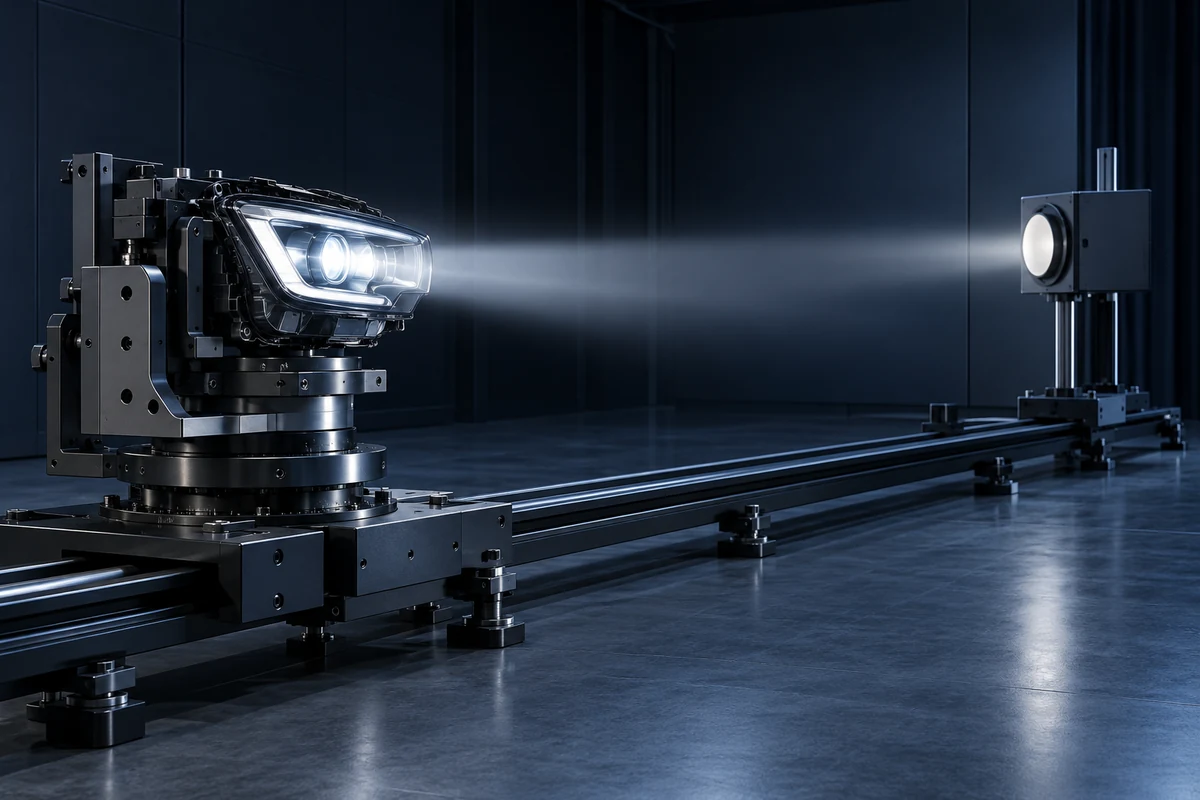
A goniophotometer measures light distribution over defined directions by controlling the angular relationship between the test object and a detector. Depending on the equipment, the lamp, detector or other system elements may move. Automotive measurements often concentrate on a forward angular field; a universal 360-degree rotating-arm arrangement is not required.
First identify the lamp or lamp-and-source combination and its revision. Mount it using the specified reference axes, establish the required aim, and operate it at the prescribed electrical conditions. Stabilization matters because temperature and driver behavior can change LED output during a scan. The laboratory must follow the applicable standard and documented procedure.
The detector system samples selected horizontal and vertical angles or performs a denser scan. Results can be reported as luminous intensity in candela. Where illuminance is measured, conversion requires the appropriate distance and measurement geometry. For a far-field point-source approximation at normal incidence, intensity is approximately illuminance multiplied by distance squared; the approximation must be justified for the setup.
Test distance is determined by the applicable method, optical characteristics and laboratory arrangement. A stated range such as 10–25 meters is not a universal requirement. Angular resolution, detector response, stray-light control, alignment, stabilization, calibration and measurement uncertainty all influence confidence in the results.
Ask for the measured distribution report and individual regulatory test-point results with limits, units and pass/fail decisions. Check supply voltage, operating mode, temperature, aim, distance where relevant and sample identification. A colored contour map without a scale or conditions is insufficient. Optical simulation predicts performance; it must be labeled separately from physical measurements.
IES or LDT files can be useful delivery formats for some photometric data. They are not mandatory outputs for every automotive regulatory test and may omit necessary approval information. Agree on usable report contents and traceable data, rather than insisting on one file extension.
Technical Comparison: Read the Units and Conditions
| Test Parameter | What It Measures | Why It Matters |
|---|---|---|
| Luminous Flux | Total emitted visible-light output, in lumens (lm). | Describes quantity of light, not where the headlamp sends it. |
| Luminous Intensity | Light output in a direction, in candela (cd). | Supports evaluation of seeing-light and glare-sensitive directions. |
| Illuminance | Light incident on a surface, in lux (lx). | Depends on distance and geometry; comparisons need equivalent conditions. |
| Beam Distribution | Intensity mapped over horizontal and vertical angles. | Shows coverage, gradients, hotspots and unwanted light. |
| Cutoff | Transition in a low-beam distribution. | Supports aim and optical evaluation where applicable. |
| Glare Control | Intensity limits in specified points or zones. | Limits unwanted light toward other road users. |
| Test Conditions | Mounting, aim, voltage, temperature and stabilization. | Makes results reproducible and comparable. |
| Regulatory Test Points | Measurements at prescribed directions against limits. | Supports assessment of the applicable photometric requirements. |
3. Cutoff Lines, Hotspots and Glare Control
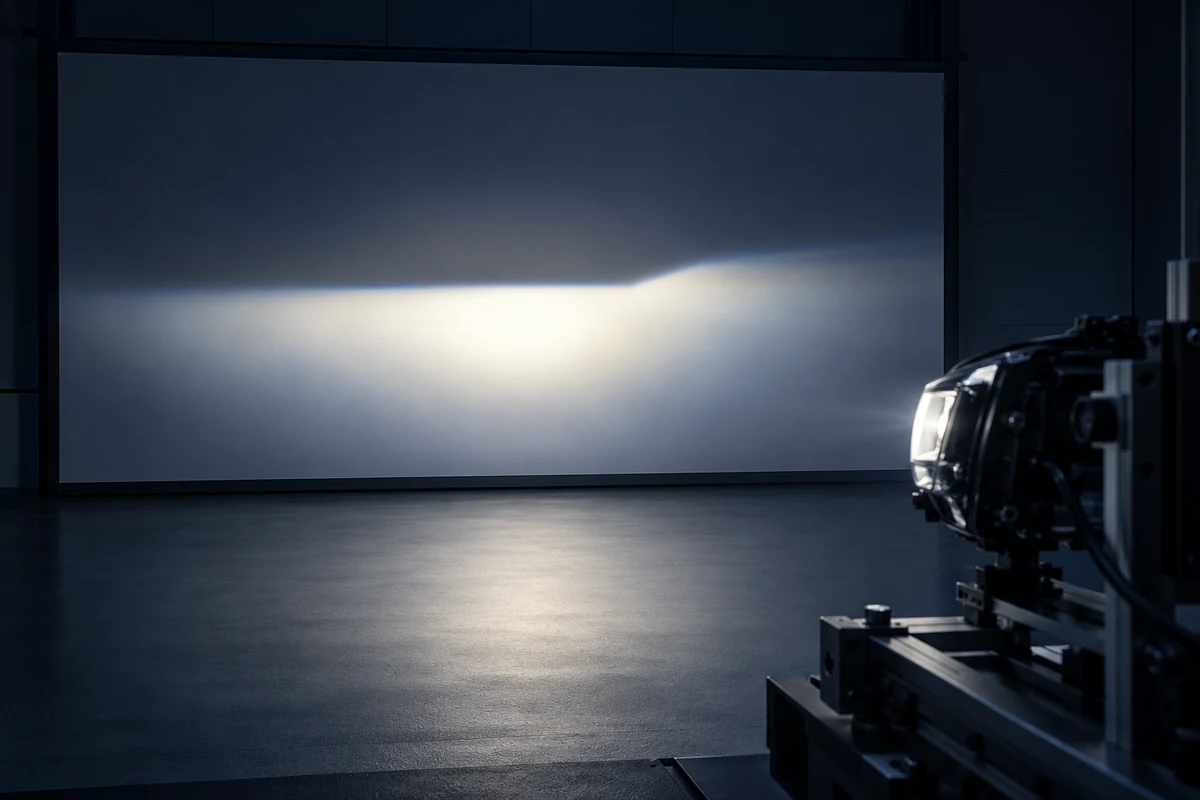
The low-beam cutoff is a transition between relatively brighter and darker regions. It helps control the distribution and, in applicable systems, provides a reference for aiming. Requirements vary with the regulation, optical system and traffic direction. Not every headlamp has the same asymmetric shape, and a 15-degree step is not universal.
A sharper cutoff is not automatically a better beam. The complete distribution must provide useful seeing light, acceptable gradients, required coverage and compliant intensity at all relevant locations. Light above the cutoff need not be zero: applicable maxima and other requirements govern it. Appearance alone cannot quantify light reaching an oncoming driver.
The hotspot is a region of higher intensity. Its location and surrounding distribution influence long-range visibility and coverage. Concentrating output into an increasingly narrow spot can reduce useful lateral illumination or create unevenness. Evaluate near-field, far-field and side coverage together with glare-sensitive directions, rather than maximizing one peak lux reading.
For LED replacement bulbs, emitter geometry interacts with the original reflector or projector. Emitter size, position, shielding, installation orientation and mounting tolerances can change the beam. Thermal and electrical operating conditions and vehicle-specific fitment also matter. Matching the nominal halogen filament position is a design consideration, not an automatic guarantee of compliant photometry.
A standalone bulb test can characterize the source, but cannot establish the complete optical performance of every headlamp in which it might be installed. Request results for identified lamp assemblies and representative fitments. Document the original source, replacement model, orientation and aim so comparisons can be reproduced.
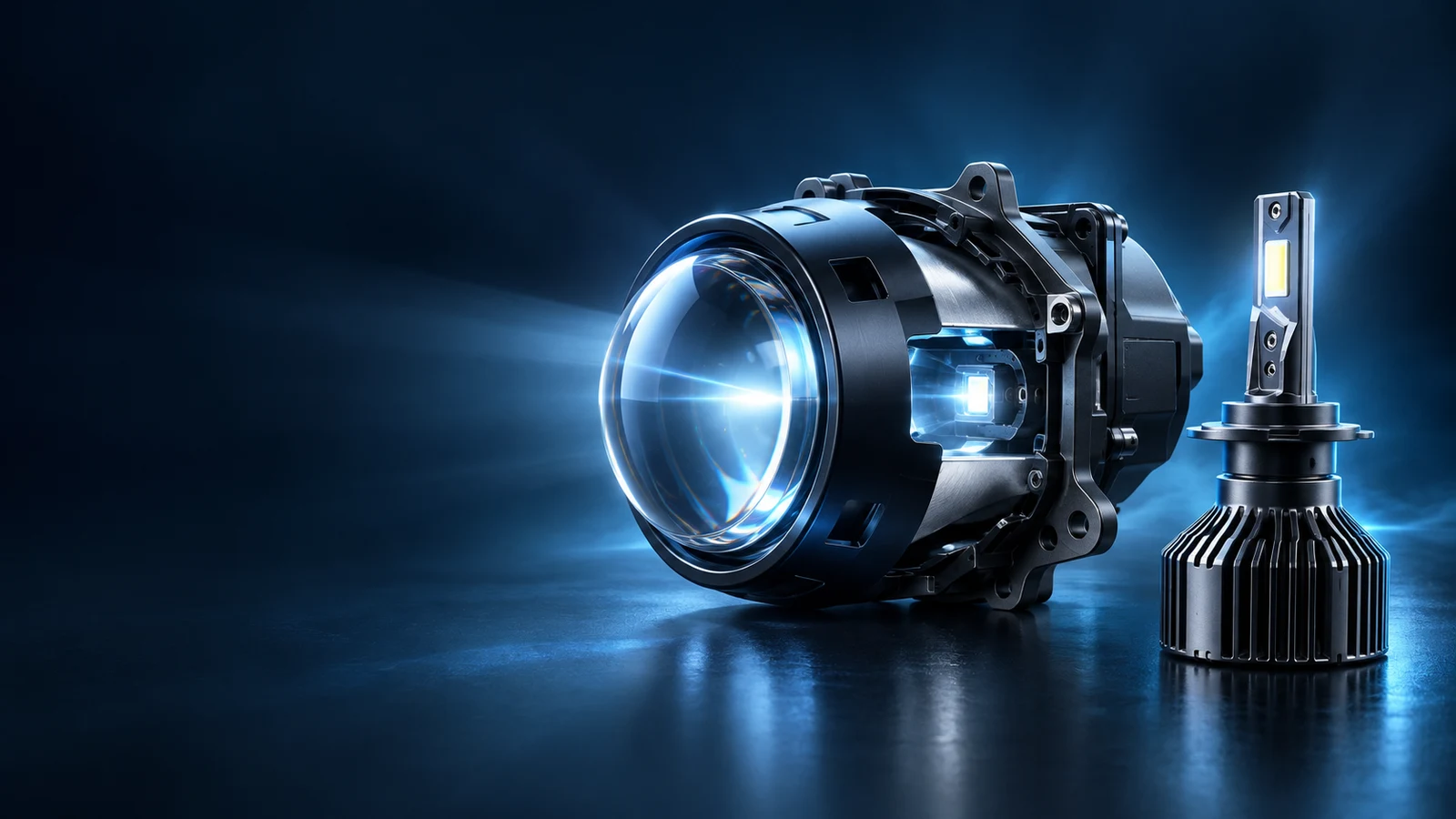
A Bi-LED projector incorporates its own optical system, often including a reflector, lens and low/high-beam mechanism. That can provide greater design control, but does not guarantee a better beam or higher lux than every alternative. Assembly accuracy, installation, aim, outer-lamp components and test conditions still affect performance. Compare identified systems against the same relevant criteria.
4. FMVSS 108 and UNECE Lighting Requirements
In the United States, FMVSS No. 108 addresses lamps, reflective devices and associated equipment. Determine the applicable provisions from the product type, lighting function and intended configuration. Relevant requirements include more than a pleasing beam image. Do not treat one SAE document as the sole basis for every headlamp design.
The U.S. system uses manufacturer self-certification to applicable requirements. A DOT marking is not a government-issued approval certificate for each product. Buyers should establish who is responsible for certification and request evidence tied to the exact product. A generic “DOT tested” statement does not show that all applicable obligations have been met.
Under the UNECE framework, UN Regulation No. 149 covers road illumination devices within its scope. Earlier approvals under regulations such as R112 may remain relevant depending on transitional provisions and market acceptance; R112 should not be presented as the only current basis for LED headlamps. Confirm the applicable regulation, amendment series and approval scope.
Distinguish the light source, lamp or system, and vehicle installation. Source requirements depend on the source category; UN Regulation No. 48 concerns vehicle lighting installation within its scope. An approval for one component does not automatically cover every assembled lamp or vehicle installation.
E-mark type approval involves the applicable approval procedure and documentation, not just one photometric report. Match approval numbers, issuing authority, product identification, function and any extensions to the supplied configuration. For replacement bulbs, verify whether the specific source-and-lamp application is permitted in the destination market. Passing a beam test alone does not establish road-use legality.
Use the current regulatory texts and competent market-specific assessment before making commercial claims. The NHTSA explanation of DOT marking and replacement headlamps and UNECE R149 reference provide starting points; confirm current amendments and local implementation for the project.
5. B2B Photometric Testing and Supplier Evaluation Checklist
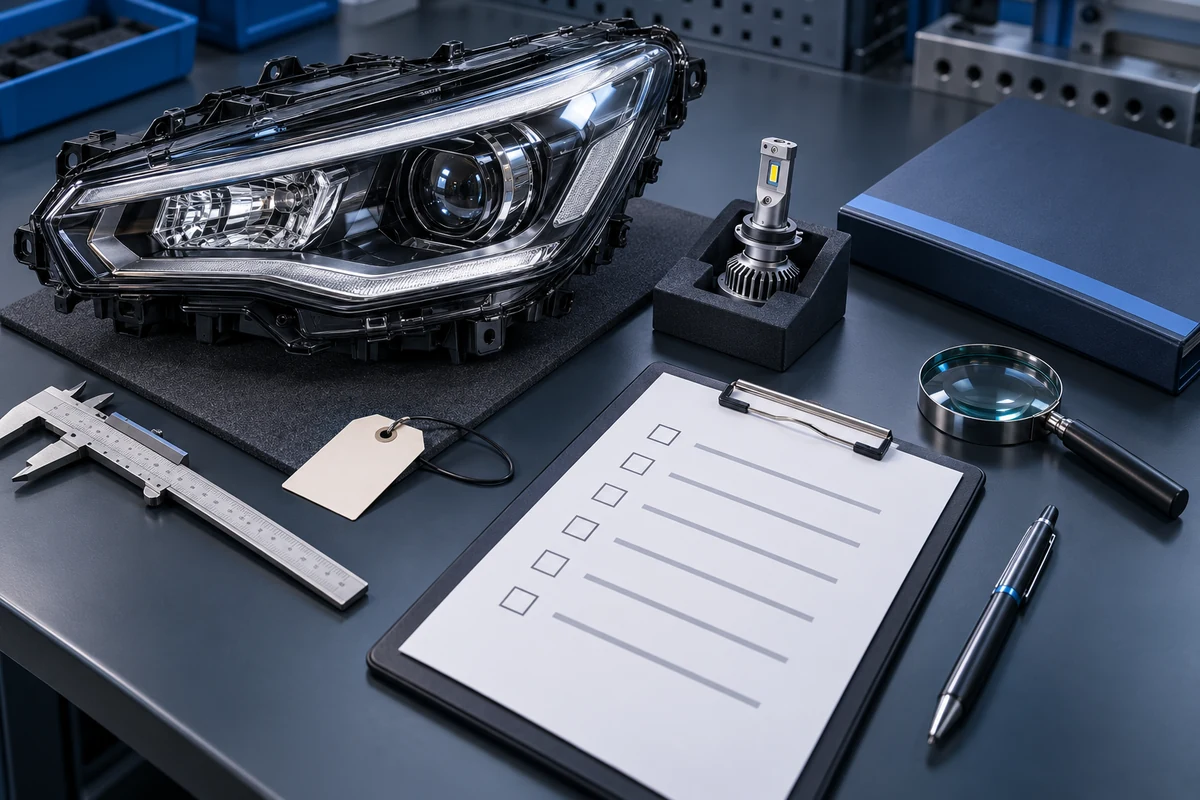
Begin qualification with a written test plan: target market, lamp function, product revision, representative assemblies, operating conditions and acceptance criteria. Separate engineering comparisons, regulatory evaluation and production inspection. These activities serve different purposes and may use different methods or sampling plans.
When evaluating suppliers, request the following evidence and resolve gaps before sample approval. The appropriate sample quantity and test frequency depend on variation, risk, applicable requirements and the purchasing agreement; there is no universal sample count.
- Report identity: unique number, date, complete pages, authorized issue and a verification route with the issuing laboratory.
- Product traceability: model, revision, sample serial or lot identification, photographs and the exact lamp-and-source combination tested.
- Applicable standard: regulation or method, version, lighting function, traffic direction, limits and an explanation of any departures.
- Laboratory competence: laboratory identity, relevant capabilities, calibration records and measurement traceability. If accreditation is claimed or required, verify the current ISO/IEC 17025 scope covers the method.
- Conditions and results: voltage, operating mode, stabilization, ambient conditions, mounting, aim, geometry, units, uncertainty where relevant, and measured test-point values.
- Authenticity and completeness: distinguish measured data from simulation; investigate edited extracts, inconsistent identifiers or unsupported blanket compliance claims.
- Compatibility: documented fitment, orientation, electrical behavior and complete-lamp evaluation for the intended vehicle or assembly.
- Production consistency: controlled drawings, optical tolerances, inspection limits, batch traceability, change approval and a risk-based plan for revalidation.
Retain approved reference samples and baseline test records. Compare later production under equivalent conditions and investigate changes in cutoff location, intensity or uniformity. A component substitution, driver revision or assembly change may require renewed validation. Agree on corrective action and release responsibilities before the first shipment.
For candidate products, review NVEL LED headlights and LED projector products. Use the same model-specific evidence process for every supplier. Product category pages identify options; they do not replace test reports or approvals.
Frequently Asked Questions
Why Do Some LED Bulbs Produce Poor Beam Patterns?
Emitter geometry, shielding and orientation may interact poorly with a headlamp designed around another source. Installation tolerances, aim and operating conditions can add variation. Evaluate the identified bulb in the intended lamp assembly; a base match alone does not establish optical compatibility.
What Is a Z-Step Cutoff?
It is a stepped transition used in some asymmetric low-beam designs to balance illumination and glare control. Its direction and geometry depend on the design, traffic side and applicable requirements. It is not a universal 15-degree feature required on every headlamp.
How Can Buyers Verify Photometric Reports?
Check the report number with the issuer, match the sample and revision, and review the method, conditions, limits and full results. Verify claimed accreditation and its scope where relevant. Request clarification or independent repeat testing if data are incomplete, inconsistent or difficult to trace.
Does Filament Alignment Guarantee Beam Quality?
No. Nominal alignment does not reproduce every characteristic of a filament, including emitting area, angular output and shielding. Thermal behavior and the original lamp optics also matter. Complete-lamp measurements are needed to assess the intended combination.
Are Bi-LED Projectors Always Better?
No. A dedicated optical system can improve design control, but performance depends on its engineering, assembly, installation and aim. Compare useful coverage, glare-sensitive intensity, operating stability and applicable requirements under equivalent conditions, rather than assuming a higher peak lux value means better performance.
How Does NVEL Verify Beam Patterns?
Buyers should ask NVEL for the evaluation method and available model-specific evidence for their project, including the tested assembly, conditions and applicable requirements. This guide does not confirm particular equipment, laboratory accreditation, batch testing frequency or blanket product approvals. Agree on any additional validation before ordering.
Should Distributors Keep Reference Test Records?
Yes. Retain complete reports, approved specifications, sample identities, fitment records and standardized photographs. Use them as a controlled baseline for incoming checks and investigations. Photographs support comparisons; they cannot replace regulatory measurements or establish compliance by themselves.
Discuss Your Headlight Evaluation Requirements
NVEL brings 25+ years of automotive lighting manufacturing experience to B2B supply and OEM/ODM cooperation. Share your target market, product configuration and validation requirements to discuss candidate products and the evidence available for your project.
Technical and regulatory note: This guide provides general technical and sourcing information. Actual optical performance, compatibility, compliance, and installation suitability must be verified for the specific product, vehicle, and destination market.
Related Technical Guides
Technical Guides · LED Headlights · LED Projector Lens
Bi-LED Projector Lenses vs. Drop-in LED Bulbs: Optical Performance & B2B Buying Guide
Technical Guides · B2B Sourcing