TECHNICAL GUIDES · LED OFF-ROAD LIGHTS
LED Light Bars for Trucks and ATVs: 22-Inch Fitment, Wiring & OEM Selection Guide
Verify mounting clearance, wiring requirements and OEM sample evidence before approving a truck or ATV light bar.
November 5, 2026 · 18 min read
Introduction
An LED light bar for truck installations is not selected by length or advertised output alone. A lamp must physically fit its mounting location, remain secure through vibration, operate within the vehicle electrical system, and illuminate the intended area without unwanted glare. These checks become more demanding when a purchasing team manages several pickup, 4×4, ATV or utility-vehicle platforms.
Searches for an off road LED light bar, an ATV LED light bar or a 22 inch LED light bar often lead to the same product catalog, but they do not describe identical installation requirements. A truck may offer a wide grille or rack position and a relatively substantial charging system; a compact ATV may have limited bracket span, tight steering clearance and less available electrical capacity. Actual capability must be confirmed for the exact vehicle.
This engineering guide focuses on packaging, wiring and sample acceptance—not another generic spot-versus-flood comparison. It explains how to turn vehicle measurements and duty cycles into a defensible specification, then uses the published dimensions of NVEL’s L90 as a documented example. For product discovery, review the NVEL off-road lighting range. Vehicle-specific fitment and approval remain subject to verification.
Table of Contents
Truck & ATV Light Bar Selection
QUICK GUIDE
Define installation envelope and lighting function.
Check mounting, moving clearance and electrical reserve.
Verify body, overall and bracket geometry.
Test current, installed beam and durability.
Control RFQ, evidence and production revisions.
LED Light Bar Configurations for Trucks and Off-Road Vehicles
The first engineering decision is not which light bar looks brightest in a photograph. Define the role of the lamp and its permitted installation space. A grille-mounted bar, bumper-mounted bar and rack-mounted bar may all illuminate the same route but create different structural, optical and service constraints. An ATV or side-by-side may require yet another arrangement because the chassis, bodywork and electrical system differ.
Define the installation envelope before comparing products
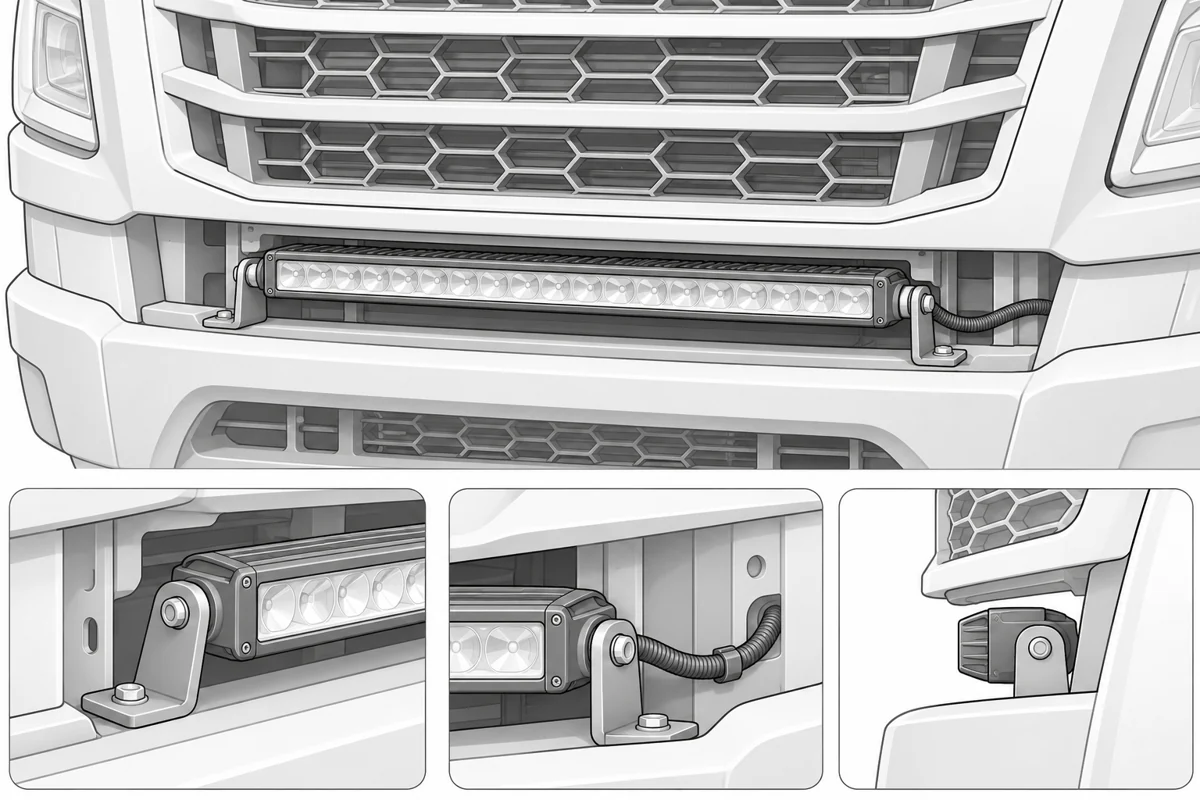
Document the available width, height and depth, the surface or bracket carrying the lamp, and the path needed to aim it. Include nearby grille shutters, winch hardware, radiator airflow, front cameras, body trim, hood opening, and access for fastener torque checks. A nominal bar length should not be used as a substitute for an overall dimensioned drawing or mounting-center measurement.
For roof or windshield installations, account for the rack, doors, wipers, windscreen reflections and cable passage through exposed areas. A bar that clears the body when parked can still obstruct a moving panel or contact a component under chassis flex. The mounting plan should specify who verifies these conditions on the actual vehicle rather than implying that a universal bracket proves compatibility.
Specify the optical function without duplicating beam-selection guides
An LED light bar can emphasize forward intensity, broad task coverage or a controlled combination. The important purchasing question is where the installed beam is needed and what measured distribution demonstrates that result. Do not infer useful range from raw chip lumens or the number of optical modules. For the underlying pattern definitions, refer to NVEL’s off-road spot, flood and combo optics guide.
For truck operations, mounting height and aim change foreground brightness and reflected glare. For low-speed utility use, a separate task-lighting circuit may be preferable to forcing one forward bar to illuminate every area. Keep the exact optical function, mounting position and switching logic together in the RFQ so the supplier does not quote a visually similar but functionally different model. Buyers comparing LED lights for trucks should distinguish an auxiliary light bar from a fog lamp: mounting position, beam purpose and applicable road-use requirements differ, so the two should be specified and validated separately. For truck-specific fog-light options, see NVEL Automotive LED Fog Lights.
ATV LED Light Bar Fitment: Mounting and Electrical Constraints
ATV LED light bar selection requires platform-specific checks. The term ATV is often used loosely for all-terrain machines, utility vehicles and side-by-sides, yet their available mounting points and charging systems are not interchangeable. Identify the actual vehicle model, engine and electrical configuration, accessory mounting restrictions and operator visibility before choosing a bar.
Check compact mounting points and moving clearances
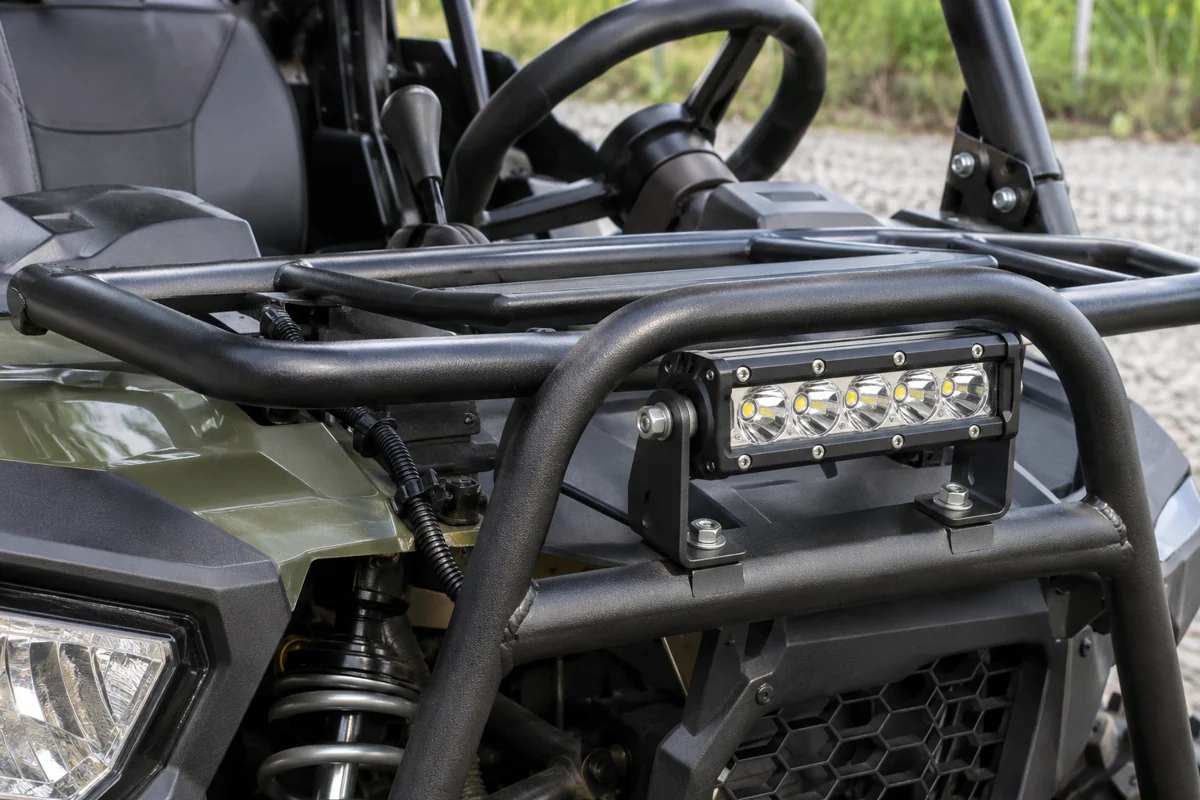
Evaluate rack and bumper strength, bracket overhang, handlebar sweep where relevant, suspension travel, protection from branches and debris, and the space to service the fasteners. The mounting assembly must retain its aim after realistic vibration and impact exposure. A light bar spanning a wide pickup grille may be too long for a compact ATV even if the electrical connector looks familiar.
Consider the operator’s sight line and reflection from hoods, windscreens, tool boxes and cargo. Protect the cable from tyre movement, steering joints, hot components and sharp edges. Secure it without using the connector as strain relief, and avoid drilling load-bearing members without vehicle-manufacturer approval.
Confirm charging capacity and operating cycle
A nominal 12 V electrical system does not guarantee enough accessory capacity at idle or during low-speed work. Check charging output across the expected engine-speed range, battery reserve, other operating loads, voltage during cranking and the light bar’s documented working range. A lighting system that appears stable during a short engine-off demonstration may drain the battery or flicker during real use.
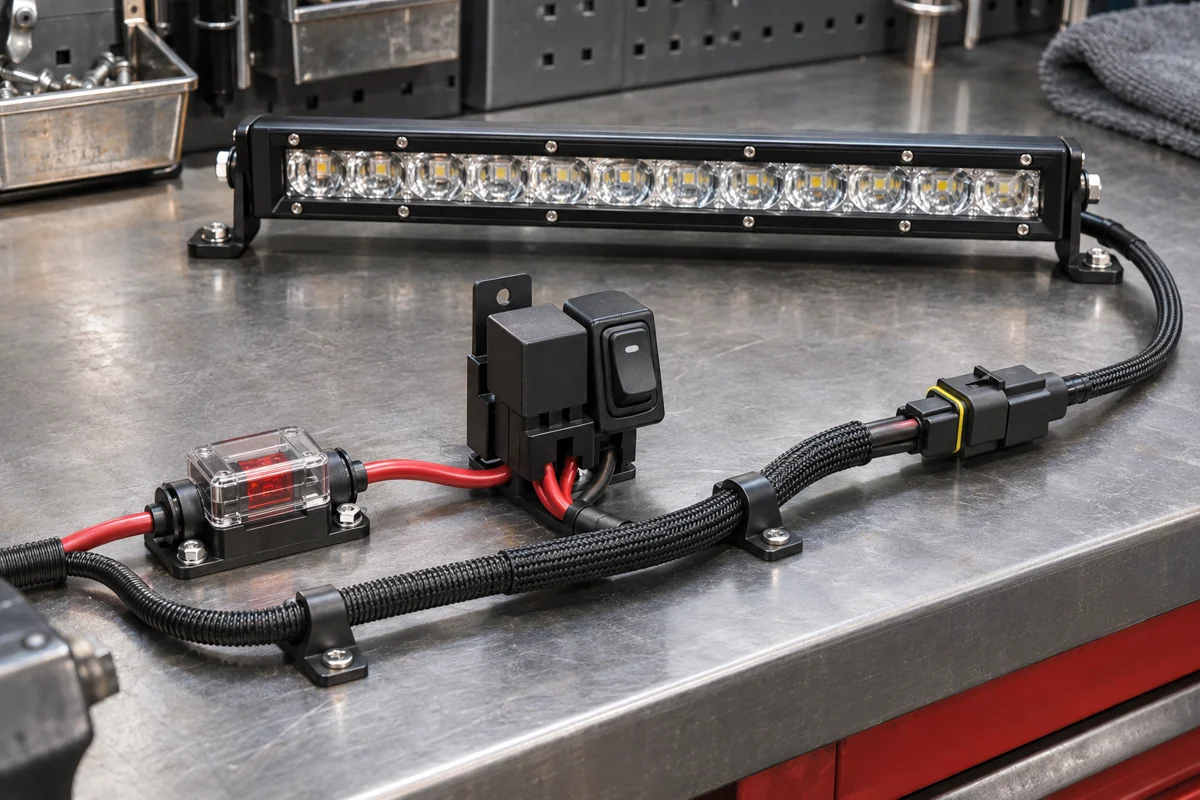
A switch, relay or electronic controller must be rated for the actual operating and startup current. Select wire size, protection, grounding and connector sealing using a vehicle-specific circuit design and the lamp maker’s instructions. The presence of an inline fuse in a generic harness is not proof that its rating, location or cable gauge is correct for the installation.
| Check | Truck / pickup review | ATV / compact vehicle review |
|---|---|---|
| Available mounting width | Measure bumper/grille/rack envelope and body movement | Measure rack or guard span; protect steering and suspension clearance |
| Bracket load path | Check structure, retention, winch and sensor access | Check compact brackets, vibration and branch/debris exposure |
| Electrical supply | Verify vehicle voltage range, accessory circuits and other loads | Verify charging output at operating RPM and battery reserve |
| Harness routing | Protect from engine heat, doors, body trim and sharp edges | Protect from steering, tyres, suspension travel and abrasion |
| Glare and reflections | Review hood, grille and windscreen reflections | Review rider sight line, cargo rack and windshield reflections |
| Operating duty | Driving, recovery or work functions may need distinct switching | Low-speed work or idling may place sustained load on small systems |
| Fitment claim | Require exact vehicle and mounting evidence | Do not extrapolate fitment from another ATV model |
These are review categories, not a universal truck-versus-ATV ranking. Some trucks have very limited accessory space; some utility vehicles have comparatively robust electrical systems. The final acceptance decision belongs to the measured platform and exact lighting configuration.
22 Inch LED Light Bar: Dimensions, Clearance and Mounting Verification
The phrase 22 inch LED light bar commonly identifies a marketed size class, not a guaranteed end-to-end measurement or bracket bolt pattern. Housing end caps, adjustable mounts, wiring exits and protective clearances can change the installed envelope. A nominal 22-inch designation equals approximately 558.8 mm as a unit conversion; it is not proof that the finished bar has that dimension.
Measure overall length and mounting-center span separately
Begin with the vendor’s revision-controlled drawing. Record overall length, illuminated or main-body length, height, front-to-back depth, bracket mounting-center distance, fixing-hole size, required aim adjustment and connector/lead exit. Check the tolerance scheme: the vehicle mounting slot may require a different allowance than the optical housing. Use the actual drawing to evaluate a 22-inch candidate rather than scaling a catalog picture.
A useful mock-up includes the lamp, supplied brackets, fasteners, cable bend radius and accessible tool space. Confirm whether the bar can be aimed and tightened without removing major trim, whether its body masks cooling airflow or sensors, and whether it can be serviced after installation. Document the result with a dimensioned sketch or verified fitment photographs.
NVEL L90: a published dimensional example, not a fitment guarantee
NVEL’s published L90 22 Inch Off-Road Dual-Beam LED Light Bar specification lists 575.0 × 37.0 × 48.0 mm overall dimensions and a 541.6 mm body length. It also lists a 10–30 V DC operating range, 60 W low-beam and 90 W high-beam modes, and IP68 protection. These are supplier-published, model-specific figures; they are not independently verified by this guide and do not establish a mounting-hole spacing or compatibility with a particular truck or ATV.
The L90 product listing also references ECE R148, R149 and R10. A purchaser should obtain the actual documents for the exact product revision, approved function and installation context; the presence of those references does not by itself authorize every operating mode in every country. Do not treat a product’s high-beam rating as permission to operate an auxiliary bar on public roads.
| Dimension or check | Documented L90 example / needed evidence | Acceptance decision |
|---|---|---|
| Marketed length class | 22 inch (nominal category) | Do not equate to overall length or hole spacing |
| Overall housing envelope | 575.0 × 37.0 × 48.0 mm (published L90 dimensions) | Compare to measured available vehicle space |
| Main body length | 541.6 mm (published L90 body) | Different from complete installed width |
| Mounting-center / bolt span | Not established by the cited product specifications | Request revision-controlled installation drawing |
| Bracket projection / angle | Depends on supplied bracket arrangement | Check clearance at all intended aim positions |
| Harness exit and bend radius | Requires selected connector and installation detail | Verify full serviceable cable route |
| Electrical configuration | 10–30 V DC; 60 W / 90 W modes (published) | Check exact vehicle supply and control scheme |
| Vehicle fitment | No model-specific truck or ATV fitment confirmed here | Perform controlled on-vehicle trial |
When preparing product copy, distinguish what is documented from what is inferred. A detailed installation drawing, representative vehicle test and approved accessory list support stronger fitment statements than a single nominal dimension.
Wiring, Beam Performance and Durability Validation
A wiring plan and a light-distribution test should be tied to the same selected lamp configuration. This prevents a common procurement error: approving one sample and then purchasing another mode, lens, controller or harness under the same marketing name.
Design the circuit for measured input behavior
Record steady operating current, input power at specified voltages, startup behavior, reverse-polarity protection and any mode-switching or position-light circuit. Electrical power divided by voltage can give a rough current estimate for an idealized calculation, but it must not substitute for measured input behavior when selecting protection, cable size, connectors or a switching device. Current can change with voltage, temperature and driver operating mode.
Place appropriate protection near the power source according to the actual circuit design, and verify the return path rather than relying on unknown painted structural contacts. Specify connector pinouts, seal ratings, cable strain relief and minimum bend conditions. A truck/ATV electrical diagram should also show which lights can operate together, how the operator switches them and how unintended activation is prevented.
Validate the installed beam, not just advertised lumens
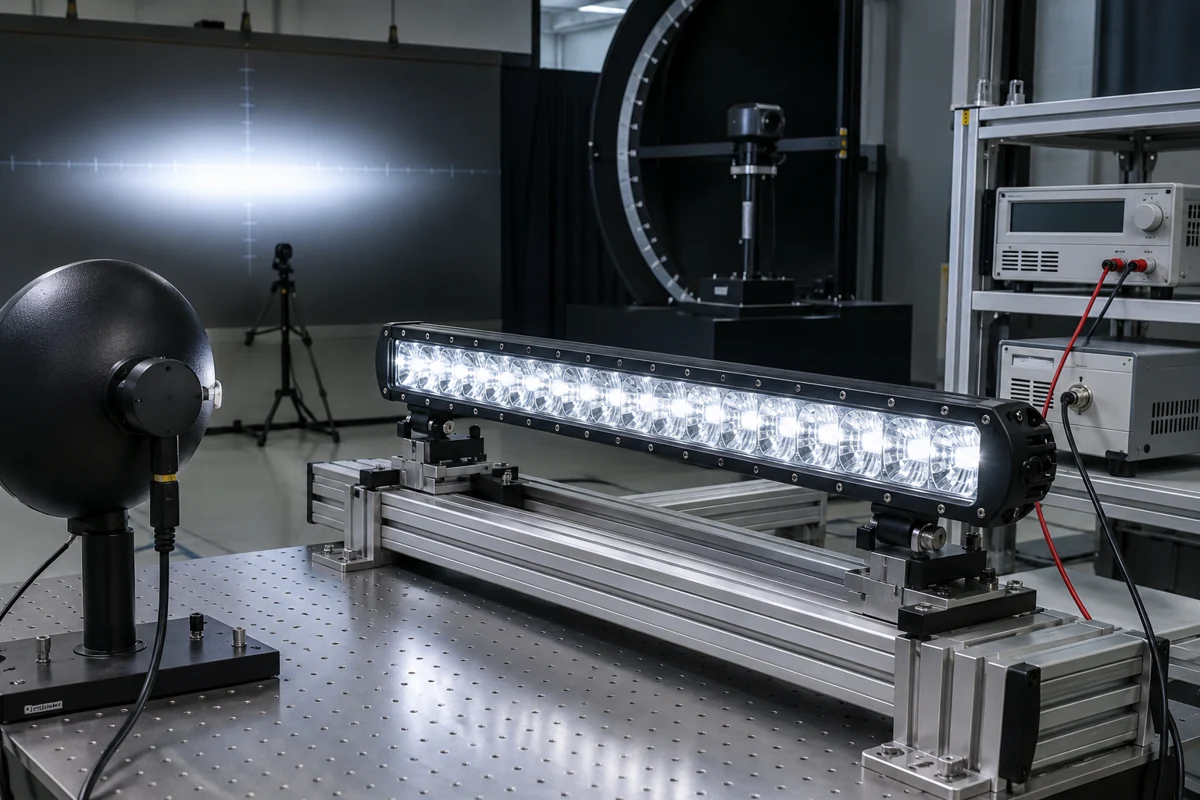
Compare optical performance using the exact model, optic and operating mode. Record test voltage, thermal state, aim, measuring geometry and how the beam-width or reach metric was defined. For a vehicle check, examine forward visibility, near-field spill, glare and reflections at the proposed mounting height. If two lights have different beam patterns, a brighter lumen headline cannot establish which is safer or more effective for the task.
For deeper definitions of candela, lumens and lux, use NVEL’s lumens-versus-lux technical guide. This article instead concentrates on the evidence needed to approve the installed electrical-and-optical configuration. Avoid inventing a universal beam reach, wattage threshold or ideal mounting angle.
Qualify mechanical durability and intended road use
Require relevant vibration, retention, water-ingress, corrosion and temperature evidence for the exact model or defined test family. A supplier’s IP rating should be accompanied by an applicable test report and does not cover every failure mode; connector and harness sealing still need assessment. Installed light bars may also interact with cooling airflow or create wind noise. For those mechanisms, refer to NVEL’s light-bar wind-noise and thermal engineering guide rather than duplicating the analysis.
Road-use legality depends on jurisdiction, lamp function, mounting, color and activation. In the United States, NHTSA explains that supplemental lighting must not impair required lighting under applicable federal requirements, and state rules may impose further operational limits. For other markets, check the relevant installation rules and the actual approval documents. An off-road designation or an ECE reference alone is not a worldwide road-use approval.
| Test area | Evidence to request | Typical rejection or recheck trigger |
|---|---|---|
| Voltage and current | Measured input by mode and specified voltage; startup behavior | Unexplained current or malfunction within required operating range |
| Switching and wiring | Pinout, switching diagram, protective-device specification | Incorrect operation or unapproved harness substitution |
| Vehicle electrical margin | Charging/battery analysis with representative accessory load | Low-voltage faults or insufficient reserve in intended duty cycle |
| Optical distribution | Model/revision-specific photometry, beam mode and test geometry | Beam does not meet agreed coverage/aim criterion |
| Installed reflections | Vehicle-specific photos/observations at agreed aim positions | Distracting glare or blocked sensors/required lamps |
| Mechanical retention | Bracket drawing, torque specification and vibration/inspection record | Fastener looseness, cracking or aim drift |
| Ingress and environment | Relevant ingress, salt, temperature and connector evidence | Result not traceable to supplied configuration |
| Regulatory scope | Applicable documents for actual functions, region and installation | Claims exceed documented approvals |
OEM and B2B LED Light Bar Selection and Sample Approval
For an OEM buyer or private-label distributor, the best off-road LED light bar is the unit whose mechanical, electrical and optical characteristics can be verified for the agreed platform and reproduced in production. The technical guide should not replace a product quotation: it should make the RFQ specific enough to compare offers without mistaking different configurations for equivalent products.
Build an RFQ around the vehicle and selected SKU
Supply a vehicle installation sketch, intended use, target mounting envelope, acceptable electrical input range, switching expectations, connector preference, environmental exposure and target-market information. Request a controlled drawing with part number and revision; ask whether bracket sets, wiring kits and optical modes have separate option codes. If a 22-inch model is proposed, treat the published product data as a starting reference, not an automatic approval.
NVEL’s off-road products overview can help identify relevant product families; the L90 product page provides model-specific specifications for quotation review. Do not claim NVEL has a verified ATV fitment list unless the supplier supplies evidence for the actual application.
Control changes from approved sample to shipment
An approved prototype is useful only if production units use the same controlled configuration. The golden sample, drawing revision, optical parts, LEDs, driver, connector and bracket kit should be traceable to the production bill of materials. Agree which changes require notice or requalification, who performs incoming checks, and how failure analysis and corrective actions will be documented.
| Required record | Buyer / supplier evidence | Approval question |
|---|---|---|
| Application identity | Exact truck or ATV model, market and intended mounting | Is vehicle-specific use actually verified? |
| Controlled product SKU | Lamp, optics, power mode, housing and accessory revision | Are quotation and sample the same configuration? |
| Envelope and bracket drawing | Overall/body dimensions, mount span, hole/tolerance, aim | Does it fit without interference? |
| Electrical harness | Voltage, measured current, pinout, switching, cable/protection | Does it run safely under expected vehicle conditions? |
| Photometry | Mode-specific measured map, test geometry and aim | Does useful coverage meet agreed criteria? |
| Durability and sealing | Applicable test reports and bracket/connector inspection | Is evidence traceable to this design? |
| Market documents | Exact approval IDs, functions and installation scope | Are claims valid for the target market? |
| Production control | Golden sample, BOM, revisions, inspection and change notice | Can approved performance be repeated in volume? |
Before signing off, use a short acceptance sequence that puts measurements ahead of sales language:
- Freeze the required vehicle platform, use case and installation drawing before sample selection.
- Confirm lamp and bracket dimensions on the physical vehicle or a representative fixture.
- Check all lighting modes, startup conditions and electrical load with the chosen harness.
- Measure the installed beam and record aim, glare and relevant photometric evidence.
- Inspect vibration retention, sealing, thermal behavior and connector routing for the actual duty.
- Review target-market documentation without extrapolating one approval to every function.
- Retain a golden sample and written change-control conditions for production supply.
These checks help purchasing teams compare a truck light bar, an ATV-specific installation and a 22-inch candidate on consistent evidence. They do not imply that every project requires the same test threshold: the parties should agree on pass/fail limits and applicable standards before testing.
Frequently Asked Questions
Can I install a 22 inch LED light bar on an ATV?
Only after verifying the actual ATV mounting envelope, bracket strength, steering and suspension clearances, electrical capacity and local operating rules. A 22-inch marketing label does not demonstrate fit, and the L90 specifications in this guide are not an ATV installation approval.
Does 22 inch LED light bar mean the overall housing is exactly 22 inches?
No. The designation may refer to a size class rather than the final end-to-end envelope. For example, NVEL lists the L90 as a 22-inch bar while publishing overall dimensions of 575.0 × 37.0 × 48.0 mm and a 541.6 mm body length. Request the exact drawing and mounting-center dimension.
How should a buyer choose an LED light bar for truck applications?
Start with the vehicle and installation constraints, then compare the lamp’s documented electrical behavior and measured beam in the planned position. Verify bracket retention, harness routing, intended operating modes and supplier records before relying on power or lumen claims.
Are off-road LED light bars automatically legal on public roads?
No. Auxiliary lighting restrictions vary by jurisdiction and depend on the actual light function, mounting, color and activation. An off-road label, light-bar shape or cited test standard does not create unrestricted road permission. Review applicable rules and approval documents for the target installation.
Is a 90 W rating enough to size wiring for a truck or ATV?
No. Power is useful as an initial estimate, but circuit design also requires actual current versus supply voltage and operating mode, startup behavior, cable length, temperature, connector capability, protection and available charging capacity. Verify the selected product and vehicle with competent electrical engineering review.
What documents should an OEM buyer request before bulk ordering an LED light bar?
Request a revision-controlled product and bracket drawing, BOM, installation instructions, measured electrical and optical records, relevant environmental test reports, exact market-approval scope, an approved sample and a written change-control process. Make acceptance thresholds part of the purchase specification.
Conclusion
A successful LED light bar program starts with real mounting geometry and the vehicle’s operating conditions. Trucks, ATVs and utility vehicles may share an interest in off-road illumination, but they cannot share an unverified fitment or electrical claim. The usable lighting result depends on the selected lamp, its mode, aim, circuit and installation—not nominal inches or headline power alone.
For B2B sourcing, use the 22-inch L90 data as a documented product example while obtaining the exact bracket drawing and application-specific evidence. Approve a traceable sample against agreed mechanical, electrical, optical, environmental and market requirements before purchasing volume. That process makes comparisons more reliable and reduces avoidable production changes.
Plan Your Truck or ATV Light Bar Project
Explore NVEL lighting products or send our OEM team your vehicle platform, mounting envelope, electrical requirements and sample acceptance criteria.